Review: The Yakusa Tattoo

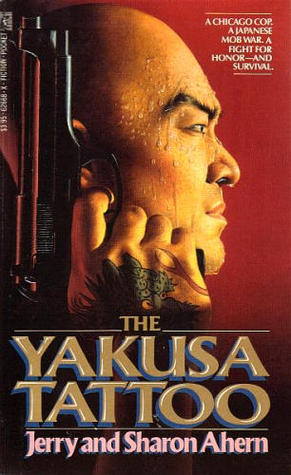
The Yakusa Tattoo

aherncover

Jerry Ahern’s turn into (sort of) hardboiled detective fiction, The Yakusa Tattoo, is something.

Ahern has the stereotypical Hardboiled Vietnam Vet Police Officer being tasked to go to (a stereotypical) Japan for a secret mission. Cue a plot with everything from a Hunt For Red October-style super-submarine to lots and lots of ninja fights. What were you expecting from someone who wrote a 27-book centuries-long epic with Hitler’s corpse as a MacGuffin in one of the books?

The prose is – not exactly the best, to put it mildly. There are the huge descriptions of guns and holsters (although thankfully a Detonics only appears once). There are characters talking in gigantic blocky paragraph-speeches. There are perhaps a few too many fight scenes for the sake of fight scenes.

And yet it has the same “I’m not holding anything back” charm that the Survivalist series at its best had. I mean, it has ninjas and Cold War spy plots. And where else can you get a hardboiled Chicago officer storming an ancient castle?

Review: USA Vs. Militia Series

USA Vs. Militia Series

Ian Slater’s USA vs. Militia series is one of those bizarre footnotes in military thriller writing that I just had to check out in full. A while ago, I reviewed Battle Front, which is actually the third installment. Having since read all five books, now I can give my opinion on the entire series.

I described Battle Front as “This book is about 5-10% crazy goofy, and about 90-95% dull tedium.” In short, this is applicable to the entire series, particularly the last two books. These involve more pedestrian hunt-the-MacGuffin plots with small unit heroes that serve as a perfect example of “Captain Beefheart Playing Normal Music Syndrome”. The most bizarre part is a general personally leading this formation, and it has all of Slater’s numerous writing weaknesses without the appealing strengths. If it consisted of two books with action somewhat below the Marine Force One line, I’d have barely given them a second thought.

But the series is more than that.

At its best, you have ferocious fights between the federal army and militia in technicals with add on “reactive armor” (Slater is, to put it mildly, not the best with terminology). You have Abrams’ deploying from C-130s. And of course, you have preternaturally well-organized and numerous militia romping through the country. To try and make them viable, Slater turns every federal commander and soldier who isn’t Mary Sue Douglas Freeman into hopeless bumblers. It’s still badly written in actual practice save for some bizarre prose turns Slater uses, but the novelty is still something.

There’s two more distinctive elements. The first is the politics. Now, normally you’d expect a book about a second American civil war to be monstrously political. This, surprisingly isn’t. Or at least it feels oddly detached, coming from an Australian-Canadian having to look across the border through a distorted, second-hand lens.

The second is a complaint I’ve heard a lot about Slater’s World War III series, and which I saw firsthand here-he has absolutely no concept of continuity. There are references to the Third World War, references to the Gulf War, jumping references to real events that happened before the book in question got published, contradictory historical references, and no real sense of overall progression. The series ends on a strange half-conclusion, with the out-of-universe reason for its stoppage obviously clear from its publication date of December 2001.

This series occasionally can be an interesting curiosity, but it’s a mere curiosity without much substance.


Review: First Clash

First Clash

firstclash

Kenneth Macksey’s First Clash stands as one of the most detailed books about a conventional Fuldapocalypse. Its “plot” can be summarized in one sentence as “a Canadian brigade group fights a Soviet division in the opening phases of World War III.”

This is not a conventional novel by any means. It’s openly stated to be a training aid with a lot of “controlling factors”. Even without that admission, it’s very, very obviously a “how-to guide for facing an attack as a Canadian mechanized brigade, from top to bottom”. This leads to a few issues because a lot of situations have to be included for the sake of training.

Some of the parts from the Soviet perspective are a little iffy. Even accepting that it’s a Cold War piece written by a westerner, they come across as a little too “Asiatic Hordesy”. Also for the sake of training, assuming the worst case about one’s opponent feels to me like the better strategy.

It could be that the Soviet advance had to be imperfect to give a single brigade with Leopard Is and M113s a fighting chance and present a tactical situation other than “they fight a desperate defense but are then overrun rapidly”. I would have cut the “enemy perspective” parts entirely and only showed what parts of the Soviets the Canadians could directly see.

This brings me to my second critique, which is that there’s a lot of detail, likely at an outright unrealistic level that hurts a book that’s otherwise rock solid in that regard. This is understandable as an “after action briefing tape recap” approach, but it doesn’t help with the rest of the book. Like The War That Never Was, this is one specific type of book, and if you don’t like it, this just isn’t for you.

I wanted to like this more than I did. I knew what it was setting out to do, and it accomplished that, but it’s a very niche, slightly dated book. I still think The Defense of Hill 781 manages to speak most of the same messages in a format that’s more readable.

Review: The Lost Codex

The Lost Codex

The third OPSIG Team Black book, The Lost Codex manages to sink lower than the first two-by a considerable amount. The bulk of the actual book is the most bland, clunky thriller against the most bland, generic terrorists imaginable, falling straight into the trap of being too “normal” to be bombastic but too exaggerated to be truly realistic.

This time, profiler Karen Vail is close to being a main character, and is handled in the worst possible way. She’s Miss Infodump and Miss Dragged Along Because The Plot Demands and , finally, Miss Action Heroine all in the same book.

But the icing on the cake is a barely connected bit of Dan Brown-style “secret religious history”. This is only linked to the “shoot the terrorist” plot in the thinniest, clumsiest way, and adds essentially nothing save for giving the book its title and a chance to sell it as being like Clive Cussler. It’s not. It’s worse. A lot worse.


Review: Master Of The Game

Master Of The Game

mastergamecover

Sidney Sheldon’s Master of the Game is, on paper, the story of Kate Blackwell, an heiress to a South African diamond fortune-turned international conglomerate. In practice, Kate herself is only a supporting character.

First is a pulp-historical thriller as Kate’s ancestor makes his diamond fortune. Then it’s Kate herself and her son. Finally, and taking up most of the book, is the saga of Kate’s granddaughters, Eve and Alexandria. The feud can be described as the vicious, wicked, and evil Eve constantly attempting to kill the stupid and clueless Alexandria so that she can take all the family fortune for herself.

Like a lot of Sheldon’s other books, this throws in Big Historical Events (the Boer and World Wars) almost as an afterthought to make it look slightly “sophisticated”. The rise of Kate herself, which was the biggest reason I got the book, is too simple and too rushed. This is another one of Sheldon’s gimmicks-dress the book up in the trappings of a legal/business/political struggle but use that as the backdrop for a lurid soap opera.

Fortunately, it has the ridiculously melodramatic saga of the twin sisters, starting with Eve’s “Agent 47 meets Pinky and the Brain” assassination attempts and ending with a climax where one twin poses as the other (gee, I didn’t expect that).

This book is obviously trash, but I can’t help but like it. For a start, it’s not the product of ineptitude-this is from the hands of a skilled showbiz writer who knew how to play to the popular crowd. Second, it gets so cliche and so lurid, it actually becomes fun in a “really?” kind of way.

Review: The High Frontier

The High Frontier

highfrontiercover

The High Frontier is the de facto ending to the The Big One series. The end of the Easy Mode Cold War is, for most intents and purposes, the end of the main published series. And, like The Sum Of All Fears, it’s a good stopping point.

This entire franchise has the slight misfortune of bad context for me. You can see why and what in the entry for the main series. That being said, while The High Frontier may not be the worst book ever, it still stands out only for its plot “novelties”. What plot novelties?

Well, for this individual book, there’s, among other things…

  • A very cheap shot at the Space Shuttle program right off the bat, where the Columbia disaster occurs right after the Challenger disaster. It’s actually semi-realistic in a rivet-counting way. The second post-Challenger mission had foam hit the heat-shield and barely survived, and the Space Shuttle program’s many, many issues are well-known. But the narrative intent is obvious.
  • Exposition where the Chipanese [yes] antagonists lament the inferiority of their military compared to the (awesome) Americans.
  •  The Chipanese campaign in Vietnam, featuring the equivalent of the Soviet general secretary personally running into Afghanistan to command forces there and then getting killed.
  • In said campaign, there are so many names of historical Vietnam War figures that I couldn’t tell if it was just bad naming or the real people (who’d be much older, and in some cases, dead.)


Finally there’s the climax, the biggest missed opportunity in the whole book. Having read The Sum Of All Fears makes it look even worse than it did when I first read it. Here’s an opportunity to foil the plot by showing restraint in the face of apocalyptic provocation-and instead it’s the equivalent of having the protagonists stop the nuke from going off in the first place.

Then the book ends with Ronald Reagan asking about the Seer and one final infodump about the nature of the unaging mutants with catlike eyes who serve as combination plot devices, Mary Sues, and ways to not have to create more characters. Of course they happen to stop aging at convenient times, have an ability to sense other long-lifers, are disease-resistant but not immune, and it took as long as it did for one person to find them out. Hmmm….

The book itself is par for the course for the TBO series, which is to say, it’s substantially below-average. Yes, a lot of its negative reputation comes from the gauntlet-throwing and internet drama accompanying its initial release. Yes, it doesn’t look quite as bad in context when compared to the worst of either internet alternate history or post-1991 technothrillers. Yes, a lot of its flaws aren’t unique to it.

But it’s still clunky, hopping around characters and events. It’s still flat, with characters being either Mary Sues, placeholders, or strawmen.  The worldbuilding is still ridiculously stacked in favor of the Americans. The action is still either bland and one-sided or extra-bland. The stiff dialogue in this book (and in the whole series) is distinctly bad, even by the standards of low-end fiction. It’s still just not good.

Snippet Reviews: January 2020

New year, new set of snippet reviews.

Return of the Ottomans

Return Of The Ottomans is a clunky “Big war thriller” only distinguished by its premise. Turkey invading Bulgaria is more conceptually interesting and the action isn’t the worst in a nuts and bolts way, but jumping viewpoints and Steel Panthers Characterization at its worst bring it down.

The Fires Of Midnight

The Fires of Midnight is the last of the classic Blaine McCrackens, before Dead Simple knocked the series off course. While I now knew the formula in great detail, it doesn’t change that the formula is a good one-and that it includes an excellent finale in an excellent place.

Sword Point

I wanted Sword Point, Harold Coyle’s second novel, to be good, and it still ultimately is. Yet it has this awkward feeling of a one-hit wonder musician trying to make lightning strike twice. The same formula and theme is there, and it’s not bad. But it just doesn’t have the kick the initial installment has.

It’s still tanks going boom in a solid, flowing way. And the Middle Eastern setting is distinct. But it’s just missing something.

Review: Rage of Angels

Rage of Angels

rageofangelscover

Sidney Sheldon’s parade of “gilded cheap thrillers” continues in Rage of Angels. This is the tale of lawyer Jennifer Parker and her twists and turns as she tangles with (and beds) powerful politicians and more powerful mobsters.

Now, it’s still a sleazy sow of a cheap thriller that smothers its face in just enough designer cosmetics to appear slightly respectable for those bookshelves. But for all its cliches, it’s considerably less sleazy and considerably more genuine than The Other Side of Midnight ever was.

This helps it a lot, as there’s more focus on the actual substance and less on forced pretentiousness. What this leads to is a virtuous cycle. Being able to dial back on some of the pseudo-splendor means the characters are more interesting, which in turn means that there’s less need for “look at this wonderful exotic place” filler…

The opening act is Fuldapocalypse’s first dip into that lucrative genre-the legal thriller. I know very little about law, but even I know that the cases move way too fast and that certain ones that I’m 99.999999999999999999999999999999% sure would result in a settlement end up in front of a jury so that Parker can win. Yes, I’m utterly and horribly shocked that a book reviewed on Fuldapocalypse is unrealistic. And I’m even more shocked that a lot of the later plot turns out to be contrived.

The later parts, although told in the faux-flowery style I’d come to know from Sheldon’s previous book, actually work better. The ending is rushed, but it’s actually less so than some of the outright pulp I’ve read. Sheldon knew his audience and knew his style, and by those standards, Rage of Angels works.


Review: The Sword of the Templars

The Sword of the Templars

swordtemplarscovers

A work in the genre of “Templar Catholic Secret History” thrillers that followed in the wake of The Da Vinci Code, Christopher Hyde’s (under the pen name “Paul Christopher”) The Sword of the Templars manages to be somehow fun. Even though by all “normal means” it shouldn’t be.

First, it manages to check every single box one could imagine in a thriller like this. Everything from the academic hero to the unreformed Nazi descendant villain to the general shenanigans to the nature of “the secret” did not exactly surprise me when it was revealed. Second, I’ll just say it sticks to the thriller norms in terms of plot, pacing and action. Third, there’s lavish descriptions of every place that seem different. Fourth, the research ranges from too precise (knowing what color a box of commercial Prvi Partizan ammunition comes in) to too obviously wrong (calling a “point guard” a football position and, worse, describing the details on a submachine gun in terms dubious at best and wrong at worst). Fifth and finally, there’s a lot of blatant direction mentions of other popular books, the very definition of throwing stones from a glass house.

However, it all works somehow. The ability of the villains to throw one goon after another with just the “right” amount of capability against the heroes, the secret history that’s somehow both ridiculous and bland at the same time, and the actually sound literary fundamentals made this readable. In fact, I might say I liked it in part because it hit each and every cliche-it felt like it was to action hero thrillers what Thunder of Erebus was to technothrillers.

Review: The Dragons of Dunkirk

The Dragons of Dunkirk

dragonsdunkirkcover

Damon Alan’s The Dragons Of Dunkirk grabbed me the moment I looked at the cover. Naturally, I thought of Harry Turtledove’s Worldwar series, only with fantasy invaders instead of sci-fi ones. I also thought of an early Fuldapocalypse review, Dark War Revelation, only set forty years earlier.

So, the German supernatural unlocking goes horrifically wrong, leaving the world exposed to a classical fantasy realm ruled by an ancient wizard (but not a zombie sorceress, sadly). Multiple characters of both sides take in the conflict as it ensues.

There’s a lot this book hasn’t done well. The dialogue is a little stiff, and the action not the best. The worldbuilding on the fantasy side isn’t the most truly distinctive.The characters, while adequate, aren’t more than that.

But what it does do well outweighs that. Alan manages to keep the conflict between a magical and technologically advanced side balanced in a way that doesn’t seem too contrived. (I’ll just say that bullets are something they can withstand to a big degree, but artillery shells are something else).

It has a great concept and an execution that, though imperfect, doesn’t squander it in any way. What’s not to like?