Review: Deep Blue

Deep Blue

Reading Deep Blue, one of the later John Schettler Kirov books, brought a strange feeling to me.

Reading it, I encountered all of the issues with Homecoming, the previous book in the series I’ve read. And then some. The almost interchangeable battles are over-detailed and underwhelming to an extreme. The plotlines are clunky and shoved together. By all “normal” accounts, I should have been dismissive at best and disliking at worst. But I just wasn’t. As I read through tons of time-travel shenanigans, I felt a sense of “woah. Wow”, for lack of a better phrase.

It hit me when the ship time-warped from the current near-future World War III to another near-future World War III, only with different equipment and different sides. Everything just then clicked suddenly into place.

This is kind of like the later Survivalists-if Ahern had meticulously simmed every clash in Advanced Squad Leader or something like that and recorded the verbatim results in the books. And the time travel isn’t just a small throwaway part-it’s a a big central element, with a huge effort towards enabling this kitchen-sink wargaming. It’s like having a zombie sorceress start a Fuldapocalyptic World War III, and devoting a lot of effort to her, her rivals, and her powers as you move from 1985 to 1988 to 1981 to a 1986 with the YF-17 chosen as the light fighter and the British using a different divisional structure.

I still don’t recommend the actual books, unless you like lots and lots of barely disguised wargaming AARs. But if I had to choose a series with a lot of novelty and effort put into it or a series that just clunks along without any of those, I’m definitely picking the former. The sheer excess of the Kirov series makes it at least interesting.

Review: Alpha-A Black Flagged Thriller

Alpha: A Black Flagged Thriller

alphacover

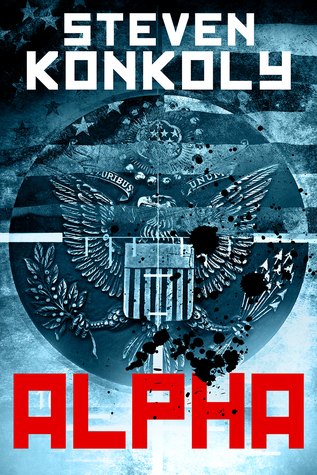
Stephen Konkoly’s “Black Flagged” series of spy thrillers starts with Alpha, telling the story of super-operative Daniel Petrovich as he’s pulled back into a web of plots.

Now, this book was moving uphill for me, simply because I’m not the biggest fan of the cloak and dagger genre of novel. I’ve come to the conclusion that it’s just a personal taste, and if I have to give a reason why, it’s because too many sit in this uncomfortable middle ground where they’re too spectacular to be a serious, grounded novel (which isn’t my favorite recreational book type itself), but not spectacular enough to just be an all-out crazy fun thriller.

That being said, this book is a very functional cheap thriller that hits all the right cheap thriller notes. Its plotting is a little rough and its characters a little flat, but its action scenes are very worthwhile. The whole is better than the sum of the parts, making this a good “51%” thriller.

Review: The Valhalla Testament

The Valhalla Testament

valhallajonland

I knew what I was getting into when I got the book. The Valhalla Testament is a Jon Land novel starring New York Giants running back (!) Jamie Skylar as he travels to Nicaragua to investigate and foil a very Jon Land-ian supervillain plot.

This book hits every Jon Land note. Trained attack crocodiles, double-crosses, double-double crosses, a plot that veers between “amazingly stupid” and “stupidly amazing”, “.60 Caliber machine guns”, and, in my personal favorite plot twist, an antimatter facility that not only gets blown up, but whose containment procedures as described were so terrible that it probably deserved to get blown up.

By its author’s ridiculous standards, it doesn’t quite reach the heights of some of the Blaine McCracken novels. But it’s still a good cheap thriller that very much has the spark Land at his best possesses.


Review: Balkan Mercenary

Balkan Mercenary

balkancover

Although not the latest Casca book, Balkan Mercenary is the most recent chronologically, occurring in the beginning of the Yugoslav Wars. It’s the first book in the series I’ve reviewed that’s written by Tony Roberts, who’s the current official author of the Casca franchise.

So, I have get this out of the way first. If this had no connection to Casca at all and was just the story of a man and his team of mercs going into the Yugoslav Wars to take down a war criminal and avenge the death of his loved one, it would be a modestly decent “51% book”. There are far better books than something in the same league as Marine Force One, but there also worse ones (which is why, in spite of my complaints, I still read the Casca books).

But this is the 44th installment in a long series that I think just doesn’t work as well in more modern times as it does in the distant past. It’s even mentioned in the book itself that Casca’s aliases are getting easier to track, so I can understand why Roberts seems keener to keep Casca a historical character.

Here, every reminder that this middling action-adventure tale featured a millennia-old immortal felt blatantly shoved in. A piece on how he remembered medieval Serbia. A piece on his blood being poisonous (this was present in the early books). And a tie-in with designated recurring enemies the Brotherhood of the Lamb, who feel especially forced. Balkan Mercenary, like many other Cascas, just plods to the middle, not daring to  try and take the extraordinary premise any farther than 51% of the way.


Review: Kill Or Capture

Kill Or Capture

brannigancover

Understandably pushed back because of the Maelstorm Rising series, Peter Nealen’s Brannigan’s Blackhearts continues with the just-released Kill Or Capture. It was well worth the wait.

Everything in this book reminded me of how great a cheap thriller this series is. Not just because the actual action is well-done (it certainly is) but because of all the touches that help it become more than the sum of its parts. There’s the opening where the protagonists are called back from their normal, everyday lives and families-something that distinguishes them from the Gold Eagle action automatons. There’s the super-conspiracy being both capable enough to pose a challenge worthy of a super-conspiracy and human enough to be fallible.

Of course, the actual plot is just a set-up for much action. I can sum it up in one sentence: The protagonists storm a fortified villa in northern Argentina. But the action is continuous, well-written, and solidly executed. The mountain terrain feels vivid and effective. The threats are varied. This is an excellent cheap thriller and worthy continuation of one of my favorite series.

Review: Lone Wolf-Night Raider

Lone Wolf: Night Raider

nightraidercover

The book Night Raider is the first entry in the Lone Wolf series of “shoot the mobster” vigilante novels, written by famed sci-fi author Barry Malzberg under the pen name “Mike Barry”. The novels have the reputation of being…. something. I’ll put it that way. And that reputation is deserved.

What Malzberg himself admitted in an interview and essays was both that: A: The Lone Wolves were churned out quickly for the money to ride the “shoot the mobster” bandwagon and B: When he read an Executioner book prior to writing the Lone Wolf, he didn’t like it. You might think this had a negative effect on the series, and you would be right.

The book itself is the most generic 70s vigilante “be wronged, shoot the mobster” plot. I could guess everything if I’d only read War Against The Mafia. I could probably even guess everything just from secondhanded knowledge of the genre. The biggest, and arguably only divergence is how much of a lunatic the main character is (which is very much intended).

But it’s executed (no pun intended) in this almost avant-garde blocky stream-of-conciousness infodump style that joins Mike Lunnon-Wood’s lush “just keep going and talk it out, describe it out, but calmly” and Bob Forrest-Webb’s “I never met an exclamation point I didn’t like!” prose in the “weird style for a cheap thriller” club.

In many ways, the thoughts and controversies surrounding this series are better and more interesting than the books themselves. Night Raider itself, thanks to its origins, just has all the all the weaknesses of both artistic and commercial fiction. It has few of the strengths of either.


Review: Cold Allies

Cold Allies

coldalliescover

Patricia Anthony’s debut novel Cold Allies is a distinctive book. But it is not exactly distinctive in a good way.

First, there’s two awkward plots. One plot is the surrealist tale of blue alien orbs that suck people in. The second plot is a sort of “World War III” where an “Arab National Army”, fleeing the drought and famine of an ecologically devastated world, invades Europe. There are (even by technothriller standards) a ton of shallow viewpoint characters who are constantly being shuffled around, taking out what little coherence might have existed.

The war plot is one of those weird cases where one might think the biggest issue would be the book being too political. And yes, a lot of the characters are shallow stereotypes, seemingly contributing to it. But it’s handled just totally matter-of-factly, kind of like Dark Rose or Ian Slater’s USA VS Militia series. For the alien plot, it crosses the line from “surreal” to “pretentious” pretty handily. This book is little but a bizarre novelty.


Review: Gray Matter Splatter

Gray Matter Splatter

gmscover

The path to opening Gray Matter Splatter was a little offbeat. I thought Jack Murphy’s debut in the Deckard series, Reflexive Fire, was wildly uneven, the kind of book that’s “Mean 51%” instead of the consistently middling “Mode 51%”. I also, similar to my experience with spacesuit commandos last winter, was getting a little worn on middling action books after reading so many of them.

So I figured, having heard that this was the craziest out of the four Deckard books, that this book with a great title was worth a shot to leap out. And so I leapfrogged over the other two and headed straight for the fourth. It was a good decision.

Now this book still has many of the problems that plagued Reflexive Fire-the political soapboxing that got in the way of the plot, the not-unusual but still irritating long descriptions of weapons, the jumpy perspectives, and the less-than-developed characters. But it’s improved to a considerable degree with the fundamentals, and the mega-conspiracy behind everything is at least tamer than the mega-conspiracy in Reflexive Fire. So there’s a little less dissonance there.

But in terms of what matters, the action is excellent and challenging as Deckard and his mercs fight their way across the entire Arctic Circle. While the sustained action may be a little more implausible than the low-level action in Reflexive Fire, I’m certainly not complaining in that sense.

This is still a cheap thriller for all its pretensions. But it’s a good cheap thriller.

Review: Dead Simple

Dead Simple

deadsimplecover

The ninth book in the Blaine McCracken series, Dead Simple marked a point where it took a very long hiatus afterward.

It’s easy to see why. This book devolves into “Captain Beefheart Playing Normal Music” in a way that no previous Blaine McCracken book did. McCracken is, in the early parts, treated as aging and vulnerable-a problem both in terms of thematic dissonance and how he’s back to his old self instantly when the climax happens. The moments of whimsy and craziness that make the series so amusing feel half-hearted at best. The storyline is closer to a mundane “shoot the terrorist” than any previous McCracken, the MacGuffin is the least interesting and most bland in the series to date, and its historical-treasure subplot felt awkward and out of place, like it was trying too hard to follow the exact path of a Clive Cussler novel.

If this was in isolation with a new hero named, I dunno, Bruce McDowell, I’d have considered it a decent, slightly eccentric, run-of-the-mill “51% thriller”. But in comparison to its gonzo predecessors, it can’t help but fall short. Leaving the series buried for over a decade before a fortunate revival might have been for the best if the alternative was to stagger on into mundanity, losing everything that made Blaine McCracken fun and distinctive to begin with.

Review: Diamondhead

Diamondhead

diamondheadcover

Patrick Robinson’s Diamondhead is in some ways the perfect book for this blog. Robinson was one of the few authors to get going as a new technothriller writer after 1991, when the genre was imploding. Robinson also has a reputation for being well, not very good. After reading Diamondhead, I can say that, at least judged from that book, that reputation is accurate.

But there’s more to it. This isn’t just a clunkfest like say, a later Tom Clancy or “Tom Clancy’s” novel. It was strangely fascinating in how so many elements of the “cheap thriller” had, by the year 2009, just sort of mushed together.

The military details are ridiculously inaccurate, from SEALS riding into battle inside tanks (yes, along with the regular crew) to Sidewinders being used as air-to-ground missiles. Where this is particularly bad is the MacGuffin of the book, the titular missiles. They’re a new, formally banned as too cruel (wha?) type of anti-tank missile that burns the crew of any vehicle it penetrates-you know, like any other ATGM with a shaped charge that shoots something very hot into something with a lot of fuel and ammunition inside it.

But even beyond that, the genre kind of comes full circle back to the vigilante style as SEAL Mack Bedford (those are two truck brands) gets excoriated by the EVIL MEDIA, subject to a court martial that reminded me, no joke, of Phoenix Wright with all the loud “OBJECTIONS!”, before he gets his revenge on the evil French businessman/politician who’s been providing these super-missiles to rogue Islamist groups-and personally aiding in the first deployment of them. 

This plot could very well have worked as one of the classic “Men’s Adventure” thrillers. But unlike those, it suffers from the two things that plagued the technothriller-bloat and self-seriousness. At least with one of those books, you tended to get a brisk, smooth, “when in doubt, fight it out” style. This plods and clunks through unsuspenseful “suspense”, and then Mr. Truck just turns into John Rourke when the time comes for him to actually fight anyway. It has cheap thriller implausibility but not cheap thriller whimsy or bombast.

And the sad part is that more and more of the big-name, big-published “mainstream” thrillers (the kind I could find in the small book section of a local grocery store) are like this. There’s a reason why I review very few “big-time big-name” authors. Part of it is expense and part of it is me wanting to highlight obscure authors who need all the recognition they can get. But to be honest, a big part is that most of these thrillers are like Diamondheads in the ways that count.