The Seventh Marine Division

So with the help of the Spatial Illusions Unit Symbol Generator, I set to work making an alternate historical USMC formation. First, the very name. The name “7th Marine Division” is deliberate to symbolize its fictional nature. In real life, the USMC never had more than six divisions even at the height of World War II.

The 7th Division itself is basically an administrative formation that would never actually deploy in full as one manuever unit. Even its subunits are often unlikely to deploy in full at any one location. Its “line” formations are the following.

  • The Parachute Regiment, a sort of revival of the Paramarine concept. The heaviest formation in the 7th Division (in that it has the light artillery and vehicles that an airdroppable regiment/brigade elsewhere would), it functions as a parachute-qualified light airborne formation.
  • The SOF Regiment, which essentially is just the real MARSOC under a different structure type.
  • The Raider regiment, which unlike the real renamed “MARSOC” is meant (at least on paper) to be a more direct-action focus formation comparable to the traditional Army Rangers.

I’m sure there are very good reasons for not adopting an organization or formations like this in real life. Oh well. This is for thriller fiction and wargaming, after all.

New Command scen for testing: Sneaky Sneaky

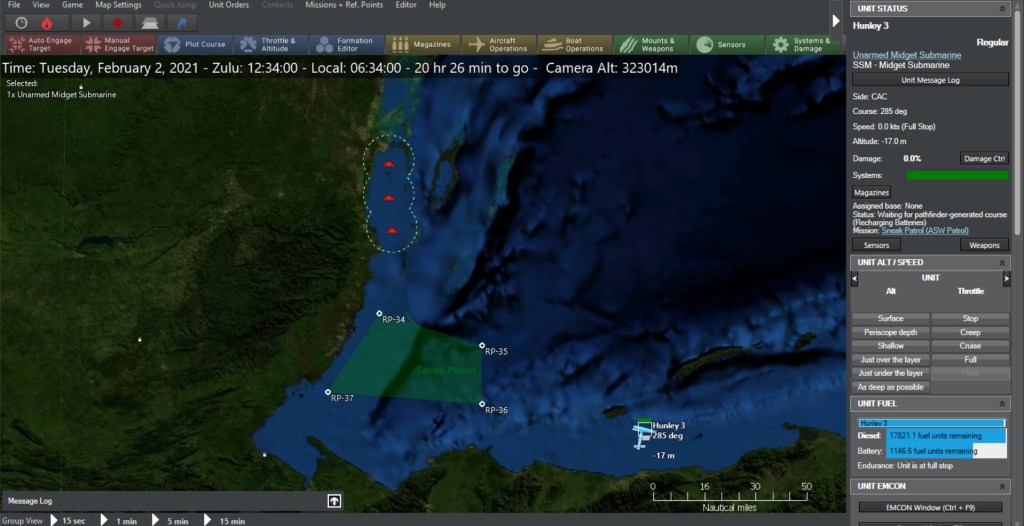
I got back into making Command: Modern Operations content with another draft scenario that I’ve called Sneaky Sneaky. It’s in an alternate historical setting where a “Walkerist” rogue state survived in Central America. Now they have to try and slip a few improvised mini-subs past the Royal Navy to Belize. Much inspirational thanks goes to the Covert Shores website for its great work on analyzing such submarines.

The scenario can be tried out here.

Weird Wargaming: From The Periphery to the Centfront

The force deployments of the Cold War Central Front have been one of the most obsessively studied and analyzed of all time. Yet some surprising curveballs can still emerge. One of them I recently found was unadopted suggestions to move either Turkish or Italian forces to permanent bases in West Germany. The Turkish force I heard was two divisions. The Italian one was undefined.

The biggest (purely military and not political) risk I felt was that a significant portion of these nation’s heavy formations (the only viable ones for a conventional Fuldapocalypse) would have to be moved. Thus they would need to be either reequiped with cheaper and less capable superpower surplus, beefed up expensively, or have fewer mechanized units on their own territory.

As for where to put them, there were a few options. One was the obvious use of them to shore up the always vital and always vulnerable NORTHAG. Another was to put them in Southern Germany and/or other areas with good defensible terrain (such as the Harz Mountains) to free up Bundeswehr troops to go elsewhere.

However they were equipped and wherever they went, having these alternate deployments seems like it would make for an interesting wargame scenario.

Weird Wargaming: The Ambitious Special Operations of WWIII

This Weird Wargaming has the original intent of Fuldapocalypse meeting what the blog has gained a focus on-largely conventional World War IIIs mixed with elite small unit actions. I got the inspiration for this from a question of “what would the Army Rangers be doing in a conventional WW3?” Whatever the skill, level, troops like them are just far too light for the Centfront and would get bulldozed and/or bypassed. My initial thought was that they’d just get sent over to Norway with all of the other light infantry.

This was a very timid use of them (and other special forces), and the responses got my eyes lighting up. One was “Delta hunting the rail-mobile command center of GSFG, with the Rangers adding extra muscle.” To me it would be a ultra high-risk operation with an iffy reward, but hey, what else would you use them for?

Something like that would be a blast to sim, even if it’d have to use a different ruleset than the usual large-unit Fuldapocalyptic reenactments. While I have the same apprehension that it would turn into another Kidnapped with a scenario the mechanics aren’t meant to handle if you used a “hard” system, good design on either end would make it excellent. And if you used a “soft” system, well, stuff like this is what action heroes are made for.

Weird Wargaming: T-64 APCs

When all you have is a hammer, everything looks like a nail. When all you have is a bunch of T-64 tanks, everything looks like it could work with a T-64. As it stood, the independent Ukraine inherited a gargantuan number of those tanks after the breakup of the USSR. As the beginning of the Donbass War showed all too vividly, it had very little else. Since the bureau that designed and the plant that built it were also in Ukraine, then… well, the hammer was even more prominent.

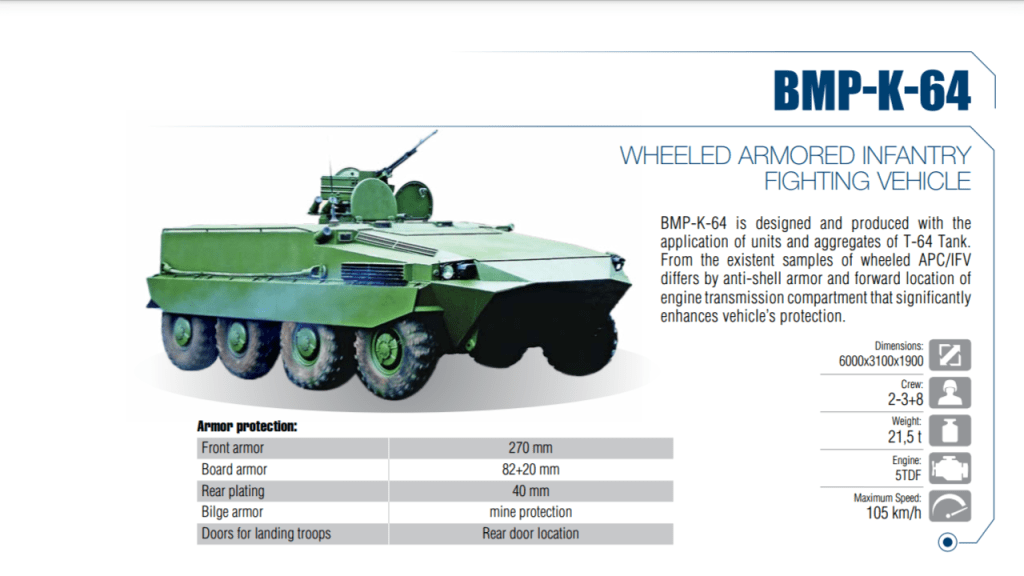
So, there’s the BMP-64, essentially an eastern Bradley on a tank platform. It has similar dimensions and a similar role as the famous American IFV (although a lot more dismounts). Note on the same brochure there’s more vehicles on the T-64 chassis and other tanks fitted with infantry compartments. The latter ones I’ve always envisioned as (at least theoretically) being more suited for a western armored cavalry structure. They can do the same things a tank in armored cav units can do, but they also have a few scouts to dismount when need be.

Then there’s the BMP-K-64, using the tank chassis for a wheeled APC. I find it simultaneously weird, interesting, questionable, and somehow impressive. This would be used like any other Stryker/BTR-style wheeled troop carrier, albeit with its thick front armor taken into account.

These desperation-born oddballs are the kind of armored vehicles I have a soft spot for.

Weird Wargaming: Artificial Humans

Ok, this is one of the weirdest Weird Wargamings yet, and it depends entirely on what ruleset is being used. Basically, one of my loves is “artificial humans“. The boring thing to do would be to treat them as either normal humans or robots. But there was one attempt at going beyond that.

Now in Fire Emblem: The Blazing Blade, the morphs are treated just like normal units with one exception-all of them, even the strongest, have zero luck. Zero luck means that they have lower hit and dodge rates mixed with massive opponent critical rates. That can definitely be incorporated into various tabletop rules.

Of course, it can make some sense to give them higher stats in other categories to compensate for that. It all depends on what the theme of these artificial humans are. They can be everything from super to expendable, as the Fire Emblem morphs are.

Weird Wargaming: OPFOR as “Actors”

In some of my Command scenarios, I’ve depicted exercises. Many similar scenarios use the “characters”, the foreign platforms they’re simulating. Therefore there would be a lot of Soviet origin fighters. And there’s no problem with that. But I’ve decided to do things a little differently in my own.

I’ve decided to frequently use the “actors”, the western units painted up as “aggressors” to play the enemy during the operations. Part of this is just for the sake of distinct novelty, and part of it is to provide a non-contrived way for advanced western platforms to fight each other.

A general substitution rule I’ve used is this.

MiG-21F-5
MiG-23F-20
MiG-29F-20, F-16
Su-27F-15
Su-24F-111

There are of course even more variants, but those are the general ones.

The next part is setting the side proficiency of the OPFOR to “Ace”, the highest one. It’s there to simulate both highly trained crews (hi Jester and Viper) and give the player more of a challenge.

That’s my small personal guideline for exercise scenarios.

Weird Wargaming: Independent Scotland

The subject of what military an independent Scotland might have has gathered a lot of attention. One of the most serious and definitive reports on the matter comes from the respected Royal United Services Institute, a piece entitled “A’ the Blue Bonnets.

The RUSI piece in short depicts a small and light land force not too dissimilar from Ireland’s, unsurprising in light of their similar geography. However it does assume a more capable air/naval element. The report shows a comparably strong navy and an air force with hand-me-down BAE Hawks as its fixed-wing fighters.

Assuming no political issues, something like the KAI Golden Eagle might also work as a basic air defense fighter, an heir to the F-5 of the past. That’s the only real quibble I have with the report, which is otherwise well worth a read.

As for the possible opponents of this Scottish military, far and away the most realistic is, like Ireland, whoever they’d face on foreign peacekeeping operations. For more out-there ones, you have Russia (especially at sea), and if you want to be really out there, you could do a “Kobayashi Maru” situation where the Scots have to inflict as much damage on the invading English/British invaders as possible.

And of course, this assumes a commitment to plausibility-if you strip-mined Scotland’s entire military age population and had an outsider equip and train it, then you could end up with something completely gigantic. But the “Ireland on land and another North Sea state on sea and air” option is the most logical.

Weird Wargaming: The UN Standing Army

An underappreciated and underutilized force for wargaming (particularly as it can be made with existing surplus equipment), the UN standing army as discussed in books like A UN Legion. Unlike some other entries in Weird Wargaming, the nature of this force makes describing it in any exact detail much harder.

On one end, there’s light peacekeepers with nothing but small arms or vaguer proposals. On the other, there’s the incredibly detailed “Vital Force” proposal. The bigger “world army” proposals also tended to be the most vague in terms of equipment. Yet it’s easy to find analogous historical units. Either the entire force or a large chunk of it could easily be structured like existing high-deployability forces. Airborne and amphibious units provide an excellent, well-documented guide.

For “world armies” with more conventional units, there’s plenty of national and/or theoretical inspiration to be drawn, possibly with some inferences (for instance, a priority may be on allowing smaller units to operate as independently as possible). The heavy divisions in the rapid-response units may get prioritization for upgraded equipment. As for that equipment, it can be anything from purpose-built (especially if it’s intended to be airdroppable/amphibious) to surplus.

The proficiency levels of a “small force” should be high, as creating a handpicked, well-trained force over clunkier ad-hoc formations is the entire point of their existence. Bigger “world armies” are going to be inevitably diluted, but should still err on the side of greater skill.

Weird Wargaming: Beat Em Ups

Ah, the “beat ’em up”, a type of video game that achieved its first popularity with Double Dragon, and may be known best from Final Fight and Streets of Rage. Should one wish to simulate it using tabletop rules, the following should be adhered to:

  • Given the genre, the system must have robust melee rules. This is an obvious requirement that needs no further explanation.
  • The enemies will resemble, by and large, stereotypical 1980s “punks”. Bosses will be bigger and stronger versions of them and/or exotic in some way.
  • If they have weapons, it will be stuff like pipes, bricks, and knives. Because…
  • The amount of guns used, especially any bigger than a pistol, can be counted on one hand. Double Dragon set the precedent that only the final boss is allowed to have a gun. While the degree to which this adhered to varies, it’s still generally enforced.
  • The final stage will be this opulent area that contrasts massively with the tone and theme of the rest of the game. Double Dragon had an ancient temple complete with mechanical traps. Final Fight and the first two Streets of Rage games have giant mansions. The latest Streets of Rage has an island supervillains lair complete with a castle.