Review: Kidnapped

Kidnapped!

Kidnappedcover

The Twilight 2000 tabletop RPG is a classic of the Fuldapocalyptic World War III genre. So it’s a little disheartening to debut it on this blog with what could easily have been the nadir of the franchise. But the “Kidnapped!” module is still a very interesting example of just a bunch of things all going on a bunch of different paths until it all just breaks.

The big “problem” is that T2K’s later modules were a victim of the very success of its initial premise. The initial European setting was a good way to square the circle of “we want you to be in the military, but we don’t want you to just have to follow orders and sit around until an artillery barrage kills you.” It was also a good balance between “We want to give you limited resources unlike a contemporary setting, but we also want to give you more toys than a full post-apocalyptic setting.”

Yes, this led to issues between the two tones of a “grim struggle for survival” and “like a classic tabletop RPG, only with tanks instead of dragons”. But I have to give GDW credit for making something distinct and adaptable. Then the question is “how do you follow up on that?”

Enter the North American modules, which became increasingly theatrical and bizarre. The “Airlords of the Ozarks” module made me use the term “Arkansas vs. The Blimps” to describe any long series that veers into craziness. It got to the point where it wouldn’t have been too surprising to see the heroes venture into an Upstate New York bunker to retrieve Adolph Hitler’s frozen corpse (as happened in the later Survivalist novels).  But Kidnapped takes the cake both for pure dissonance and poor design.

  • It starts with a description of the super-drought about to strike North America. Too bad the actual main focus isn’t about this Frostpunk-style societal triage. No, it’s about a Hitman/Splinter Cell-style “go and get a high value target”. The target is Carl Hughes, leader of the authoritarian New America, in his Shenandoah supervillain lair.
  • Hughes, the target of the adventure, does not get official stats or an official portrait. But there is a page devoted to a gang of Native American marauders (oh, you 80s action RPGs) and several pages devoted to an abandoned New American facility that does nothing but give a “clue” and a “We’re sorry, Hughes is in another castle” experience.
  • Is Twilight 2000 supposed to be semi-grounded? Good. Now plausibly take on a fortified lair with over a hundred guards and a target who needs to be captured alive (so you can’t just snipe him).
  • Naturally, to fit this mammoth Cadillac V8 into a Smart Fortwo and make the module even slightly viable, there are gimmicks like convenient gaps in the security camera coverage, guards who’ve lived and worked together for years being able to fall for players in simple disguises, and Hughes never going any more than one level deep in the four-level underground complex even when threatened.
  • There are lots of descriptions of places that are either irrelevant or “beef-gated” (too well guarded to realistically challenge), and the “listing of important characters” not only doesn’t have Hughes, but also doesn’t have anyone else actually living in Hughes’ lair. But it does have lots of throwaway bandits-of-the-week!

So Kidnapped! is something I’d recommend only for Twilight 2000 completionists or people fascinated by “How NOT to make an RPG module.” It’s at the point where, if people were running a T2K game in North America and the GM wanted them to take on Hughes, I’d recommend just writing a scenario from scratch instead of consulting this.

For a second opinion on Kidnapped, you can check the the Twilight 2000 Wargaming Blog. That opinion is also not complimentary.

Review: Day Of The Delphi

Day Of The Delphi

delphicover

Despite being the sixth in the series, Day Of The Delphi is actually the first Blaine McCracken book I’d heard of. How had I heard of it? Well, it’s quite a story. Shamus Young, one of my favorite video game commentators, had listed it as one of his least favorite books ever. Naturally, this piqued my interest and I found the greatest thriller protagonist name ever. A little later, I heard the name “Blaine McCracken” again, got The Omega Command, and never looked back.

As for Day Of The Delphi itself, it’s excellent-by Blaine McCracken standards. The previous entry, The Vengeance of the Tau was still good, but it suffered from having the first disappointing central gimmick in the series. McCracken returns to form in this ridiculous epic.

The tone of this book (and the whole series) can be summed up by a scene disappointing to me. The disappointing scene did not involve any inconsistency, by now routine super-gambits, or laughably inaccurate designations of weapons. All those are in the book, but they aren’t the disappointing part of it.

No, the disappointing scene was a fight in a slaughterhouse that failed to take advantage of the potential to use live cows as weapons. McCracken uses the ramrod to kill an enemy. It needed more “battle cattle”. Other than the lack of battle cattle, this was a ridiculous Blaine McCracken spectacle extraordinaire. Yes, even by the standards of other books in the series.

It doesn’t have a MacGuffin that’s weird, but it makes up for by having an incredibly ridiculous (the plan of this book’s super-conspiracy ranks as dumb even by the standards of Blaine McCracken super-conspiracies) main plot. Some might reasonably think that’s bad. To me, I view it as part of the fun.

Review: The Samurai

The Samurai

cascacover

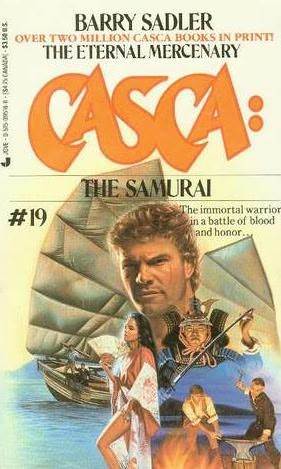
With the nineteenth entry in the series, The Samurai, Casca swings and misses dramatically like a called-up minor leaguer facing Nolan Ryan. Of all the Casca books I’ve read, this is the worst of them (so far). I’ve heard conflicting answers as to who was actually writing the later Casca books before Sadler’s death, but whoever was did not succeed here.

Knowing the history of the series, I was expecting a clumsy, stereotypical depiction of ancient Japan. And I got it. But it also has very blocky, clunky prose and flat fight scenes that take away the biggest strength of the Casca series-the ability to have effective action despite its protagonist being, you know, immortal.

Not that it really matters much, because here Casca himself might as well just be a second-rate hired gun in a dull story about dull rivals fighting for power in dull battles. Having all the weaknesses of the Casca books but none of the strengths, The Samurai is something I wouldn’t recommend even to fans of the series.

Review: SEAL Team Seven Direct Action

SEAL Team Seven 4: Direct Action

directactioncover

The SEAL Team Seven series, however much I enjoyed the first installment, is not the kind of series where reading every book in order is the most appropriate. So I decided on Direct Action for two main reasons. The first is that the summary seemed a little interesting. The second is that it’s the first book after original author William Keith was replaced by another writer under the “Keith Douglass” house name.

So, Lt. Blake Murdock (it’s not quite Blaine McCracken but it’s close) has to lead his SEALS into Lebanon to destroy a plant producing counterfeit American money, fighting Hezbollah and the Syrian Army in the process. The prose is a little clunkier and the action somewhat more extreme than the first book, but it’s still a good cheap thriller.

In fact, this book manages to have its cake and eat it too in a good way. It manages to have its SEALS scything their way through enemy fighters, soldiers, commandos, BMPS, and helicopters while at the same time throwing semi-plausible bits of “friction” in their path to make them earn their mission-and not without loss.

A part of me has “glass half empty” thoughts where I think “what if the big-name technothriller writers did a slightly higher-brow version of this instead of clunking along with an increasingly obsolete Cold War thriller model?” and lament what wasn’t. But another part of me has “glass half full” thoughts where I can just enjoy this well-done cheap thriller for what it is.

A Tag Change

For my 150th post on Fuldapocalypse, I’ve decided to make a few announcements. First, I made the tag cloud bigger again (It kind of needed to be). Second, I decided to break away from one of the most-used tags.

The “Infantry” category is perhaps the most awkward one on Fuldapocalypse. I first used it for a technothriller that did include infantry. Then it expanded to not only include special forces and sci-fi infantry, but also vigilantes and secret agents. The result was that, even though infantry “grunt fiction” isn’t exactly one of my favorite subgenres, “infantry” became one of the biggest and most used tags in Fuldapocalypse.

So while I’m not trying to edit existing posts, I’ve decided to specialize rather than generalize for “infantry”. So on the occasions that I do review ordinary infantry, I can keep the normal tag. Otherwise, stuff like “Secret agent” or “Special Forces” or “Vigilante” can work.

There’s obviously going to be tricky choices, but I think I can handle those on a case by case basis.


Review: War Breaks Out

War Breaks Out

When I got Martin Archer’s War Breaks Out, I was expecting a plodding Cold-War-Turned-Fuldapocalyptic-Hot story. The initial premise and the mediocre experience of the previous book I’d reviewed, Israel’s Next War, made me think that. Instead, I got one of the most crazy and just plain out-there examples of a World War III story I’ve ever read.

  • The timestream got scrambled. There are Eurofighter Typhoons and people who were injured in the Iraq and Afghanistan wars, but at the same time there’s a 1980s WWIII and everyone is using M60s and T-62s. Oh and Belgium has F-15s for some reason.
  • We’re introduced to the main character (who frequently appears in a weird form of first-person similar to that present in Israel’s Next War) immediately. He’s a one-star general who gets a quick promotion worthy of spacesuit commandos. The president decides he’s just that good, and needs a fighter, not those deskbound bureaucrats! (To be fair, this is officially the third in a series with the same main character, but still).
  • Said main character promptly comes up with a bunch of gimmicky tricks and special ops to turn the tide of the impending war against the USSR. These range from tricking Soviet AWACS with mass transponder changes to landing troops with ferries in the Baltic. Naturally, they all work.
  • The actual battle scenes themselves are the least amusing and most clunky and repetitive. Except for something I haven’t seen in a while-the attempted Soviet invasion of Iceland! It’s been a while, Ísland. I missed you!
  • The book ends with one of the most ridiculously blatant examples of “Foreshadowing” for the next installment in the series that I’ve seen. It’s not foreshadowing so much as building a city of giant neon signs indicating the plot point, then causing it to be lit up in a giant fireworks display that’s internationally televised, telling the plot point in a Super Bowl commercial, and then carving the plot point into the moon for good measure.


This was an experience. It’s probably as bad as “World War 1990” in terms of pure writing quality, but I had a lot more fun reading (and reviewing) it. I guess a better example would be an even more rough version of Ian Slater.

Review: Steel World

Steel World

steelworldcover

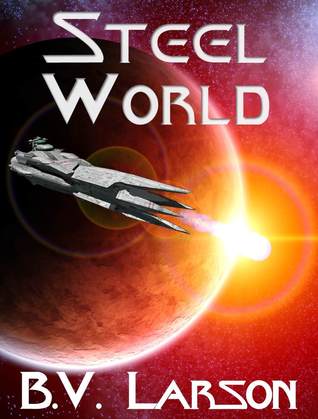
For BV Larson’s Steel World, I returned to a familiar place-the land of spacesuit commandos. Almost every single value checks out. Dystopian background? Check. The main character is a super-special spacesuit commando in a super-special spacesuit commando unit (in this case, a secret dirty tricks “Legion”)? Check. The main characters use nothing more than power armor and ray guns that don’t seem to really do much? Check. The tactics are iffy and everyone uses Roman ranks? Check.

The only novel feature, besides the use of “rules of war” that are clearly structured to enable the plot, is revivification. However, in practice all it does is remove tension, best summed up by having people -multiple times at that- want to be “killed” for the sake of convenience.

For all my complaining, Steel World manages to dodge the biggest problem with the subgenre. Its training sequences are not overly long, and I was thankful for that. And for all its issues, it’s still readable and fun as a mindless spacesuit commando novel.

Review: Red Storm Box Set

The Red Storm Box Set

James Ronsone and Miranda Watson’s “Red Storm” series ran for six books. The omnibus box set I bought contained the first three- “Battlefield Ukraine, Battlefield Korea, and Battlefield Taiwan”.

This checks all the boxes. Lots of conference room infodumps with generals and leaders? Check. Huge descriptions of everything? Check. Characters whose sole characterization is at best an infodump and (more frequently) at worst a “Steel Panthers Characterization” where they’re just paper placeholders who crew military equipment? Check. Hopping around viewpoint characters around the world with what feels like no rhyme or reason? Check. And the cherry on top is the Hackett-style “city trade” plotnukes, as Oakland and Shenyang go boom.

This is what I thought I’d be reading en masse when starting Fuldapocalypse. Thankfully, it hasn’t been what I actually have been reading. Reading countless non-dry, non-World War III books has allowed me to view this in a better perspective than I had before. In the past, I’d have probably just denounced it with a combination of fire-breathing and eye-rolling.

I still view this as a subpar book-it’s in the awkward, neither fish-nor-fowl area of being too “literary”, gimmicky, and inaccurate in a rivet-county way to be a War That Never Was-style pure play by play while being too bland and disjointed to be an actual literary book. But now I can weirdly appreciate it for trying to scratch a specific itch. My mindset has gone from “this is bad” to “this has flaws and isn’t really my thing.”

If a sort of “Hackett but with some technothriller gimmicks” style book is your thing, you could do worse than this series.

Review: Transit To Scorpio

Transit To Scorpio

scorpiocover

Though published close to fifty years ago, Kenneth Bulmer’s Transit to Scorpio was already almost an anachronism when it was released. Much of what we now know as “science fiction” and “fantasy” was once unified in a type of genre following in the footsteps of the legendary John Carter of Mars, one known as “sword and planet”, involving Earthmen traveling across exotic worlds and fighting with blades.

This book fits that category to a T. 18th century sailor Dray Prescot is transported to the planet Kregen around the star of Antares, where he proceeds to be rejuvenated and made near-immortal, only to be cast loose as he disobeys his masters to aid a beautiful woman, Delia. Cue a book of “planetary romance” (another name for the genre) in every definition of the term.

Transit to Scorpio has a lot of prose that’s sadly familiar even to someone like me who’s only read a bit of the style of the day, being both overwrought and clunky. It also has a plot setup that’s familiar, with almost all of the “science fiction” elements being used to set up the plot and little more. In spite of this, it’s not bad, particularly by the standards of the genre.

Review: The Peace of Amiens

Drake’s Drum: The Peace Of Amiens

drakesdrumcover

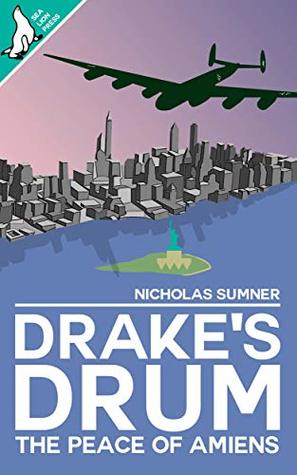
A fresh Sea Lion Press Release and the first book in an intended series, Drake’s Drum: The Peace Of Amiens is classic “crunchy” alternate history. Starting with flaws in British naval shells being fixed in World War I and a more decisive British victory at Jutland, the “butterflies” spiral off until a bankrupt Britain throws in the towel in World War II, the Caucasus is overrun and the Soviet economy collapses, and the stage is set for a German-American confrontation (the cover depicts Amerika Bombers striking New York, with the book ending on a cliffhanger).

The book cuts between character vignettes and “pseduo-history”. I didn’t get the most out of the character scenes, as well intended as they were, save for one chilling scene depicting the Madagascar Plan in “action”. Thus like a lot of alternate history, it leans a lot on plausibility.

And here, it does better than many others. I’ll also admit to not being the biggest fan of this kind of genre, but this is how to do it right. First, there’s very clearly a lot of research being done, and it being done in a good way. Second, there’s a sense that a lot of it feels right. There are handwaves like the war outcomes and stumbles like my pet peeve of the pool of American political candidates being too small. But there’s more things that sound right and plausible, especially compared to other alternate histories.

For people who like detailed alternate history, The Peace of Amiens is a treat.