What really brought down general aviation

I was looking at histories and such concerning the post-WW2 decline of general aviation in America. Most of the stated reasons center around costs, regulation, lawsuits, and changing demographics. None of these I’m denying were factors, even major ones. But I came across something that was very eye-opening and was not mentioned in most of the usual ones.

That was the decline in its practicality. One amusing side-part of the “flying car” discourse is that in a way, in the early postwar period, flying cars in the way we think of them kind of existed. See, in the early postwar period, as long as you could afford something that still always cost at least the equivalent of six figures today just for the airframe (ie you were a rich professional), flying in your own aircraft over the Depression-adjacent countryside was frequently the quickest and most convenient way to get from point A to point B. Whether it was for the luxury of a getaway or the necessity of business travel, there was a practical use.

Later on this eroded with two big things, which I shall provide graphical illustrations of.
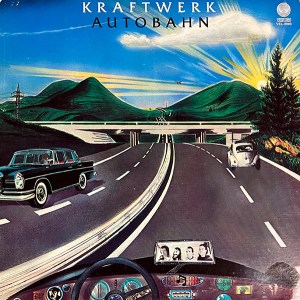
Yep, better roads and better, cheaper, and more accessible commercial air travel. Which meant a lesser actual need for private planes, which naturally had giant ripple effects. At the very least it’s an underappreciated piece of the pie.
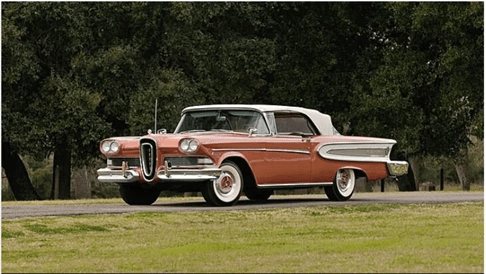
Gaming’s Ford Edsel

Looking at retrospectives for the infamously legendary recent video game bust Concord , I thought a lot of “wow, this really is the Ford Edsel of video games.” And I mean that specifically.

This video is as good as any for explaining in short terms what Concord was. That said:

  • It wasn’t actually that bad mechanically
    The Edsel was no worse in performance or safety than any other car of its era. Whatever issues it did have could be understood as it being brand new and not ‘broken in’. Likewise, Concord wasn’t a Memetic Bethesda Launch glitchfest with a lot of its immediate issues being… brand new and not ‘broken in’.
  • The timing was terrible
    The Edsel launched in a recession where the cars in its market segment were the hardest hit. Concord launched when hero shooters had gone from “hot” to “disco in 1982.”
  • The visual design was bad
    I don’t think I really have to elaborate here.
  • Expectations were far too high
    Concord was supposed to be a big merchandising and spinoff paradise as well as a tentpole franchise. The Edsel was supposed to be an entire division like Lincoln, the slightly above average in the brand ladder.

    Amazing how history can rhyme.

Classic Cars Were Terrible

So yeah, time to bust the legend of super-classic cars. In short. They sucked.

This video shows the biggest reason I dislike “classics”. They were/are horrifically, monstrously, massively unsafe. Bad seatbelts even assuming people wore them (they didn’t), cars that were basically metal sculptures designed with no concern for the people inside in mind, and yeah.

Ah, but what about the handling? Good question. Your car engine was either so underpowered that a modern econobox can match it or it was a gargantuan rocket inside a frame that could barely contain it, which doesn’t exactly help with safety. And said engines burned through gas so massively that the supposed halcyon days of cheap gas (even beyond inflation) often actually weren’t. Oh yeah, and they were tremendously space-inefficient.

But they built them to last unlike todays evil capitalist planned obsolesence machines, uh…? Well, I’ll just point out that an odometer on an old car being a full order of magnitude (10 times/1 digit) lower in max numbers speaks for itself. But even if it didn’t, you remembered the survivors who stuck around, the lovingly maintained Cadillacs and not the five millionth Chevy Nova that instantly broke down.

So yes, in everything except raw performance (and sometimes not even then), this rightfully regarded bottom-feeder 2017 Mitsubishi Mirage is vastly superior to the fin-boats of old.

A Thousand Words: Electric Football

Electric Football

As Christmas approaches, it’s important to acknowledge a rite of passage every American child has faced. Getting an electric football set and only using it once. I remember getting an electric football set, thinking the players were actually programmable (ha!), watching them shake downfield once after turning the game on, and never touching it again.

The creation of Norman Sas and Tudor Games shortly after WWII, electric football involves a vibrating board to move its players. When the NFL expanded massively in popularity, electric football gained the official license, becoming the Madden of its day. If Madden was programmed in two days by people who couldn’t make the cut at Game Freak or Bethesda.

Now electric football is both technically improved and far less popular because, you know, video games exist. But it was and still is a thing.

Review: Our Man On The Hill

Our Man On The Hill

Matthew Kresal’s debut on Sea Lion Press (full disclosure, I’m published there too) is Our Man On The Hill, a story which takes a bit of historical commentary and plays with it. It’s been said that Joe McCarthy was such a blustering bumbler that he actually did damage to legitimate anti-communism. Thus Kresal turns into him being a Soviet agent intended to sabotage the opposition.

Though not exact, this has parallels with Agent Lavender, the book that started SLP in the first place. Both make alternate histories where a conspiracy theory about a huge political figure (Wilson, McCarthy) is treated as true. Both are well researched. And both are excellent reads.

Even though I’m not generally the biggest fan of this kind of political/spy story, Our Man On The Hill is well done enough that I had a blast reading it. I highly recommend this book.

Review: The Professional

The Professional

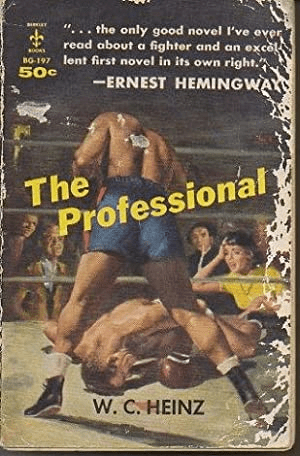
A tale of middleweight contender Eddie Brown, The Professional is a novel by legendary sportswriter W. C. Heinz. What’s interesting is comparing it to Malamud’s The Natural, as they take extremely different paths but arrive at the same level of quality. This deserves more explanation.

Malamud did not know much about baseball. Heinz knew boxing inside and out. Book Roy Hobbs is an ass that you’re not supposed to root for. Book Eddie Brown is meant to be a decent, sympathetic figure in a bad sport. The Natural loved making flourish and mysterious performance shifts depending on the plot. The Professional is grounded and realistic to a fault. The Natural is a third-person book. The Professional is a first-person book. The prose is blocky in both, but while Malamud is excessively flowery, Heinz is very Hemingway-esque (not surprisingly, that author loved the book). And yet both come across as being stilted, pretentious, and dated.

Its main characters are not very good. Brown is not a bad protagonist but he can’t make up for the faults of the other two, which are massive. The two other central figures are Brown’s hideous Mary Sue of a trainer/manager and the first person sportswriter narrator, who fits the “character as camera” archetype I’ve seen in other negative reviews of first-person books.

As for the book itself, it consists of realism-as-padding, outright padding, and expects the reader to treat the technical decline of boxing as some great tragedy. I could be a little harsh on it because it would be far more novel and revealing to a 1950s reader who only knew boxing from television and the pulps (not surprisingly, there’s a scene where Heinz, via one of his mouthpieces, swipes at them for their inaccuracies). But to someone much later who’s read a lot of excellent nonfiction on the sport, it just felt plain and empty.

Review: Friday Night Fighter

Friday Night Fighter

Troy Rondinone’s Friday Night Fighter is the story of both a boxer and a time period. It is the story of boxer Gaspar Ortega. It is also the story of a huge-in-its-day sporting event, the time when boxing aired en masse on network television and attracted a viewing share comparable on the low end to the NFL playoffs today. It is the story of a far more unified sport than the later “alphabet belts”.

Rondinone’s writing is excellent and Ortega, a boxer who appeared on television many times, is arguably the perfect figure for this age. On one hand, he was much more than a small journeyman who appeared on television a few times. On the other, he wasn’t the kind of already-immortal figure that everyone already knows about (ie, Marciano, Patterson, Liston). A contender who never got to actually wear the belt, he illustrates the time period exactly.

Another impressive element of this book is that it rarely sinks into Good Old Days nostalgia despite boxing being the one sport where it’s the most viable. It makes it clear that boxing gave up on network TV because network TV gave up on boxing, with viewership substantially down even before Benny Paret’s death. Yes, TV played a role in diluting the talent pool and closing down the old clubs and gyms that served as the fighter pipeline, but so did simple demographic change. And it doesn’t hesitate to tackle the sleaze in the sport.

The best complement I can give to this book is that it truly takes the reader into another time, and that’s something a lot of history books just can’t manage. Friday Night Fighter is one of the best works of sports history that I’ve read, and I highly recommend it.

Review: Gil Thorp

Gil Thorp

Fuldapocalypse now turns its attention to the so-called “funny pages”, the coleacanths that linger in newspapers across the country. One of these living fossils is Gil Thorp, a sports comic that has been running nonstop since 1958. The comic has a simple premise. It follows the title character, a coach/athletic director of the fictional Milford High School, and his students as they play through the seasons and have off-the-field drama. (The name is a combination of real star players Gil Hodges and Jim Thorpe).

One thing in the strip’s favor is that it’s been timed to match each real sport in its real season. So you have baseball/softball in the spring, football in the fall, and basketball in the winter. Of course, this means that the summer, when school’s out, leads to huge segments of nothing but non-athletic filler.

There have been several artists drawing the strip, none of them particularly good. This was an issue in one arc where two characters thirty years apart in age looked almost exactly alike, which drew some confusion-and this was reading the strips in hindsight. Beyond that extreme example, you have tons of barely distinguishable, interchangeable, moving-in-and-out characters.

Which brings me to the next problem, and one that shows why this particular type of comic strip has been mostly destroyed. It turns out that soap-opera style arcs told one three-panel strip at a time are not the most ideal way to tell a story. That the storylines themselves fall into an awkward melodramatic-yet-tame-enough-for-the-mainstream-papers uncanny valley and are frequently repeated can be forgiven/understood, even if it doesn’t help. But no matter the quality of the plots as a whole, the format just does not lend itself to good reading.

This was the first work of fiction I really binge-read in some time. And while I liked the goofy experience, there’s a reason why most other storyline strips like it have sunk into the depths.

The Big Baseball Business What-If

There’s an underappreciated what-if concerning the business of baseball that I’ve considered worth exploring. Too much sports alternate history simply shuffles players, teams, and outcomes around. It feels both obvious and unsatisfying to me, the equivalent of the Red Sox unloading not just Babe Ruth but the entire core of what would become the 1923 champions on the Yankees or the A’s “Mustache Gang” all leaving in free agency when they got the chance. This is something different and could have changed the entire business model to be more like what’s in our time a vastly different type of sports.

In the 1950s, the Dodgers were intrigued by a company called Skiatron, offering pay-TV services. The technology did exist at the time but was very rudimentary. The possiblities were obvious. After all, even at a dollar per game, a six figure audience could translate to that much every home game, a huge sum at the time.

In OTL, this did not come to pass in this form. Besides the obvious ferocious opposition from the existing broadcasting industry, Skiatron’s technology and finances just weren’t viable at the time. But if something like that could be done (and I don’t know the exact plausibility-I’m not that kind of technical expert), it would be, no pun intended, a game changer. The obvious is that there’d be a big jolt of money, getting the historical broadcast windfall in earlier.

There are easy ramifications. There’d be more money in the sport, which would increase the pressure by players to get more of the growing pie for themselves. A historically unsuccessful team that used this to its advantage would result in the championship races being different. But there’s also more thoughtful ones.

One on-the-field change I could see resulting from this could be in pitcher usage. Here I’m kind of extrapolating from the “overworked for the sake of attendance” policy of Mark “The Bird” Fidrych (which may have contributed to his severe injury). I’m also extrapolating from boxing and MMA, which historically have leaned the most on PPVs. Put simply, more people have been willing to pay to see Connor McGregor than to see Valentina Shevchenko. And I’d bet more people would be more willing to see Sandy Koufax than Ned Garver.

Another, sleazier one is the notion of small-market/poor team owners simply giving up and advertising the players on the opposing team for the PPV spectacle. “Hey, [Small City], do you want to see the Yankees? The Dodgers? The [other good team with an exciting player]?” There are possibilities here.