Review: The Betsy

The Betsy

Harold Robbins was an author with a…. “reputation”. As successful as he was sleazy, Robbins turned to the car industry in The Betsy. The number of fictional novels centered specifically around the automobile industry is tiny-it makes conventional World War IIIs look like Harlequins in comparison.

It’s a story of sleaze, the struggles of Ford-esque Bethlehem Motors, and more sleaze. Oh, and bureaucracy as well. There’s a lot of that too. Robbins’ writing “style” can be determined right from the very start, as the first-person narrator appraises his nurse.

However, the rest of the book is a bizarre jumble. There’s the ridiculous exaggerated sleaze that everyone knows him for along with countless meetings about cars and the titular car in particular. It has the personalities of Ford, but the market share of one of the struggling “independents” like AMC, the “auto side isn’t profitable while the non-auto side is, so we want to leave the auto business” situation that characterized Studebaker, and oh yeah, the actual car companies of the past still exist as well alongside this upstart.

The impression is one of knowing the basics but not the whole. The Betsy is supposed to be powered by a turbine, making it the car version of the T-80 tank. Compared to its rivals with conventional engines, it would probably, like that tracked vehicle, offer a little more (theoretical) performance, regardless of raw power, at a lot more expense. Chrysler’s turbine car program failed. A struggling, close-to-stopping car company likely wouldn’t/couldn’t have funded it. The impending gas crisis or any fuel price increase would probably stop it, and it’s unlikely even a initial success would…

…Yeah, I’m probably overthinking things. It’s just I’ve read so much about the actual history of the actual auto industry that it feels like I’m obligated to critique it that way. But I do think Robbins threw down the gauntlet by including so many meetings and so many details.

Anyway, there’s meetings, weird sex scenes, more meetings, car scenes, even more meetings, even more weird sex scenes, flashbacks, and did I mention meetings? This unfocused narrative isn’t helped by the perspective shifting from first to third person at various intervals. While the prose is decent when not having to describe anything either tasteless or dull, the plotting is horrendous.

The obvious comparison is to Sidney Sheldon, who relished in “gilded sleaze”. But Sheldon was far more coherent in his writing and, as weird as it sounds to say it, actually more tasteful as well. Go read Sheldon instead of Robbins if you want “sleaze in high places” done better.

Review: Manhounds of Antares

Manhounds of Antares

Having read the first arc of the Dray Prescot series, I had anticipated what I was in for when I started Manhounds of Antares. I expected horrendously purple prose, a first-person narrative of constant action, and a plot driven by cosmic contrivances. How accurate were my predictions?

For the first, the prose is a teeny-tiny bit better than in the Delian Cycle, but it’s still very, very, purple and overly blocky. For the second, it was pretty much exactly what I’d expected. For the third, it was somehow slightly worse than before, as Prescot is teleported around multiple times by the Plot Star Lords in ways that feel especially forced and jarring. Another returning element is Bulmer’s broad but shallow worldbuilding. consisting entirely of creating pseudo-wondrous names and species.

And yet I’ll readily admit this book served its purpose for me as a light read with a tone and prose style considerably different than the “contemporary action” books I’ve been reading. I’m just not sure I’d recommend it to others.

The Conventional War In The Air, 1970s

I’ve come across a declassified CIA document from 1972 illustrating a speculative Soviet air campaign in a Cold War turned conventionally hot. Having just emerged from the nuclear monomania of the past decade, it shows the weaknesses of the Soviet air forces in what was new territory for them. Almost everything was either too short-ranged, too vulnerable, carried too small a bomb load for conventional war, or a combination of the above.

That being said, it still would be very formidable to oppose, especially by the standards of “we only need to hold the air above the North German Plain for a few days”.

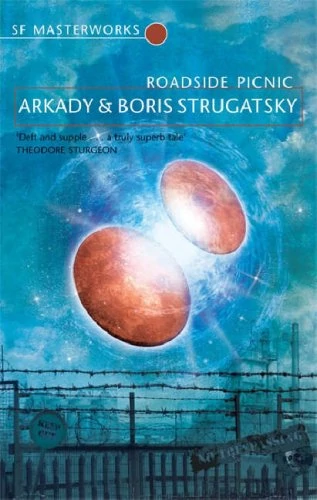
Review: Roadside Picnic

Roadside Picnic

It’s time to review another classic of science fiction, the Strugatsky brothers’ Roadside Picnic. It’s famous for leading to the “Stalker” movie and video game series, as well as gaining extra prominence after the Chernobyl disaster. But how does the book itself hold up?

Sadly, my thought after reading it is “not the best”. Maybe this is just the translation, but I felt constantly felt like the concepts were far better than the execution. The execution felt like it was either dull or pretentious with nothing in between, while the concepts of both “ultra-advanced aliens nonchalantly passing by” and “weird zone full of weirdness” are more interesting.

Perhaps this kind of higher-brow science fiction just isn’t my genre. But I could see why the book was both influential (because adaptations could take advantage of the really, really good concepts) and at least in some places less prominent by itself (because the actual novel doesn’t work as well).

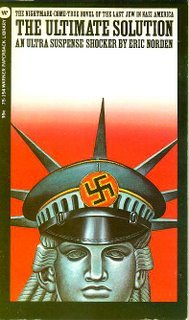
Review: The Ultimate Solution

The Ultimate Solution

Eric Norden’s The Ultimate Solution is a fairly early alternate history novel. A short book told in the style of a classic detective novella, it tells the story of an NYPD officer who, after the German victory in World War II and occupation of America, must track down a reappeared Jew, long after they were thought exterminated. Or at least that’s what the nominal plot is about.

The real meaning of this book is a trend in alternate history that this book was a pioneer in-use an Axis victory world as a way to express social commentary about contemporary society. This is the kind of thing that sometimes can be an insightful “mirror darkly” presentation, but often degenerates into massive axe-grinding.

Here it’s the latter, with a vengeance. Norden has the subtlety of Tsar Bombas preceding a parade of NASA Crawlers blaring Korn out of sonic blasters. Everyone is a (literal) puppy kicking monster. It’s so over-the-top it actually takes away from the message. Instead of “this is how good people can believe and do bad things”, it’s the far less profound or interesting “people here are bad”. And since most of the small book is devoted to this horrible horribleness of horrors, there isn’t really much else. This is the kind of book that’s interesting for its place in the chronology of its genre (in this case, alternate history) but has little else to recommend it.

Review: Exxoneration

Exxoneration

The American invasion of Canada finally begins in Richard Rohmer’s second book on the subject, Exxoneration. The previous installment, Ultimatum, ended with the US announcing its intention to annex Canada. Here, it moves ahead.

As far as its literary quality goes, I’ll just say this: I’ve read field manuals that were less cumbersome and infodumpy. Seriously. The mega-padding is still there, including such things as aircraft takeoff instructions. And the er, “lopsided” nature of a Canadian/American armed conflict means the book has to twist to have its cake and eat it too.

There’s only one fairly brief semi-battle in the novel itself. In it, the Canadians ambush a flight of American aircraft landing at Toronto who falsely assume the invasion will be unopposed. Basically, the Canadians need to win but there’s obviously no way for them to win conventionally so they have to rely on American public opinion (plausibly) promoting a backlash however the tone of the book is such that it wouldn’t do to have Canada devastated by war, so the only onscreen conflict needs to be short and neat.

Most of the book is just about the later efforts by Canada to purchase Exxon (hence the title). Needless to say, this is not exactly the most scintillating topic. While a better author could have made it exciting, Rohmer does not.

I want to compare this to Mike Lunnon-Wood, who wrote about slightly ridiculous to highly ridiculous scenarios in a matter-of-fact manner, but Lunnon-Wood’s prose is significantly better than Rohmer’s. It takes some effort to make a book about a Canadian-American war dull, but Rohmer does so.

Review: Ultimatum

Ultimatum

Richard Rohmer’s Ultimatum is the story of the U.S. invading Canada as written by a Canadian. More precisely, it is the buildup to the invasion, the haggling, set in the backdrop of the 1970s energy crisis as the embargo-facing US confronts resource-rich Canada. Because of this, the novel takes the form of one conference room scene and exposition drop after another. It’s a book meant to show events, not characters.

It’s also a book that, although fairy short, features ridiculous amounts of padding. Part of this can be justified in that its format is that of “events/setting-first”, but even by those standards, it has a lot of stuff beyond it. There are incredibly long Herman Melville -style infodumps on everything from the nature of the Canadian government to pipelines to transport aircraft. A subplot involving two bomb-planters is about the only time the book leaves the meeting room, and even then it somehow feels like it could be cut without really missing anything.

Although I will say that a plot involving native saboteurs destroying oil infrastructure, helping lead to a large, somewhat contrived war is basically Red Storm Rising more than a decade before the real Red Storm Rising was published. I don’t know if Tom Clancy saw the plot and I think it’s likely just a coincidence, but it’s still an interesting combination. And in some weird ways it’s actually more plausible than Red Storm Rising, given that seizing Canada directly is more straightforward than “invade Europe so we can seize the Middle East later.”

However, the actual war will have to wait for the sequel, Exxoneration. Here, the book simply ends with the declaration to annex Canada. Thus, it’s all setup.

In terms of quality, this is a very dated book, and I’m not just talking about the politics. It’s entirely meant to capture a zeitgeist, giving curious readers a look at the wheeling and dealing towards an event. This was a time period where the US openly studied seizing OPEC-held fields by force, after all. But this type of work, especially one as “matter of fact” as this, has a very short shelf life, and the result is a historical curiosity.

Review: Operation Sea Lion

Operation Sea Lion

The most infamous invasion that never was, Operation Sea Lion holds a special place in the annals of alternate history. Richard Cox’s book takes a 1974 wargame of it at Sandhurst and turns it into a Hackett-esque big picture tale. This can be described as a World War II version of The War That Never Was, taking simple wargame results and giving them a tiny fig leaf of “plot” via various vignettes.

Not surprisingly to anyone knowledgeable about alternate history, the wargame, despite deliberately going easy on the first wave (to have a substantive ground element at all) ends with the Royal Navy cutting the lines and the Germans defeated. It’s not Cox’s fault, but something with the outcome never in doubt is hard to make exciting for someone who knows the context.

That being said, this remains an amusing little historical alternate history footnote. It’s aimed at a popular audience who wouldn’t necessarily know the context, and is at least more literary than a rote after action report of the wargame itself would have been.


Snippet Reviews: April 2020

So, it’s time for a few more snippet reviews.

Bloodline

After reading only a few Sidney Sheldon books, I found that Bloodline matches his formula very closely. This is not a bad thing. While it doesn’t exceed the excess of Master of the Game, it comes fairly close, and his story of elite “intrigue” is everything you’d expect.

False Flag

A disappointing second entry in the Jason Trapp series, False Flag keeps the semi-serious tone while turning the plot up to full Roger Moore Bond ridiculousness. It doesn’t work well compared to its predecessor.

Extraordinary Retribution

Erec Stebbins’ second INTEL 1 novel, Extraordinary Retribution, is kind of an in-name-only endeavor. Not only are the politics even more blatant and hamfisted, but the main characters of The Ragnarok Conspiracy only appear at the end as a final deus ex machina. Otherwise, it’s a completely separate story. And not the best-written one.

Review: The Delian Cycle

The Delian Cycle

The quality of Kenneth Bulmer’s “Delian Cycle” of Dray Prescot novels (I got the omnibus edition) can be described in this anecdote. I dove straight through all 27 Survivalists with ease. To get through the five individually shorter Prescots took me considerably more effort. The question is…. why? I know I’ve explained my frustrations in my review of the second installment, but they deserve elaboration. After all, it’s not like I’ve had objections to reading similarly shallow cheap thrillers before.

The biggest reason is the prose, which is incredibly overwrought. It’s very hard to get through and takes away from whatever feelings the action might generate. Bulmer is seemingly never satisfied to use one paragraph to describe something when he can use three, and throw in another made-up word or ten while he’s at it. Still, if I can read Mike Lunnon-Wood, I can read him.

Then there’s the action, which labors under the horrendous prose and is just so constant that it becomes mundane. This is another reason, and it’d be a perfectly good reason. After all, cheap thrillers need to be good with action. But the action still isn’t the worst.

Another issue is the setting. The worldbuilding consists of nothing but throwing out so many names that the omnibus needs a giant glossary at the end, yet all it accomplishes is the creation of a sword and planet theme park, with the “exotic” names and airships and places being pushed so hard they lose any appeal. But it’s not like a bad setting is an absolute turn-off in a genre that depends on execution.

No, I think the biggest problem is the artificial nature of it. The books always involve Prescot getting teleported in and out by the MacGuffin People Star Lords. To use so blatant a setup would be bad, but what makes it worse is that they’re written in a kayfabe “Prescot has narrated this on cassette tapes to Alan Burt Akers [Bulmer’s pen name]” style. What turns this from a gimmick into a flaw is that the tapes are used as get-out-of-trouble cards where-not infrequently during a dramatic moment-Bulmer will just say “and then the tapes are missing, but Prescot clearly got out of it”.

I maintain a weird curiosity for the series, but it’s not very good.