Review: The Zone Hard Target

The Zone: Hard Target

hardtarget

In 1980, Hard Target was released. It was the first book in The Zone series of post-semi-apocalyptic World War III novels. Just that description alone gives the impression of the book being weirdly different. And in many ways, it is.

The background of this book is simple, contrived, and still somewhat novel. Basically, there’s a World War III, but now the fighting is limited to a contaminated zone in Europe, and the westerners have super-hovercraft for some science fiction flair. I was reminded of the Ogre board game/franchise, which has hovercraft and limited conventional nuclear war (it makes sense in context). That came out three years before this book did, and I don’t know how much influence, if any, it had over the writing.

This is a “have your cake and eat it too” kind of book. On one hand, the action is grittier and gorier compared to some other works in the genre, and the target MacGuffin is a tank repair unit and not some kind of superweapon. On the other, it’s still very much a cheap thriller with a premise, like Twilight 2000, that’s pretty much designed to be an adventure-friendly setting.

But this isn’t necessarily a bad thing, and Hard Target is a good book for what it is. It checks the boxes of what makes a cheap thriller passable, and as obviously contrived as they were, the setting and tone were novel enough to take things up a notch for me.

Another opinion on this book can be found on the excellent Books That Time Forgot blog.
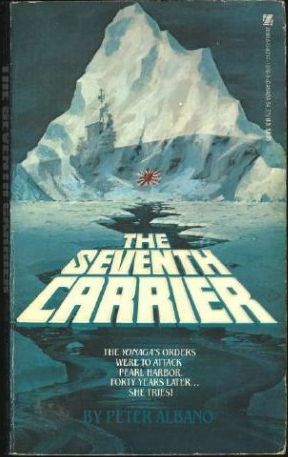
 

Review: The Seventh Carrier

The Seventh Carrier

coverseventhcarrier

Peter Albano’s The Seventh Carrier is one of those novels that rivals even Lunnon-Wood’s Dark Rose for “most ridiculous premise yet”. In it, an American boat, and later a Coast Guard helicopter are attacked by something using World War II Japanese ammunition. There are rumors that it’s some kind of privateer using surplus weapons, but it’s not, as the survivors of the boat, held captive, can attest.

It’s the Yonaga, a fourth Yamato hull, turned into a carrier like Shinano. Kept hidden in a cove, it was frozen for forty years. According to the book it was because of a glacier rockslide, but I know a zombie sorceress froze it with her fimbulvter ice magic. They survived (not in suspended animation) by, among other things, tapping into geothermal steam power. Then they eventually attack Pearl Harbor anyway with their propeller planes and do better than they ought to. This is not the kind of book where thinking about how things in it would plausibly happen is encouraged.

The action is good, even if it’s somehow both a little kooky (guess why) and a little rote (a few too many exact descriptions of what the aircraft did). The characterization is not. To say that the portrayal of the Japanese is stereotypical is like saying that Manute Bol was a little tall, and the other characters aren’t much better.

It’s not the worst book ever, but like Dark Rose with its Libyan-Palestinian invasion of Ireland, The Seventh Carrier is better for the ridiculous novelty of the premise than the actual substance of the execution.

Snippet Reviews: July 1-6, 2019

Ok, it’s time for the next round of snippet reviews.

Trident Force

Trident Force is one of those mushy, mediocre 2000s cheap thrillers, not bad so much as just dull. Not much action happens, and not much else interesting happens (it’s definitely not a Melville-style “slice of military life” book-it’s meant to be a thriller). A one sentence summary is “A lethargic version of SEAL Team Seven”.

I don’t know why I keep reading thrillers from this time period, but I do. Maybe it’s the hope of finding another Tin Soldiers, or maybe it’s a weird fascination with seeing a genre at its lowest.

Merchants Of War

Merchants of War is a decent mindless popcorn mecha action novel. It’s let down by a few weird perspective shifts, but still works if you just want to see mechs explode. You have to suspend disbelief about their effectiveness, but that’s true of almost all fiction.

Belfast Blitz

A middling entry in the Cody’s Army series, for the most part Belfast Blitz offers what one might expect from a second-tier 1980s action-adventure series. The “International Flashpoint” wheel landed on “Northern Ireland” for this adventure. The only standout is an incredibly telegraphed “tragic love story” between the British member of the Army and a local woman.

Review: The Battle Begins

The Battle Begins

battlebegins

So, a part of me, probably the same part of me that went “OK, read a long Jerry Ahern series in order”, said “OK, now read another, slightly less long Jerry Ahern series in order.” So it was time to go to the Defender series, namely the first installment, The Battle Begins.

Instead of John Rourke, ex-supercommando and high-powered gun nut, we have David Holden, ex-supercommando and high-powered gun nut. Cue a large amount of action as he and a group of “Patriots” fight back against a plot that can best be described as “Cyrus from The Warriors actually put his mega-gang war plan into action, and he was sponsored by the Kremlin.”

This has many of the same strengths as The Survivalist. Namely, it’s 80s action in novel form with a sincere attempt at humanizing its protagonists that isn’t seen as often as it should be. When the inevitable Detonics .45 pistol showed up, to me it was like the scene in a Zelda game when Link grabs the Master Sword. And the final battle is in a nuclear power plant with a computerized voice counting down the seconds until meltdown, with said meltdown able to be stopped by pushing one button.

Yet it has some of the Survivalist’s weaknesses as well, and then some. First, it’s a lot more politicized than the Survivalist ever was, and while the portrayal of the Soviets in Total War was decently evenhanded, the portrayal of the antagonists in this book is not. Ahern put a lot of effort into trying to dodge the uncomfortable racial implications by blatantly diversifying his heroes. He put very little in trying to make their opponents even slightly sympathetic. But then again, this is a 1980s action novel, and at least it’s not that much worse.

The phrase “at least it’s not that much worse” can arguably be applied to this book as a whole. Is it better than The Survivalist? No. Would I recommend it over the Survivalist to someone for their first Jerry Ahern book? Is it still a perfectly readable ridiculous over the top 1980s action novel? You bet it is.


Review: The Alpha Deception

The Alpha Deception

alphadeceptioncover

It’s not Jon Land’s fault that his first Blaine McCracken book left big shoes to fill. How does the second, The Alpha Deception, fare? In it, Blaine McCracken has another crazy adventure as he fights a rogue Soviet general with a death ray and an army of cheap thriller flunkies.

The book starts with a scene where a Hind-D helicopter is treated like it’s some kind of Airwolf-style superweapon. It only gets more ridiculous from there, from a fight with a pet panther to McCracken being subjected to a combination Dr. Evil Deathtrap and Greek mythology reenactment to a giant submarine/crab-mecha.

There’s a few stumbles with the plot. First, the ending is, well, a little Indiana Jones-y, and not in a good way. More important is the plot centered around the villain’s takeover of a small town and the resistance of its residents, which is far less interesting than McCracken’s own exploits (until, of course, they intersect). But those stumbles are very small, and The Alpha Deception maintains all the charm of the first book and then some.


Snippet Reviews: June 2019

So this “snippets” feature is here so I can share books I recently read, but which I would struggle to write in a longer review. So here it goes.

Third Law: Let It Burn

Third Law: Let It Burn is the sort of throwaway cheap thriller it’s hard to write about. It’s at the prose level of a lower-grade self-published book and with a lot of really blocky paragraphs. But at the same time it’s not totally bad, and it worked for a day’s read. The only thing really interesting is that it’s one of the first books I’ve read since Ian Slater to have a domestic militia as the antagonist.

Sweetwater Gunslinger 201

William LaBarge’s Sweetwater Gunslinger 201 is basically “Herman Melville, but with aircraft carriers”. This is not an insult. It’s the story of fighter pilots on an aircraft carrier, not facing any technothriller-level threat (but indeed facing the Libyan Air Force over the Gulf of Sidra-it had to have some action). Good for what it is.

Texas Lockdown

Robert Boren’s Texas Lockdown is the first book out of thirteen in the Bug Out: Texas series, which is itself a spinoff of the Bug Out series (13 books) and Bug Out California (15 books). It’s a combination invasion novel, survival novel, and (unsubtle) political novel. It’s adequate, if cliche, and its focus on the characters makes it better than some. But I’m skeptical as to it being a good starter for a series that long.

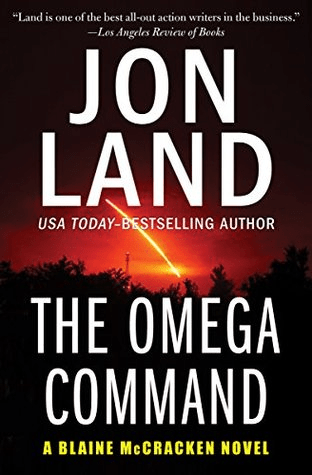
Review: The Omega Command

The Omega Command

blainemccrackencover

Jon Land’s The Omega Command is the first entry in a series of thrillers starring someone with arguably the best thriller protagonist name ever: Blaine McCracken. It starts with a typical cheap thriller plot involving a space shuttle getting blown up, and then goes on a one-way trip to Crazyville, going from New England to Atlanta to secret mercenary islands to supervillain lairs to outer space.

Blaine McCracken is a “Rogue Agent Who Doesn’t Play By The Rules” cliche. The supporting characters are equal mixes of cliches and stereotypes. The plot can basically be described as this conspiracy theory pileup of escalations, swerves, and “twists” without foreshadowing. 80s Computer Technology is involved, and I would feel comfortable in saying that this is a technothriller. However, it is an off-the-wall bonkers goofy ridiculous monster of a technothriller, and I loved it all the more for it.

This was amazing to read. Simply amazing. Not really a “good” book in the true sense of the term, although the action and pacing essential to every cheap thriller were by no means bad. It was a spectacle, and an ridiculous, stupid, bizarre, and somehow totally satisfying spectacle at that.


Review: Contract For Slaughter

Contract For Slaughter

contractforslaughtercover

The first book in the “Eagle Force” series, Contract For Slaughter was released in 1989 by Dan Schmidt, a veteran of the action-adventure genre who wrote literal dozens of Mack Bolan tales. Coming close to the tail end of the 80s action-novel boom, it provides a very, very good example of it.

It’s a team-centric book where a group of colorful mercenaries in the low single digits (in this case four people) form and fight. This is both a first installment (so it has a not insignificant space devoted to the “forming” part) and it’s short (so there’s less room for the final fight). Though to be fair, a lot of the “forming” segments involve fighting too. Lots and lots and lots of fighting. The action is solid for a book of this genre, even if not the absolute best, and Schmidt wasn’t afraid to throw a curveball in terms of the plot and enemies.

What stood out to me, at least a little, was how the weapons were basically 80s Action Novel Bingo. What felt like every single flashy and exotic writers toy showed up in the pages of this book. Ooh, big MM-1 grenade launchers! Ooh, super-advanced G11 rifles! And of course, the classic giant pistols (can’t forget them). Even Jerry Ahern’s beloved Detonics show up as well.

This was one of the cheapest of the cheap thrillers, but I had lots of fun with it nonetheless.


Review: Soldier of Gideon

Soldier of Gideon

soldierofgideoncover

The Casca series takes its path to the Arab-Israeli wars hinted at in the first book. Soldier of Gideon is a “modern” Casca, as opposed to the ancient Cascas. Taking place in the Six Day War, it’s typical of later Cascas-formulaic but good.

The action-packed book is in this kind of particular subgenre of war story that’s more gory and grisly than a John Wayne-style sanitized work, but still far more over the top and spectacular than a truly grounded novel. This isn’t a bad thing, but it’s interesting.

(Sidenote: For whatever reason, historical war fiction isn’t usually my cup of tea. I’ve read good examples, but it just doesn’t grab me the way action-adventure or even technothrillers do. That being said, I have read enough to tell which slot Soldier of Gideon fell into)

The Arab armies seem to use primarily western equipment (to the extent that only Jordan did in the historical war)  with a few IS-3 tanks thrown in as level bosses challenging encounters. Casca and friends go to every theater of the war. In the process, Sadler demonstrated both his greatest strength and greatest weakness as the series dragged on.

The greatest strength is managing to maintain dramatic tension and fluid excitement in a story that features A: A historically decisive blowout victory, and B: An immortal protagonist. This is no easy task, and it’s a sign of Sadler’s proficiency that Casca never devolves into the “unironic One Punch Man” that it could have.

However, the other side of the coin is the almost complete lack of interest in using the immortal protagonist who’s lived for thousands of years, met every important Eurasian historical figure in that time, and is linked personally to Christianity as anything but a placeholder to build period pieces around. While cheap thrillers like these aren’t philosophical works, the wasted potential is still very high.

That said, as cheap thrillers, the Casca books still work, and work well.


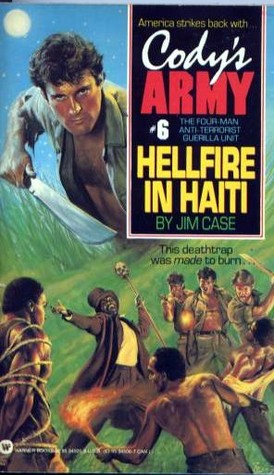
Review: Hellfire in Haiti

Hellfire in Haiti

codysarmy2

If I had to pick a favorite entry in the seven-book Cody’s Army series, Hellfire In Haiti would easily win. Nothing else has the same mix of action, fun, and good villains. I never had as much entertainment out of a Cody’s Army book as I did here.

The entire Cody’s Army series feels to me like the action adventure novel version one of those knockoff fighting games that tried to piggyback on the Street Fighter and Mortal Kombat-not bad , but the incredibly obvious influence is still there, and it could only have existed in the middle of a very big pack. Still, none of the Cody’s Army books are unreadable, and this one in particular is a highlight of the entire genre.

Hellfire in Haiti sort of recycles its main plot from an earlier Cody’s Army book, Philippine Hardpunch. There, a former buddy of Marcos plots to reconquer the Philippines. Here, a former buddy of Duvalier plots to reconquer Haiti. The former book simply didn’t punch as hard as it could (I had to say it). This delivers a Mike Tyson haymaker.

Army member Rufe Murphy is kidnapped and subjected to a voodoo ritual, adding to the over-the-topness of this book. The villains in this book are excellent action-adventure fodder. There’s main villain Clairvius Bourreau  the ex-death squad leader and drug lord who enjoys dressing in showy outfits. And there’s his American ally Wes Taggart, a psychotic former Vietnam unit-mate of protagonist John Cody. That brought a smile to my face as Taggart reminded me of some of the sort of dubious “hard man who breaks the rules” “protagonists” of more recent war-fantasy novel.

And the final battle featuring the Army vs. Bourreau’s stronghold stands as the literary version of Arnold Schwarzenegger’s Commando. It’s easily one of the best climaxes I’ve read in an 80s action-adventure book. Cheap thrillers, especially ones of the time, don’t get much better than this.