A Thousand Words: Ishtar

Ishtar

The film Ishtar, about a pair of dopey musicians that end up involved in a Middle Eastern revolution, is frequently labeled one of the worst films ever. Is it that bad? Not really. Is it bad, period? Kind of. See, it wants to be smart, but it fails spectacularly at being smart. When it lets itself be dumb, it has some good moments.

The highlight of the film is a scene in a bazaar involving a ton of secret agents with terribly stereotyped disguises. It had me laughing massively, and reminded me of the classic Oktoberfest scene in The Pink Panther Strikes Again. But the attempts at actually providing DEEP POLITICAL COMMENTARY? Not so much. Even some of the dumb comedy moments don’t work-there’s a scene later in the movie that involved arms dealers, natives, and the main characters “translating” by speaking gibberish that came across as contrived, unfunny, and honestly a little offensive.

The acting is iffy. Charles Grodin does a great job as a secret agent. The actor playing the emir of Ishtar is undeniably talented and would have worked well in a serious movie, but fails here where a Chaplin/Baren Cohen-style goofball dictator would have fit a lot better. The main characters are annoying and idiotic, but they’re meant to be annoying and idiotic. Does that help? You can decide.

It’s not the best movie of all time or even really “good”, but it doesn’t deserve to be considered one of the worst films ever.
Review: The Voroshilov Lectures

The Voroshilov Lectures

The Voroshilov Academy was/is one the most prominent Soviet/Russian military training centers of all time. In the late 1980s, a peek behind the curtain emerged. An Afghan officer named Ghulam Wardak attended the academy in the mid-1970s and carefully transcribed the courses. Wardak later fought with the mujaheddin and escaped to the United States, where staff from the US Army’s Soviet Army Studies Office eagerly edited and published his notes. Since its publication, the CIA’s FOIA reading room has declassified similar lectures and studies from there that support Wardak’s interpretation of them.

In three volumes (two on strategic and one on operational combat), the lectures go into detail about how to plan and execute a Soviet campaign in 197X. Most importantly, they occurred in a time period that finally allowed for the discussion and making of purely conventional plans. The lectures and planning do not take the naive belief that a Fuldapocalypse would stay conventional from start to finish, but they do view non-nuclear war as important. (Of course, with Soviet conventional superiority at the time, they’d have a vested interest to keep it non-nuclear as long as possible…)

Obviously much of these lectures need to be taken with a pile of salt. There’s obvious politically uh, slanted passages and some of the advance rates seem a little too optimistic. But these are nonetheless an invaluable resource for the wargamer and/or conventional World War III historian. As detailed Soviet primary sources, they excellently fill a previously blind spot in knowledge.

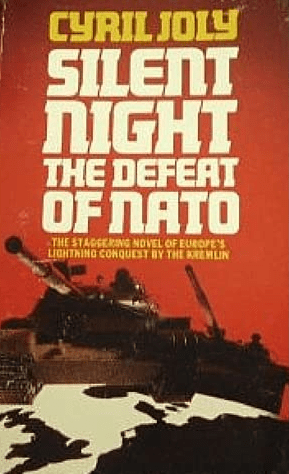
Review: Silent Night

Silent Night: The Defeat of NATO

I thought that the well of classic Fuldapocalypses had run too low. Then I found out about and read Silent Night, a 1980 story about a Soviet invasion of Western Europe. Written by WWII tank veteran Cyril Joly, it, as the title suggests, tells the story of NATO’s loss. There’s a reason why this book is not mentioned alongside Red Army in the list of “bad guys win” novels. Or talked about much at all.

That’s because it’s a terrible book. First the prose is clunky and none of the characters sound natural. Then there’s a ton of conference rooms, hopping viewpoints around everywhere and a tone of forced “solemn darkness”. It honestly reminded me of the online TLs/fanfics I’d read and gotten too angry about-but this was published in 1980. Of course, one thing about it is incredibly different and that is the nature of the war’s conduct.

Basically, 99.9999% of the work is done by infiltrated-in irregular forces, ranging from external operators to local collaborators. They smash bases, kill or capture commanders, and generally break NATO completely. By the time the Soviet conventional forces cross the Inter-German border, they’re facing only a tiny amount of scattered, light resistance. I’d compare it to the Iraqis in 2003 or the final stages of World War II in the west-but that would be an insult to the Fedayeen Saddam and Volkssturm.

After the cakewalk conquest, the later portion of the book involves a clear author rant where he suggests that NATO dramatically reduce its conventional forces in favor of fortifications with “micronuclear” launchers. Then it ends with an OOB dump to add “character.”

There’s a thing called survivorship bias, where you get nostalgia because you remember the good and not the bad. People remember Red Storm Rising, Team Yankee, Red Army, Chieftains, and Hackett for good reasons. They do not remember this, and it’s also for good reason.

Review: Air Battle Central Europe

Air Battle Central Europe

Alfred Price’s Air Battle Central Europe is a magisterial study of aviation plans for a hypothetical conventional World War III. What makes it different from other technical studies? The answer is simple-it looks at the whole and not just the sum of the parts.

In the interviews and discussions, every piece of the NATO air power puzzle is studied, and each role of each aircraft is talked about. The result is a lot of detail, and an important look at how combined arms works in the air. It’s both accessible and comprehensive.

There are a few sour parts. Some aren’t it’s fault, like the book being dated compared to a post-Gulf War understanding. The biggest issue I thought that was its fault was a willingness to talk more about the ideals of what air power would do than a stress-tested analysis that involved a worse case. But the book is still excellent and a must-read for anyone studying a conventional Fuldapocalypse.

Review: Firepower

Firepower: A History of the American Heavy Tank

R. P. Hunnicutt was the dean of American tank history, and in Firepower he turned his attention away from the famous Shermans, Pattons, and Abrams’ to something more obscure-heavy tanks. Due to the issues needed to ship them across the oceans, the American military was never the fondest of heavy tanks (a similar issue with being able to travel on bad roads and be easily shipped across the Eurasian landmass has always constrained the size of Soviet/Russian tanks). Excluding the Pershings considered “heavies” while operating alongside lighter Shermans, the only heavy tanks actually produced were a handful of M103s.

But their doctrine was heavily (no pun intended) spelled out and there were, as this reference book shows, a lot of interesting designs. These range from the produced M103 to the World War II boondoggle that was the M6 to the French-esque autoloaded Cold War heavies that languished in obscurity until the World of Tanks computer game. And of course, there’s the monstrous, monomaniacal T28.

This is a dry reference book that reads like a dry reference book. Yet its subject matter is obscure and fascinating, and I highly recommend it to tank enthusiasts and people who like “what-ifs”.

Review: Third World War: The Untold Story

Third World War: The Untold Story

It’s very hard for lightning to strike twice. And in Third World War: The Untold Story, John Hackett tried. He did not really succeed. The problem was that much of the appeal of the original came from being the first out of the gate, whereas by 1982 the zeitgeist had clearly shifted. (An obscure and amusing example comes from the line “World War III is drawing near” in the XTC song Generals and Majors, released in 1980).

While possibly unfair to list the earliest instance of a genre as not having held up well over time, I do believe that Hackett’s work has aged the worst of all the few “big-name” conventional WW3 books. It’s earliest, and it’s clearly meant as an explicit lobbying document in a way that the (still-slanted) other works of that nature did not. And this applies far more to a modestly repackaged version released four years after the original. Because that’s what it is.

This is the book equivalent of one of those “remastered special edition” movie DVD releases. There’s a reason why those, even if the underlying film is sound, do not generate nearly as much enthusiasm as the first, novel release.

Review: Sins of the Fathers

Sins of the Fathers

My love of books of all kinds has led me to Susan Howatch’s Sins of the Fathers. This tale of intrigue in a Wall Street tycoon family puts the “block” in “blockbuster”, both in terms of the whole book and individual paragraphs. It’s not an easy book to get through. Characters talk and monologue in giant, close to unreadable segments. And nearly every one of the characters is unlikable. I get that you’re not supposed to truly “like” them, but they’re unpleasant in a bad rather than a good way.

It’s just a chore to get through yet another man with more money than morals complaining about the “plastic society”, or yet another pregnancy drama. Howatch doesn’t even succeed in making the stakes seem that high. You could take away nearly all of everyone’s assets and make it about store owners in a small town plaza and it wouldn’t feel any different. There’s never the impression, beyond a few luxuries, that these are people who hold the financial world in their hands.

It’s a shame because I love the concept of a giant family saga, an internal struggle of the titans that mixes the personal with the societal. It’s just this is not it. In fact, this might be one of the worst books I’ve read in some time.

A Thousand Words: Unmasking The Idol

Unmasking The Idol

The film Unmasking the Idol may be the most 1980s action movie ever. And one of the most ridiculous, whatever the decade. The film has ninjas, a trained baboon, “homages” to nearly every popular film of the time, a super-lair, and, as the icing on the cake, a flying pickup truck that looks as “majestic” as it sounds. And an incredibly 80s soundtrack, but you could have probably guessed that already.

Besides being very dumb fun in its own right, this movie has special resonance for this blog. It illustrates how by this point, visual media could provide cheap thrills just as well as, if not better than, any book. Stuff like this was the “Tecmo Bowl” compared to the “electric football” of men’s adventure novels. And the “Madden” was yet to come.

A Thousand Words: Super Mario Land

Super Mario Land

I remember playing Super Mario Land when young and being extremely unimpressed. Of course, this was after I played the (well-done) port of the original Super Mario Bros on the Game Boy Color. So a part of me goes “of course a launch title for a very low-powered console is going to be bad in hindsight”. But another part of me wants to judge it by the standards of the time, when having Mario in a portable form at all was an amazing feat. Certainly the game wasn’t objectively bad enough to be a flop-it was an amazing seller.

And yet with full hindsight, it’s little more than a downscaled Super Mario Bros with weirder backgrounds that feels jerky and unsatisfying. The most obvious example is the physics-fireball, but the rest doesn’t feel as charming as the console games. This isn’t the fault of the weird aesthetic, which I don’t have any issues with. It’s just aged badly.