Review: The Lucifer Directive

The Lucifer Directive
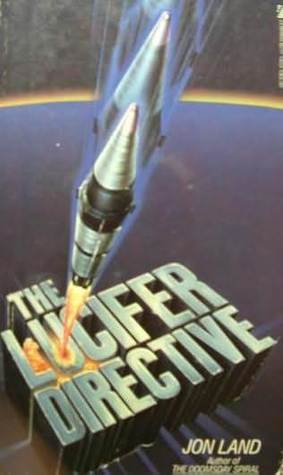
jonlandcover

This early Jon Land thriller, his second published novel, has all the hallmarks now familiar to me after reading literally over a dozen of his books. In The Lucifer Directive, a young college student gets a wrong number call that changes the fate of him and the world. What makes this book relevant to the original goal of Fuldapocalypse is that the evil plot involves triggering a (nuclear) World War III.

It’s very hard to review a lot of books by the same author in the same style – even if it’s a style one enjoys. And this book, while a little clunkier than some of Land’s later books, still does his “escalating craziness” gambit very well.

In fact, think one of Land’s biggest strengths as a writer, besides his sheer over-the-topness, is his skill at that kind of plot “buildup”, for lack of a better word. Granted, it’s it’s not done in the most graceful way. Yet it works, and works very well.
Review: Marching Through Georgia

Marching Through Georgia

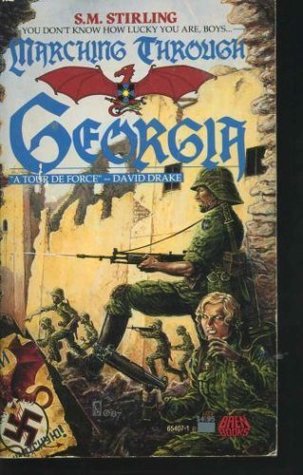
marchingthroughgeorgiacover

For a while, SM Stirling’s Draka series was a lightning rod for controversy in the online alternate history community. So I wanted to see how these tales of a continent-spanning slave empire fared as books, minus the controversy over their “plausibility”. Fittingly, I started with Marching Through Georgia.

As the paratroopers jump into the Caucasus, there are anachronistic assault rifles and Vasilek-style automortars against Kar98ks and MG34s. There are the equivalent of postwar MBTs with gun stabilizers. Now it’s not quite the most exaggerated “Vietnam technology against a WWII army” some people have claimed and the Drakan characters are certainly challenged, but it’s unmistakably clear that the Drakans are better than the Germans they’re fighting, that they have better equipment and are better fighters. The deck is clearly stacked and the “These are author’s pets” alarms are clearly ringing. So I could see why the backlash came.

In literary terms, the prose is functional even with a lot of clunky exposition to establish how the timeline diverged (a problem hardly unique to it). There are worse stories out there. The biggest problem is that the Draka themselves aren’t just unsympathetic, they’re uninteresting.

Although to be fair, this never really rises above the level of “slam-bang action war story with even more sleazy titillation thrown in”. In fact, it got to the point where I felt that all the effort expended in (not unreasonably) critiquing its plausibility seemed like punching down.

Take a decent-at-best war romp story with an inherently pulpy nation, add in a bunch of BISEXUAL AMAZONS, and for good measure, toss in some of the  understandable “commercial alternate history” tropes like “there’s still people and events the readers will recognize despite the point of divergence being centuries ago”. Now think-would something like that really stand up to massive, gigantic scrutiny over its plausibility? Would you even expect it to?

A Thousand Words: Iron Eagle

Iron Eagle

Time for a nostalgia piece from my past. I watched Iron Eagle a lot on DVD when I was younger. It is an amazingly stupid and stupidly amazing action aviation movie that is incredibly 1980s.

So, a fighter pilot is shot down over “Libya” and his son, with the aid of a fellow pilot, “acquires” a pair of F-16s to rescue him, causing a massive number of explosions in the process. Because the actual US Air Force was not exactly keen on sponsoring a movie where kids can steal F-16s, the filming was in Israel, with Kfirs playing the role of “MiG-23s.”

The movie’s gotten a lot of understandable comparisons to Top Gun which I think are off-base, and not just because Iron Eagle was actually released before it. Top Gun is a very “Tom Clancy” movie, an idealized story that still has a fig leaf of grounding. Iron Eagle is a very “Mack Maloney” movie, something that just goes “Prepare film for ludicrous speed” and never looks back.

So yeah, there’s a lot of explosions, an F-16 that never runs out of ammunition, an F-16 that lands on a convenient runway in the film’s climax, a water treatment plant that stands in for an oil refinery, the politics you’d expect from an 80s action film, buildings exploding after getting hit with individual Vulcan rounds, a convenient in-universe excuse to play the (excellent) soundtrack at every opportunity, and so much more.

There’s a reason why I watched it so much, and it’s not because the acting was Oscar-worthy. This movie is classic ridiculous 80s fun.

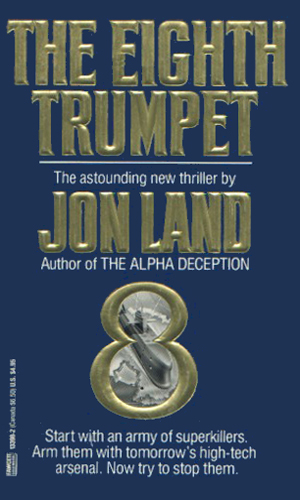
Review: The Eighth Trumpet

The Eighth Trumpet

Kimberlain_Jared1

Fresh off the first Blaine McCrackens, Jon Land introduced fellow super-agent Jared Kimberlain for a similar absolutely bonkers thriller. The Eighth Trumpet not only has offbeat fight scenes, it also has a plot centered around an, uh-Jerry Ahern-ian grasp of geography. By this point the formula has solidified, especially with the Hulking Strong Sidekick Protagonist who fights the dedicated Hulking Strong Antagonist hand to hand during the climax.

That being said, it manages to out-McCracken even some of Land’s other books with how ridiculous-and fun- some of the set pieces are. It’s not that much different “plot”-wise from many of Land’s other books (at least to someone like me who has actually read a ton of them), but it definitely has a huge spark of “WOAH!” in it, making it very worthwhile.

Review: The Doomsday Spiral

The Doomsday Spiral

Some content creators have first works that are rough around the edges. Some start off strong and get weaker. Some, like Billy Joel in the psychedic-progressive-just-a-keyboardist-and-a-drummer Atilla, are vastly different from their subsequent and most famous pieces. So I decided to read Jon Land’s first novel, The Doomsday Spiral, and see where it fell.

The book roars out of the gate as Israeli super-vigilante “Alabaster” must stop a plot by the Palestinian “Red Prince” to neutralize the Americans so that they can deal with the Israelis later (the Red Prince must have gotten his lessons in target priorities from the Red Storm Rising Politburo). This could have been a middle-of-the-road “shoot the terrorist” novel. It wasn’t.

By Jon Land standards, fighting a giant man with a chainsaw (as happens in this book) is pretty tame. By normal thriller standards, especially the kind of thrillers I call “supermarket novels”, it’s delightfully out there.

I saw pretty much every plot device used in subsequent Land novels. The superpowered main character. The over-the-top ridiculousness of it all. The conspiracy-in-a-conspiracy. The inevitable action scene against a particularly tough level boss antagonist. An overall feeling of swinging back and forth between “awesomely stupid” and “stupidly awesome.” I’d say it’s formulaic, but when part of the formula is “ridiculous stuff happens”, it doesn’t feel so bad as long as Land can deliver. And here he does.

Review: A Talent For Revenge

A Talent For Revenge

specialistcover

I think I may have found it. The apex. The apogee. The peak. The high point, the distillation of everything that “men’s adventure” fiction contained, all packed into A Talent For Revenge, the premier book in the “Specialist” series by “John Cutter” (a pen name of John Shirley).

The book stars supermerc Jack Sullivan as he’s hired by an heiress to kill an exiled African dictator. (Yes, the plot can be summed up in one sentence. This is men’s adventure). The men’s adventure-ness of this can be summed up by how the book blends more or less every single trend that these throwaway pulps put together.

  • 70s men’s adventure was notorious for sexual sleaze. Guess what this book has lots of?
  • 80s men’s adventure was notorious for ridiculously long descriptions of weapons. Guess what this book has lots of?
  • 70s men’s adventure frequently let its heroes get banged up. This happens to Sullivan, but….
  • 80s men’s adventure frequently turned its heroes into unstoppable fleshy Terminators. Sullivan also definitely qualifies as one.
  • Then there’s the constants, like a ridiculous amount of gore and a total lack of tastefulness.

By the late 80s, the genre had (with the obvious exceptions) begun to harden around the “80s, no sex, lots and lots of gun descriptions” style. The 90s commercially devastated it to such a degree that technothrillers looked untouched in comparison. When I came of age, “men’s adventure” in its purest form was down to cheap-looking Gold Eagles with awkward covers.

So I have a strange appreciation for this spectacle. If I had to show someone one book that would sum up “men’s adventure”, it would be this one.

Review: Kidnapped

Kidnapped!

Kidnappedcover

The Twilight 2000 tabletop RPG is a classic of the Fuldapocalyptic World War III genre. So it’s a little disheartening to debut it on this blog with what could easily have been the nadir of the franchise. But the “Kidnapped!” module is still a very interesting example of just a bunch of things all going on a bunch of different paths until it all just breaks.

The big “problem” is that T2K’s later modules were a victim of the very success of its initial premise. The initial European setting was a good way to square the circle of “we want you to be in the military, but we don’t want you to just have to follow orders and sit around until an artillery barrage kills you.” It was also a good balance between “We want to give you limited resources unlike a contemporary setting, but we also want to give you more toys than a full post-apocalyptic setting.”

Yes, this led to issues between the two tones of a “grim struggle for survival” and “like a classic tabletop RPG, only with tanks instead of dragons”. But I have to give GDW credit for making something distinct and adaptable. Then the question is “how do you follow up on that?”

Enter the North American modules, which became increasingly theatrical and bizarre. The “Airlords of the Ozarks” module made me use the term “Arkansas vs. The Blimps” to describe any long series that veers into craziness. It got to the point where it wouldn’t have been too surprising to see the heroes venture into an Upstate New York bunker to retrieve Adolph Hitler’s frozen corpse (as happened in the later Survivalist novels).  But Kidnapped takes the cake both for pure dissonance and poor design.

  • It starts with a description of the super-drought about to strike North America. Too bad the actual main focus isn’t about this Frostpunk-style societal triage. No, it’s about a Hitman/Splinter Cell-style “go and get a high value target”. The target is Carl Hughes, leader of the authoritarian New America, in his Shenandoah supervillain lair.
  • Hughes, the target of the adventure, does not get official stats or an official portrait. But there is a page devoted to a gang of Native American marauders (oh, you 80s action RPGs) and several pages devoted to an abandoned New American facility that does nothing but give a “clue” and a “We’re sorry, Hughes is in another castle” experience.
  • Is Twilight 2000 supposed to be semi-grounded? Good. Now plausibly take on a fortified lair with over a hundred guards and a target who needs to be captured alive (so you can’t just snipe him).
  • Naturally, to fit this mammoth Cadillac V8 into a Smart Fortwo and make the module even slightly viable, there are gimmicks like convenient gaps in the security camera coverage, guards who’ve lived and worked together for years being able to fall for players in simple disguises, and Hughes never going any more than one level deep in the four-level underground complex even when threatened.
  • There are lots of descriptions of places that are either irrelevant or “beef-gated” (too well guarded to realistically challenge), and the “listing of important characters” not only doesn’t have Hughes, but also doesn’t have anyone else actually living in Hughes’ lair. But it does have lots of throwaway bandits-of-the-week!

So Kidnapped! is something I’d recommend only for Twilight 2000 completionists or people fascinated by “How NOT to make an RPG module.” It’s at the point where, if people were running a T2K game in North America and the GM wanted them to take on Hughes, I’d recommend just writing a scenario from scratch instead of consulting this.

For a second opinion on Kidnapped, you can check the the Twilight 2000 Wargaming Blog. That opinion is also not complimentary.

Review: The Samurai

The Samurai

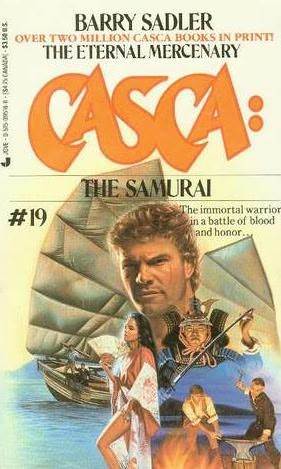
cascacover

With the nineteenth entry in the series, The Samurai, Casca swings and misses dramatically like a called-up minor leaguer facing Nolan Ryan. Of all the Casca books I’ve read, this is the worst of them (so far). I’ve heard conflicting answers as to who was actually writing the later Casca books before Sadler’s death, but whoever was did not succeed here.

Knowing the history of the series, I was expecting a clumsy, stereotypical depiction of ancient Japan. And I got it. But it also has very blocky, clunky prose and flat fight scenes that take away the biggest strength of the Casca series-the ability to have effective action despite its protagonist being, you know, immortal.

Not that it really matters much, because here Casca himself might as well just be a second-rate hired gun in a dull story about dull rivals fighting for power in dull battles. Having all the weaknesses of the Casca books but none of the strengths, The Samurai is something I wouldn’t recommend even to fans of the series.

Review: Out Of The Ashes

Out Of The Ashes

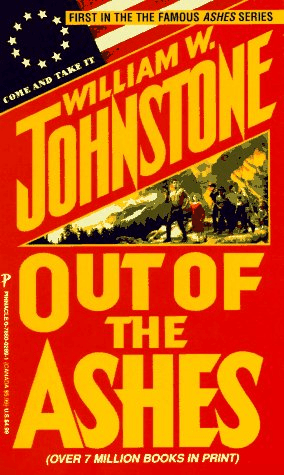
outoftheashes

William W. Johnstone’s The Ashes series (not to be confused with the cricket series) is one of the worst long-running series ever. I might even be bold and say that it’s the single worst chronological series made by a mainstream commercial publisher that I’ve read. Even if it isn’t, it’s certainly up there. They, along with the The Big One novels, were some of my first exposure to “bad books” as I knew them.

In a fashion strangely typical of me, I read the later Ashes first, finding them via the ancient 2000s method of buying them in a bookstore. Somehow these monstrosities were successful enough to reissue after their initial publication date. So a curious thought came to me. Was there a chance, in spite of what I’d heard and read in other reviews, that the early Ashes might have been good, or at least not terribly bad? Could they have started as second-rate but readable Survivalist knockoffs and then devolved into the rambling political screeds and one-sided, toothless battles I knew them as? Did they have merit?

Well, now I’ve finished Out Of The Ashes, and I can confidently give an answer to that question. N-O-P-E.

  • The book starts with an introduction to paperback pulp author (hmm….) and former supermerc Ben Raines nobly turning down a chance to participate in a coup attempt against the EVIL LIBERAL GUN GRABBERS.
  • Then the General Jack Ripper-style conspirators, in an overlong “first act”, trigger the apocalyptic nuclear war everyone who saw the covers of the book knew would happen. It’s like if someone watched Dr. Strangelove and read the opening of a Larry Bond novel at the same time while glugging down bottle after bottle of whiskey, and then wrote something down while drunk.
  • Then Raines wakes up and experiences arguably the lamest and tamest Easy Mode Apocalypse ever, where he has no problem finding supplies (including weapons in a convenient arsenal) and bedding one beautiful woman after another while he battles and effortlessly kills all sorts of stereotypes. After this, any attempt to truly be considered post-apocalyptic stops. For what seems like the rest of the series.
  • Then the political tirades start getting even worse, with Raines starting his authoritarian Huey Long-on-steroids paradise utopia where unemployment is 0% and everyone is educated “properly”, and no one can be truly rich. But it’s not communism or socialism because of guns. Yes, he uses that exact argument in the book.
  • Then the strawman journalists, in a scene that seemed, and probably was longer than any of the actual battles, are taken to the Tri-State Glorious Peoples Democratic Republic Utopia for another exposition.
  • Then the federal EVIL LIBERAL GUN GRABBERS, in a scene that dials up the gore and squickiness (but not in a good way), slaughter the “paradise” and force Raines to return to guerilla warfare, setting up the rest of the series (don’t worry, he’ll be back commanding unrealistically huge armies and ruling Utopia 2.0 soon enough).
  • Finally, some of the Tri-States survivors and allies kill the EVIL LIBERAL GUN GRABBERS. The end, but not of the series, with its 34 (!) more installments.

Whew.

So what are the issues that plague this book and its XXXIV sequels? If I had to choose only three (and there are a lot more than those), I’d say these.

  1. Johnstone cannot write action well, and he cannot pace well, the two things cheap thriller writers need to be able to do. Pretty much every single fight amounts simply to “and then Raines shot them”, they almost never last more than a few paragraphs, and the tone of the book is such that removes the “well, they’re realistically short” justification. There are a very small number of exceptions, but it’s not worth digging through 34 books of slop when even a mediocre cheap thriller leaves Johnstone in its dust.
  2. The story frequently goes from “product of its time” to “ugly and creepy” in terms of offensiveness. The prose doesn’t help one bit, with it sounding clunky, creepy and oddly juvenile.
  3. Johnstone is not consistent or coherent in the slightest with his political tirades. Not only that, but they make the main character look pathetic, like a grumbler instead of Jerry Ahern’s stoic badass John Rourke.

This book, and this series, is one of the worst of all time.


Review: The Gamma Option

The Gamma Option

The third Blaine McCracken book, The Gamma Option continues the crazy twists and turns, the crazier plot swerves, nonsensical politics, and surprisingly solid fundamentals that marked the previous two installments. It does yo-yo a little more into “amazingly stupid” (to give any detail on these moments and twists would be to spoil them, but rest assured-they are very, very, dumb)  but still has a lot of “stupidly amazing” moments. My favorite of these is Chekov’s Monster Truck.

See, Blaine McCracken notices a monster truck parked nearby when he goes to interview someone. I knew when I read the passage that the monster truck was not Jon Land’s attempt at some kind of weird literary metaphor, nor was it just a bit of background description. I knew that McCracken was going to end up driving it in a chase scene. And drive it he did.

This is everything I expected from a Blaine McCracken book, and it has all of the ridiculous appeal that makes reading them such a treat.