Review: The Nash Criterion

The Nash Criterion

After three stumbles, Erec Stebbins suddenly struck the right note with The Nash Criterion.

After one bad and two middling thrillers, Stebbins suddenly turns into Jon Land-if not Hideo Kojima- with this ridiculously overstuffed tale of a second American Civil War and ancient world-controlling super conspiracies. This book just was so over-the-top that I grinned at every single later page.

A lot of times it’s hard to review additional books in a series. This is not one of them, as it offers a distinct change. Many more times, if there’s a distinct change worth pointing out, it’s a negative one as the series drops in quality. Here, the opposite is thankfully true. The INTEL 1 series has gained in quality with this book, and I was very glad to see it.

Review: Ward

Ward

The sequel to Spacebattles darling Worm, Ward arrived to much fanfare, to the point where the end of its author’s last web serial was overshadowed by antsy fans waiting for it to start. Now Ward itself has just finished.

When I started reading it, I saw that Wildbow’s literary issues didn’t change. The prose was too flat. The action likewise was too flat. The pacing had only two speeds: “Way too fast” and “Way too slow”. The descriptions are either overdetailed or underdetailed. I’d tried to follow all of his serials after Worm itself when they were written, and ended up just abandoning them.

Reading more of Ward, it has Worm’s problems, if not more. The structural issues mentioned above. The tendency to write into a corner and then ESCALATE out of it. The way the cosmology becomes ridiculous (you don’t include precognition as a power without good reason, much less two super-precogs, and that’s just one problem).

But really, Ward is a tragedy. I don’t mean inside the story itself, although it has plenty of dark moments. I mean that it’s dragged down by two big factors. The first is the legend of Worm bringing up unrealistic expectations (something Wildbow himself mentioned in his retrospective). The second is that its predecessor had just the right amount of factors to make it popular. Lightning was never going to strike twice.

One strange effect was that an improvement in the characterization actually doomed the serial. Worm’s fandom success hinged on Taylor, its protagonist, and her lack of what would normally be considered substance. Someone who was about 30% power fantasy of fighting back against the people who were just UNFAIR TO HER and 70% blank slate camera RPG protagonist created some strange incentives.

If you saw Worm as something that was more of a superhero RPG let’s play than anything else (which it comes across as), then the fanfiction boom made sense. Taylor’s bug power was just one “build” among others, and if the sole part of her character that filtered down was that wish fulfillment, then it’s easy to see why (combined with bandwagon inertia) why it got all the fanfiction it did on one small part of the internet.

So Victoria Dallon may have been an improved character, but the mystique was lost. Ward ended up as feeling to me like the kind of webfiction that, if you’re into it from the start (I wasn’t) you’d follow until it finished and then leave it behind.



Review: Manuscript For Murder

Manuscript For Murder

Jon Land took over writing the Murder She Wrote books, and Manuscript For Murder is the result. Inside a very thin shell of a cozy mystery, Land releases one of his thrillers, complete with the super-conspiracy of the week.

Jessica Fletcher starts by investigating murders (how shocking) and ends up following a enigmatic political thriller manuscript that turns into a murder-soaked conspiracy reaching to the highest levels of power. In other words, it’s par for the course for his books.

One strange factor is the context vs. the actual details. The former would make it weirder-after all, this is supposed to be a cozy mystery, yet it involves multiple gunfights and deathtraps. This is an older woman author, not Blaine McCracken. The latter, in comparison to Land’s other books, seems less weird, since this is still Jon Land we’re talking about.

That being said, the nameplate ultimately doesn’t matter much. This is a weird, bizarre quirky, and quick Jon Land book. I can understand why actual cozy mystery fans would be disappointed, but come on, this is the guy who had monster truck chases in his “proper” books. I can also understand why this is tamer than his “normal” books. Still, normally a book like this would sink into the mix. Shifting genres gives it a chance to stand out.


Review: Daughters of the Night Sky

Daughters of the Night Sky

nightskycover

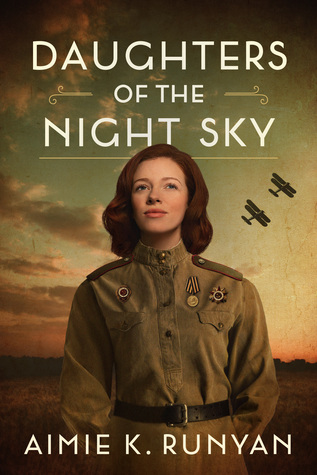
With Aimie Runyan’s Daughters of the Night Sky, Fuldapocalypse moves into yet another new genre-the Romance Centered Around Night Witches. It’s a little tricky to review, but I’ll try. The first “issue” is that this is obviously chick-lit, which is not something normally associated with the Eastern Front, for good reason. That the heroine falls in love with an artist is kind of the icing on the cake.

The second issue is that it feels like chick-lit and not like characters who are actually in the middle of a horrendous world war. What this came across as was “romance characters, plus add a few obligatory flying scenes and the occasional stereotype like a reference to blocking detachments.” While the author admits she wasn’t that knowledgeable about Russia or military aviation, it just feels too generic.

And that brings me to the third issue, which is that the actual flying isn’t very good. While I wasn’t expecting Dale Brown and while it’s actually admirable to not try and dwell on something you admit you don’t have much knowledge of, this still falls short. The problem is there’s too much of it and not enough research.

It would be like if a writer was making a story about American football (hey, I’m posting this review on NFL Draft day) and only knew the basic positions, such as quarterback and receiver. This would be obvious to those who read it and knew even a bit about the subject matter, but the writer still insisted on showing several games. This is like that, only with Polikarpovs instead.

As a whole, this is just a fluffy romance novel with World War II flying scenes and the characters having Russian names.


Snippet Reviews: April 2020

So, it’s time for a few more snippet reviews.

Bloodline

After reading only a few Sidney Sheldon books, I found that Bloodline matches his formula very closely. This is not a bad thing. While it doesn’t exceed the excess of Master of the Game, it comes fairly close, and his story of elite “intrigue” is everything you’d expect.

False Flag

A disappointing second entry in the Jason Trapp series, False Flag keeps the semi-serious tone while turning the plot up to full Roger Moore Bond ridiculousness. It doesn’t work well compared to its predecessor.

Extraordinary Retribution

Erec Stebbins’ second INTEL 1 novel, Extraordinary Retribution, is kind of an in-name-only endeavor. Not only are the politics even more blatant and hamfisted, but the main characters of The Ragnarok Conspiracy only appear at the end as a final deus ex machina. Otherwise, it’s a completely separate story. And not the best-written one.

Review: The Hard Kill

The Hard Kill

hardkillcover

Reading The Hard Kill got off to a good start when I saw it was by “the Manning brothers.” Though a coincidence, I was reminded of the quarterbacks. This sports joke got me in the perfect lighthearted mood for a book that defines the term “Cheap Thriller”.

It stars a John Stone out to save his goddaughter and keep the Macguffin out of the wrong hands. Now, I’ve already read cheap thrillers starring a Mark Stone and a Luke Stone, so I guess someone else with that last name was inevitable. The time this book really clicked for me was when John pursued a villain named Karl (which also brings up a sports reference to my mind, one of the the greatest basketball duos ever) in a vehicle chase involving an Audi R8 and a bunch of conveniently placed big vehicles the R8 hits.

Then after that there’s a finale where the main character brings a rifle, a pistol, and a submachine gun to the fight. What I’m trying to say is that this is an incredibly over-the-top thriller despite its pedestrian plot. It’s also incredibly fun. In fact, it’s the most fun I’ve had reading an action hero thriller in some time, and I highly recommend this book to anyone who likes “cheap action”.

Review: Covert Action

Covert Action

Chet Cunningham’s Covert Action was one of his last books released, out on a small independent press. While I didn’t think too much of it upon my initial readthrough, now I think it clarifies something that’s been bothering me.

Having read some of Cunningham’s SEAL Team Seven novels, the book itself is basically one of those. The names are obviously changed, but the plot structure of hyperactive zipping around the world and constant action remains unmistakable to someone who’s read the “Keith Douglass” books helmed by him. The problem is that thanks to even iffier fundamentals and considerably worse proofreading, it goes from “ok” to “bad.” The book itself I’d just leave and not really recommend.

But what was the “a-ha” moment for me was how this affected reviewing. This is an example of how some cheap thrillers can feel interchangeable-because in some cases they are. There’s this. There’s the same author doing most of the work on both the MIA Hunter and Cody’s Army series. And finally, in one of the most extreme examples, the “Sharpshooter” and “Marksman” series of ‘shoot the mobster’ novels in the 1970s shared so much and were so rushed that manuscripts from the latter were used for the former, to the point where the main character’s name didn’t stay consistent.

There’s going to be a lot of overlap in a genre that’s formulaic by nature. And not all, or even most of the books I read reach this extreme. But there’s an undeniably sour feeling I’ve been getting as I reach for the keyboard.

The kind of “51% book” that Marine Force One still stands as the best example of can still be perfectly fun to read. But I’m finding, much like I’ve found with books in the same series, that repeated examples of those are getting harder and harder to actually review.

Review: Deep State

Deep State

slatercover

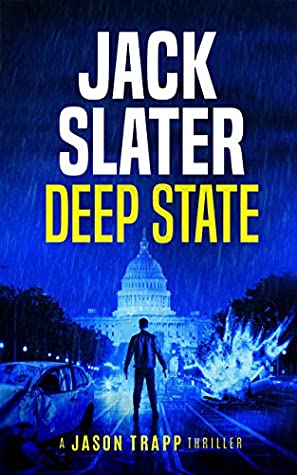
Jack Slater’s debut, Deep State , is a very zig-zaggy book. It features super-operative Jason Trapp (another action hero name for you) as he foils the same kind of “attempted American coup” plot that has been going on in cheap thrillers since Seven Days in May. Despite its title, it’s not really that political, which was a pleasant surprise.

This book has one of my cheap thriller pet peeves front and center-when the writer repeatedly goes “this isn’t like the movies” but then has the characters do ridiculous stuff anyway. This is why the book goes up and down so much. It wants to go “THIS IS SERIOUS AND NOT MOVIE-LIKE” but then has Trapp doing incredible things. It also has a few extraneous characters, a villain contrivance so powerful it needs a heroic contrivance to compensate, and manages to hit a few too many genre notes (although that could just be me having read waaaaaaaay too many of these kinds of books).

In spite of all this, the fundamentals are good enough (barring the “this isn’t like the movies, he just does incredible things in an un-cinematic way” dissonance) and it flows well enough to make all of that forgivable. This is still worth a read.

Review: Black Sea Terror

Black Sea Terror

Eric Meyer and Todd McLeod’s SEAL Strike: Black Sea Terror is a short story. The story of SEALs preventing a shipment of S-400 missiles to Syria, it reminded me of Chet Cunningham’s SEAL Team Seven novels. Or rather, it reminded me of a hypothetical Chet Cunningham SEAL Team Seven novel that was shrunk to a fifth of its size to fit in a magazine.

The S-400 system itself is treated as a multirole missile that’s somehow incredibly dangerous on its own (and no, it doesn’t have any kind of different warhead) instead of just being a high-end SAM. The action is just passably good enough, in a “small bag of potato chips” way.

In fact, a “small bag of potato chips” accurately describes the entire book. It’s tiny, insubstantial, and not truly “good” by any measure, but it’s still quite “edible”.

Review: The Gambit

The Gambit

Take a stilted first novel, add a difficult genre, and you have Brad Carlson’s The Gambit. This tale of Iranian plots and the Americans out to stop them reminds me of, if anything else, an even rougher version of Gavin Parmar’s Unseen Warriors. The problem is that technothrillers are harder to do right than small unit thrillers. I don’t want to be hard on the author. This is a first novel, I know firsthand how much effort writing any kind of long fiction is, and everyone has to start somewhere. But I have to be hard on the book.

There’s the clumsy prose, but there’s also the awkward pacing. There’s the action that falls well below even the standards of Marine Force One, but there’s also a ton of conference rooms and really rote instances of military equipment doing its thing (I hesistate to use the term “action” for the scenes describing it). There isn’t even an out-there premise. It’s just “shoot the terrorist” and stopping the most basic and mundane plots, all the while moving through something horrendously unpolished.

There are good independent first novels. This is not one of them.