Review: Retribution

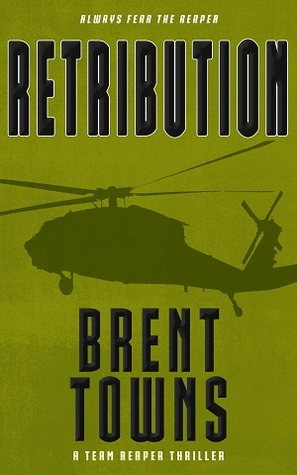
Retribution: A Team Reaper Thriller

teamreaper

Brent Towns’ Retribution is the inaugural book in the Team Reaper series, intended as a modern continuation of classic action-adventure novels. Here, the titular team forms and battles a Mexican drug cartel, along with its crooked political allies.

This is not high literature by any means and takes its time getting going. I felt the early pacing was slightly sluggish, though not nearly enough to really hurt the book overall…

…especially since the main pacing, once the action really starts, is excellent. As is the action itself. This is an unashamed homage to classic action adventure fiction and works very well at recreating the feel of the genre. The action is good, and that’s what matters in a book like this.

Retribution is a book that I recommend for anyone who likes classic action novels.

Review: The Red Collusion

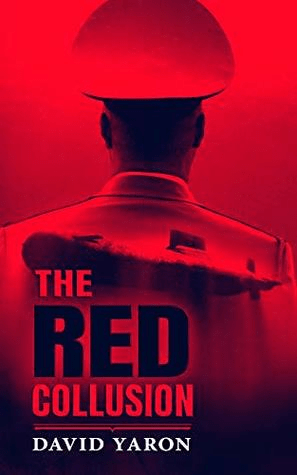
The Red Collusion

redcollusioncover

David Yaron’s The Red Collusion is a tale of rogue Soviets in 1981 attempting to start World War III, leading to a climax where they attempt to attack an American ballistic missile submarine.

This book is mostly pedestrian but has managed to surprise me in one regard-the sheer number of conference room scenes. The ratio of “people talking” scenes to “people actually doing something” scenes is very, very, high.

It’s realistic to have people talking and arguing about a big plan before they (attempt to) carry it out, but it’s also realistic to have cars stopped at red lights. Imagine a travel book where the author described every single red light, stop sign, and gas station the car stopped at, as well as every single argument the occupants of the car had about where to stop for gas or food. And then in the final action, there’s a time limit-so they urgently, reluctantly, and desperately stop at those traffic lights.

This is the technothriller version of that. Much of the book, apart from a few decently-written if generic spy fiction scenes, consists of the conspirators talking. It amounts to chapter after chapter of…

“Let’s do this.”

(cue long explanation of and preparations for what they want to do.)

“Actually, it would be better if we did this.”

(cue long explanation/plot thread)

“No, we should really do this.

(you get the idea).

Once they finally get going, the rushed “action” isn’t the worst, but isn’t exactly good either. This leaves the book as a strangely amusing novelty. The Red Collusion is saved from  simple mediocrity by taking a genre trope to ridiculous excess. I’ll leave it up to the readers to decide if it’s a good or bad thing.


Review: Burmese Crossfire

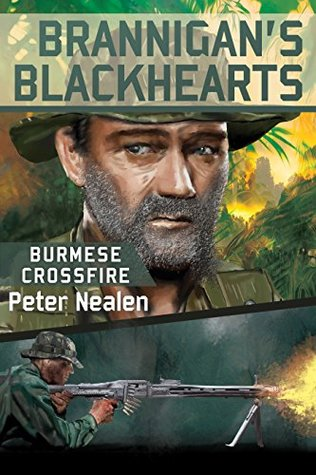
Burmese Crossfire

burmesecrossfire cover

One of the reasons why I sound more critical towards Peter Nealen than I actually am is because this particular book set the bar very high. From the moment I read it, I fell in love. The Brannigan’s Blackhearts series was meant to be a love letter to the classic action-adventure novels of the 1980s, and Burmese Crossfire delivers.

Colonel Brannigan, leader of a small mercenary band, gets a mission to go to the titular Southeast Asian country. Cue a “rumble in the jungle” (with apologies to Ali and Foreman) against many Burmese and North Koreans. This isn’t that much more than a classic simple action-adventure novel. But it takes that formula and with beautifully written, well-done action, hits a home run.

It’s in a well-researched, obscure part of the world that’s an ideal place for a book of its genre. One of my favorite small-unit action-adventure books of all time, this is well worth a read.


Review: The Blue Effect

The Blue Effect

The final entry in Harvey Black’s Effect series is The Blue Effect. This book manages to be slightly better than its predecessors in some ways and a lot worse in another. There’s a sorta-kinda-semi-plot where the British face the Soviets in what could be the make-or-break battle near Hanover. But once again, it never really clicks into a whole that it could have been. If The Red Effect was just listing the ingredients before hurriedly pouring them into a bowl and The Black Effect was having them sit in the mixing bowl doing nothing, this at least turns them into batter-but not a finished dish.

The highlight of this book, besides more tanks exploding, is a very long scene in which a Vulcan bomber soars into action. A part of me was going “oh come on, this relic would probably be shot down, malfunction or just miss”, but another part of me, the part that likes unconventional units, was going “WOW NICE”. I mean, I’d love to read (or even write) a book of unconventional relic units flying into battle. This is not that book.

What really sours the The Blue Effect is not any of the action in the main book, but rather its anticlimax of an ending. Here was where going the Chieftains/Dr. Strangelove route and just nuking everything might very well have been better. Instead, it’s a have your cake and eat it too deal where after a few plotnukes and a few losses, the Warsaw Pact just gives up very abruptly. It’s a circumstance where either another full length tide-turning installment (with proper plotting) or trimming the entire three-book series into one could have been better. And there’s a lot of fat to trim.

Furthermore, all of the hindsight-driven greater “micro”- accuracy of the series (See the now-known durability of tanks with Kontakt-series reactive armor! See the proper tank mix in GSFG instead of just having everything be a T-72!) is squandered by this “macro”-level flop in the conclusion. Whatever issues there are with a clean NATO win in 1984, there are a lot more with it happening in this fashion. If the goal is realism, it’s implausible. If the goal is storytelling, it’s a contrivance and makes the victory seem unearned.

The result is something that could have risen higher than it did, both in this specific book and the overall series.

Review: Sacred Mountain

Sacred Mountain

blackeagleforcecover

The second book in the Black Eagle Force series, Sacred Mountain, takes a look at the over-the-top goofiness of the first and goes “all right, time to unleash the cheap thriller equivalent of the dubstep gun.”

The president is kidnapped by ninjas. Are the people of Black Eagle Force bad enough dudes to rescue her? That is the plot of the book, but the execution is something. See, the Mexican billionaire from the first book returns in his volcano-lair. And so does Osama bin Laden (see, it was his brother acting as a stand-in who died in Abbotabad). And so do a huge number of Russian mercenaries with their accompanying hardware. It’s like the opening scene of The Naked Gun, only stretched into a ridiculous, and ridiculously fun spectacle.

The book is still a little too long and clunky, it has a few typos including one of the character’s names being slightly inconsistent, and at times it got a little bit too tasteless. But it manages to be ridiculously goofy while taking the action just seriously enough, and I enjoyed it a lot for being “more Mack Maloney than Mack Maloney”.  It’s hard to go wrong where one of the protagonists is a dog in a suit of armor.

Review: The Black Effect

The Black Effect

blackeffectcover

Harvey Black’s The Black Effect is the kind of book I thought I’d be reviewing en masse on this blog, at least in terms of basic plot. Namely, in 198_ World War III breaks out. Cue a lot of tanks exploding. This is the second book in Black’s _____ Effect series, and the first I reviewed at Sea Lion Press before this blog even started.

The Black Effect is what I feared Team Yankee would be before being pleasantly surprised.  It’s a mostly-conventional 198X WW3 book that happens to be a picture-perfect case for why a bowl of ingredients does not equal a meal.

Some of the individual ingredients (battle scenes) in the novel are good, if repetitive. Others are weighed down by things like Black constantly listing the full designations of every piece of equipment in overwhelming detail (fog of war? target fixation? Limited viewpoints? What are those?). But as a whole the book just amounts to a disorganized parade of various pieces of military equipment and graphene-thin Steel Panthers Characters differing only in what they’re crewing and how much ‘camera time’ that they get before being blown up.

There is an almost total lack of anything cohesive or coherent beyond “WW3 stuff happens”. It gets to the point where the intelligence photographers who were the high point of the previous installment turn into just another pace-breaking liability. This at least doesn’t have The Red Effect’s using up nearly all of its space on historical events with names badly changed (ie, Stanislav Petrov became “Perov”) before rushing to stuff a bunch of battles into the last thirty pages.

The Black Effect isn’t all bad. It’s more evenhanded than a lot of WWIII stories, it being written as an alternate history with decades of hindsight helps with some (but not all) technical accuracy issues, and it works at providing simple action scenes. It’s just I’ve read better, even in this very specific subgenre.

Review: Eye Of The Storm

Eye Of The Storm

eyeofthestorm

The first book in the “Black Eagle Force” series by Ken Farmer and Buck Steinke, Eye Of The Storm is a delightfully cheesy exercise in Mack Maloney-style military melodrama.

Starting a Super Secret Task Force With Super Tech and Super Planes, the men, women, and high-tech aircraft of Black Eagle Force battle a Mexican billionaire whose last name is an obscenity in Spanish (uh…) and who has a private island with a pyramid-lair and a gigantic arsenal of soldiers and military equipment (ok…).

I was impressed. Oh, it’s not the best ever. Even beyond its cheesiness, cliche-ness, and dubious character names, it’s about a hundred pages too long. But its downsides are thankfully much fewer than its upsides. I just really like Mack Maloney-esque “over the top but not really science fiction” military action, and when the action happens, it happens well.

The nature of the story means any “errors” or “contrivances” are easily forgiven. The BEF gets opponents of an appropriately challenging nature-no small feat. It has just the right amount of threat and “look at ’em go.” This is an excellent “popcorn book” and one I was overjoyed to uncover.

Review: Death Run

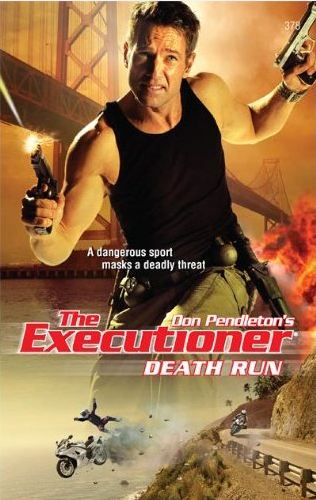
Death Run

deathrrun

It was inevitable that my run of at-least “decent enough” later Mack Bolans would come to an end at some point.

The blurb was promising enough. To stop a nuke, Mack Bolan gets caught up in the world of motorcycle racing. It felt like the kind of zombie sorceress plot I enjoy, and I was wondering “So, how are these going to connect?” It reminded me of one of those missions in Grand Theft Auto games everyone hates where the boss-of-the-week forces you into this linear, nonsensical set-piece with dubious mechanics where a more direct approach is seemingly better. Something like:

“Ok, Claude/Tommy/CJ/Niko/Michael/Franklin/Trevor, the nuke is in a shack with only three guards. Last mission you killed thirty armed people, but you can’t just grab your minigun and storm the shack. No, you first have to win a motorcycle race against computer opponents who do everything but throw blue shells at you. What, that’s unfair? Well, we could have put trains in! Be lucky we didn’t do that!”

The actual book is not nearly as amusing as that hypothetical thought. The motorcycle racing plot is mostly just A: A way to set up the various Macguffins, and B: A way for the author to talk about motorcycles and motocross. Cue some of the most generic, third-rate action possible to defeat some of the most generic “evil terrorists” possible, and conclude with one of the most stereotypical “defuse the bomb” scenes.

It’s kind of a little hard to even criticize because of how shallow and generic it seems. But yeah, in short it’s shallow, generic, and the motorcycle racing plot isn’t taken advantage of in an amusing way.


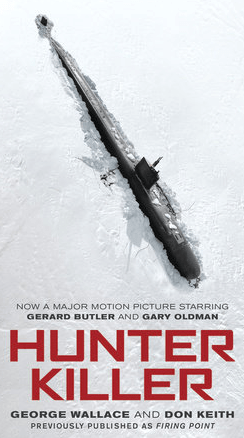
Review: Hunter-Killer

Hunter-Killer

hkcover

Before I start my review of Hunter-Killer (or its original title, Firing Point), the submarine thriller novel about the rogue commander of the Russian Northern Fleet and the American submarine out to stop him, I must mention that I have not seen the movie adaptation. What I’ve heard about said adaptation from other people ranges from “bad, but in an amusing way” to “bad, and not in an amusing way.” But I wouldn’t know any better.

So, for the book itself, what I got was something that was neither bad (amusing or not) nor really all that good. It was a sort of middle-of-the-road technothriller (this is not an insult) that was too bulky for its own good (there’s a big plotline barely related to the submarine stuff about Russian mobsters manipulating the stock market that only exists as a form of additional ‘crisis overload’) but still managed to avoid the clunkiness of say, a later Tom Clancy book.

The submarine action itself? Passable. The SEAL action? Passable. The characters? Ehh, a little less than passable. The book was published in 2012, but feels incredibly 1990s in its depiction of Russia, some of its technology, and its overall tone. That’s one of the few really interesting things about it, and it wouldn’t surprise me if it turned out that some of the drafts were written in that decade. Other than that, Hunter Killer/Firing Point is just a humdrum popcorn technothriller that unfortunately embraces length for length’s own sake. There’s a lot worse out there, but there’s also a lot better.

Review: Northern Fury H-Hour

Northern Fury H-Hour

(note: I received a review copy).

When I first got into Command: Modern Air/Naval Operations, I noticed a scenario set called Northern Fury, describing a third world war with a surviving USSR in the early 1990s. One of the first scenarios I played was one of the smaller ones there, called “A Cold And Lonely Place.”

Since then, I’ve been following the scenario set, and was delighted to hear that the novel had been announced. Having gotten a review copy and been cleared to post, I can say that H-Hour, the first book in the Northern Fury series, works well and dodges a lot of the pitfalls it could have fallen into. The August Coup has succeeded and the Third World War is not far off, with this story focusing not on Central Europe but in other theaters, particularly Norway and its waters.

First, it needs to be said: This book wears its technothriller heritage and inspiration on its sleeve, for better or worse. It has many of the prime technothriller elements in it. That being said, it handles them well, and in particular manages to escape-and escape completely- two pits that fiction like it tends to fall into.

The first is that it does not feel like just a rote let’s play/after action report of Command. Without giving too much away, focusing a lot on land makes it seem better, deeper, and out of the sim’s comfort zone, so to speak.

The second is more impressive and more important. Northern Fury manages to avoid what I call “Steel Panthers Characterization.” Named after how in the computer wargame “Steel Panthers”, units will have a rank and surname in the language of their nationality, Steel Panthers Characterization is when Character Name X controlling Military Weapon Y will appear in scene Z, with no characterization save for maybe a thrown-in national or rank stereotype. They will appear, operate the necessary piece of military equipment, and often die in the process. Then another flat character will appear.

In Northern Fury, this doesn’t happen. While there is a lot of viewpoint hopping, all the characters and their arcs have meat on their bones. This was an impressive feat that did a lot to raise my opinion of the book.

So, to briefly conclude, Northern Fury: H-Hour is both an excellent example of how a simulation can be used in the creation of a novel (like the original Harpoon tabletop version was for Red Storm Rising) and a very good throwback to the technothriller/WWIII fiction of days past.

Northern Fury: H-Hour releases on May 6. Its official website is here