Review: World War III 1987

World War III 1987 Blog

Now that the main war has finished, I feel comfortable reviewing the World War III 1987 blog. Now, I must admit that I’m benefiting a lot from the context I’ve learned since I’ve started Fuldapocalypse. Part of it is that there are too few 198X Cold War Hot works of fiction instead of the too many. But another part of it is that web serials (which this ultimately is) and traditional books are apples and oranges. Or, to be more accurate, the relationship between them is like that between baseball and cricket, boxing and mixed martial arts, or rugby and American football. All involve hitting a ball with a bat/pileups of burly players/beating one’s opponent up, but anyone with knowledge of both would admit to big differences and often a lack of overlap.

Likewise, writing a book and writing a serial both involve creative writing, but they also have different priorities and require different skillsets to really excel at. And I can say that as a serial, the WWIII87 blog succeeded very. The first thing a serial needs to do-and I mean needs, is be punctual with updates. While there were understandable human slip ups, the update schedule was nonetheless brisk.

The update schedule was good, and so was the content of said updates. I could quibble with a lot of things, but I don’t really have the heart to go “no, the combat power of that division was (X) instead of (Y)” or nitpick minor technical details or circumstances. There are just too many soft factors and confounds in a hypothetical Fuldapocalypse to really call any one outcome plausible, especially given the unlikeliness of a sustained conventional conflict (Cold War era field manuals from both sides are very clear-a third world war is likely to start off conventionally, but highly unlikely to end that way). Let me just say I’ve read substantially worse and leave it at that.

I do have to take issue with the plotnukes, which do the Hackett style of “trade two cities” (Madrid and Gorky/Nizhny Novgorod), and which serve as a Deus ex Atomo at the end. Though even there there isn’t a real good way to do them. I think the least contrived option, which I really haven’t much of in other fiction is to have them deployed tactically against field formations but not strategically against targets in cities or deep beyond the front (kind of like a local version of Arc Light’s skewed extreme counterforce strikes to make a large exchange survivable). Like faster than light travel in science fiction, you just have to try and stay consistent and run with it. And I’ll admit the nuclear ride, when the story goes there, is a little bumpy to me. There’s also a little too much focus, IMO, on detailed actions in the peripheral theaters, which made the pace on the truly important Centfront somewhat slower than I would have liked.

That being said, this is a good effort and my hat’s off to the writer. My personal journey since starting Fuldapocalypse and reading so many books has broadened my mind, and the serial has progressed throughout this blog’s existence. Congratulations and good work!

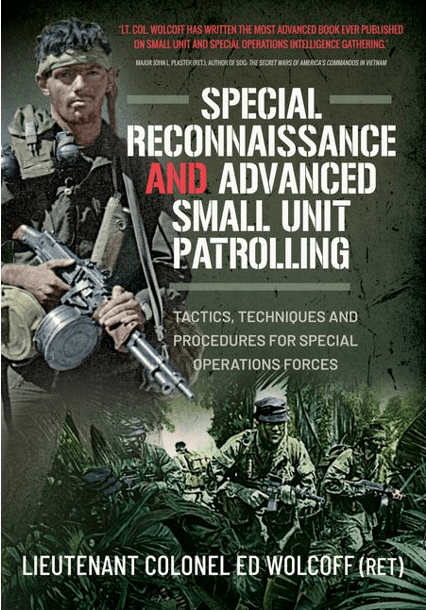
Review: Special Reconnaissance and Advanced Small Unit Patrolling

Special Forces (specifically MACV-SOG) veteran Edward Wolcoff has created a masterpiece in Special Reconnaissance and Advanced Small Unit Patrolling. Despite the long and clunky title, the book itself is very accessible. The goal was to create a list of tactics, techniques, and procedures determined by both theory and practice. It was also to present them in a way that was easily accessible and not written in field manualese (indeed, taking issue with official doctrine is stated in the introduction as a big motivation for the entire book). Wolcoff succeeds admirably in both parts.

This is not just for people who actually do light infantry patrols. Even armchair writers like me will find it very useful for both research and curiosity. Few stones are left unturned. This aims to be comprehensive and it succeeds. It does arguably focus a little too much on the past, but given the author’s Vietnam service, this is quite understandable. While “tone” isn’t the most relevant for a book like this, I enjoy how this comes across as being critical of official doctrine and often greatly so, but not in a bitter or axe-grinding way (Wolcoff has said that he submitted this book to a security review and cooperated with the Pentagon in its publication, FWIW).

What I particularly like is how Wolcoff makes it very clear that failure is as big a teacher (if not more) as success. Survivorship bias can skew things massively, so it’s important to look at what didn’t work as well as what did. This is a great resource for well, anyone, and well worth a purchase.

Review: High Intensity Military Urban Combat

High Intensity Military Urban Combat

The book High Intensity Military Urban Combat focuses on exactly what the title says. It aims to teach in the very relevant task of high intensity war in built-up areas. To an extent (being adopted from an official use only instruction) it’s focused on a military audience and having them “unlearn” the circumstances of low-intensity urban war (superior resources, ability to do complex operations, rightful focus on collateral damage) compared to a slugfest in Seoul/Tallin/Taipei (or wherever. There are a lot of big cities!)

Focused on squad level operations, it’s well-illustrated and detailed. To a degree, it duplicates what’s in existing publications, although trading field manual-ese for clear text and good diagrams is a welcome tradeoff. I can’t say how helpful it’d be to a professional audience, but to an armchair observer like me it’s illuminating.

Review: Exile

The Last Roman: Exile

Starting The Last Roman: Exile, I was struck by the extreme similarity of the gimmick to the Casca series. Namely, a Roman gets splattered during the Crucifixion, becomes healed and unaging as a result. I’ll let it slide because they’re both based on the Longinus legend that long precedes them both. Yet that’s not the biggest difference between them. Marcus, the protagonist here, and Sadler’s titular hero could not be more apart.

Basically, the Casca series after the second book used the circumstances of its main character as just an excuse for the pop-historical setting of the week. That he was connected to Christianity meant nothing, his background meant nothing, and each story was just a 51% effort (at most) historical thriller. This book is still a cheap thriller through and through, but everything in it is done so much better.

There’s a lot of flashbacks and jumping between eras, but it’s done very smoothly and effectively. The contemporary cheap thriller setting features a MacGuffin and plan that would do Jon Land proud. There’s an energy to it that Casca completely lacks, and I’m always glad to see a premise with potential done right.

Review: Encore

Kirov: Encore

Like every good concert, the 64-book Kirov series has to have an encore at the end. And so it was made in a book creatively titled Encore. I mentioned in my review of the final proper installment, Journey’s End, that the overarching villains of the aliens and Ivan Volkov were dealt with in an anticlimactic, rushed manner. This hoped to give them proper closure in proper battles.

It did not exactly work. By this point there was no way for the series to conclude in anything but a screeching halt, and all the big set pieces here did was change their fates from “short and contrived” to “long and contrived.” Then again, “long and contrived” describes the whole series well, so (shrugs).

This is only for Kirov completionists.

Review: Concrete Jungle

Concrete Jungle

Getting the latest Brannigan’s Blackhearts novel was about as easy a decision for me as a panda’s decision to eat bamboo. After devouring Concrete Jungle, where the Blackhearts go to Prague, what do I think? It’s very sad for me to say this given how much I absolutely adore the series, but I did feel this was lacking compared to past installments. Now don’t get me wrong, it’s still a decent 51% (or more?) cheap thriller. Everything I like about them is still there. And it’s very hard for any series to remain completely electrifying for twelve installments.

But I did feel that this is the (comparative) worst of the series to date. Most of the enemy gimmicks are either reused from earlier books or mundane. For instance, in the the bulk of the novel, the Blackhearts fight-Eastern European mobsters. Mobster-slaying is as 70s as disco and bad mustaches. And I felt that the lucky breaks/narrative contrivances the protagonists got this time were a little too obvious. Yes, they were always there, but they were concealed a lot better in earlier installments.

This series has been on a great run, and nothing can take that away. But still I hope it isn’t jumping the shark completely.

Review: Advance To Contact 1980 (Ronsone/Aaronson)

Advance To Contact 1980

The time has come to finally return to the starting theme of this blog. A 1980s World War III book is being reviewed here, Advance to Contact by James Ronsone and Alex Aaronson. This is a very Larry Bond-esque book taking place at an unusual time (beginning of the decade, or as I like to call it NATO Hard Mode) and in unusual places like Iran and Central America. Operation Eagle Claw succeeds-and things spiral from there.

Of course, I have an obligatory rivet-counting nitpick. Eagle Claw was more or less completely unworkable and it was probably for the best that it failed as early as it did. Reaching the city itself would just lead to massive collateral damage and the deaths of the hostages. Eagle Claw succeeding is like Operation Sea Lion succeeding in terms of plausibility.

But for the sake of the story, I’ll gladly it slide. Different theaters certainly beats Germany and the North Atlantic. Especially when the geography leads to different types of battles than giant mechanized blasts in the Fulda Gap.

As far as literary quality, this is a little rough but very forgivable. While at times it gets clunky, this is an extremely hard genre to write well. It certainly did not stop me from enjoying this book, and I look forward to the next installment.

Review: The Wandering Warriors

The Wandering Warriors

Rick Wilder and Alan Smale’s The Wandering Warriors is a very goofy novel. In it, a 1940s baseball team finds itself isekaied to Ancient Rome. Hijinks ensue. Lots of hijinks. Ok, lots and lots of hijinks.

This silly book has a silly premise and a silly conclusion. But it’s a lot of fun. Don’t read it expecting any kind of historical accuracy, serious study or culture clash. Read it for the ridiculous fun of a baseball team teaching Romans to play baseball in the Colosseum.

If you like out-there time travel fantasy, this is the book for you.

Review: Wings Over The Hindu Kush

Wings Over The Hindu Kush

Lukas Muller’s Wings Over The Hindu Kush shines a light on an obscure footnote in aviation history: The Afghan air forces (yes, plural) between the Soviet withdraw and Enduring Freedom. Leaving behind a large quantity of helicopters and aircraft, there were enough parts and willing pilots for the Taliban and its rivals to create air forces up until 2001. As someone aware of their existence and interested in how functional air units could be maintained from such “scraps”, this book was an easy purchase.

In a complex, fluid situation without the best documentation, getting the detail that Muller did was no small feat. The book isn’t the biggest or most absolutely detailed, but it does tell the story of these helicopters, Fitters, and Fishbeds. And it’s a very interesting story.

The strike aircraft were far from the most capable or effective (the transports in a place with poor infrastructure were far more vital), but their mere presence in such conditions was surprising. And this book clears up the surprise in a great way.

Review: Soviet Era Airliners

Soviet-Era Airliners: The Final Three Decades

In many ways, Aeroflot mirrored the USSR itself. Its breakup in 1991 scattered the massive airline’s assets across all the independent republics. Christopher Buckley’s Soviet-Era Airliners: The Final Three Decades tells the story of what happened to all the “Classics”, “Crusties”, “Carelesses”, “Clobbers”, and more. While the collapse of the USSR and the failure of its aviation industry to make a competitive product caused its new-build civil aircraft industry to fall apart instantly, there were lots of surplus planes around.

This book does a great job showing most of their fates. There’s lots of details and even more excellent photographs. If you like civil aviation at all, this is a great book. I was curious to see what happened to these flying trilobites, and now I know.