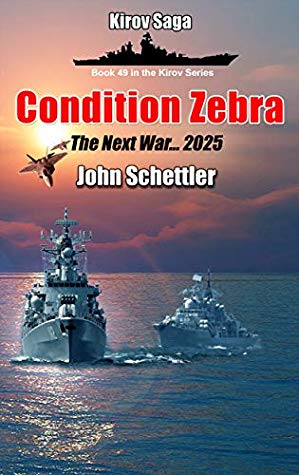
Review: Condition Zebra

Condition Zebra

conditionzebra

The (supposedly) final arc of John Schettler’s epic Kirov series, now exceeding even The Subspace Emissary’s Worlds Conquest in terms of word count, begins with Condition Zebra. This is the story of a contemporary World War III, after the Kirov timeshifted away from another contemporary World War III, possibly making it the first series to have multiple World War IIIs in it.

Having read two books in the 49-and-counting series, I figured it would at least be the same as before.  I was wrong. It somehow managed to be worse. And it manages to be worse in ways that might be considered contradictory at first glance.

One one end, the basic nuts and bolts writing has all the problems of the past Kirov books (characters who exist solely to operate military equipment, rote technical descriptions of the battles that give away the wargames used to sim them, and overall clunkiness) and just feels sloppier, with the dialogue, grammar, and even structure seeming worse.

On the other, the giant timeline tangles get bigger, more confusing, and somehow more pointless-seeming than ever. Knowing the end result and purpose, it just feels like the developers of Madden, 2K, or The Show making up a gigantic plot about time machines and time-traveling team general managers to explain why past players can appear in a game with current stars.

Maybe it’s those above flaws and maybe it’s just that the novelty of seeing the world’s longest wargame let’s play has worn off after three books, but this doesn’t even seem bad in a bemusing way anymore. It’s just bad.


Review: Divided Armies

Divided Armies

Jason Lyall’s Divided Armies is a big look at how societal inequality can influence military peformance. It’s mixed and uneven but still worthy.

First, the research is exhaustive and extensive. Lyall specifically aims to avoid a Eurocentric/great war bias by looking at a gigantic sample size of conflicts around the world from 1800 to the present. The book is not the easiest read and is written in “Academic-ese” with lots of political science formulas. However, I didn’t consider this a bad thing so much as just being part of its very nature (it’s not the only book of this type of I’ve read). The case studies feature more and more obscure battles. It’s a solid, disciplined set of information that shows a lot of underappreciated and understudied wars.

Of course, this book also has the weakness of the approach. I had two main doubts about this book. One was that Lyall would overcorrect and make the issue too dominant. Although not quite as bad as I feared, I saw a lot of this happening.

The weakest part of his research by far is, ironically, when he goes into great power wars. His study of the World War II Eastern Front, despite citing modern scholars, is still disappointing and clearly viewed through the lens of his thesis. So it means an overt focus on the early war (because the Soviets were clearly doing poorly), and an over-focus on Stalinism at the expense of other factors (because it fits the tone of the book). This image is rather distorted, to say the least.

A far less bad but still iffy example comes from his comparison of Ethiopa in the 1998 war with Eritrea and the DRC in the simultaneous Second Congo War. Despite Lyall’s box-checking and vigorous arguments, I’m still left thinking of the two having far more differences than similarities. They’re not the ones I’d use in a direct comparison, the former having overwhelmingly more experience with large, conventional operations.

The second doubt I was also vindicated with was a sense of “you needed a ton of formal data to say this?” The conclusion of less cohesive societies translating that into ineffectual military performance was not exactly the most shocking or counter-intuitive one.

However, with those caveats in mind, as well as the usual focus on keeping eyes open, the book is still a worthwhile read. The basic conclusion is sound, the examination of previously under-explored conflicts is fascinating, and if the “what” isn’t the most interesting or noteworthy, the “how” definitely is.