A Thousand Words: Power Slap

Power Slap

A show devoted to a “sport” that is as bizarre as it is dangerous, Power Slap is the brainchild of Ultimate Fighting Championship head Dana White. While White is no ones idea of an ethical person, but this is a low even for him. You might think that slapfighting is some silly, wimpy gimmick. That would be wrong. Expect maybe the silly part. You might also think that slapfighting is some kind of boxing but with open hands. That would be extra-wrong.

Slapfighting goes like this: The combatants stand on either side of a short table. Starting with the winner of a coin flip, they take turns being the attacker and victim. The attacker does an open-hand powerful slap. The victim…. holds their hands behind their back, and it’s a foul if they so much as flinch slightly.

Yes, this is a sport that literally forbids any kind of defense. There’s a reason why even people active in boxing and mixed martial arts have been scorching this for its danger. More than one commentator has argued, and I agree, that it feels like a way to prove the detractors of early MMA right. It’s nothing but hitting until one person falls down (or the round ends).

I love mixed martial arts. But this is an offshoot I do not. It feels like trying to skip straight to the highlight reel knockouts without grasping that the reason why those knockouts are so impressive is that they’re earned in a way that hitting a literally defenseless opponent is not. Or maybe it’s just Dana White being weird. Wouldn’t be the first time him or another promoter acted that way.
Review: Star Wars vs. Warhammer 40k Season 2

Star Wars vs. Warhammer 40k, Season 2

My voracious consumption of the Star Wars vs. Warhammer 40k fan audio drama continues apace. Having finished the self-declared second season, I feel like I should give my thoughts on it. The planet Axum is the site of the first gargantuan Imperium-Republic slugfest, and no stone is left unturned.

The pace does slow as seemingly everyone from top to bottom gets a viewpoint treatment. Clones, guardsmen, marines, admirals, Jedi, you name it. I will sadly say that a few times it does feel like the story focuses too much on individual trees and not enough on the forest, and that I’d like to see more post-Axum installments where more time and events pass in one episode.

However, this also has the virtues of such an approach, and it shows as well. A lot of the set pieces are excellent to the point where it feels like Larry Bond decided to take up writing crossover fanfiction. The culture clash as the tamer Star Wars universe is exposed to the gonzo craziness of 40k is still there and still well done. And it has one of my personal favorite plausible moments: When Republic clone troopers see Guard Ogryns, look at the huge humanoids, and think they’re Astartes/Space Marines. It’s very much a “the Panzer IV looks like a Tiger” situation, and I smiled.

For all my minor critiques, I’m majorly enjoying this drama.

Review: Children of the Night

Children of the Night: The Strange and Epic Story of Modern Romania

With All Union and my Soviet-Romanian War project, I figured getting a good one-volume history of the Southeast European country would be nice. And Paul Kenyon’s Children of the Night delivers. It starts in 1442 with Vlad “Dracula”, or “The Impaler” Tepes, and more or less concludes with the execution of Nicolae Ceausescu in 1989. The book is a magisterial epic of Romania’s frequently bizarre and violent history.

One consistent theme is Romania being perched on an unsteady point and being tugged on in multiple directions for centuries. Whether it be the Hungarians and Turks, the Russians and Turks, or the east and west in the Cold War, Romania always feels like an odd one out, a Latin enclave in a Slavic realm. The most blatant example of this was Romania spending the first part of World War I figuring out who it should support (it sided with the Entente eventually), but this was shown throughout history. The most ghoulish is Ion Antonescu’s regime conducting some of the worst massacres of the Holocaust, but suddenly changing its mind on the deportation of Jews-conveniently right after the encirclement at Stalingrad.

But it’s its postwar history where the book shines. Ceausescu’s reign of terror is well documented, and the scenes of his fall and execution read like they could have come straight from The Death of Stalin. It also shows that his tendencies towards what can be called “independent totalitarianism” started under his predecessor, Gheorge Gheorghiu-Dej.

If you could only read one book on the history of Romania, this would be a good contender for the choice. It’s definitely worth reading.

Review: White Horizon

White Horizon

TK Blackwood’s 1990s continued Cold War gone conventionally hot series continues in White Horizon, an excellent installment. The Fuldapocalypse not only continues apace but features the powerful but often overlooked country of Sweden as a major setting. Featuring everything that has made the past installments so good, this was a joy to read.

The only real “problem” was teasing a successor. But that’s a good problem to have. This shows that the “cold war gone conventionally hot” subgenre still has quite a bit of life in it.

Review: Infiltrated

I recently finished Infiltrated, the latest (as of this post) entry in the Duncan Hunter series by Mark Hewitt. I was extremely relieved to be done with it, having gone ahead with the final two books out of plain curiosity. It probably was not the wisest decision out there.

By now the main character is an internet Navy SEAL meme done unironically. The set pieces are reduced to the same old superplane gimmick that’s already been repeated many times over. But those are small problems compared to the absolute biggest sign of devolution: The series has become more than ever like William W. Johnstone.

Like Johnstone, the final two books have been taken over more and more by repetitive political rants. They reach a particular low in Infiltrated, not helped by a change in tone. The conspiracies go from “The Hindenburg was destroyed by communists and Amelia Earhart kidnapped by a Soviet submarine and sold into slavery in the Middle East” to boring, annoying, and slightly creepy internet conspiracy theories turned real. It’s like going from “Actually, JFK was killed by a combination of Jackie and the car’s driver” to someone going on tirade after tirade on the “international bankers”.

So yeah, I’m glad to be finished. It was a fun ride for a few books, but overstayed its welcome without a good stopping point.

Review: Small Unit Infantry Ambush Tactics

Small Unit Infantry Ambush Tactics

It’s very rare that I find a book that’s essentially a “strictly worse” version of another one. Where another work exists that can do literally everything it can and do it better. Yet that is the case for Small Unit Infantry Ambush Tactics, a how to fight guide about-look at the title.

By itself it’s not too bad, showing different ambush types and critiquing rote training. But it’s just that Special Reconnaissance and Advanced Small Unit Patrolling has everything it does and so much more. Plus the latter book has a far better tone, giving credit to the establishment where the author thinks it’s due instead of the more overly critical one of this book. So I feel comfortable in saying: Get Wolcoff’s masterpiece instead.

A Thousand Words: Armoured Commander II

Armoured Commander II

Surrounded by all kinds of danger, a threat can come out of nowhere and kill you. This describes war, but it also describes roguelikes, the kind of deliberately unfair randomized video games that have occupied a niche for decades. Naturally, someone had the great idea to combine them. The result was the Armoured Commander series, with the second installment being the subject of this review.

You are a tank in World War II. You can command just about any kind of tank in any campaign at any point during the war. Try and survive in a world of ASCII graphics and constant threats. The deliberately ultra-retro UI gives the game a bit of a learning curve, but I didn’t consider it too hard. A more intentional “issue” is that you get what you want. I learned the hard way that a Renault FT means you’re slow, you’re weak, you’re inaccurate, and the commander has to do a ridiculous amount of multitasking.

This is an excellent game for anyone who likes roguelikes and/or tanks.

Review: World War III 1987

World War III 1987 Blog

Now that the main war has finished, I feel comfortable reviewing the World War III 1987 blog. Now, I must admit that I’m benefiting a lot from the context I’ve learned since I’ve started Fuldapocalypse. Part of it is that there are too few 198X Cold War Hot works of fiction instead of the too many. But another part of it is that web serials (which this ultimately is) and traditional books are apples and oranges. Or, to be more accurate, the relationship between them is like that between baseball and cricket, boxing and mixed martial arts, or rugby and American football. All involve hitting a ball with a bat/pileups of burly players/beating one’s opponent up, but anyone with knowledge of both would admit to big differences and often a lack of overlap.

Likewise, writing a book and writing a serial both involve creative writing, but they also have different priorities and require different skillsets to really excel at. And I can say that as a serial, the WWIII87 blog succeeded very. The first thing a serial needs to do-and I mean needs, is be punctual with updates. While there were understandable human slip ups, the update schedule was nonetheless brisk.

The update schedule was good, and so was the content of said updates. I could quibble with a lot of things, but I don’t really have the heart to go “no, the combat power of that division was (X) instead of (Y)” or nitpick minor technical details or circumstances. There are just too many soft factors and confounds in a hypothetical Fuldapocalypse to really call any one outcome plausible, especially given the unlikeliness of a sustained conventional conflict (Cold War era field manuals from both sides are very clear-a third world war is likely to start off conventionally, but highly unlikely to end that way). Let me just say I’ve read substantially worse and leave it at that.

I do have to take issue with the plotnukes, which do the Hackett style of “trade two cities” (Madrid and Gorky/Nizhny Novgorod), and which serve as a Deus ex Atomo at the end. Though even there there isn’t a real good way to do them. I think the least contrived option, which I really haven’t much of in other fiction is to have them deployed tactically against field formations but not strategically against targets in cities or deep beyond the front (kind of like a local version of Arc Light’s skewed extreme counterforce strikes to make a large exchange survivable). Like faster than light travel in science fiction, you just have to try and stay consistent and run with it. And I’ll admit the nuclear ride, when the story goes there, is a little bumpy to me. There’s also a little too much focus, IMO, on detailed actions in the peripheral theaters, which made the pace on the truly important Centfront somewhat slower than I would have liked.

That being said, this is a good effort and my hat’s off to the writer. My personal journey since starting Fuldapocalypse and reading so many books has broadened my mind, and the serial has progressed throughout this blog’s existence. Congratulations and good work!

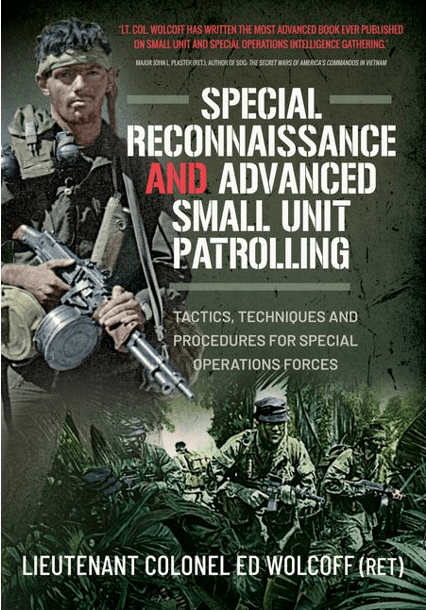
Review: Special Reconnaissance and Advanced Small Unit Patrolling

Special Forces (specifically MACV-SOG) veteran Edward Wolcoff has created a masterpiece in Special Reconnaissance and Advanced Small Unit Patrolling. Despite the long and clunky title, the book itself is very accessible. The goal was to create a list of tactics, techniques, and procedures determined by both theory and practice. It was also to present them in a way that was easily accessible and not written in field manualese (indeed, taking issue with official doctrine is stated in the introduction as a big motivation for the entire book). Wolcoff succeeds admirably in both parts.

This is not just for people who actually do light infantry patrols. Even armchair writers like me will find it very useful for both research and curiosity. Few stones are left unturned. This aims to be comprehensive and it succeeds. It does arguably focus a little too much on the past, but given the author’s Vietnam service, this is quite understandable. While “tone” isn’t the most relevant for a book like this, I enjoy how this comes across as being critical of official doctrine and often greatly so, but not in a bitter or axe-grinding way (Wolcoff has said that he submitted this book to a security review and cooperated with the Pentagon in its publication, FWIW).

What I particularly like is how Wolcoff makes it very clear that failure is as big a teacher (if not more) as success. Survivorship bias can skew things massively, so it’s important to look at what didn’t work as well as what did. This is a great resource for well, anyone, and well worth a purchase.

Review: High Intensity Military Urban Combat

High Intensity Military Urban Combat

The book High Intensity Military Urban Combat focuses on exactly what the title says. It aims to teach in the very relevant task of high intensity war in built-up areas. To an extent (being adopted from an official use only instruction) it’s focused on a military audience and having them “unlearn” the circumstances of low-intensity urban war (superior resources, ability to do complex operations, rightful focus on collateral damage) compared to a slugfest in Seoul/Tallin/Taipei (or wherever. There are a lot of big cities!)

Focused on squad level operations, it’s well-illustrated and detailed. To a degree, it duplicates what’s in existing publications, although trading field manual-ese for clear text and good diagrams is a welcome tradeoff. I can’t say how helpful it’d be to a professional audience, but to an armchair observer like me it’s illuminating.