A Thousand Words: Warriors of Fate

Warriors of Fate

Capcom’s Warriors of Fate is a Final Fight-type beat em up set in ancient China. Err.. except the American translation set it in a fictional place that just happened to resemble ancient China. And the simple and easy Chinese names got turned into complex Mongolian-inspired names. Yeah, it was a little weird.

That being said, it’s a Final Fight successor that plays like a Final Fight successor and has the fun of a Final Fight successor. Unlike Captain Commando, mounts (horses in this case, not mechs) actually are useful and usable. It doesn’t quite reach the heights of Battle Circuit in terms of pure technical ability, but there is a lot more depth than many other games of its ilk and it makes up for it in terms of spectacle.

Not a bad slightly forgotten arcade game.

Review: Fenimore Coopers Literary Offenses

Fenimore Cooper’s Literary Offenses

Fuldapocalypse now turns its attention to noted World War III author Mark Twain. I have to share Fenimore Cooper’s Literary Offenses because as a child, it was the kind of thing that made me guffaw massively. And still does. Since I have not read any of Cooper’s actual novels, if I was to do so now it would probably be something like watching a Jean-Luc Goddard movie after the Monty Python “French Subtitled Film” sketch that parodied it massively.

Twain was proceeding Mystery Science Theater 3000 by a century and it was amazing. Whether or not he was accurate in his critique of Cooper, it was certainly fun to read. (Also fun fact: The home of the Baseball Hall of Fame, Cooperstown, was named after the author. Twain would have had a field day critiquing the ballots of writers who do things like vote for steroid-tarred Gary Sheffield but not Bonds or Clemens).

A Thousand Words: Air Crew

Air Crew

1980’s Air Crew (sometimes translated as “Flight Crew” or “The Crew“) was the USSR’s attempt to copy the Airport-style disaster movie. The first half is an incredibly slow episode of Aeroflot: The Soap Opera and features such white-knuckle thrills as a child custody hearing (not kidding), but the second is pure 70s disaster cheesy fun.

The plane lands in the most treacherous fictional airport in the most treacherous fictional land, and its crew then confronts a simultaneous earthquake-flood-firestorm. Getting off the ground is just the start, leading to a ridiculous and ridiculously fun conclusion that involves members of the cockpit crew bundling up and going outside as if they were cosmonauts on a spacewalk and climaxes with geography ceasing to make sense.

As a time filler, you could do a lot worse than this movie.

Review: Shadows of the Empire

Star Wars: Shadows of the Empire

In the mid-1990s, an unusual multimedia product occurred. George Lucas and company released Shadows of the Empire, a Star Wars side story set between The Empire Strikes Back and Return of the Jedi. The results for Steve Perry’s primary novel were… interesting. First off, the book itself is not so bad that it falls into the tier of “horrible tie-ins”, but is nowhere near good enough to overcome the problems which every anime fan would know.

Yes, I said anime fan. Because this is like one of those movies that are based off a sequential anime (which is itself based on a sequential manga). In other words, everything has to be completely self-contained, every loose end has to be either tied up or cut loose, and the status quo for the series overall can’t really change. That every major character introduced in this book is killed off at the end shows the limitations it was working under, and Perry could not write his way past such a major obstacle.

I supposed it works if you just want Star Wars filler, but there’s better choices even in that regard.

A Thousand Words: Under Siege

Under Siege

Steven Seagal has had a career trajectory that very few artists have duplicated. Imagine a one or two-hit wonder who, next thing you know, is making cheap grindhouse flicks on behalf of a dictator. Well, with Seagal you don’t have to imagine.

Anyway, the lone movie of his that many people like unironically is the cheap thriller Under Siege, AKA Die Hard On A Battleship. The plot is a very simple one and involves villains taking over the USS Missouri and Seagal being the one to stop them. Look, it’s not exactly a deep and intelligent movie, all right?

Thankfully, it is a fun movie. A very fun movie. It has Tommy Lee Jones and Gary Busey as delightfully crazy and corny supervillains, a chance to see a battleship in action, and takes full advantage of its setting. I think it goes without saying that a warship is one of the better places to set a Die Hard knockoff.

Review: Cataclysm

Cataclysm: A Matt Sheridan Novel

Robert Cole’s Cataclysm is a story of post-apocalyptic survival as a man and his family struggle in the aftermath of a nuclear exchange-I mean, terrorist attack. I have to mention this “night of the war” (to use the Survivalist’s term). Because not since the beginning Fuldapocalyptic days of The Red Line have I seen a setup so contrived when it didn’t have to be. In fact, The Red Line can at least be excused as commercial editors wanting it to be contemporary for sales reasons.

This independent novel has no such justification. Anyway, might as well tell this. So nuclear weapons destroy many American major cities in a strike that’s more than Arc Light but less than a classic Strangelove/North Star wipeout. That’s not so bad and I’d even call it somewhat refreshing to have some semblance of a government left. Except it’s not the obvious normal nuclear war. No, its setup goes like this: Islamic terrorists snuck nuclear bombs into said cities and detonated them. In response, the American government launched an immediate retaliatory strike against the fifty largest Muslim-majority cities across the world before concentrating on licking its worlds.

It feels gratuitous, and even for me a little insulting a setup. Like you could have just had say, Iran go nuclear, get several ICBMs, and have a “normal” exchange with them and no one would bat an eye.

Anyway, the book itself has a lot of exposition about every single slightly relevant thing. It also has constant references to the author’s protagonist’s “past wargames”, which makes this turn into the Survivalist-Kirov (this is not a bad thing).

The next arc is terrorist weaponized mega-smallpox, because one cheap thriller cliche wasn’t enough and Cole had to include another one. All he needed was VX gas for the Cheap Thriller WMD Triple Crown. But he goes for the second-best thing, and a tried and true literary device: When in doubt, have your characters fight a bunch of crazy bikers. In fact, such a super-biker gang becomes the main antagonists, a delightful change from the terrorists I was expecting.

The literary and action fundamentals are adequate. This sounds like passive-aggressiveness, but it’s not. Thankfully, the whole leaning so much into “Postapocalyptic Kirov” and huge expositions come across as endearing and not annoying. I had a lot of fun reading this book, and that’s what matters.

Review: Vortex (Catherine Coulter)

Vortex (Catherine Coulter)

This is the third book with the title of Vortex I’ve reviewed at Fuldapocalypse, after Jon Land’s and Larry Bond’s. It doesn’t exactly measure up to either of them. I got it in a grocery store, which was probably a bad omen because this is a perfect “grocery store thriller” mushy book. It’s not 51%, it’s 49%, which makes more of a difference than you might think.

About the only thing that makes this tale of a female agent stand out is an extremely bizarre narrative device at the beginning. She’s recovering in a hospital after a hairy field mission in Iran. Instead of actually describing the mission in a third-person narrative, the author instead has the character watching film footage of it and narrating what goes on in first person for the entire chapter. It’s strange.

But it’s the only strange part of a dull book.

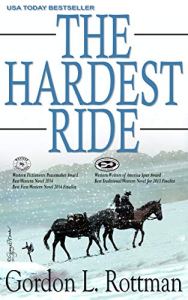
Review: The Hardest Ride

The Hardest Ride

Having loved Gordon Rottman’s nonfiction books, I figured I’d give his fiction novels a try, starting with The Hardest Ride. Even though westerns aren’t really my genre, I felt “why not? I know this guy can write.” So I opened this story of a cowboy and a mute Mexican woman.

It’s written in first person, which is a little awkward, and is full of “darn tootin” slang, which is even more awkward. Yes, you can make a realism argument for it, but it’s like phonetically spelling out every character with a non-English accent. The whole thing just makes it less readable more than it makes it more immersive. The first half of the book is a mere slog as the characters stumble around from town to town.

Thankfully, the pace picks up after said mute woman is kidnapped and the remaining half is devoted to her rescue. It’s well written but falls into the small pit of “too realistic for its own good” (where the author knows firsthand human limitations but still wants to have the main character accomplish something spectacular). Still, at least it’s a plot, and it’s not poorly written.

This is an iffy book, but it’s a good kind of iffy and I’m looking forward to see if Rottman can improve in later installments.

Review: The Bucharest Dossier

The Bucharest Dossier

I knew I had to read a spy thriller when I saw the setting was Romania. So I eagerly snapped up William Maz’s The Bucharest Dossier. That the author actually grew up in said country during the bad old days made me want it even more. Sadly, what goes up must come down. Taking place in the obvious year of 1989, it uses this excellent setting and…. squanders it.

A clumsy moral equivalence between Ceausescu’s Romania and Reagan’s America and making many of the events of the 1989 revolution the actions of foreign intelligence makes this sour. The author to be fair labels it a work of fiction in the afterword, but I can still see how it leaves a bad taste. There’s also the characterization and love story not really doing it for me.

That leaves the main plot. Now I’ll admit I’m not the biggest fan of Le Carre-style grounded spy novels. So I may be biased in this regard. But it still amounted to little more than a 51% story that was dragged down by its other weaknesses. The book does portray its setting mostly well, which makes me think that Maz would have been better off writing a plain historical novel.

Oh well. This could have been a lot better than it was.

Review: Cody’s Return

Cody’s Return

Stephen Mertz was the main man behind the “Jim Case” pen name adorning the front of the Cody’s Army books in the 1980s. Since he didn’t have the exact rights to the men’s adventure stories featuring John Cody, he made a new character named (brace yourself) – Jack Cody! Who also had thrilling action adventures! What a coincidence! The late Chet Cunningham did something similar with “SEAL Team Twenty”, and it predates self-publishing by quite a bit when authors worked for multiple firms. (In fact, there were times when the throwaway series couldn’t even keep the main character’s name consistent!)

Cody’s Return, in spite of what the name implies, is not the first book in the series. It is, however, the first book in a self-declared trilogy that centers around a crazed arms dealer and his even more crazed girlfriend/cult leader.

The thing about the original Cody’s Army was that, with some exceptions, it was very much a middle of the road series that had all the weaknesses of its format. Which is to say that something like a classic men’s adventure novel is extremely shallow even by cheap thriller standards. And this is the case here as well. This isn’t always a bad thing, but it does make it hard to pick one over another.

What makes this worse is that the book is aiming for a huge plot that it’s trying to stuff into too few pages. I get it’s the intended beginning of a trilogy where the author has complete control, but even in that circumstance it still feels too poorly done. Which is a shame. The plot of nukes, crazies, and colorful characters is something that almost needed a meatier book to do right.

Mertz is a champion of the genre, but he’s done better.