Review: Vortex (Catherine Coulter)

Vortex (Catherine Coulter)

This is the third book with the title of Vortex I’ve reviewed at Fuldapocalypse, after Jon Land’s and Larry Bond’s. It doesn’t exactly measure up to either of them. I got it in a grocery store, which was probably a bad omen because this is a perfect “grocery store thriller” mushy book. It’s not 51%, it’s 49%, which makes more of a difference than you might think.

About the only thing that makes this tale of a female agent stand out is an extremely bizarre narrative device at the beginning. She’s recovering in a hospital after a hairy field mission in Iran. Instead of actually describing the mission in a third-person narrative, the author instead has the character watching film footage of it and narrating what goes on in first person for the entire chapter. It’s strange.

But it’s the only strange part of a dull book.

Review: The Hardest Ride

The Hardest Ride

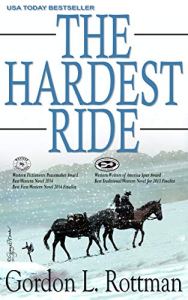
Having loved Gordon Rottman’s nonfiction books, I figured I’d give his fiction novels a try, starting with The Hardest Ride. Even though westerns aren’t really my genre, I felt “why not? I know this guy can write.” So I opened this story of a cowboy and a mute Mexican woman.

It’s written in first person, which is a little awkward, and is full of “darn tootin” slang, which is even more awkward. Yes, you can make a realism argument for it, but it’s like phonetically spelling out every character with a non-English accent. The whole thing just makes it less readable more than it makes it more immersive. The first half of the book is a mere slog as the characters stumble around from town to town.

Thankfully, the pace picks up after said mute woman is kidnapped and the remaining half is devoted to her rescue. It’s well written but falls into the small pit of “too realistic for its own good” (where the author knows firsthand human limitations but still wants to have the main character accomplish something spectacular). Still, at least it’s a plot, and it’s not poorly written.

This is an iffy book, but it’s a good kind of iffy and I’m looking forward to see if Rottman can improve in later installments.

Review: The Bucharest Dossier

The Bucharest Dossier

I knew I had to read a spy thriller when I saw the setting was Romania. So I eagerly snapped up William Maz’s The Bucharest Dossier. That the author actually grew up in said country during the bad old days made me want it even more. Sadly, what goes up must come down. Taking place in the obvious year of 1989, it uses this excellent setting and…. squanders it.

A clumsy moral equivalence between Ceausescu’s Romania and Reagan’s America and making many of the events of the 1989 revolution the actions of foreign intelligence makes this sour. The author to be fair labels it a work of fiction in the afterword, but I can still see how it leaves a bad taste. There’s also the characterization and love story not really doing it for me.

That leaves the main plot. Now I’ll admit I’m not the biggest fan of Le Carre-style grounded spy novels. So I may be biased in this regard. But it still amounted to little more than a 51% story that was dragged down by its other weaknesses. The book does portray its setting mostly well, which makes me think that Maz would have been better off writing a plain historical novel.

Oh well. This could have been a lot better than it was.

Review: Cody’s Return

Cody’s Return

Stephen Mertz was the main man behind the “Jim Case” pen name adorning the front of the Cody’s Army books in the 1980s. Since he didn’t have the exact rights to the men’s adventure stories featuring John Cody, he made a new character named (brace yourself) – Jack Cody! Who also had thrilling action adventures! What a coincidence! The late Chet Cunningham did something similar with “SEAL Team Twenty”, and it predates self-publishing by quite a bit when authors worked for multiple firms. (In fact, there were times when the throwaway series couldn’t even keep the main character’s name consistent!)

Cody’s Return, in spite of what the name implies, is not the first book in the series. It is, however, the first book in a self-declared trilogy that centers around a crazed arms dealer and his even more crazed girlfriend/cult leader.

The thing about the original Cody’s Army was that, with some exceptions, it was very much a middle of the road series that had all the weaknesses of its format. Which is to say that something like a classic men’s adventure novel is extremely shallow even by cheap thriller standards. And this is the case here as well. This isn’t always a bad thing, but it does make it hard to pick one over another.

What makes this worse is that the book is aiming for a huge plot that it’s trying to stuff into too few pages. I get it’s the intended beginning of a trilogy where the author has complete control, but even in that circumstance it still feels too poorly done. Which is a shame. The plot of nukes, crazies, and colorful characters is something that almost needed a meatier book to do right.

Mertz is a champion of the genre, but he’s done better.

A Thousand Words: Battle Circuit

Battle Circuit

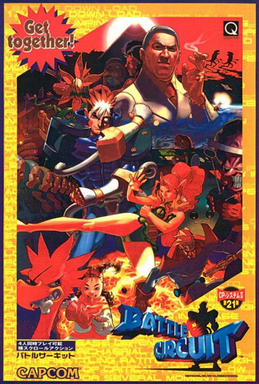
One of the last arcade beat em ups that Capcom released in the wake of Final Fight, 1997’s Battle Circuit was obscure for many years until its availability in the Capcom Arcade Stadium collection. This is a shame, because of all the successors to that masterpiece, Battle Circuit is the best I’ve played.

The plot is simple: In a sci fi future, control one of five bounty hunters as they pursue a bunch of colorful villains. The quirkiness and silliness of the genre shows in both the heroes and villains. You can choose between Cyber Blue, a pretty normal anime hero, Captain Silver, a Plastic Man/Mr. Fantastic style stretch-armer, and three goofballs: Catgirl Yellow Iris, walking Venus Flytrap Alien Green, and the weirdest yet: Pink Ostrich, the titular bird with a girl riding on its back (it’s unclear who’s the brains). Similarly, the bosses are just as ridiculous. They start with a disco Elvis impersonator and go through such things as a woman and her giant mandril, an all-female biker gang, and a robot samurai riding some giant beast. The final boss can only be described as looking like an evil Santa Claus.

But what makes the game amazing beyond these characters and their beautiful sprites/animations is how it’s both easy and deep. Sure, it can be played like Final Fight. You can jump around, throw, and do sweep attacks that cost you health. But each character has a lot of moves, and they can be upgraded between levels if you’ve earned enough coins-which you get by landing lots of hits on enemies. Mastering each of these moves makes things a lot more fun. Especially as the characters have their styles, with Alien Green being the slow grappler a la Haggar and Yellow Iris being the rapid “Guy”. All can jump and power up with a special gauge, the effects of which range from gaining more power to recovering health to becoming very durable for a brief time.

There are a few snags. The first is that the characters are not exactly balanced compared to each other. Cyber Blue is the cheap easy mode character. Not only is he intuitive and strong, but his upgraded sweep attack damages everything on the screen. Bosses can be cheesed by just powering up (which increases his strength) and then spamming that move. Meanwhile, Pink Ostrich is very weak normally, only has a flight power of dubious use, and is hard to control. The others fall between those extremes. The worse one, I’d say, is that the segments between the bosses are kind of minimal and forgettable. There’s only a few enemy types and no real engaging set pieces. It’s not really bad, but it doesn’t have the spark the rest of the game does.

Also the third boss is a blander giant robot with very wonky hit detection that’s just frustrating and not fun. But hey, five out of six aren’t bad.

If you like any kind of beat em up, you deserve to check out Battle Circuit. It’s an amazing underappreciated game.

Review: A Killing Truth

A Killing Truth

Author DV Berkom, a self-proclaimed lover of thriller novels, begins her Leine Basso series with A Killing Truth. Short and sweet, the love of its author for the genre shows obviously. The negative side of this love is that this tale of a female assassin doesn’t exactly break much new ground or push any authorial limits. It’s firmly in the 51% middle of books of this nature.

But it’s also positively in the 51% middle. If you want a good cheap thriller, this is the book for you. Everything about this that needs to work does, and I had a great time reading. I look forward to reading more of Berkom’s work, as it’s clear that she knows what makes a thriller good.

And that’s two positives of loving the genre to one negative. I’ll take that.

Review: The Angola Deception

The Angola Deception

Because I’m crazy, I decided to check out a book by an author whose past series I was less than fond of. So I read DC Alden’s The Angola Deception, a cheap thriller about a super-conspiracy that wants to kill the bulk of the world’s population through an engineered germ. I believe there are at least four Jon Land books I’ve read with this exact plot. Blaine McCracken probably stops one bio-conspiracy shadow government in the morning and one in the afternoon each day.

The difference between them is of course that Land writes about monster truck chases and Antarctica exploding, while Alden writes about how one of the worst things about the evil Muslim conquering state is that it’s too feminist. Guess which book is a goofy fun romp and which is an axe-grinding, plodding, mess.

It’s not exactly a difficult question. There is every single New World Order conspiracy played completely straight here, but there are no minotaur-men. On top of that, the ending of The Angola Deception manages to be both too open ended (setting up the later series) and wrapped up too quickly (dealing with the antagonists of that specific book) at the exact same time. How does it manage that? I’m a little awestruck at how it does, but it does.

Suffice to say I don’t recommend this book. I might keep reading the series because I’m crazy and want to see just how crazy it gets (the Invasion series got pretty out-there, but not intentionally). But I don’t recommend it to others.

Review: The Han Solo Adventures

The Han Solo Adventures

Originally published in three installments from 1979 to 1980, the Han Solo Adventures by Brian Daley were the first books in what would become the Star Wars expanded universe. Star Wars fans tend to love them, and I’m one of them. Without restrictions or a desire to one-up the movies (I’m looking at you, Kevin J. Anderson), the books are a fresh fun romp through the Corporate Sector.

Daley can write everything from prison breaks to starfighter bouts to duelists well, and he does in these books. Every Star Wars fan, science fiction fan, or just fiction fan should read these.

A Thousand Words: Captain Commando

Captain Commando

Capcom, fresh off the success of Final Fight, made another arcade brawler called Captain Commando in 1991. I’m sure the title was just a coincidence. You can control the titular vanilla superhero, a ninja, an alien mummy named “Mack The Knife”, and, most bizarrely, a baby prodigy that controls a mech-that can ride other mechs. It’s like the walking robot version of a nesting doll.

Anyway, to call it a superhero version of Final Fight would be unfair. It’s more like a souped up superhero Final Fight. For instance, the second boss of Captain Commando is almost exactly like the final boss in that game (someone who jumps around with a crossbow). Only he’s much faster. As for the real final boss, it’s one of the cheapest in all arcade brawlers, and exists primarily to devour quarters.

For all this enhanced goofiness, it doesn’t seem as graceful or punchy as Final Fight was. The new move additions consist of the previously mentioned mechs (which are few and far between, and clunky enough to generally be more trouble than they’re worth) and dash moves that are both hard to do and rarely of that much use.

It gets the basics right, but if you have to choose, I’d say either Final Fight itself or one of the better successors. This is not one of the better successors.

A bizarre archetype

I’ve been playing a lot of beat ’em up video games (ie Final Fight), and I’ve noticed (and have not been the only one who’s noticed) a recurring enemy theme. Yes, you get the normal goons, the musclemen, the femme fatales, and the final boss who has the only ranged weapon in the entire game. And the people with very few hit points who run in, attack once, and leave. And big fat enemies.

But among the last, there’s one strange consistent theme. These portly foes breathe fire. Ok. I don’t know why, but somehow game designers thought “All right, let’s keep doing this.”