Review: Airport

Airport

Author Arthur Hailey had a gimmick. He would find a certain field, research it massively, and then build a thriller and/or pop epic around said filed. One of his most famous and successful novels was 1968’s Airport, which inspired the movie series and the parody Airplane!. In it, an airliner is threatened by a both literal and figurative perfect storm of everything from horrible weather to a blocked runway to angry neighbors to a man determined to kill himself and blow up the plane-for the sake of insurance, nothing political.

Hailey spent a gargantuan amount of time on research, and it shows. I’ve always wondered if him being around in the age of the internet would have made his endeavours quicker and easier, or if it would have just prompted him to go even further down the rabbit hole. My hunch is the latter. There’s a lot of well-done and accurate depictions of airport operations (and a lot of weird-in-hindsight 1960s futurism, such as talk of superlifter cargo planes being thought of as something that would render sea freighters as obsolete as ocean liners and passenger pods being loaded into civilian C-5s).

The biggest issue is that the pacing is incredibly slow and lethargic for about four fifths of the book, then it hurriedly sprints to its conclusion. Maybe it was deliberate to try and be suspenseful, but if so, it didn’t work. The second biggest issue is that the characters are dull and dated-most obviously shown in a subplot where one of the main characters gets a flight attendant pregnant and the resulting drama.

This is a decent product of its time, but it’s still a product of its time and not the most recommended for later readers. It comes from an age when air travel was still something novel, and where readers would be less familiar with it. It’s not Hailey’s fault, but the book has aged terribly in that regard. Now it just comes across as 80% Herman Melville’s Airport Tales and 20% A Brief Disaster Novella, neither of which can really stand up.
Cold War Kitona

The Fuldapocalypse has traditionally been opened with a vast set of Soviet special operations that involve varying degrees of risk, realism, and audacity. Red Storm Rising famously had one such jury-rigged gamble resulting in the capture of Iceland. I’ve found another possibility that would involve my two obsessions of past and present: Conventional World War IIIs and commercial airplanes.

While the Second Congo War is about as far in terms of tone and nature from a Fuldapocalypse as it’s possible to get, its opening act nonetheless could have been lifted from the pages of a technothriller. In Operation Kitona, Rwandan and Ugandan troops seized four airliners and flew west to sever the DRC’s links to the outside world. The initial landing worked, but external support for the Congolese government doomed the offensive, plunging central and southern Africa into a long, bloody, and horrific war.

So it’s not too terribly farfetched to imagine planes being filled with “unruly passengers” happening to land at important dual-purpose airports at the worst possible prewar time…

The Ameriyak That Never Was

Soviet airliners have an understandably poor reputation and record. It’s gotten to the point where one should be fair and point out that their less than ideal safety record was more to the issues with infrastructure and human resources and less to the mechanical design of the aircraft themselves. But it isn’t excessive criticism to point out that in spite of their rough-field capability, they were fuel-inefficient, uncomfortable, and only able to succeed in a politically closed field.

But there were still some diamonds in the rough, and not just giants like the Antonov beasts. The three-engined Yak-40 was interesting for being a pioneer in the field of light regional jets when the rest of the world was still using propeller planes for that role.

Which leads to a detente-era footnote: The plans to build and sell a version of the Codling (yes, that was its reporting name) in America. Amazingly, this was not a project from the legendarily Kremlin-friendly Armand Hammer. But it could have been. The potential plants were located in the depressed locations of Youngstown and Niagara Falls. The engines and avionics would be replaced with western models. A memo in the White House of all places (pgs 22-26) details the lofty goals for the LC-3, as it was planned to be called.

Of course, the deal unsurprisingly fell through. But it’s still an interesting piece of aircraft history. As is, it was the first Soviet civilian aircraft to attract legitimate attention from western airlines. And the irony of an airplane designed by a communist state being used to ferry rich private-sector VIPs to their vacations in Aspen is too fun not to smile at.

Cargo and Charters

My love of the big, weird, and military aircraft has made me neglect the humble workhorse transport. Until now. What I’ve taken an interest in is the world of air cargo and charters, especially cargo charters. So in terms of looking at never-were designs, this leads me to see something and ponder where its place in the commercial air ecosystem would be.

In most cases this is be pretty obvious. Where a superjumbo goes and where a tiny STOL plane goes are very simple. Likewise for any one craft in between. The biggest issue comes from the real exotics, like supersonics and VTOLS. I guess you could be reasonable and say “clearly their expense makes them impractical for civilian air transport at all”, but where’s the fun in that?

Furthermore, looking at air transport in general has given me flashbacks to my first novel. After all, the airline industry is incredibly low margin (at best!), volatile, and has very few ways of distinguishing one participant from another. So is the sports betting industry….

Review: Red Front

Red Front

The conventional Fuldapocalypse begins in earnest with Red Front, the second book in the Iron Crucible series. After the Yugoslav opening act in the previous entry , this follows the war everywhere from the Atlantic to… outer space. Author T. K Blackwood continues a solid Bond/Red Storm Rising style narrative in this installment.

This has the issues that a big perspective WWIII has, but it also has the strengths, and Blackwood succeeds in a genre that’s incredibly difficult to write well. The book ends on a cliffhanger, but it’s not an unsatsifying one. With a ton of varied battles in a type of novel that doesn’t come along very often, I can say that I highly recommend this to fans of the “conventional WW3” genre.

Review: Shadow Strike

Shadow Strike

In true Israeli fashion, the country’s leadership stayed publicly mum when a building in eastern Syria mysteriously exploded on September 6, 2007. Ten years later, they announced what everyone already knew-they had bombed and destroyed a Syrian reactor building. Yaakov Katz proceeded to write Shadow Strike, the story of the operation and its lead-up.

Previously, I had regarded the operation purely in terms of its anticlimactic execution. Like so many other times since 1948, the Israelis came, they bombed, they conquered. For the sake of secrecy, the site of the North Korean-supplied reactor had no defenses around it. But Katz tells the story of how a combination of flukes (getting a Syrian official’s laptop that showed very well what it was), politics (in Jerusalem and Washington), and urgency (the reactor had to be destroyed before it went critical) and in the process, makes it far more intriguing then the tip of the iceberg.

The reactor, unlike Osirak, was optimized to produce plutonium for weapons, and getting it operational would have cleared the biggest bottleneck to nuclear warheads. While no reprocessing or warhead assembly buildings were found, those are significantly easier to hide.

This has to rank as one of the lucky fates of history. I do not think Assad would have launched a first strike-his family did not survive by being foolhardy. And even with the bottleneck cleared, there were still more obstacles to actually making a bomb. But knowing that the Syrian Civil War beckoned, having a hot reactor running during it-and one of a more rickety design than the heavily shielded ones at Enerhodar, is a nightmare that was averted.

Superjumbos

I’ve always been intrigued by “superjumbos, which I unscientifically define as “any airliner which is bigger and/or can carry more passengers than a 747.” Perhaps the only mass-produced superjumbo has been Airbus’ doomed A380, a luxurious plane that was nonetheless brought down by an inability to be used as a freighter and a shift away from the “hub and spoke” model that it was designed for.

But with the hub and spoke model in place, and with air travel increasing, the superjumbo does make at least conceptual sense. The justification works like this: If, thanks to a lack of runway space, you can only get X number of flights per major airport, you might as well give them to a bigger plane. To oversimplify it, the choice isn’t between two planes with 300 passengers each or one with 600, it’s between one with 300 or one with 600.

Granted, there are many, many practical obstacles too, like if your superjumbo needs more engines and/or is less fuel efficient (neither an unreasonable thought). But the place for these aerial titans is a legitimate one. Or at least an excusable one with regards to getting one or more of the many on the drawing board designs into alternate production.

And of course, mammoth aircraft that, unlike the A380, were designed to be heavy freighters, do have a niche role in carrying big and oversized loads. See the late An-225 (which had a passenger variant proposed!) and the Super Guppy/Beluga/Dreamlifter oversized transport planes.

It’s all food for thought. After all, what aviation enthusiast doesn’t like gargantuan planes?

Review: Red Flag

Red Flag

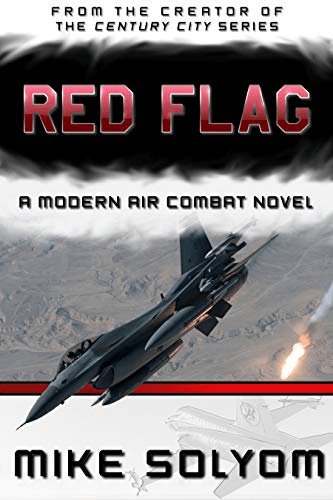
I was intrigued by Mike Solyom’s Red Flag, a novel set around the titular air combat exercise. After reading it, I found it rather underwhelming. There’s actually more than one main plot. There’s the air combat exercise, there’s the backdrop of the author’s other books and ridiculous geopolitics with a de facto WWIII against a “Caliphate” armed with Cold War surplus stuff, and there’s a boilerplate science fiction UFO thriller.

The book isn’t bad at all. The author has genuine expertise, and it shows, even if sometimes it falls into the twin banes of Herman Melville Exposition and “Let me tell you how it really is, unlike on that TV” statements. What it does feel is dissonant. Because of the details and what’s supposed to be grounding, whenever there’s iffy geopolitics and/or weapons choices, it feels extra-off. And when there’s alien spider robots, it feels off even more.

I feel like truly weird, alien, Stephen Baxter-esque beasts would work better with a more grounded novel like it tries to be in air combat. I also feel like the aliens in this story would work fine in a more bombastic, Mack Maloney-type tale. But together they just don’t feel right.

Still, this is still a cheap thriller, and since when do cheap thrillers care about “dissonance”? As a cheap thriller, it may be a “mean 51%” book of varying degrees of quality instead of a “median 51%” book of consistent adequacy, but it still works.

Review: In The Balance

Worldwar: In The Balance

In 1994, Harry Turtledove decided to run with what can rationally and scientifically be called one of the most awesome fictional concepts ever: Aliens invade during World War II. The opening book, In The Balance, starts things off with a bang.

A group of lizard-aliens known only as “The Race” with juuust the right amount of technological balancing to make for a great story attack a humanity that’s stronger and more advanced than anticipated. While the issues Turtledove has with long series (pacing, repetition, etc…) appear even during this book, they’re not deal-breakers. And the weaknesses are more than made up for by the amazing first impression the book makes.

If you like alternate history, science fiction, World War II, or just strange concepts in general, this is worth checking out.