Review: Shadow Strike

Shadow Strike

In true Israeli fashion, the country’s leadership stayed publicly mum when a building in eastern Syria mysteriously exploded on September 6, 2007. Ten years later, they announced what everyone already knew-they had bombed and destroyed a Syrian reactor building. Yaakov Katz proceeded to write Shadow Strike, the story of the operation and its lead-up.

Previously, I had regarded the operation purely in terms of its anticlimactic execution. Like so many other times since 1948, the Israelis came, they bombed, they conquered. For the sake of secrecy, the site of the North Korean-supplied reactor had no defenses around it. But Katz tells the story of how a combination of flukes (getting a Syrian official’s laptop that showed very well what it was), politics (in Jerusalem and Washington), and urgency (the reactor had to be destroyed before it went critical) and in the process, makes it far more intriguing then the tip of the iceberg.

The reactor, unlike Osirak, was optimized to produce plutonium for weapons, and getting it operational would have cleared the biggest bottleneck to nuclear warheads. While no reprocessing or warhead assembly buildings were found, those are significantly easier to hide.

This has to rank as one of the lucky fates of history. I do not think Assad would have launched a first strike-his family did not survive by being foolhardy. And even with the bottleneck cleared, there were still more obstacles to actually making a bomb. But knowing that the Syrian Civil War beckoned, having a hot reactor running during it-and one of a more rickety design than the heavily shielded ones at Enerhodar, is a nightmare that was averted.
Superjumbos

I’ve always been intrigued by “superjumbos, which I unscientifically define as “any airliner which is bigger and/or can carry more passengers than a 747.” Perhaps the only mass-produced superjumbo has been Airbus’ doomed A380, a luxurious plane that was nonetheless brought down by an inability to be used as a freighter and a shift away from the “hub and spoke” model that it was designed for.

But with the hub and spoke model in place, and with air travel increasing, the superjumbo does make at least conceptual sense. The justification works like this: If, thanks to a lack of runway space, you can only get X number of flights per major airport, you might as well give them to a bigger plane. To oversimplify it, the choice isn’t between two planes with 300 passengers each or one with 600, it’s between one with 300 or one with 600.

Granted, there are many, many practical obstacles too, like if your superjumbo needs more engines and/or is less fuel efficient (neither an unreasonable thought). But the place for these aerial titans is a legitimate one. Or at least an excusable one with regards to getting one or more of the many on the drawing board designs into alternate production.

And of course, mammoth aircraft that, unlike the A380, were designed to be heavy freighters, do have a niche role in carrying big and oversized loads. See the late An-225 (which had a passenger variant proposed!) and the Super Guppy/Beluga/Dreamlifter oversized transport planes.

It’s all food for thought. After all, what aviation enthusiast doesn’t like gargantuan planes?

Review: Red Flag

Red Flag

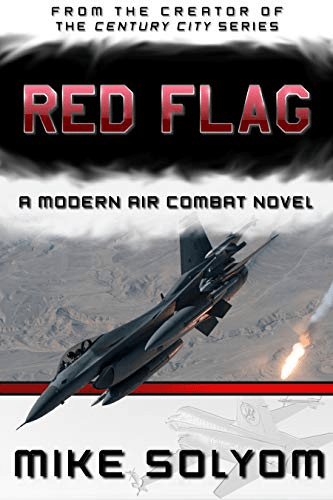
I was intrigued by Mike Solyom’s Red Flag, a novel set around the titular air combat exercise. After reading it, I found it rather underwhelming. There’s actually more than one main plot. There’s the air combat exercise, there’s the backdrop of the author’s other books and ridiculous geopolitics with a de facto WWIII against a “Caliphate” armed with Cold War surplus stuff, and there’s a boilerplate science fiction UFO thriller.

The book isn’t bad at all. The author has genuine expertise, and it shows, even if sometimes it falls into the twin banes of Herman Melville Exposition and “Let me tell you how it really is, unlike on that TV” statements. What it does feel is dissonant. Because of the details and what’s supposed to be grounding, whenever there’s iffy geopolitics and/or weapons choices, it feels extra-off. And when there’s alien spider robots, it feels off even more.

I feel like truly weird, alien, Stephen Baxter-esque beasts would work better with a more grounded novel like it tries to be in air combat. I also feel like the aliens in this story would work fine in a more bombastic, Mack Maloney-type tale. But together they just don’t feel right.

Still, this is still a cheap thriller, and since when do cheap thrillers care about “dissonance”? As a cheap thriller, it may be a “mean 51%” book of varying degrees of quality instead of a “median 51%” book of consistent adequacy, but it still works.

Review: In The Balance

Worldwar: In The Balance

In 1994, Harry Turtledove decided to run with what can rationally and scientifically be called one of the most awesome fictional concepts ever: Aliens invade during World War II. The opening book, In The Balance, starts things off with a bang.

A group of lizard-aliens known only as “The Race” with juuust the right amount of technological balancing to make for a great story attack a humanity that’s stronger and more advanced than anticipated. While the issues Turtledove has with long series (pacing, repetition, etc…) appear even during this book, they’re not deal-breakers. And the weaknesses are more than made up for by the amazing first impression the book makes.

If you like alternate history, science fiction, World War II, or just strange concepts in general, this is worth checking out.

Weird Wargaming: The Axis Contraptions

After World War II, various veterans of the vanquished (to put it that way) offered to design and make various military platforms. Only a few actually entered production. Kurt Tank designed the HF-24 Marut and sputtered-out Pulqui jet fighters. An Italian submachine gun, the TZ-45, found its way into the Burmese Army. Most fell victim to the same culprits: A combination of Cold War military aid and cheap Allied surplus sweeping them aside, while not being high-performance enough to beat them that way.

Yet for alternate historians/wargamers/writers wanting to add various wunderwaffe to their scenarios, it’s not that implausible that a few could slip through here and there. They’d mostly be out of the way unless history moved to that region (for instance, the Willy Messerschmidt-designed HA-300 would undoubtedly see service in the Arab-Israeli Wars if it entered mass production.) But they could still be done.

What would be most interesting would be the really exotic and large Luft 46 aircraft and wunderpanzer tanks. Those would probably need veto-able foreign engines (or other less obvious components) and would be no picnic to design. But they would be the most fun to play.

Review: Coup D’Etat

Coup D’Etat

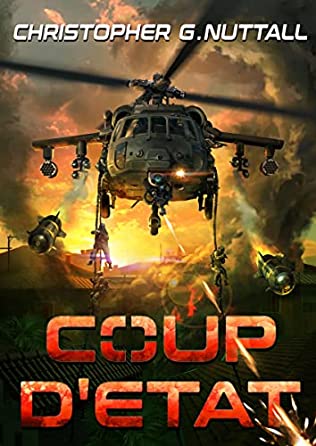
Chris Nuttall’s Coup D’Etat is a book I knew I had to get when I saw the premise. A princess of a Middle Eastern country wrangles western mercenaries to overthrow it in a modern Dogs of War (explicitly cited as an influence, and obvious enough even without the citation)? Sounds good enough. The possibility of a thriller that can be more than just a small group of commandos? You betcha!

The premise is thus very good. The problem is that the execution is not. First, the main character comes across as an uncomfortable Mary Sue, and his opinions along with a more important portrayal cross the line from “hardened realist” to “creep”. But the bigger problem is the setting.

Taking place in a petrostate is a good, and arguably great setting. Having a fictional one so you don’t need to step on real toes and can make it to your needs is another good literary tool this book uses. The problem is that, well…

Say you had a fictional US state in the Old South for your story, and it was portrayed as being composed entirely of corrupt redneck bosses, uneducated and bigoted rural poor, Klansmen, and oppressed African-American sharecroppers who are used entirely as a mentioned prop to show how bad things are without actually being elaborated on. Replace that with the contemporary Middle Eastern equivalents and you have “Kabat”, the oil kingdom the novel takes place in. Compounding the worst true elements of an environment for the sake of fiction isn’t necessarily bad, but here it is. It takes away the stakes by making it look like an irredeemable and worse, dull wasteland. Pretty much any character who isn’t a power broker, trigger puller, or supervillain is used as nothing but a pop-up attraction in the freak show obstacle course.

Granted, you could reasonably argue that I’m overthinking the backdrop for an action thriller. Except this isn’t a very good action thriller. Not just because the prose is only decent at best, but because so much is devoted to the setup and exploring this dubious setting. So this book fails at being a suspense thriller and it fails at being an action thriller. It aims very high and falls very, very short.

A Thousand Words: Money Plane

Money Plane

Adam “Edge” Copeland and Kelsey Grammer’s Money Plane is the story of an attempt to rob a flying super-casino. It fails. Not the heist, the movie. This is an extremely stupid movie. And it’s not even that stupid in a fun way. It’s just inept. Even if one follows the reasonable assumption that action movies do not have to make sense, it’s a failure. Its suspension of disbelief refuses to be followed.

For instance, in-universe, a “master thief” doesn’t seem to know how many people crew the average commercial cockpit. Out of universe, a professional wrestler is squandered by having him spend the bulk of the movie sitting at the controls and talking. In-universe, there are no staff on this supervillain plane and no one goes to check on the cockpit even after the plane shakes and diverts from its original course. Oh, and almost all the resistance comes not from the plane runners but from other gamblers.

The film is very short but still feels overstuffed, not knowing if it wants to be a serious heist movie or a silly heist movie. None of the protagonists are very developed or charming, and even Grammer’s performance is a little too forced. The people behind the titular super-plane are squandered: The actors who play the “concierge” and “bookkeeper” on the plane actually do their supervillain roles well, but the movie bizarrely shifts away from them and towards unfunny “wacky” guests like a cowboy who ends up shooting himself in the head (it’s a long story). I wanted to like this movie, but it really doesn’t work, even as a dumb action movie.

Review: The Russian Way of War

The Russian Way of War

One of the biggest surprises of the initial part of the 2022 Russo-Ukrainian War was that the former did not fight according to its paper doctrine. At all. Lester Grau and Charles Bartles The Russian Way of War is an excellent attempt at explaining said doctrine for a western audience. As anyone who’s studied them knows, they’ve left quite the paper trail. While sources like the VDV Textbooks Collection can provide them online in Russian fairly handily, this translates them to English.

And it translates them to English well. I have a few quibbles. The biggest is the authors taking an overly optimistic view of vehicle adoption, perhaps taking propaganda sources a little too much at face value. But the rest of it is well-done and evenhanded. The only real “problem” I’ve noticed is that I’ve read so many OPFOR documents that much of what they’re saying is already familiar.

But that’s a good “problem” to have, and I was still enlightened by this book. Every wargamer wanting to do missile-age combat involving the Soviets/Russians should read this.

Airfield Construction

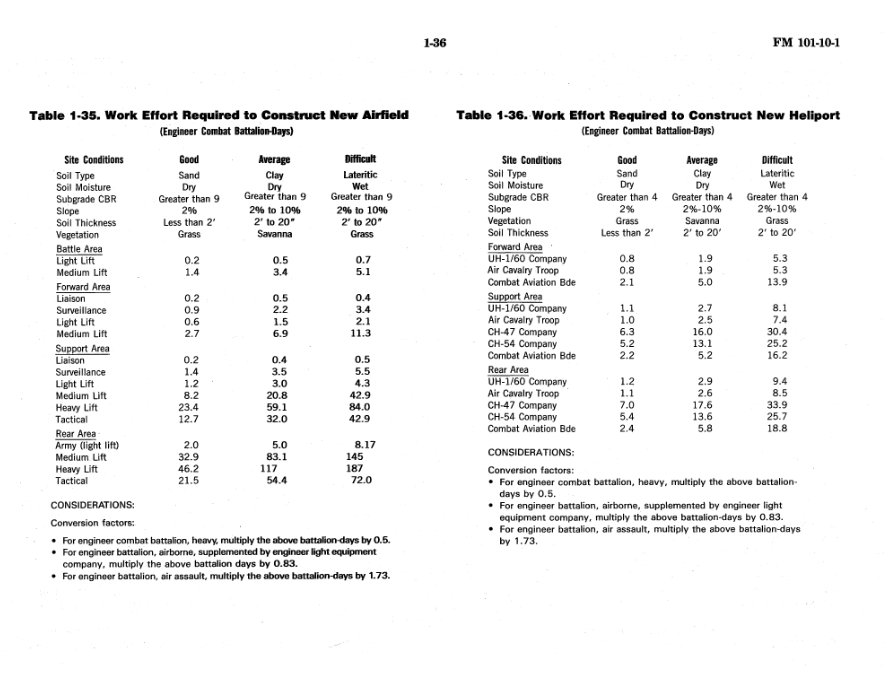
Notional airfield construction times from the 1987 Staff Officer’s Handbook

Although obviously outside the scope of this simple spherical cow chart, I do wonder when the point would come when more engineer battalions would pass the point of diminishing returns. Nine women can’t make a baby in a month, after all.

A Heavy OPFOR army/corps has an organic engineer brigade with heavy equipment that would presumably halve the time required. Fronts will also include at least one engineer brigade. The construction of airfields and other base areas is a stated mission of those high-level assets. (If only the Russians had spent 2021 building and refurbishing better depots right on the borders instead of just piling up the rusty AFVs…)