Courses of Action

So one of my concepts, well, anyway…

-Intact, with all the cancelled toys USSR going to finally rid themselves of the surviving Ceausescu (I’ve wanted to write a sort of “Soviet Gulf War”). Notably, the only ex-Warsaw Pact state that allows staging and troop support by this point is Bulgaria. (Bulgaria was considered the most politically reliable of them, being a longtime Slavic ally of Russia that did not experience much unrest before the fall).

-This was created using the amazing Map.Army program.

-Heavy OPFOR Operational says that high-level paradrops generally max out around 250 km from friendly troops (Which means 36 hours to catch up even under their most ideal advance rates, four days under the most ideal against a peer opponent, and at least a week under any kind of realistic resistance). The earlier Voroshilov Lectures say 150 km at most in conventional conditions.

That being said, the map!

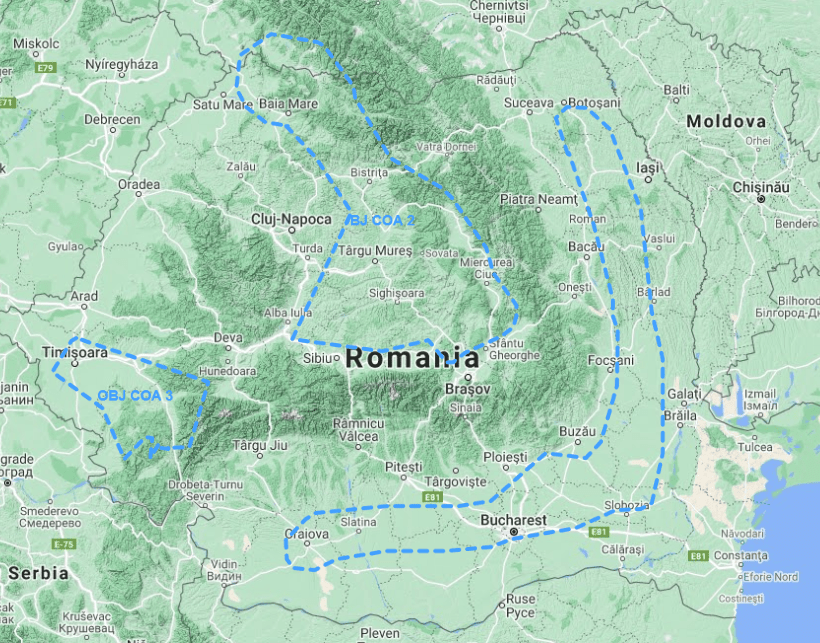
Three courses of action. These are not specific drop zones but general guidance areas, and yes, I did extend COA 2 into the Ukrainian SSR itself. OOPS!.

Course of Action 1 (not labeled but closest to the border) is the most tame, and features a variety of tactical close-to-support airdrops in the initial advance areas. Course of Action 2 is a deeper operational/strategic drop to secure the other side of the Carpathian Mountains. Finally, COA 3 is the deepest and most daring yet and involves having paratroopers land ultra-deep to quickly establish a presence in the Yugoslav/Serbian border to try and hold off any escape or resistance aid from there.

As for the rest of the plan, it’s pretty much Soviet boilerplate-blast through, charge deep. Bucharest is going to be encircled first and then left to second-line units (including Bulgarian ones) to actually reduce. Romania’s plan in this not-unexpected event was to just stage a prolonged unconventional resistance and use their inevitable-to-be-overrun regular units to buy a little setup time.

Review: Stalin Strikes First

World War III 1946: Stalin Strikes First

I’ve said before that I don’t really consider 1940s World War IIIs to really be in the same genre as post-Vietnam ones. However, they still meet the very basic definition. One such work was World War III 1946, which was involved in internet controversy about its quality and plausibility before it got commercialized. The first printed installment is Stalin Strikes First.

This is not the most ideal story. The first issue is that its writing system just isn’t that good. It’s a mixture of snippets, conference rooms, and vignettes that never really rise beyond exposition. The second and more fascinating issue is how the war develops, with the Soviets skill on the ground being downplayed while they pull one superweapon in an area of historical weakness after another out of their hats. There’s also a bit of taking primary sources too literally, especially dated ones. Imagine a 1980s World War III where the Warsaw Pact armies could consistently move at their maximum on-paper speeds at the same time that NATO air power was inflicting its maximum on-paper attrition and you’ll get the idea.

This particular book has the Soviets winning the initial advance. And not through their existing strengths or through Red Army-style showing how they can be more than the sum of their parts. No, it’s through author fiat handing them one victory after another on a silver platter. There is obvious enthusiasm put into this book, but I still cannot recommend it. There are just so many better World War IIIs out there.

Review: Super Tiger

Grumman F11F-1F Super Tiger

The original F-11 Tiger was just one of many 1950s flash-in-the-pan fighters. But there was a developed upgraded version that could have given it more staying power. In this book, former Grumman test pilot Corky Meyer tells its story.

There really isn’t that much to say about the airplane from a macro-technical point of view. It was basically an F-11 with a slightly different shape and a J79 engine (made famous on the F-4 Phantom). This gave it massively more thrust, to the point where it could hit Mach 2 in ideal conditions and reach the practical limit of performance for most fighters. The other unusual feature was that it carried a pair of Sidewinders on the top of the fuselage. From this emerged several other proposals. Described are a basic single-seat, a two-seater with Sparrows, a multirole non-carrier export version, and a reconnaissance aircraft with cameras.

Of course, the best and worst part of the book comes from the story of how it failed to gain traction. While Meyer’s deep connection to the aircraft meant he could say much about it, it also made him obviously biased when it came to its prospects. He was not the best person to give a fair evaluation of why it didn’t go anywhere. The reasons were the US Navy not wanting another jury-rigged shoved-in fighter when the F-4 was almost ready, the Air Force wanting the raw power of the F-104, and export customers facing a mix of Lockheed sleaze, a sales effort that Meyer admitted was understaffed and inexperienced, and the turn-off of the Americans seemingly not wanting it for themselves.

It’s still ultimately hard to feel too much sorrow at the loss of the Super Tiger. While it may have been safer than the F-104, it would still be a 1950s design in an inherently risky role if used the same way, and the accidents would have piled up regardless. Its role was soon successfully filled by the F-4 in American service and the F-5 (which ironically became known as the Tiger II) with export customers. But it’s a fascinating footnote in aviation history nonetheless.

Review: Air Battle Central Europe

Air Battle Central Europe

Alfred Price’s Air Battle Central Europe is a magisterial study of aviation plans for a hypothetical conventional World War III. What makes it different from other technical studies? The answer is simple-it looks at the whole and not just the sum of the parts.

In the interviews and discussions, every piece of the NATO air power puzzle is studied, and each role of each aircraft is talked about. The result is a lot of detail, and an important look at how combined arms works in the air. It’s both accessible and comprehensive.

There are a few sour parts. Some aren’t it’s fault, like the book being dated compared to a post-Gulf War understanding. The biggest issue I thought that was its fault was a willingness to talk more about the ideals of what air power would do than a stress-tested analysis that involved a worse case. But the book is still excellent and a must-read for anyone studying a conventional Fuldapocalypse.

Review: Postwar AANW

The Anglo American Nazi War: Part 2

The first installment of The Anglo American Nazi War, published as Festung Europa, has been reviewed on this blog before. Because the postwar part is A: different, B: worse, and C: deliberately not included in the published version, I figured it deserved a separate review.

The wartime portion can fit, slightly awkwardly, into a certain form of pseudo-historical fiction. For fans of conventional World War IIIs, it can be compared somewhat to Hackett and The War That Never Was. It’s a description of a conflict that didn’t happen written in the style of recounting one that did. There is thus a tiny connection to fiction in general, albeit with the thread leading to another very small niche. It also fits into “AH as a genre.”

The postwar installment lacks even that connection. It’s a pure example of internet alternate history, and one of the big problems I’ve had when trying to review is that internet AH is an extremely insulated subculture that lacks almost any tie to normal literary storytelling. How can you critique the characters if there are none? I’ve had to strain to explain it, with the best I can give being “The outline of a de facto fanfic that uses ‘history’ as its setting”. If that sounds unusual and bizarre, it is.

Internet AH has a reputation for its installments being extremely short, something that actually sets it apart from other serialized web-fics that have a deserved reputation for often leaving War and Peace and Atlas Shrugged in their dust where length is concerned. The more substantive wartime portion takes up over 86% of the words written in the story. What’s left is a series of short infodumps.

Here’s what happens. In an utterly ruined Eurasia, everything from the Channel-bordering regions of France returning to British semi-rule as crown dependencies to the US annexing the Russian Far East as “Western Alaska”, with it later becoming a state, occurs. There’s both a “Russia” and a “Soviet Union.” The remnants of Germany are divided into many Morgenthau Plan-style restricted microstates. All this is told in blocks of exposition that somehow feel even flatter than the wartime ones. Which is a shame because there’s both comparison to another alternate history (in this specific case) and a huge amount of lost potential.

The world that develops is one where the US builds lots of superweapons the author clearly likes, adopts a full-on might makes right policy, has the path cleared for cakewalks despite its historical postwar advantages and lack of historical rivals, and uses them frequently against totally ineffectual opponents who exist purely to serve as live-fire targets. This is very much like The Big One, except it lacks the utter audacity and, in something you’d never have hear me say earlier, literary skill of that series.

Instead of using the power of Mary Sue project management to get the superweapons into service without breaking the bank, postwar AANW just has the US continue to run what amounts to a total war economy, falling victim to the “nine women can have a baby in a month” fallacy of funding always equaling results. Instead of having immortal manipulators with catlike eyes provide unrealistic policy continuity, postwar AANW just has a lazy unshakeable consensus emerge. Even after the US destroys several German cities with space weapons after their uprising had been conventionally suppressed, the result is not a “you kicked them when they were down” backlash similar to the real one (however fair or not) over the atomic bombings of Japan, but rather the even more hawkish party gaining support.

What should be an audacious, massive divergence that could easily serve as the foundation for a distinctive work instead is summarized in only around two dozen pages worth of actual text. This is a shame because the premise of a superweapon-obsessed US that never truly left the wartime era (and its ugliness and excesses) behind could make for a great “AH as a setting” story. It could be a highbrow book about generational change, with the upheaval making the historical 1960s look tame. It could be a thriller as the nation with a bazooka suddenly faces problems requiring daggers.

Instead it’s just the outline of an even more biased late Tom Clancy novel mixed with map trinkets. Instead of being made into a potentially tasty meal, the ingredients were just placed in a bowl and left there, next to other bowls full of uncooked flour, eggs, and spices.

Review: North Korean Tactics

North Korean Tactics

One of the best OPFOR manuals I’ve seen, and one of the most recent, is ATP 7-100.2, North Korean Tactics. The manual itself is a good read, and the “Breaking Doctrine” podcast that comes along with does a great job explaining how both it and other OPFOR documents (a long weird guilty pleasure of mine) have come into being.

Thus the manual isn’t a direct “They will do this” the way that some of the more overly rigid Soviet-inspired ones were. But it does show the characteristics of the secretive country (light infantry, high willingness to take casualties, artillery over tanks, etc…) and has to focus on its specific qualities instead of just lumping them in with a generic OPFOR designed for challenge above adherence to any specific country.

It’s not perfect, but it’s intriguing and well-done, showing the seeming contradiction of mass asymmetric warfare in action. Ones for China and Iran are planned, and I’m awaiting them. (There’s one for Russia announced, but it’s kind of in limbo. My hunch is that the need for something so specific is less for a country that’s already studied and already fairly close to the generic OPFOR).

Review: Blood Brothers

Blood Brothers

I’d thought I’d read all of the books in the Black Eagle Force series, but no. There was a semi-spinoff series, the Mark Ingrham one. Blood Brothers is the first installment. Upon finding that out, I knew I had to get it. And I did. How was it?

Well, first, like every other Black Eagle Force book it is goofy, tasteless, and ridiculous. If I had to really rank them, I’d say this is a little worse than most of the rest. There are two reasons for this. The first is just because a lot of the structural issues are still there. The second is that there’s less focus on the unique “super-VTOL” elements and more on conventional action hero action. This isn’t a deal-breaker, but I’d recommend reading the “proper” BEF novels first.

Review: On The Path of Songun

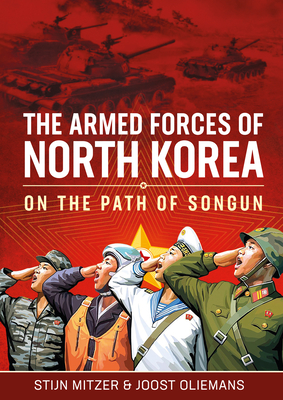
The Armed Forces of North Korea: On The Path of Songun

It’s been a while since I read a really, really good military nonfiction reference. Thankfully, Stijn Mitzer and Joost Olieman’s The Armed Forces Of North Korea: On The Path Of Songun takes the cake. The product of the same people behind the legendary Oryx Blog of military intelligence, this took a while to finally get going. Thankfully, it’s well, well, well worth the effort.

So why is it so good? Well, for a start, it’s incredibly well researched, written, and photographed. It’s not an OPFOR manual or a ridiculously broad order of battle chart. What it does do is go into legitimate detail and depth about the KPA and its rise, fall, and rise. What made me absolutely fall in love with this was how this is the rare military book that doesn’t fall into either extreme of “unstoppable or helpless”. When I saw the self-proclaimed intent to the debunk the notion that the KPA wasn’t/isn’t a threat, I feared it would go too far in the opposite direction.

That was not the case. I was treated to a very evenhanded look that amounts to “Yes, there’s modernization, yes there’s legitimately advanced indigenous developments, but as of now it’s limited and foreign support is undoubtedly there” and doesn’t hesitate to point out their shortcomings and material issues. The authors are even good at pointing out what they can verify and what they can’t, a must for dealing with a country as secretive as North Korea.

For enthusiasts, general audiences, wargamers, and anyone, really, this is a great book that I highly recommend.

A Thousand Words: The Blue Max

The Blue Max

A classic World War I aircraft film, 1966’s The Blue Max is the story of Bruno Stachel, a self-absorbed, vainglorious fighter pilot in the German military. How does it hold up today? Well, I think it suffers from being a product of its time, although not in the way one might think.

For its time, the aerial flying sequences and acting are very good. For its time, it’s an edgy and hard-hitting movie compared to the stereotypical John Wayne fluff of war movies past. Yet by modern standards, it pales in comparison to what post-Vietnam war films have to offer. Still, that’s through no fault of its own and it’s still a very good historical fiction film.

As an aside, I’ve heard it’s one of the few movies to depict largely realistic air combat maneuvering. Later movies have gone for more visually impressive but less practical aerobatics. This goes for wider, bigger turns. It may be a virtue made out of necessity with the lower-performance planes involved in production, but it’s still interesting to see.

Drones of the OPFOR

As some of the OPFOR documents were published as the UAV revolution began and as they were based on countries known to have substantive drone programs/the means to obtain high-quality commercial ones, it’s not surprising that remote vehicles play a role. In the 1990s documents, they are referred to as “RPVs” (Remotely piloted vehicles)

The American Heavy OPFOR is mentioned as using multiple kinds of drones. Its operational/strategic drones are mentioned as having a maximum radius of around 300 kilometers. Divisions have smaller RPVs for spotting purposes. The Light OPFOR has similar units in its better-equipped formations.

The British GENFORCE-Mobile Forces goes into more detail.

  • A combined “reconaissance-strike” UCAV that can spot AND attack.
  • Strategic groupings/fronts have an UAV with a 500km range, armies/corps one with 300 km.
  • Divisions and brigades have “long” range (70 km) UAVs and “short” range (30 km) ones.
  • Artillery regiments/brigades have organic 50 km range UAVs for spotting and laser-designating for smart weapons.

The figures stated are somewhat generic, especially for the bigger and/or more advanced ones, but given the giant number of UAVs in service/development (and undoubtedly even many more since that chart was published around ten years ago!), it’s easy to find representative platforms.