Review: Operation Zhukov

Operation Zhukov

It’s been a while. But John Agnew’s Operation Zhukov has brought me back. Back to the time when I started Fuldapocalypse.

So in an alternate 1992 with the USSR still going, the just-reunified Germany clashes with Poland, and it expands into a (conventional) Fuldapocalypse. And yes, there is a reference to the Fulda Gap, although most of the action follows British units farther north.

And this brought a weird feeling to me, a feeling of strange comfort and nostalgia. This is a book of constant clunky jumping around between paper-thin Steel Panthers Characters who exist purely to operate military equipment. This is a book of conference room and makeshift conference room infodumps. This is a book of clashes too grounded and technically “realistic” to be over the top fun but too detailed to be genuinely realistic (what fog of war?).

Because of all that, it’s a callback to the day where I was expecting to review books in a spectrum so narrow that I’d highlight the (in)accuracy of tank unit TO&Es to see how the book differed from the others in the pack. Here, I can say that it has more accurate T-80s in the GSFG arsenal and not the more commonly used but technically inaccurate T-72s. A similar pattern exists throughout the entire book-while there’s undeniably some issues somewhere in the “there’s this many roadwheels on this type of tank” type of description, I didn’t see any big red flags (no pun intended).

I would probably have been frustrated with this book had I read it some time ago. Now, knowing that there are many individual authors who’ve written more books than the entirety of the “Conventional World War III” genre, I feel strangely nostalgic.

This kind of book isn’t crowding out any genre and isn’t setting any bad trends. This specific book isn’t badly made for what it is, not having any truly massive errors or truly gigantic bloat. Yes, I consider it a little flat, but “flat” isn’t the worst thing a book can be. Operation Zhukov can be summed up as the World War III version of Marine Force One, a “51% book” that fits its (in this case, narrow) genre with the most basic competence but doesn’t go above or beyond it.
A Thousand Words: Dr. Strangelove

Dr. Strangelove

Welcome to A Thousand Words, my attempt to expand Fuldapocalypse into visual media. Since this is a blog that’s technically about World War III, I figured I’d open it up by reviewing the movie that probably, more than any other, represents World War III in popular culture. This movie, obviously, is the Stanley Kubrick/Peter Sellers classic Dr. Strangelove.

The movie itself is excellent. I could complain about how some of the humor seems a little forced at times, but the positives vastly outweigh the negatives. It’s a classic for a reason.

What I find more intriguing is how utterly different Dr. Strangelove is from, say, Red Storm Rising. The entire plot centers around nuclear war, as opposed to the sidestepping most of the “WW3s” I knew did. It’s started by an American general, and there are only a few characters. Granted, some of this is the movie format at work, but still.

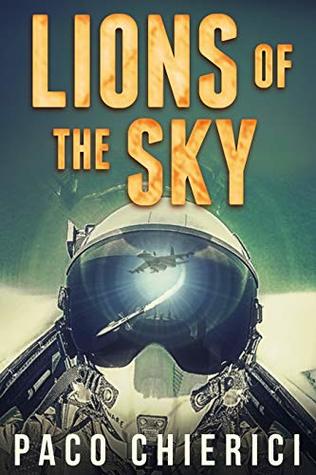
Review: Lions of the Sky

Lions of the Sky

lionscover

The F/A-18 centric Lions of the Sky is naval aviator Paco Chierici’s first novel.

If I was to make a comparison, I’d say it’s like a modern version of Sweetwater Gunslinger 201 with a few more technothriller elements thrown in. Or, to use a less obscure pop culture reference, a modern version of Top Gun in print form with somewhat higher stakes.

I’m willing to forgive a lot of the roughness in a first novel, especially if I ultimately still found it enjoyable (which I did). Yet I feel obligated to point out that it is indeed there. The problem is that the sum of the parts seem like more than the whole. In particular, the entire “Spratly Islands Technothriller Plot” that winds in and out through the book is the least interesting part of it. What went through my mind as I read every section involving it was “it didn’t need to be like this. To set up the final action set piece, there doesn’t need to be a stakes-raising gimmick like what happens here.”

Beyond that, it doesn’t flow the best. There’s no real exact way to describe it and it’s clearly just the rough edges every first novel has, but the slightly clunky pacing is still apparent.

When the actual aircraft action scenes occur, they’re well written. Many of the on-the-ground relationship scenes are also well written. There’s definite talent here, and I hope, if/when Chierici completes any more books, he plays to his strengths and makes it a little more coherent in one direction or another. Lions of the Sky itself isn’t bad by any means, but it still feels like just a decent orange dish that has a few apple slices awkwardly stuffed in.

Review: Deep Blue

Deep Blue

Reading Deep Blue, one of the later John Schettler Kirov books, brought a strange feeling to me.

Reading it, I encountered all of the issues with Homecoming, the previous book in the series I’ve read. And then some. The almost interchangeable battles are over-detailed and underwhelming to an extreme. The plotlines are clunky and shoved together. By all “normal” accounts, I should have been dismissive at best and disliking at worst. But I just wasn’t. As I read through tons of time-travel shenanigans, I felt a sense of “woah. Wow”, for lack of a better phrase.

It hit me when the ship time-warped from the current near-future World War III to another near-future World War III, only with different equipment and different sides. Everything just then clicked suddenly into place.

This is kind of like the later Survivalists-if Ahern had meticulously simmed every clash in Advanced Squad Leader or something like that and recorded the verbatim results in the books. And the time travel isn’t just a small throwaway part-it’s a a big central element, with a huge effort towards enabling this kitchen-sink wargaming. It’s like having a zombie sorceress start a Fuldapocalyptic World War III, and devoting a lot of effort to her, her rivals, and her powers as you move from 1985 to 1988 to 1981 to a 1986 with the YF-17 chosen as the light fighter and the British using a different divisional structure.

I still don’t recommend the actual books, unless you like lots and lots of barely disguised wargaming AARs. But if I had to choose a series with a lot of novelty and effort put into it or a series that just clunks along without any of those, I’m definitely picking the former. The sheer excess of the Kirov series makes it at least interesting.

Review: War Breaks Out

War Breaks Out

When I got Martin Archer’s War Breaks Out, I was expecting a plodding Cold-War-Turned-Fuldapocalyptic-Hot story. The initial premise and the mediocre experience of the previous book I’d reviewed, Israel’s Next War, made me think that. Instead, I got one of the most crazy and just plain out-there examples of a World War III story I’ve ever read.

  • The timestream got scrambled. There are Eurofighter Typhoons and people who were injured in the Iraq and Afghanistan wars, but at the same time there’s a 1980s WWIII and everyone is using M60s and T-62s. Oh and Belgium has F-15s for some reason.
  • We’re introduced to the main character (who frequently appears in a weird form of first-person similar to that present in Israel’s Next War) immediately. He’s a one-star general who gets a quick promotion worthy of spacesuit commandos. The president decides he’s just that good, and needs a fighter, not those deskbound bureaucrats! (To be fair, this is officially the third in a series with the same main character, but still).
  • Said main character promptly comes up with a bunch of gimmicky tricks and special ops to turn the tide of the impending war against the USSR. These range from tricking Soviet AWACS with mass transponder changes to landing troops with ferries in the Baltic. Naturally, they all work.
  • The actual battle scenes themselves are the least amusing and most clunky and repetitive. Except for something I haven’t seen in a while-the attempted Soviet invasion of Iceland! It’s been a while, Ísland. I missed you!
  • The book ends with one of the most ridiculously blatant examples of “Foreshadowing” for the next installment in the series that I’ve seen. It’s not foreshadowing so much as building a city of giant neon signs indicating the plot point, then causing it to be lit up in a giant fireworks display that’s internationally televised, telling the plot point in a Super Bowl commercial, and then carving the plot point into the moon for good measure.


This was an experience. It’s probably as bad as “World War 1990” in terms of pure writing quality, but I had a lot more fun reading (and reviewing) it. I guess a better example would be an even more rough version of Ian Slater.

Review: Red Storm Box Set

The Red Storm Box Set

James Ronsone and Miranda Watson’s “Red Storm” series ran for six books. The omnibus box set I bought contained the first three- “Battlefield Ukraine, Battlefield Korea, and Battlefield Taiwan”.

This checks all the boxes. Lots of conference room infodumps with generals and leaders? Check. Huge descriptions of everything? Check. Characters whose sole characterization is at best an infodump and (more frequently) at worst a “Steel Panthers Characterization” where they’re just paper placeholders who crew military equipment? Check. Hopping around viewpoint characters around the world with what feels like no rhyme or reason? Check. And the cherry on top is the Hackett-style “city trade” plotnukes, as Oakland and Shenyang go boom.

This is what I thought I’d be reading en masse when starting Fuldapocalypse. Thankfully, it hasn’t been what I actually have been reading. Reading countless non-dry, non-World War III books has allowed me to view this in a better perspective than I had before. In the past, I’d have probably just denounced it with a combination of fire-breathing and eye-rolling.

I still view this as a subpar book-it’s in the awkward, neither fish-nor-fowl area of being too “literary”, gimmicky, and inaccurate in a rivet-county way to be a War That Never Was-style pure play by play while being too bland and disjointed to be an actual literary book. But now I can weirdly appreciate it for trying to scratch a specific itch. My mindset has gone from “this is bad” to “this has flaws and isn’t really my thing.”

If a sort of “Hackett but with some technothriller gimmicks” style book is your thing, you could do worse than this series.

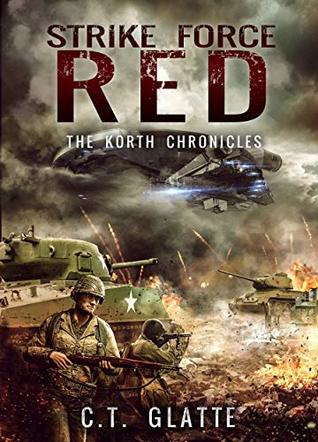
Review: Strike Force Red

Strike Force Red

strikeforceredcover

C. T. Glatte’s Strike Force Red is an alien World War II. The book might invite comparisons to Harry Turtledove’s Worldwar series, but is actually much different.

Aliens, wishing to take over the world to repair their damaged spaceship, land, kill Hitler, make Stalin into their pawn, and then proceed to form a League of Evil with everyone from Mao to Vorster on their side before sending a Soviet army to invade Alaska. Opposing them are, of course, the Americans with anachronistic P-51s (with even more anachronistic female pilots) and Sherman tanks.

So, I’ll get this out of the way. Historical war novels are generally not my thing. Especially not World War II novels. I’m just weird in how I judge them, and a lot of my feelings on the genre can be boiled down to “if I want to read about a historical conflict, I’ll read a history book”. So I’d be lying if I said this bias wasn’t slanting my review.

That being said, this book has a lot of wasted potential. High on the list are the aliens themselves. They’re mustache twirling puppy kickers who fail to be anything but the sort of “pop-up antagonists” usually reserved for spacesuit commandos. They’re not complex or developed or deep. Improving them would be easy as sincerely believing their rule to be ideal for humanity’s improvement (like XCOM’s Ethereals) or being able to be better than Stalin and thus inspire genuine loyalty among their subjects would make them more interesting. Or both-they clean up and improve in authoritarian and/or war-torn areas, earn the loyalty of the populace, and then find that wealthier, freer countries don’t take as kindly to them.

Barring that, they could at least be entertaining space opera megalomaniacs. They’re not. The aliens come across as being like washed-up actors who are desperate for a paycheck, so they put on the rubber alien suit and phone in their lines for the B-movie they hate but do anyway for the money.

But even higher is the technology, which seems very unimaginative. I don’t expect a deep examination of industrial capacity in the 1930s, but going straight to P-51s and Shermans in 1940 because those are the most famous is both inaccurate and dull. Likewise for T-34s and “MiGs”. The alien technology is rarely exploited and, in practice, amounts to just a way to get a Soviet army over to Alaska. It’s like a Fuldapocalyptic story where in 198X, a zombie sorceress full of magic explicitly appears and starts World War III-and all she does is torture animals for fun and move a motor rifle brigade to Iceland.

This book should have featured multi-turret tanks with deathrays against American Heroes in pulp science contraptions. Instead it’s just a rote war drama with all of the potential it had in its plot left unexploited.

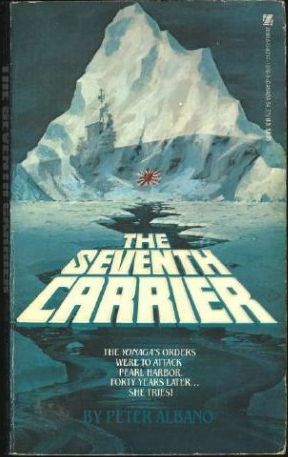
Review: The Seventh Carrier

The Seventh Carrier

coverseventhcarrier

Peter Albano’s The Seventh Carrier is one of those novels that rivals even Lunnon-Wood’s Dark Rose for “most ridiculous premise yet”. In it, an American boat, and later a Coast Guard helicopter are attacked by something using World War II Japanese ammunition. There are rumors that it’s some kind of privateer using surplus weapons, but it’s not, as the survivors of the boat, held captive, can attest.

It’s the Yonaga, a fourth Yamato hull, turned into a carrier like Shinano. Kept hidden in a cove, it was frozen for forty years. According to the book it was because of a glacier rockslide, but I know a zombie sorceress froze it with her fimbulvter ice magic. They survived (not in suspended animation) by, among other things, tapping into geothermal steam power. Then they eventually attack Pearl Harbor anyway with their propeller planes and do better than they ought to. This is not the kind of book where thinking about how things in it would plausibly happen is encouraged.

The action is good, even if it’s somehow both a little kooky (guess why) and a little rote (a few too many exact descriptions of what the aircraft did). The characterization is not. To say that the portrayal of the Japanese is stereotypical is like saying that Manute Bol was a little tall, and the other characters aren’t much better.

It’s not the worst book ever, but like Dark Rose with its Libyan-Palestinian invasion of Ireland, The Seventh Carrier is better for the ridiculous novelty of the premise than the actual substance of the execution.

Review: PRIMAL Unleashed

PRIMAL Unleashed

primalunleashedcover

PRIMAL Origins was good. PRIMAL Unleashed is better. Here Jack Silkstone hits his stride with the super-agent supermercs as they fight warlords and arms dealers in a struggle from Afghanistan to Eastern Europe and beyond. To be honest, it felt a little like X-COM, only against terrorists instead of aliens.

It’s just a really good example of a cheap thriller that hit all the right notes. The plotting and pacing are well done. The action manages to be well done with just a touch of grounding even as spectacular feats are performed. The enemy is credible (from a challenge standpoint) and Silkstone isn’t afraid to have them do damage to the heroes.

There’s also, completing the puzzle, a diversity of action that fits very well. It isn’t just a classic Gold Eagle-style “a few guys with rifles”. There’s scenes in APCs, shootouts, and aircraft attacks. This feels closer to the ideal of “a more serious Mack Maloney” I’ve always sought than any other book I’ve read in quite some time.

It’s also an example of the post-2000 technothriller. Which is to say, it’s a story of super-technology and special forces as they fight to stop the villains from taking the MacGuffin. But here, it’s done right. I highly recommend this book.

Snippet Reviews: June 2019

So this “snippets” feature is here so I can share books I recently read, but which I would struggle to write in a longer review. So here it goes.

Third Law: Let It Burn

Third Law: Let It Burn is the sort of throwaway cheap thriller it’s hard to write about. It’s at the prose level of a lower-grade self-published book and with a lot of really blocky paragraphs. But at the same time it’s not totally bad, and it worked for a day’s read. The only thing really interesting is that it’s one of the first books I’ve read since Ian Slater to have a domestic militia as the antagonist.

Sweetwater Gunslinger 201

William LaBarge’s Sweetwater Gunslinger 201 is basically “Herman Melville, but with aircraft carriers”. This is not an insult. It’s the story of fighter pilots on an aircraft carrier, not facing any technothriller-level threat (but indeed facing the Libyan Air Force over the Gulf of Sidra-it had to have some action). Good for what it is.

Texas Lockdown

Robert Boren’s Texas Lockdown is the first book out of thirteen in the Bug Out: Texas series, which is itself a spinoff of the Bug Out series (13 books) and Bug Out California (15 books). It’s a combination invasion novel, survival novel, and (unsubtle) political novel. It’s adequate, if cliche, and its focus on the characters makes it better than some. But I’m skeptical as to it being a good starter for a series that long.