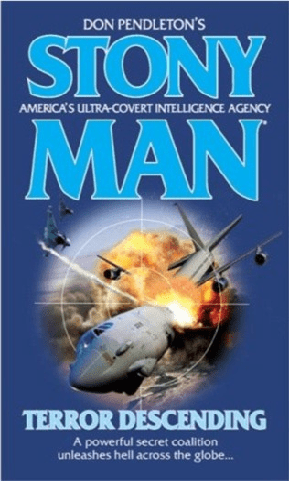
Review: Terror Descending

Terror Descending

terrordescending

When I browsed the Stony Man Executioner spinoffs on mackbolan.com , I followed one of my personal rules-when in doubt, go for the most ridiculous. Upon seeing the ridiculous commentary about Terror Descending, I went “go for it” and got it.

A 1960s relic left-wing terror group is using B-52s disguised as 707s to hit targets around the world with the aid of Cray supercomputer-launched cyberwarfare, and the Stony Man Farm team must stop them. This zombie sorceress-licious premise made me get the book. One reviewer compared it to a Mack Maloney book-this especially made me want to get it.

Terror Descending has the problem of “going into big technical detail and getting it wrong” with a vengeance. “F-17 Eagles”, F-22s staging from aircraft carriers, B-52s being “common” with thousands built, B-52s being disguisable as 707s, “Chinese-made Stingers”, and “MiG-8” fighters. And that’s without the “interesting” aircraft procurement this world has made (Austria uses F-14s). Oh, and despite the book being released in 2009, “Yugoslavia” still exists. This would have been more of a problem if I had the slightest expectation of genuine realism out of this book. Fortunately, I did not. The Mack Maloney comparison is very apt indeed.

Terror Descending, like the previous Gold Eagle Bolan Season of Slaughter, is rather overstuffed. There’s everything from skinhead gangs to airstrikes to a dogfight over Chad to every single flashpoint in the world from the Aegean to the Korean DMZ flaring up to South American prisons. And that’s just the villains. Having to use both Able Team and Phoenix Force as the heroes doesn’t help matters. While workable, the action isn’t good enough to really compensate for all of these flaws.

Still, I’d rather have “fun/crazy bad” than “dull bad”, and Terror Descending is definitely the former.

Review: Fortunes of War

Fortunes of War

While Stephen Coonts is one of the classic technothriller writers, I’d actually never read any one of his books in full until now. Picking Fortunes of War, a late 1990s technothriller after his sales had peaked, is kind of like wanting to start listening to Yes with Big Generator.

Now that that shoved-in prog rock reference is out of the way, I was interested in this because of its depiction of a second Russo-Japanese War. One of my Command Live scenarios deals with such a thing itself, so I was curious to see how a spectacularly successful author handled it.

Who and What

Let’s see, an unconventional opponent (Japan) with some sort of super-gimmick weapon (Super fighter aircraft),  attacks a helpless Russia for zombie-sorceress induced reasons. This is very 1990s technothriller. In fact, this is one of the most 1990s technothrillers that ever technothrilled in the 1990s, even more so than poster child Cauldron. The 90s contrivances are there, and the technothriller “snapshot and superweapons” model, going from aircraft to submarines to dogfights to knife/fistfights is there.

Apart from that, it’s a little iffy with characterization (even by the standards of the genre). The American “Volunteer” F-22 pilots are too numerous and the book too short to really examine in depth. One final bit of serendipity happens in this novel. The villainous Japanese Prime Minister is named “Abe“-I was reminded of The Hunt For Red October having a “Putin” in it as well.

DEEP HISTORY OF TEM

This is slightly less infodumpy than the absolute worst the genre has to offer, although it’s still very, very description-heavy. One interesting part is that Coonts can leverage two pieces of genuine but “new enough to be exotic and techno-thrillery” technology-the F-22 and JDAM-style munitions.

Zombie Sorceresses

Ok. Apart from the geopolitics (Belligerent Japan, Russia being worse than it was even at its 1990s nadir), and the technology, the big zombie sorceress contrivance is in nuclear weapons. Russia has disarmed (almost) all of its nuclear weapons as a foreign aid condition so that the conventional invasion of Siberia, but kept a few for the plotnuke climax. Japan has developed a few in secret, also for the plotnuke climax.

Tank Booms

There are two types of action scenes in this book. The first are the aerial combat scenes, something which the Distinguished Flying Cross recipient Coonts knows very well. The second are the technothriller/action scenes like fistfights or anti-submarine warfare that he doesn’t have as much firsthand experience with. And it shows.

Even the former are let down a little by a few too many exact-detailed “and the missile exploded in exactly 2,003 fragments, turning the enemy plane into 1,200 fragements and its pilot into 320 fragements” scenes.

The Only Score That Really Matters

By the standards of 1990s technothrillers, this is very good for what it is. It’s technically competent and has its authors expertise in his subject matter carry it above the pack. But in some ways it feels more artificially stilted, like its creator’s most vigorously creative days are behind it. So, suspiciously like 1980s Yes (to swing back to progressive rock).

Still, it makes me want to check out Coonts’ earlier books, and that’s endorsement enough for me.

Review: Strikemasters

Strikemasters

Mack Maloney’s Strikemasters follows in the footsteps of his earlier “Wingman” books, being set much later and with a much different background, but maintaining the elements that made that novel so much fun.

Who and What

The book can be summed up as “Special Operations Forces in super-powered C-17s fight terrorists in a super-powered mountain fortress.” It’s the sort of bombast that characterizes Maloney’s work and makes it able to navigate the dark technothriller decade of the 2000s without many problems.

And to his credit, Maloney is not afraid to throw challenges and imperfections at his super-characters and super-planes. He’s not afraid to kill central characters off. Doing this while going full-crazy ahead might be dissonant on paper, but it works here, being a writer who can have his cake and eat it too.

Of course, the characters, good and evil, are little but shallow stereotypes, but this is the kind of book where this isn’t that big a deal. And the last part of the book is a little rushed. But this also isn’t that much of an issue.

DEEP HISTORY OF TEM

Yes, we do get huge, loving descriptions of the super-tech. Why did you ask?

Zombie Sorceresses

Like every Mack Maloney novel, this book is full of bombastic, ridiculous super-contrivances. But it strangely doesn’t feel as contrived. A lot of technothrillers are stuffed with what Nader Elfhefnawy rightly calls the “illusion of realism” . As they became steadily more ridiculous, this issue amplified. The pure bombastic unrestrained “go for it” attitude of this book and Maloney’s others solves the problem.

Tank Booms

The action, as mentioned above, manages a good balance between “over-the-top” and “challenging”. It could have failed in either direction. It could have had a jarring effect of flaws clashing with the “look at the superplane go!” It also could have had the superplane effortlessly cakewalking to victory. Strikemasters did not fall into either pit, and is all the better for it.

The Only Score That Really Matters

This is another excellent Mack Maloney title, with him being able to leverage his strengths to make a tale of super C-17s doing superpowered feats in a well-told fashion. Highly recommended.


Review: Carrier – Enemies

Carrier: Enemies

The “Carrier” series was a long-running series. When searching for books in it to read and review, I followed my famous rule: When in doubt, go for the most outlandish. The enemy of this book, the fifteenth of the series, is…. Greece. How could I resist?

Who and What

As the Greek-Macedonian conflict (at least a strange version of it) heats up and a news helicopter is brought down by a Greek Tomcat on a false-flag mission, Admiral Matthew “Tombstone” Magruder and the carrier USS Jefferson goes to the region to enforce peace while a reporter who survived stays on the ground amidst the Macedonians. And that’s about as coherent as it gets.

There are really two parts of this book. The first is essentially applying the technothriller “top-to-bottom” viewpoint style to the “low budget assembly line book” quality level. So there’s the conference rooms, the scrambling reporter, the subplots, and the aviators themselves, all done in a slapdash style. For instance, the main antagonist is a general but is called an “admiral” in one passage. Then there’s the small problem of the book’s ending being abrupt and simply unfinished. That’s the boring, bad part.

The second is the goofy part. Greeks with bad names flying F-14s. An evil general launching a ridiculously obvious (to the reader) false flag plot. A main character with the nickname “Tombstone.”

DEEP HISTORY OF TEM

There really aren’t that many “The F-111F triggered the Pave Tack and dropped a GBU-12B straight on the Spoon Rest” moments in this book. There are, however, a lot of conference room scenes.

Zombie Sorceresses

The zombie sorceresses were changing everything from Greek aircraft procurement to naming customs to the nature of the Greece-Macedonia conflict to well, almost everything.

Tank Booms

The actual action isn’t the best. Most of the dogfights between aircraft feel like fanfiction of the Top Gun movie from someone who has that and maybe one other technothriller as their sole source for aerial combat, and there isn’t much “adrenaline”, for lack of a better word. Constantly cutting back to conference rooms doesn’t help.

The Only Score That Really Matters

Like Ian Slater’s USA vs. Militia series, this book is the kind of thing someone like me would find more appealing than a “normal” person probably would. The plotting and action is too dry, badly done, and generic to hold that much appeal, but the premise and excesses were music to my ears. But even they can’t stop the very bad fundamentals this book has.

Review: Defcon One

Defcon One

Joe Weber’s Defcon One is a late Cold War technothriller with one unintentionally prescient scene and a lot of iffy clunkiness.

Who and What

This is a very stock technothriller. It’s also a very boring techno-“thriller”. Which is a shame because its nuclear “almost-war” could have been better in defter hands. Instead it has supervillain Soviets and makes what should have been a second Cuban Missile Crisis look very boring. It’s technically competent, but also dull and feels from start to finish like it’s just going through the motions of what a technothriller is supposed to be. “Superweapons. Check. Action. Check. Conference Rooms. Check. Lots of Viewpoint Characters [who aren’t developed even by genre standards]. Check.”

The creepy and unintentionally prescient scene is having the Space Shuttle Columbia get damaged in space and then be destroyed during reentry. The book was published in 1989, 14 years before that happened in real life.

DEEP HISTORY OF TEM

Not only are there lots of infodumps in Defcon One, but they feel sort of-forced. Like it’s “I have to describe what this aircraft engine is”. Weber is a former Marine aviator, but at least in this book he fell too often into the trap of “I know the exact designation of a Scud TEL, and I’ll share it” that some writers with genuine expertise fall into.

Zombie Sorceresses

Let’s see, the initial push, the too-neat final resolution of this (even Arc Light did better), and the general “supervillain Soviet” trend. A goofier premise might have helped it along.

Tank Booms

There’s some fighting at sea, having spies run around in the USSR, and having the occasional superweapon-beam destroy a space shuttle. The action describes the biggest problem that DefCon One has-it’s too exaggerated to be a good grounded highbrow story, but too tame to be a good cheap thriller.

The Only Score That Really Matters

Defcon One is well-put together, especially for the first novel that it was. I just found it dull and kind of an “IKEA Technothriller”. It has the contrivances and structure of a technothriller, but surprisingly few actual thrills.


Unstructured Review: X-Wing Series

As a kid, I inherited (and read) a lot of my family’s old Star Wars novels. The most relevant to Fuldapocalypse and most fun are the X-Wing novels by Michael A. Stackpole and the late Aaron Allston. For books that are both movie tie-ins and video game tie-ins at the same time, they’re actually really good.

Especially Allston’s. The Wraith Squadron series are a combination Dirty Dozen and fighter story (and yes, fighter pilots somehow turn into effective commando-spies. But this is Star Wars), and manage a degree of emotional height (Allston’s not afraid to kill off developed sympathetic characters) and comedy (such as someone having to fly into battle with a giant stuffed Ewok in his lap-long story) without feeling jarring at all.

Stackpole’s books are more formulaic, less daring, and he has the tendency to take game mechanics a little too literally, but they’re still solid and still better-scaled than a lot of the other Star Wars books of the time period (which have all the antagonist problems of 1990s technothrillers and then some).

Technothriller authors could do worse than read these. They’re good examples of how you can manage a decent-sized cast and medium-scope story, and they’re fun.


Review: Thunder of Erebus

Thunder of Erebus

Thunder of Erebus may just be the technothrillerest technothriller that ever technothrilled. I’ll probably eat those words, but I don’t say this lightly either. And it’s not a bad thing.

Who and What

The book features a Soviet-American battle in Antarctica over a rare element. When reading it, I checked all the technothriller boxes. Land battle! Air Battle! Sea Battle! Soviets who only really win anything with their zombie sorceress superweapons! Viewpoint characters galore!

But more importantly, this was the clearest kind of technothriller that really emphasized the “techno-” part. Technology is both the goal and the process, be it real platforms or the ASBM-torpedo dispensers. By being so blatant, it cleared up a very blurry genre.

And the prose is-interesting. There’s a lot of flowery descriptions that made me smile, starting with  someone being “So thin that his polyester uniform seemed to be draped on a coat hanger instead of a human frame”, and only getting ‘better’ from there. Despite (or because of) this, it flowed well, which is good because…

DEEP HISTORY OF TEM

Not only does the “technothriller trope bingo” extend to infodumps, this book also has an infodump that states that an infantry division with the word “light” in its name is, in fact, a light infantry division. Yes.

Zombie Sorceresses

There’s every contrivance needed to have a giant battle take place in Antarctica.

Tank Booms

There are M1 tanks booming in Antarctica, and boomer submarines booming, and aircraft booming. The “maximum technothriller” and “flowery prose” apply to the battles as well.

The Only Score That Really Matters

This is it. A 1991 (year of the USSR’s collapse) maximum technothriller. Everything technothrillery in one package. I didn’t find the cliches grating-I found them, and the book, entertaining.

Review: Wingman

Wingman

Mack Maloney’s Wingman kicks off a post-apocalyptic fighter pilot series that is pure undistilled, full-strength, high-dose 80s ridiculous fun. I was reminded of everything from Iron Eagle to Area 88 to just goofing off in the Command: Modern Air/Naval Operations scenario editor.

Who and What

Wingman is the story of Hawker Hunter (the name is not a coincidence), a fighter pilot who flies in the shattered remnants of the US after an apocalyptic third world war. It is the story of his super F-16. It is the story of Hunter fighting lots and lots and lots of stock 1980s Post-Apocalyptic Bandits and enemy fighter aircraft of both western and eastern design. It is the story of Hunter bedding beautiful woman after beautiful woman. It is the story of Hunter going to various theme park apocalypse cities and places.

It moves very well and has all the characterization you’d expect from a cheap thriller. And that’s all it needs.

DEEP HISTORY OF TEM

The infodumps are there, but they don’t really feel like that much of a burden. The book flows very breezily, and it feels like everything is part of the fun. I feel obligated to say that a lot of technical description is (brace yourself) not the most realistically accurate.

If you have strenuous objections to this, please do not read the book. Otherwise, enjoy how an F-16 equipped with six 20mm Vulcans and ship-busting Sidewinders can blast its way through the competition.

Zombie Sorceresses

It would be easier to say “what did the zombie sorceresses not have to set up?” when describing the plot of this book. Most of the aircraft in this book have the same names as historical ones, and that’s about it.

It’s crazy. But it’s a good type of crazy.

Tank Booms

With the exception of a clunky out-of-the-cockpit action scene in the middle of the book, the action is ridiculously over the top and well-done. Yes, it’s as out-there as everything else, but it’s fast and novel.

The Only Score That Really Matters

This is one of the most fun cheap thrillers I’ve read in a while. I highly, highly, highly recommend it.

Review: Season of Slaughter

Season of Slaughter

It’s time to fast forward several decades from the debut of Mack Bolan. Now he’s the well-established king of the adventure novel with many spinoffs and many, many more novels to his name. A more recent Bolan, 2005’s Season of Slaughter, is the subject of this review.

Who and What

Bad guys do something very bad at the beginning. Mack Bolan and company move to stop them from doing more bad things. Simple cheap thriller plot, simple cheap thriller characters. Although I have to say there are a lot of characters here, contributing to the “overstuffed” feeling of the book. I have a slight hunch that some may have been there to let a casual reader notice that the spinoffs existed.

The prose unsurprisingly feels like an action movie in words. Characters firing Desert Eagles and skidding safely away from mammoth fireballs.

DEEP HISTORY OF TEM

There are the usual gun infodumps, and a very, very detailed infodump about a super-helicopter used by the protagonists. Only a few of these infodumps go to ‘waste’ in that they’re totally irrelevant, but many of them are gratuitous. Of course, this entire book is gratuitous.

Zombie Sorceresses

Apart from the action novel contrivances, the choice of villains is less zombie-sorceress than you might think in one way. It’s an alliance between Islamist terrorists and white supremacist terrorists. This is handled with a surprising amount of deftness-it’s treated only as a teeth gritted alliance of convenience against someone they both hate and nothing more.

Of course, they’re coordinated by a cartoon anarchist group and backed by supermercs, so the zombie sorceresses reassert themselves there.

Tank Booms

The “overstuffed” nature of the book is nowhere more apparent than in the action. There’s a lot of action scenes shoved together into this fairly small book, from fistfights to helicopter dogfights. The action can still be blurred and clunky at times, but one advantage of the many characters is that it allows for diverse fights.

And to be fair, this kind of book is the kind where you expect lots of action. I’d rather have too much action in a cheap thriller like this than too little.

The Only Score That Really Matters

This is an assembly-line book, and it shows. But it works as an assembly-line cheap thriller. The first Mack Bolan was a late 1960s cheap thriller, while this is a 2000s cheap thriller. This has explosions and Mack Bolan action, and that’s what’s asked of this kind of story.


Unstructured Review: The Big One

About a decade ago, I saw a thread on Spacebattles and got a self-published book that set me on a path. I still can’t make up my mind whether that path was for better or worse, or if that one thriller really had too much of an influence. But that book was Crusade, in The Big One series.

The thing about stuff like this was that it was part of my strange experience where I often experienced the imitators and follow-ons first, and only later looked at the originals.

So my initial view of it was that, after the somewhat forgivable first book, it was something as bad as it was implausible. Now it’s changed. The books themselves haven’t changed and I can still see the many flaws. What has changed in the context I see them in.

So, the Big One Series goes like this. In 1940, Lord Halifax stages a parliamentary coup and withdraws the UK from the war. So far, good enough. Then via zombie sorceress contrivance, the Germans seize Britain in what amounts to a Crimea-style sneak attack into already-guarded airbases. Moscow is overrun, Stalin is taken out in a coup, Zhukov rises to the top and decommunizes near-immediately, returning to just “Russia” (and quickly becoming a pro-American teddy bear). The US gets involved, fighting on the Eastern Front on the ground while its carriers pound western Europe. It devolves into a stalemate until 1947, when a stockpiled fleet of B-36s nuke Germany into utter ruin.

The goal is to show “throw Germany all the bones, and as long as the US enters the war, it’ll just end up nuked even if it does better.” It has many issues with plausibility, but is still accurate in the most general terms and isn’t too bad in terms of plot tangles.

Later, it devolves. The Germans fight on for years in the occupied USSR and flee into the Middle East, where they aid an implausible strawman “Caliphate” as it twirls its mustache and gets beaten up by the Americans. Farther east, China and Japan kind of meld into Communist Imperial Chipan, which proceeds to engage the US in an Easy Mode Cold War where the Chipanese (yes, really) have all the USSR’s weaknesses (and then some) but few to none of its actual strengths.

Meanwhile, immortal millenia-old manipulators have their adventures, and one of them, “The Seer”, serves as advisor to every single American leader. Under his guidance, the US sticks with the course of Massive Retaliation, with a military composed mostly of super-bombers like the B-70.

So, what changed? Well, I still view the series as subpar. It’s just no longer as distinctly subpar as I had initially thought, when stacked against its two obvious fellows in arms-later technothrillers and internet alternate history. Look at Crusade, my first entry, and where it was into its full goofiness. That has…

  • Multiple meandering plots that don’t really connect and get in each others way
  • Characters and scenes that exist solely for the author to give political rants.
  • A main character who exists to give the author a mouthpiece in a position of power.
  • Long descriptions of weaponry.
  • An implausible Middle Eastern superstate that beats up a few local jobbers before being effortlessly crushed by (awesome) American Weaponry.

Now, what does bestseller Executive Orders, by the technothriller king himself have?

  • Multiple meandering plots that barely connect and get in each others way.
  • Characters and scenes that exist solely for the author to give political rants.
  • A main character who exists to give the author a mouthpiece in a position of power.
  • Long descriptions of weaponry.
  • An implausible Middle Eastern superstate that beats up a few local jobbers before being effortlessly crushed by (awesome) American Weaponry.

I rest my case. And if I want to go into obscure works, well, I have the Arab invasion of Ireland or the aircraft-carrier spawning Middle Eastern superstate. In terms of plausibility, it really isn’t that much (if at all) worse than other military thrillers. Their wrongs don’t make it right, but at least they’re wrong together.

And in terms of characters and plot, it’s actually better than its contemporaries-especially internet alternate history. The series at least tries to have characters and a conventional plot instead of being purely pseudo-textbook. Whether or not that’s a good idea is a matter of opinion, but it earnestly tries. And it’s definitely not the only tale to star paper-thin and/or strawman characters. The prose is still clunky, but that’s both true of a lot of stories and understandable. The author is an analyst and it can be hard to leave the “analyst mindset” when writing fiction, particularly on a whim.

So what does separate it from the pack? I’d honestly say simple timing, both on my end (it was one of the first technothrillers I really read in depth, alongside Dale Brown) and in general. It was self-published in Lulu and managed to be self-published alternate history that arrived earlier before the Kindle/web machine really got going. Also, at the time, it was both detailed and controversial in the history/military nerd corners of the internet, and you know what they say about bad publicity. And it’s distinct from the “South/Germans win ACW/World War II” divergences that dominate popular alternate history.

But to be fair, I think there still is something that makes it stand out in a dubious way and it’s not the weird divergences or the immortal manipulator contrivance characters (who needs zombie sorceresses?)

The standout element is how ridiculously and incredibly one-sided it is.

Now, far be it from me to say that other thrillers aren’t or can’t be one-sided. They definitely can be and have been. But TBO has work put in to making it one sided. Lots of work. Detailed worldbuilding work on everything from force structure to force competence to technology to politics and constant mentions in-story about how awesome the Americans are.

Any main TBO book will be filled with variants of “The Americans are awesome.” “We can’t attract the attention of the Americans, lest they destroy us awesomely.” “What we can do is nothing compared to what the [awesome] Americans can do.” “The Americans are ruthless and driving (and therefore awesome)” and so on.Likewise, there’s infodumps and conversations galore about how weak their current or potential enemies are compared to them. One one-sided encounter where an American fighter aircraft sinks a missile boat even says “it really wasn’t fair.”

I’ve said multiple times that TBO resembles an “unironic One Punch Man” in terms of how stacked the deck is in favor of its (awesome) Americans. To be fair, there’s battles that are nominally more even because they don’t involve the Americans-only there the clunky writing style really shows and I rarely felt interested. It never felt organic, and in every case I could tell who the winner would be anyway.

So was this worth my kind of fixation on it? Not really, with full hindsight and full knowledge of other books/series’ at the same time or in the same genre. I cannot emphasize enough how much more forgiving of other dubious military thrillers Executive Orders has made me-because if the most mainstream, most popular author in the genre sank that low, could you really blame any of the others?

I wouldn’t recommend anything beyond the original book for casual reading or anything except seeing what happens when an author goes “How can I use a lot of effort and knowledge to remove drama and tension?”.

Still, it’s not the absolute worst ever, and just happens to have been in a prominent place at a prominent time.