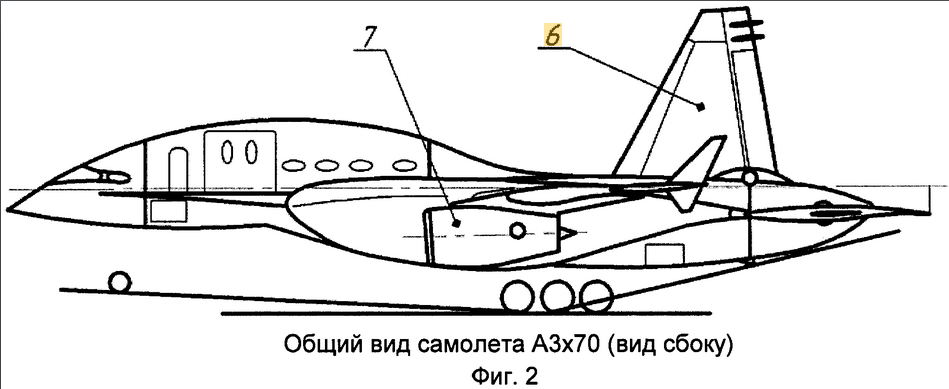
Eurasia Aviation is a fictional company of mine that I can plop into basically any setting I want that’s appropriate.
Logo created in Stable Diffusion XLEurasia aircraft factory, also created in Stable Diffusion. Don’t ask exactly what the cone-thing is for, I just thought it’d look cool
Eurasia is an unashamed way for me to put any never-was alternate history aircraft (or even aircraft concept) into production. Since it’s a conglomerate with a presence on every continent, it can take designs for every one, and so on. Not the most plausible but I’m having fun with it.
It can be fun to put an alternate airliner into service, but unless it’s really big, really fast, or both, a lot of people wouldn’t notice much difference. That being said, the same can be said about a lot of things and it’s never stopped alternate history writers before.
I’ve even made a couple “formal” tiers:
Tier 1: Barely Noticeable
Planes like these (in this case the MD-XX and the An-218 “777ski”), are going to be barely noticeable to non-aviation afficiandos, however different they may be on the inside.
Tier 2: Standing Out A Bit
The dreaded propfan is one instance of these airplanes having one obvious standout in addition to their other more subtle features. Others include a distinct shape like the 747 fuselage or even a “four engines all in the back” like the VC-10/Il-62
Tier 3: Really Stand Out
LEAD Technologies Inc. V1.01
These involve strange but technically plausible shapes like lifting bodies or circular hulls of various nature. Their mere appearance makes them stand-out. This ironically applies to delta wings and civilianized early jet bombers.
Tier 4: Exotics
These are the ones that ascend into pure science fiction.
Here is a logo for Asialink, a fictional airline I’ve made headquartered in Singapore and focused on linking all of one continent (guess which ).
The yin-yang (Asia) and circular chain (link) were made seperately in Stable Diffusion XL and edited together externally. The text was manually added and uses the Shojumaru font.
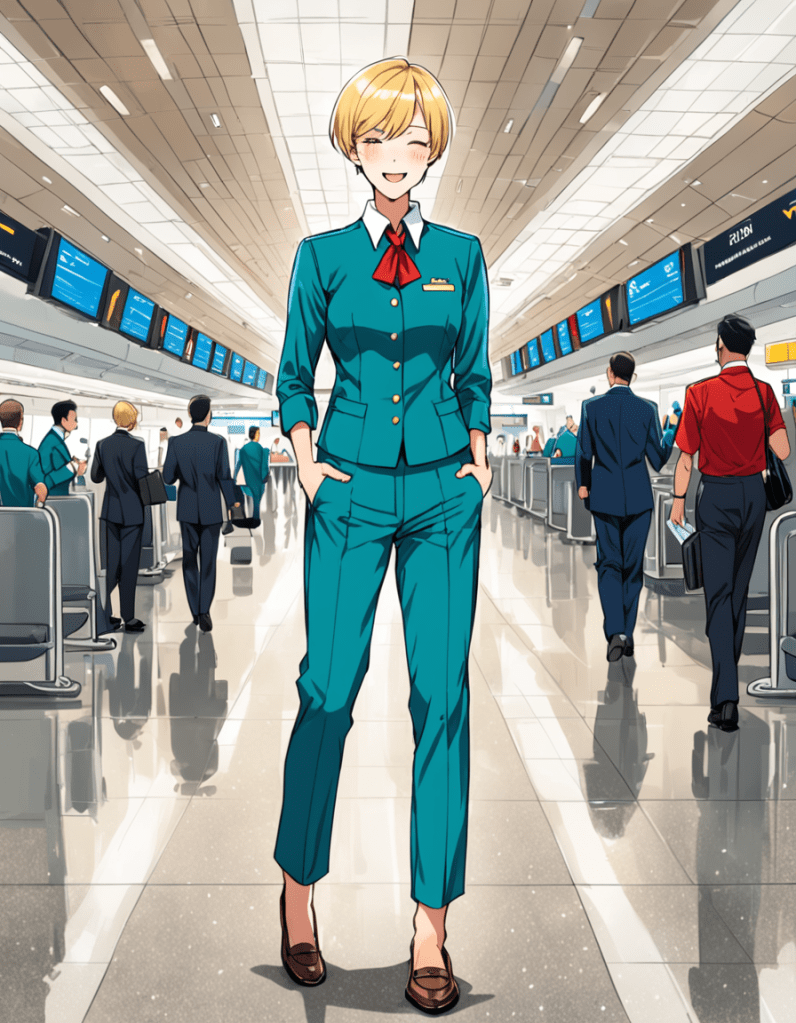
Asialink flight attendant uniforms are the same combination of teal and/or light green with red neckwear.
So Boeing planes have been in the news for…. issues. What’s surprising about it to aviation observers is how unsurprising they consider it. And as for why? Well, here’s the oversimplified and likely wrong in a few ways explanation.
So Boeing seemingly was a legend of Engineers until the evil Finance People ruined it. Anyone who has looked at the history of the auto industry will find this familiar. And while there is truth to nickel and diming, the context both on and above the ground is always more complex. If you look at the types of cars produced on both sides of the Pacific before the oil crisis/bubble popped, yes, there was a time when engineering was obvious-and obviously excessive.
In short and simply: Boeing was/is the last of the big post-WWII dinosaurs to encounter serious competition. There was no need for it to shape up because of the lack of a challenge, buoyed by their spectacular good luck concerning federal policy. The 747 came and was snapped up by airlines just in time for the oil crisis. But since the airline industry was a symbotic pampered cartel then, it was just passed on to customers to bail them out. Then came deregulation after that, with Boeing taking advantage of the boom. Then came the opening up of previously closed-off markets after 1991, and then…
…then the low-hanging fruit already got picked and the guys in Toulouse figured out how to make good airplanes. Oops.
The first Fuldapocalypse review of 2024 is of a nonfiction book by pilot and aviation commentary Sylvia Wrigley. Pilot Error looks at the plane crashes where it was obviously the pilot’s fault. And not being unlucky or something, but just really, really bad.
So in this you get drunks, idiots, and drunken idiots. It’s enough to make you glad that 99.9999% of the people in a very demanding role are not like the ones in this book.
A Yefim Gordon book on the titular interceptor, Sukhoi Su-15 is exactly what it says it is and exactly what you’d expect. Which is to say, a book on an obscure Soviet plane that has a lot of details, but is questionably laid out and where you really, really want to double-check everything. In this case, some of the details are interesting.
These include things like the overlooked for-but-almost-always-not-with ground attack armament it had, and of course model kit reviews. (I do like the look of the Flagon). The issues besides the ones inherent to any Yefim Gordon book are that the Su-15 really didn’t have many variants or career highlights beyond the KAL shootdown. But you could do worse if you like obscure planes.
Fuldapocalypse now has a cropped section from my “Stable Diffusion XL with just World War 3 as the prompt” picture. It may be an interim picture as I make/find a better one, but I think the old stock photo of Bulgarian T-72s was due for a change.
Now People Playground has no shortage of contraptions simulating various pieces of military equipment. Fixed wing aircraft are either the best or worst, as you get one pass before having to either try and land the thing (no fun) or let it crash (more fun!).
The strange thing is that if you pit one of these resistible forces against the moveable objects of elaborate destructible buildings also made in-game, you get a bizarrely realistic and illustrative example of the problem with urban warfare targeting. A bomb or explosive, even one that hits a building, won’t necessarily destroy more than a small part of it. A large bomb can do better but has the problem of more collater-I mean, no problems whatsoever since this is People Playground.
Quite fun that a silly ragdoll physics simulator can illustrate the issues of having one shot, having to dive, aim, and lead, and knowing the target is not guaranteed to be neutralized even after a successful hit.
Written by RAF veteran and Gulf War POW John Nichol, Exclusion Zone is a novel about a second… Falklands War. A rather pretentious and melodramatic thriller, this is no Larry Bond for better or worse. Mostly worse.
You get a doomed workplace romance, war flashbacks, huge descriptions, and a contrived “you must fire your torpedo down the exhaust port” conclusion. It’s too over the top to be a serious war novel but too self-serious to be a cheap thriller.
I wouldn’t call it the worst book of its kind ever, but it’s still below average.
1980’s Air Crew (sometimes translated as “Flight Crew” or “The Crew“) was the USSR’s attempt to copy the Airport-style disaster movie. The first half is an incredibly slow episode of Aeroflot: The Soap Opera and features such white-knuckle thrills as a child custody hearing (not kidding), but the second is pure 70s disaster cheesy fun.
The plane lands in the most treacherous fictional airport in the most treacherous fictional land, and its crew then confronts a simultaneous earthquake-flood-firestorm. Getting off the ground is just the start, leading to a ridiculous and ridiculously fun conclusion that involves members of the cockpit crew bundling up and going outside as if they were cosmonauts on a spacewalk and climaxes with geography ceasing to make sense.
As a time filler, you could do a lot worse than this movie.