Soviet-Romanian Air War

With All Union now on a little cooldown, I figured I’d share my exposition/notes about the Soviet-Romanian air war:

Overall course of the war: Starting on September 8, 1998, the Sovereign Union invaded Romania with two fronts (army groups). The northern Dniester Front was arguably the most advanced and powerful fighting force in history at that time. That combined with good terrain made it sweep south in close to nine days. The southern Danube Front had a more difficult task in the form of more fortifications,more cohesive defense, the daunting task of crossing a massive river opposed, and the bulk of it consisting of forcibly mobilized Bulgarians. Still, after the same nine days they had encircled Bucharest and linked up with the Dniester Front. For the rest of the month they prepared to storm the city, continued bombardment, and tried to push for a surrender that eventually came.

In the end, the USSR lost around 3,500 soldiers and the Bulgarians and other minor allies around 7,000. Romanian casualties are almost literally uncountable with at least 70,000 being essentially confirmed and with estimates as high as 120,000 KIA.

Now for the air:

The USSR’s air force was a curious mixture of everything from the hyper-advanced Su-37 Fermion fighter to dozens of ancient Il-28s. In general, METT-TC was used to allocate things, with older planes doing area strikes with smother/splash damage weapons in the daytime and newer ones using PGMs at night whenever possible. While not perfect, it was extremely devastating.

Romania:

The initial fire strike took out around five hundred Romanian aircraft on the ground, over 80% of its total. This caused a lot of panic in the USAF after the war. A few planes made it through, most notably in the defeat of a Danube Front forward detachment at Alexandria very early on. Otherwise Romanian aircraft were limited to tiny nuisance strikes and suffered very heavy losses while doing so, though surprisingly few to the vaunted SAMs. (Total air superiority+tons of friendly Soviet aircraft = a very short ROE leash and lots of fighter opportunities).
What’s In A Space Warship Name

(That I’m interested in this topic just as I’ve gotten into Starmada is just a coincidence, I swear.)

Atomic Rockets is a great site for semi-realistic spacecraft design. However, one of their contributors was adamant about not transplanting ship names wholesale from maritime ones, as has happened many times before. Is this a sensible avoidance of tropes or just hipsterism for the sake of being different?

I feel it depends on the setting and tone. IE Warhammer 40k and its broadside space cathedrals and obvious Age of Sail symbolism can adopt naval terminology just fine. But there are understandable reasons to avoid the ‘superdreadnought’.

Names I think could make the cut:

  • Battleship. Pretty self-explanatory.
  • Carrier for anything carrying smaller craft. Also pretty self-explanatory.
  • Gunship/gunboat. I think this has already passed one test in that plenty of real aircraft are called gunships, and an added bonus of being a good literal description for many designs. (IE, big weapon on a spinal mount the rest of the ship is built around).

Cruiser, Destroyer, and Frigate are already a mess and have been for decades if not longer. These smaller ships are probably the best to make up your own terminology for (ie “Dragonship”).

Review: Starmada

Starmada 30th Anniversary Edition

I was looking for something to scratch my spaceship wargaming itch. A set of generalist rules that you could apply to basically any setting and have a semi-reasonable approximation of things. Enter Starmada. Now its newest 30th anniversary edition, it lets you build and battle on the tabletop whatever ships you can imagine.

Naturally as a generalist set it lacks specific gimmicks, with anything offensive having to be translated into weapon qualities (ie a big area blast would be “proximity”, and a powerful kinetic cannon shell would be “crushing”) and anything defensive being translated to either “screens” (roll above X or the attack fails) or “shields” (takes a hit before anything else). You get the idea.

It requires some imagination. But if you have imagination and a willingness to abstract, well let me just say that even my initial crude playtesting sessions had me beaming bright. Want to play as a cumbersome pure brute force fleet going against an agile but brittle rapier? This lets you do all that and then some.

Review: Eastern Front 1945

Eastern Front 1945

An Osprey book on the air war in WWII’s final year, Eastern Front 1945 is about the often-overlooked in the west clash in the eastern skies. It basically does every Osprey book thing right. While it’s not the most detailed, it provides an excellent overview of the somewhat different air war (ie, where the P-39 shined even as it flopped in other theaters).

One thing I particularly liked was how the book accurately showed the air campaign’s influence on postwar Soviet/Russian doctrine. Instead of a “big blue blanket” smothering every enemy in its tracks, it was focused on targeted air superiority and supporting maneuver formations. Which led to February 1945 when the Luftwaffe actually regained air superiority for a time. ( In short, they pulled more or less every propeller fighter away from the fruitless bomber interceptions and were were able to operate from intact developed airbases while the Soviets were worn and had their field strips wrecked by bad weather)

It’s a good look at both Soviet air doctrine being successful and at the eastern air war.

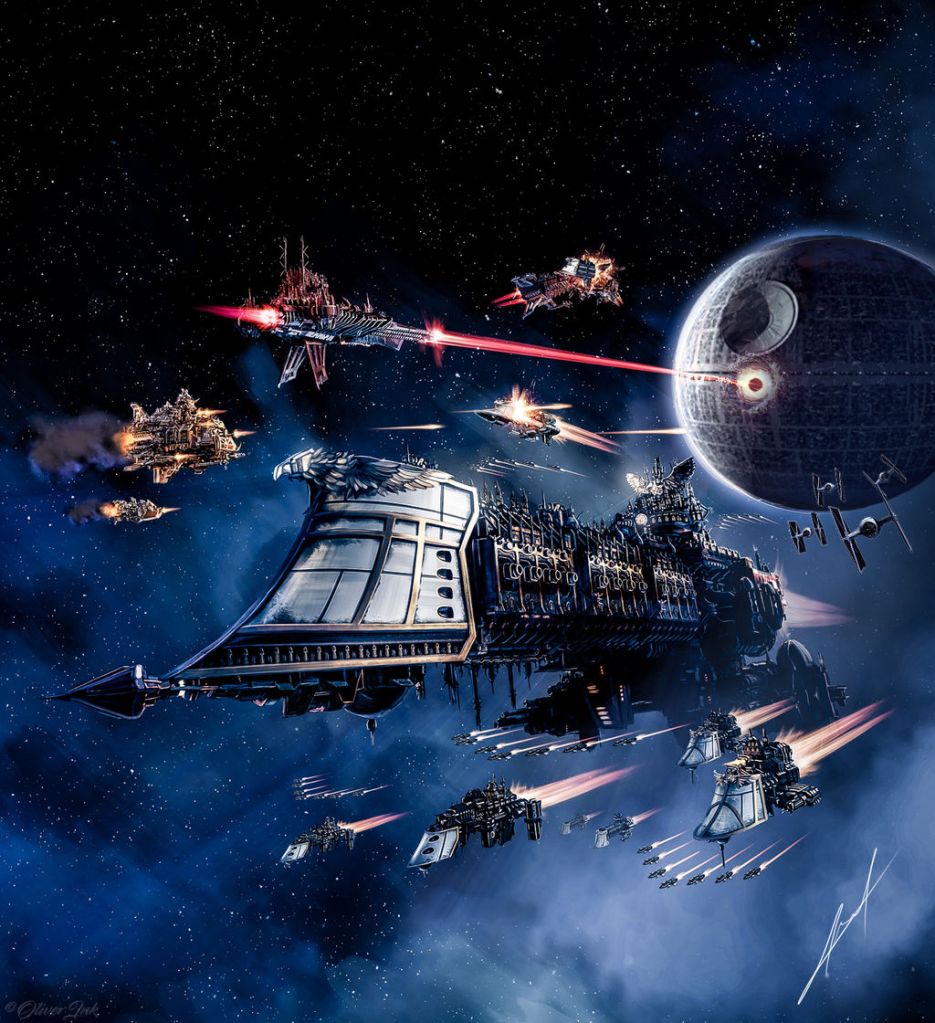
The Imperium Vs. The Death Star

So the question has to be asked: What about this?

Original source

A Star Wars/Warhammer 40k crossover has to include the battles of evil vs. slightly more justified evil and feature a large Imperial Navy cathedral armada going up against the Death Star (presumably with its own array of Star Destroyers). Now I have put some actual thought into this.

  • The Imperium is not likely to be terribly fazed by the Death Star, thanks to confrontations with giant horrific superweapons being known as “Wednesday” over there.
  • If they cannot overpower it via masses of lances, nova cannons, and whatever other exotic tricks they’d undoubtedly pull out (ie psychic lashes, vortex torpedoes to just shunt it into the warp, etc…), for the main Imperial Navy it would be difficult to duplicate what the Rebel Alliance did. The reason simply is because Warhammer 40k space fighters are substantially larger than their Star Wars counterparts, and their ordnance is the same.
  • However, moving in for a pinpoint strike on a difficult but decisive target is the exact thing that Astartes were made for. So trench runs of Thunderhawks, vacuum chainsword fights, and tossing a melta bomb down the port would make for a fitting story.

Review: Stuck On The Drawing Board

Stuck On The Drawing Board: Unbuilt British Commercial Aircraft Since 1945

Passenger planes made in Britain followed an almost exactly stereotypical British pattern: At first bold and trend-setting, then fell behind due to both luck and skill, finally becoming just an international cog. The could have beens and never weres of this are shown in Richard Payne’s Stuck on the Drawing Board.

This is a fun, if niche, book for aviation enthusiasts. The big problem from the nature of the planes it describes. For passenger planes that are all essentially just tubes with different capacities, VTOLs and odd shapes are the absolute most different you’re going to get.

But this isn’t the book’s fault, and you’re left with a fun look at what could have happened before the 707 and its successors crushed any hope of a full-scale British aviation industry.

Review: Raven

Raven

William Kinsolving’s 1983 novel Raven is an aviation pop epic about one Buck Faulkner and his family. Faulkner starts his aviation company in the 1930s, which starts with a 21 seat airliner and moves up. Like many other traditional pop epics of the time, we get a mixture of semi-spicy personal drama and big picture discussion about airline orders.

This is no technothriller and Kinsolving is clearly just modeling the planes on famous existing ones. However, (and this sounds like faint praise), he at least knows the basics. This is no Ian Slater. Some of the names may be a little goofy, but that’s it.

As for the novel itself, it’s a good 51% book. It’s not the absolute greatest, but as a brief time passer, it works. Plus it manages to avoid at least some of the pitfalls of authors writing about technology, so it has that in its favor.

Fictional and Alternate Historical Airlines

Airplane manufacturing is a very tough process. Barring some strange point of divergence, it’s hard to avoid large airplane builders sorting out into a few giants. Yet airlines are another story altogether. It’s interesting how in the “Goldilocks businesses”, airplane builders and airlines fall on opposite disadvantageous ends.

For the manufacturers, it’s the “too many barriers to entry, thus you end up with a oligopoly” issue. For the airlines, where existing planes and even crews are just a few lease deals away, it’s the “too few barriers to entry, which leads to too many participants chasing too small a market”. In many cases both of these are unavoidable. (Novels, sadly, were the latter even before the rise of internet self-publishing).

What this means is that it’s incredibly easy to change the fates of the airlines, and even easier with a point of divergence after the large and successful deregulation of the late 1970s.

Review: Aircrew Confidential

Aircrew Confidential

Pilot Chris Manno’s Aircrew Confidential is a set of short stories about airliner crews. He does a convenient disclaimer saying “Oh some is true some might not be, that’s how gossip goes”. I obviously have no way of verifying that but it’s important to note its not being claimed as totally 100% factual. The only real solid historical benchmark is one story that takes place during 9/11.

For all the “look behind the cockpit door”, it’s really nothing one with even the slightest bit of knowledge or experience hasn’t seen or heard a million times before already. None are particularly shocking or funny or even engaging. I just can’t recommend this book.

Review: Dragon’s Wings

A 2013 book by noted PLAAF watcher Andreas Rupprecht, Dragon’s Wings is one of the first looks behind the curtain of the Chinese aircraft industry. Though now obviously old, it’s still a good snapshot into the past. Besides the familiar J-6/7s and the newer domestic J-8/10-etcs, it provides a look at many of the never-were (and frequently technically impossible at the time) aircraft proposed.

However much it’s shown its age, it’s still a great book. It’s an excellent coffee table book for aircraft enthusiasts.