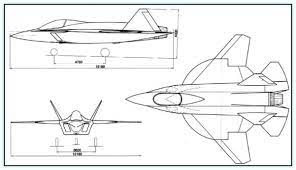
In one of those weird footnotes of aviation history, Mukhamedov, like Stavatti in the west, has been a maker of so-called “paper planes”. The company owes its existence to Fatadin Mukhamedov, a Soviet/Tajik engineer who had a successful career with the big bureaus (for instance, the Dushanbe center of Mikoyan) before striking out on his own. No actual aircraft were produced by the Mukhamedov bureau before Fatadin’s death in 2013, but the bulk had one specific shape.
Mukhamedov designed everything from fifth-generation fighters to gargantuan transports with the same distinctive circular inner wing. The most practical and achievable design was an advanced jet trainer/light strike aircraft for the competition eventually won by the Yak-130. Not coincidentally, the design may have found its way to Iran as the would-be HESA Shafaq. All of the other circular planes were just interesting and distinctive dreams.
I’ve talked before about a Soviet-Romanian War that’s a kind of “Soviet Gulf War“. There have been many obstacles to me actually writing such a thing, ranging from “what do I do with it” to “it’s a little eerie seeing Russia’s OTL buildup and interventions, including currently off Ukraine…”. But I figure I might as well get the rivet-counting parts of it down now while they’re fresh in my mind.
The Setting
It is the year 199X. The USSR is still intact. The reason isn’t because, as in Northern Fury, the August Coup succeeded. Here, it never happened, and the result is a “Union of Soviet Sovereign Republics” ( Союз Советских Суверенных Республик ), which allows for the continued use of the “USSR”, “Soviet Union”, and “CCCP” abreviations. The resulting semi-decommunized USSR has varying degrees of freedom and business openness, and is best symbolized by a flag: Still red, but with the hammer and sickle replaced with a light green vertical stripe on the left and a darker blue one on the right (to symbolize Central Asia and the Western Slavic republics).
Its economy has also been better improved from the historical collapse, but it retains its gigantic spending on the military. Having a bigger pie and more access to the Asian tech industry helps a lot. The result is that one of my favorite OPFOR models, the “Mobile Forces“, can finally be put into practice.
Meanwhile, to its west, the renegade Romania has clung on. But the time has finally come to eliminate it…
(Yes, I haven’t thought of the casus belli yet. Oh well.)
The Combatants
The USSR is able to deploy the Dniester and Danube Fronts. The Dniester Front is to the north and is composed mainly of national-level deployment forces and local ones in the Ukrainian and Moldovan military areas. The Danube Front stages out of Bulgaria (the most docile Warsaw Pact ally), and consists mainly of Bulgarian units with a smattering of Soviet ones, often in support roles. The only other foreign ally participating in a major role is a by-now-fairly-stabilized Afghanistan, contributing a motor rifle division and various mountain/commando units to the Dniester Front.
Investment has paid off, as the new pride and joy of the Red Army, its “mobile corps” are ready and set to participate in the invasion. A new generation of equipment has entered service. Many of the local participants are less well-equipped (in Bulgaria’s case, sometimes severely less so). The force contains thousands of tanks, artillery pieces, and aircraft, many of them new.
Opposing it is a force long considered the bottom of the Warsaw Pact barrel. Romania has had time to introduce some external and indigenous weapons systems. It has also semi-openly planned for a conventional delaying action followed by irregular resistance since the Ceausescu/Soviet split. But it remains hopelessly outclassed.
The Plan
The Dniester Front will do the bulk of the heavy lifting, sweeping through Romania. The Danube Front’s main goal is to cut off Bucharest and the Yugoslav border to head off reinforcement or escape in that direction. The biggest airborne and special operations since World War II will be conducted to aid the advance, secure the western side of the Carpathian Mountains, and interfere with the Yugoslav crossing.
Romania’s plan is to simply hold off long enough to set up a guerilla oppositions. In addition to all their other problems, an insistence on holding down the more Hungarian northwest, if only with security troops, lingers. (Hungary proper cares little for either side and has almost no intervention ability).
The Outcome and the Story
Ah, now that’s what I want to write about. I have many vignettes in my mind as of now but less of a coherent narrative. Still, I think I’ll have fun trying.
For some time after the fall of the USSR, the independent Russian military was known for its huge array of often-mismatched camo patterns. Even after the “digi-flora” standardization, this remains true to a degree (as in other armies-look at the classic “Woodland vest over desert camo” look in the Iraq War.)
For the camo sweepstakes of a surviving Red Army, I see a few options.
VSR-93. This pattern historically was in development when the USSR collapsed. There’s no reason why an intact, better-funded USSR wouldn’t be able to standardize.
TTSKO. This was an existing camouflage pattern widely continued by ex-Soviet republics.
For a more fanciful idea, a type of early digital camo could be adopted. As it stands, one was adopted by an ex-SSR, with Latvia’s “LATPAT” camo. Although not to the degree of the American Dual-Tex, the “pixels” are still significantly bigger than most other digital patterns.
Something else. Even in Russia itself, the Interior Troops adopted many patterns that could easily be used for the regular army.
Simple legacy pattern uniforms.
A combination. The GENFORCE-Mobile concept gives me the idea of the Mobile Corps and Airborne Forces having “fancier” uniforms.
Two previously speculated-upon formations that have not had much evidence to substantiate their (exact) existence include Iraqi “Special Forces Divisions” and the “Islamic Regiments” of the 1980s Afghan mujaheddin.
The former were depicted as regular army formations containing soldiers with at least some greater training and morale than the bottom-of-the-barrel rabble. They were fairly conventional triangular motorized infantry divisions in terms of structure, operating in either trucks or wheeled APCs. These divisions contained no organic (part of their structure) tanks, but could easily get them cross-attached if need be.
The latter were supposedly black-clad formations of raiders with more organization and standardization than the usual bands, but nothing (usually) heavier than normal crew-served weapons. They consisted of about 600-900 people broken into multiple small battalions. It’s worth noting that their layout does bear a resemblance to the kind of “guerilla regiments” that Mao described in detail in On Guerilla Warfare.
Of course, there is a hint of truth to these formations. There were/are large commando formations in the Iraqi and especially Syrian armies, the Republican Guard did have an unambiguous “Special Forces Division”, and the mujaheddin did occasionally operate in formations the size of the fabled “Islamic Regiments”, as well as deploy better trained and equipped subunits. This is of course is what leads to the inevitable exaggerations.
And also, the joy of generalist wargaming rules and alternate history is that these units can easily be simulated as if genuine. Neither requires much in the way of exotic equipment or modifiers to use.
James Ronsone and Matt Jackson’s Project 19 is an alternate history story about a far more severe Gulf War. In it, the Soviets, eager to disrupt the world’s oil supply (and thus raise the value of their own products) have more or less openly supported the Iraqis with piles of modern equipment and trained pilots. Thus they charge full-force down the Arabian Peninsula, and the squash of the historical war turns into a frantic struggle instead.
The very designation of this book (and its series) is a matter of question. It’s an alternate history “big war thriller” for certain, but even though not designated as such, I feel it deserves the term “World War III”. Yes, the location is different and so are some of the participants. But I see a giant conventional Soviet-American conflict and know only one thing to call it.
As for literary quality, it’s a little awkward. On one hand, the characters are Steel Panthers cutouts who exist to stand around in conference rooms or operate military equipment with cameras strapped to their heads so that the reader can see them. And the prose, well, sometimes it comes across as even clunkier than what I’ve read in the Kirov series. That is no small feat. Finally, while the technical inaccuracies are never more than mild, something this infodumpy has no right to get details like “Chinese T-62 copies” (which never existed) wrong.
But on the other hand, this is an extremely hard genre to write well. I’d even go so far as to say that “big war thrillers” are arguably the hardest type of fiction to write well. They’re certainly tougher and require far more balancing than normal action hero or small unit stories. What Ronsone and Jackson want to do is make a broad scope telling of a very different war. And here they succeed. It comes at the expense of a lot of other things, but this book succeeds in its main goal.
Apart from that dichotomy, I could have a few more nitpicks about the plausibility. The Soviets couldn’t supply an external country with high-end tanks without either stripping their most essential forward forces or diverting a year or two’s worth of factory production. Even there, advanced tanks didn’t grow on trees. The speed at which the Iraqis advance is more than the ideal distance of a successful operation, much less the imperfect, generally slow military that they were. But all these can be handwaved aside in the name of wanting to provide a challenging opponent, which is where this succeeds. I particularly like the US military being placed in a position where it doesn’t have total air control right away.
So in conclusion, this book has many virtues and flaws. Though not the best example of its subgenre, it’s nonetheless readable for fans of Larry Bond and the like.
It’s my 600th post on Fuldapocalypse. I’ve gotten a lot of books recently on never-were aircraft. Thus it’s fitting to make this post about a pattern I’ve seen in equipment that never was. From least to most interesting, here are the three big categories I’ve seen.
The first is “a different proposal for the same requirements”. This is often the least interesting, because the different proposals are still designed to meet the same goals. Most of the time you get something that just looks different but has similar (theoretical) performance, and sometimes not even then. There can be real and appreciable differences, but they especially aren’t noticeable on the outside.
The second is kind of related to the first, and that’s “a proposal that lost, and whose reasons for losing are obvious”. For instance, it’s very easy to see why the T-8 design won handily for what would become the Su-25 compared to its competitors-and not just from other bureaus. It faced the anachronistic Il-40/102, and some shoved-in kitbashes of existing aircraft (Yakovlev put forward a variant of its not-exactly-ideal existing designs, Mikoyan used something based off the classic Fishbed, and even Sukhoi itself had a derivative of the Su-15 interceptor that looked very little like its “parent.”).
The third is the real fun part, and that’s stuff made with totally different goals. This is where you get all the giant napkinwaffe planes. But you also stuff that’s knowingly lower-performance for the sake of affordability.
I’m doing it. I’m breaking all my rules. I’m reviewing an in-progress internet online alternate history piece by an author I overreacted to in the past, at one point calling his TLs the “worst ever”, something which is not true and which I apologize for. I speculated as to why I felt as negative as I did in the very review itself, and with years of hindsight I can say that, sadly, it was just personal stress mixed with tunnel vision. The actual view I have of them is what I said I’d have felt in isolation before-middling Hackett-fics, no better or worse than say, Operation Zhukov and not really the most able to build a long review around.
But I think this new TL is worthy. I feel I’m calm enough to look at it more objectively, unlike my past axe-grinding. Like with New Deal Coalition Retained, I feel that this isn’t an obsession and that one post on an internet timeline won’t overwhelm dozens of those on other topics far less controversial to me. And I feel it does have something to say about the genre. I don’t want to come across as gatekeeping or saying someone shouldn’t do anything that they and others enjoy. I’m just giving my personal opinion. And of course, if my opinion on it changes as new updates emerge, I will gladly make an update post.
The timeline is called People’s War, and it’s about a surviving East Germany.
What I consider People’s War to show actually has a parallel in sports betting. What William Leiss calls “manual research”.
Now obviously literature is not a zero-sum game like sports gambling is. Everyone has to start off with the surface level details, and not everyone can or wants to do Kirov-level simulations. But this kind of ultimately surface research applied to a pseudo-Hackett pure exposition style has made me see the strengths and weaknesses of it.
The biggest strength is that there is a lot more verisimilitude. This is something that Young Grognard Me took for granted because I started with nonfiction books and wargames and went backwards from there. Now I know how rare even nominally accurate military fiction is in a world of “machine gun pistols”, “Flamethrower M60 Abrams”, and “A-130 helicopter gunships”. More to the point, this and the WW3 TLs that preceded it and which I got far too angry about are far more sensible than the clearly just tossed carelessly out “stock photo and a wikibox” stuff like the infamous New Deal Coalition Retained Part II. It’s one thing to arguably lean too heavily on Hackett, Bond, and primary sources as Lions Will Fight Bears and its successors did. It’s quite another to avoid them completely in favor of BIG NUMBERS, as NDCR Part II did.
But Hackett, Bond, and the WW3 TLs were dealing with a hypothetical conflict that had decades and decades of simulations, analyses, and sources dedicated to it. Said documentation is a big reason why it’s up there with the American Civil War and World Wars for wargaming and “hard” alternate history. But what happens when you’re dealing with something that doesn’t have that paper trail?
Trying to Hackett-ify a 1980s technothriller scenario is one thing. But this TL is trying to Hackett-ify what’s essentially a 1990s technothriller, where a surviving East Germany ruled by Honecker’s widow comes into conflict with the western world. Now looking at the reams of studies of a theoretical conventional Fuldapocalypse is one thing. But where are the think tank papers for “Fighting a somehow surviving ex-Warsaw Pact state post-USSR, especially with the hint of threat balancers you’d find in a Larry Bond novel?” They aren’t there. The closest are clear surface details like the names and amounts of weapons that end up feeling close to the more shallow “here’s the exact designation of a Scud TEL” than what effect barrages of those missiles would have in practice.
And this is my objection. Because there’s less opportunity to look, this sort of thing just feels kind of shallow to me without either simulation/deep analysis or just setting up the basics and running with a conventional story. And the TL format prevents the latter.
It’s still far superior to the outright Calvinball of NDCR’s Neo-Timurid Empire or postwar AANW’s “Eastern Siberia as an American state.” The military details are still far greater and more plausible than 3 million Soviet troops sloooooooooooowly advancing against 2 million NATO ones. Compared to “historical fanfiction” AH, it is better.
But there still doesn’t like a real solid base is there. And by the standards of either wargaming or literary fiction, I feel it doesn’t reach its potential.
Especially because this is a redo of a previous concept for a surviving East Germany war that was ultimately abandoned in part because, unsurprisingly, its base was too one-sided strategically. This is what I think goes full circle back to the “Manual Research” video, because Leiss specifically talks about the follies of using manual research for an obvious mismatch. Manual research can tell you what common sense and the odds show-that the powerhouse team against a paid-to-lose punching bag will easily win. But it can’t tell you how likely the opponent is to cover the inevitably massive point spread.
The force regarded as the best non-Soviet Warsaw Pact military can definitely still threaten the characters in a normal narrative and can definitely still do more damage than Saddam’s army did. It’s just that this and other works like it sit in an awkward middle ground between hard and soft. I wouldn’t call it a trinket, but it still feels less than whole.
I was somewhat critical of Yefim Gordon’s book on the MiG-29. Yet for his Unflown Wings, showing nearly a century of never-built Soviet/Russian aircraft, I’m far less so. This is an amazing book about amazing aircraft. It’s rightfully massive, covering every major design bureau.
People looking at the weird “Luft 46” German aircraft often overlook that every country had its similar oddball paper planes. And so it is with this book. With many illustrations, one can see everything from the redundant to the too expensive to the too out-there. It’s a lot to make you wonder what could have been, from the cancelled jet-powered maritime patroller to giant seaplanes to my personal favorite, the overambitious “Backfiretomcat” Tu-148 multi-role fighter.
The very nature of this book means that the issues I had with the Fulcrum one are far less so. Because the aircraft here never actually entered service in any event, it means there’s less need for total rigor and one doesn’t have to be “deep”. Breadth is required for this overview, and it’s very, very broad indeed.
This is a very fun, very thick book, and I recommend it to any aviation fan in spite of its size and expense.
-Intact, with all the cancelled toys USSR going to finally rid themselves of the surviving Ceausescu (I’ve wanted to write a sort of “Soviet Gulf War”). Notably, the only ex-Warsaw Pact state that allows staging and troop support by this point is Bulgaria. (Bulgaria was considered the most politically reliable of them, being a longtime Slavic ally of Russia that did not experience much unrest before the fall).
-Heavy OPFOR Operational says that high-level paradrops generally max out around 250 km from friendly troops (Which means 36 hours to catch up even under their most ideal advance rates, four days under the most ideal against a peer opponent, and at least a week under any kind of realistic resistance). The earlier Voroshilov Lectures say 150 km at most in conventional conditions.
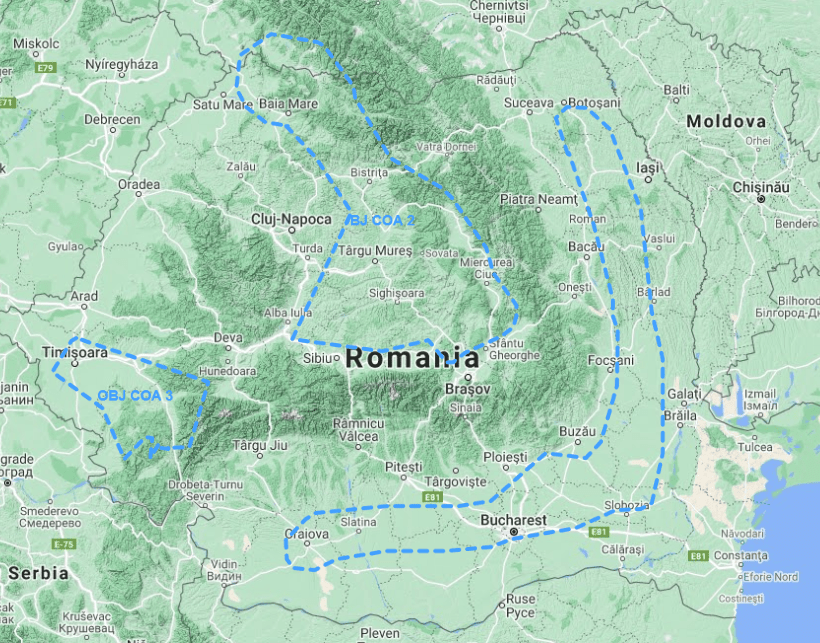
That being said, the map!
Three courses of action. These are not specific drop zones but general guidance areas, and yes, I did extend COA 2 into the Ukrainian SSR itself. OOPS!.
Course of Action 1 (not labeled but closest to the border) is the most tame, and features a variety of tactical close-to-support airdrops in the initial advance areas. Course of Action 2 is a deeper operational/strategic drop to secure the other side of the Carpathian Mountains. Finally, COA 3 is the deepest and most daring yet and involves having paratroopers land ultra-deep to quickly establish a presence in the Yugoslav/Serbian border to try and hold off any escape or resistance aid from there.
As for the rest of the plan, it’s pretty much Soviet boilerplate-blast through, charge deep. Bucharest is going to be encircled first and then left to second-line units (including Bulgarian ones) to actually reduce. Romania’s plan in this not-unexpected event was to just stage a prolonged unconventional resistance and use their inevitable-to-be-overrun regular units to buy a little setup time.

 Fuldapocalypse Fiction