Review: Louisiana Firestorm

Black Berets: Louisiana Firestorm

The Black Berets series was a range of now obscure 1980s men’s adventure novels. My first exposure to it was in Louisiana Firestorm, the fifth installment. I found it a sad disappointment. For an action novel series, there really wasn’t that much action, and what there was wasn’t that well written.

These are the perils of a quantity based series that has every book being short. It should come as no surprise that the listed author, “Mike McCray”, was actually two separate people sharing the pen name. One of those people, Michael McDowell, was also someone whose work included screenwriting for the movie Beetlejuice (!). Ultra-cheap thrillers seem to attract the weirdest array of people.

Unfortunately, McDowell’s presence in this series is far more interesting than anything in Louisiana Firestorm itself. You make as many shots as a quickie, throwaway mens adventure series does, and you’re bound to have a lot more misses than hits.
Review: Tomorrow’s Soldier

Tomorrow’s Soldier

David Alexander’s Tomorrow’s Soldier is a book that you’d expected to be dated based on its subject matter. It’s a 1999 popular account of the WARS AND WARRIORS OF THE FUTURE. And it is dated. It’s also somewhat shallow even by the standards of the time.

It’s still interesting, but isn’t really a rigorous study. The descriptions basically consist of trends that were obvious even at the time (ie, more digitization/etc…) and the obligatory description of wunderwaffe like power armor. This is a little less triumphalist than some other books of its nature, but it isn’t really more substantive.

This felt like a throwaway book even when it was written. And now it’s an older throwaway book. So I’m not really recommending it except as a curiosity. I do wonder if the same “David Alexander” who wrote this was the same “David Alexander” who wrote the ultra-middling Marine Force One. If so, it would be fitting.

Review: Fire and Maneuver

Fire and Maneuver

The second entry in James Ronsone and Alex Aaronson’s 1981 World War III, Fire and Maneuver continues its predecessor’s excellent work. While it does not bring the most novelty to the subgenre in terms of its structure, in execution it does very well, hopping between viewpoints in a way that’s both smooth and fast. And it actually has an M47 Dragon being able to destroy something in a stretch of logic that works for story reasons.

Jokes about the Cold War’s worst ATGM aside, this is a good entry in a scarce genre. If I had to make one criticism, it’s that long, exact system designations are used a little more often than I found credible. But that’s a tiny nitpick and doesn’t detract from the experience.

Review: Expedition Mars

Expedition Mars

Martin J. L. Turner’s Expedition Mars is an analysis of what a manned voyage to the red planet would take. It’s a very detailed analysis that includes a final hypothetical trip. It’s a very good and interesting book. The problem is that it’s not a very accessible book.

This is a very math heavy book full of calculations. There doesn’t even feel like an attempt at making it readable by someone not terribly knowledgeable in the field (ie me). It’s fine to make an apple instead of an orange, but if I don’t like apples (actually I do like real apples but that’s not the point), I’ll say it.

If you like a hardcore book on Mars exploration, I recommend it. But only if.

Review: Shanghaied on the Rio Grande

Shanghaied on the Rio Grande: A Novel of World War Three

Just looking at the suffix of this book made me go “I had to review this.” Granted, William Joiner’s Shanghaied on the Rio Grande is more like a short story. But it’s still a World War III invasion story. I thought the length of this would mean there was some kind of publishing mistake or the story was unfinished, but no. It’s wrapped up within its few pages.

This reads like a teenager with little knowledge of the military or geopolitics who read far too many 1980s adventure novels writing a fanfic of those. I do not mean this in a negative term. The Chinese seize control of the American nuclear arsenal and walk in, dominating and trying to force Americans to become Buddhists (seriously). Opposing them are heroic Texans, one of whom is named Billy Bob (also, seriously). The story wraps up incredibly quickly (as in two pages) once the Americans get their nukes back and rout the Chinese.

Is this stupid and offensive to Texans and Chinese alike? Yes. But is it fun? Also yes.

Review: The Fury

The Fury

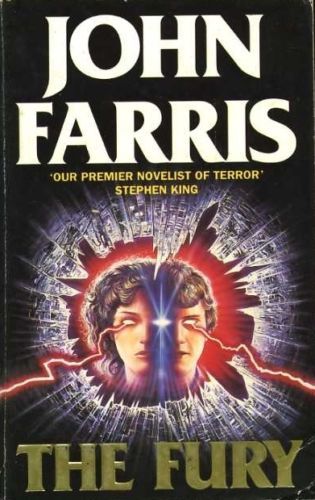
John Farris’ psychic horror thriller The Fury is an extremely 1970s novel. The horror story of psychic heiress Gillian Bellaver and the Sandza family consisting of father/agent Peter and psychic son Robin, it manages to have both the good and bad of its genre in full, making it a very “mean 51%” book.

The Fury has genuinely atmospheric tension, excellent body horror, and a serviceable plot that anyone who’s seen Carrie and/or Scanners can get into. It also has horrendously purple smut scenes and incredible pretentiousness. For every “good icky” scene like horror powers manifesting, there’s a “bad icky” scene like-well, pretty much all of the “naughty” there is.

Beyond that, it just has too much missed potential. There’s an entire metaphysical world described past the immediate characters that reminds me of the Warp from Warhammer 40,000, but instead of exploring that and the emergence of superhumans, Farris spends way too much time on middling action and not-so-middling character scenes.

Still, this is unique enough and good enough that I’d at least recommend giving it a shot. I can see different readers having different tolerances for its weaknesses.

A Thousand Words: Power Slap

Power Slap

A show devoted to a “sport” that is as bizarre as it is dangerous, Power Slap is the brainchild of Ultimate Fighting Championship head Dana White. While White is no ones idea of an ethical person, but this is a low even for him. You might think that slapfighting is some silly, wimpy gimmick. That would be wrong. Expect maybe the silly part. You might also think that slapfighting is some kind of boxing but with open hands. That would be extra-wrong.

Slapfighting goes like this: The combatants stand on either side of a short table. Starting with the winner of a coin flip, they take turns being the attacker and victim. The attacker does an open-hand powerful slap. The victim…. holds their hands behind their back, and it’s a foul if they so much as flinch slightly.

Yes, this is a sport that literally forbids any kind of defense. There’s a reason why even people active in boxing and mixed martial arts have been scorching this for its danger. More than one commentator has argued, and I agree, that it feels like a way to prove the detractors of early MMA right. It’s nothing but hitting until one person falls down (or the round ends).

I love mixed martial arts. But this is an offshoot I do not. It feels like trying to skip straight to the highlight reel knockouts without grasping that the reason why those knockouts are so impressive is that they’re earned in a way that hitting a literally defenseless opponent is not. Or maybe it’s just Dana White being weird. Wouldn’t be the first time him or another promoter acted that way.

Review: In The Presence of Mine Enemies

In The Presence of Mine Enemies

Harry Turtledove’s In The Presence of Mine Enemies is an expansion of a previous short story that tells the tale of a secret Jew in an Axis victory world. There’s turmoil in the Reich, and Turtledove’s classic “obvious historical parallel” is to the late USSR with obvious “Gorbachev” and “Yeltsin” figures. This is a very frustrating novel, and it shows both Turtledove’s strengths and weaknesses at full blast.

The obvious strength comes from its set pieces. The story it was based on was widely acclaimed, and in particular the “August Coup” is very well done. It also has an interesting advantage in that it’s one of the Axis victory novels that is the least unintentionally glorifying of them (as described in this post). The only wunderwaffe are the ICBMs the Germans used off-camera to blast the Americans into submission after World War II, and it’s hard to imagine a less romantic setting than the last days of the USSR. Finally it has a sinister tone and unromantic in general. The reformists are still racist (ie we want elections, but only involving “proper Aryans”), and the “August Coup” is foiled not by any fluffy ideals, but by exposing the Jewish heritage of one of the conspirators.

That works. The rest of the novel does not.

It’s long, slow, and padded out with stuff like games of bridge repeated constantly. Much of the book is given over to a lame love triangle drama. While the parallelism is understandable, it can get a little too blatant at times. The good parts of this book are great, but the bad parts dramatically outnumber them. It’s an interesting discussion piece, but I wouldn’t really recommend it for pleasure reading.

Review: An Untaken Road

An Untaken Road

Steven Pomeroy’s An Untaken Road is officially a book explaining why mobile ICBMs never caught on with the US military the way they did elsewhere. It’s that, but it’s also a history of the many, many, many different proposals for missile basing of all sorts. That alone makes it very good, especially since there’s a huge synergy with Nuclear War Simulator (after all, you can easily build and uh, “test-fire” a lot of the platforms described here).

At times the central argument can get a little pretentious and a little too focused on abstract themes. But as a pure source of information, this is excellent. There were a lot of nuclear missile base proposals right out of cheap thrillers, and this book is a great resource on them. It’s also a serious and informative look at nuclear war strategy. So I highly recommend it.

Review: Dead In Their Tracks

Dead In Their Tracks

After the arduous effort of writing a book, you sometimes need to relax with a nice simple 51% novel. And JT Sawyer’s Dead In Their Tracks fit the bill nicely. The plot is the usual cheap thriller fare. The action is nothing to write home about, though I will say the book is very lean and moves very quickly and nicely.

Still, it’s like potato chips. But sometimes potato chips are what you need. I had fun and that’s what matters. Not every book can be deep, and not every book should be.