Review: North Korea’s Hidden Assets

North Korea’s Hidden Assets

H. John Poole returns to Fuldapocalypse with North Korea’s Hidden Assets, a warning about how North Korea may be stronger than anticipated. Or rather, that’s a central message in a meandering book. The content here ranges from loooong descriptions of Iwo Jima fortifications (because as a country occupied by Japan, they were undeniably influenced by its doctrine. Legit link, but not worth the obsession he shows) to constant tirades against the clunky, idiotic American doctrine and how the North Koreans have so much better military culture and small unit tactics.

Some of the book’s arguments are good. Poole spends a lot of time legitimately arguing against mirror-imaging a Second Korean War as being a repeat of the mechanized charge to take the entire peninsula that was the first. He argues and reasonably so that the north would be more likely to bite, hold, and wear the Americans and southerners down to win at the peace table. And the fortifications and tactics from the first Korean War are at least more relevant. So are the surprisingly few times he looks at contemporary North Korea (the nominal point of the whole thing)

But this book is mostly axe-grinding. It’s also hypocritical in that Poole portrays it as some kind of secret hidden source when almost all of its analysis comes from official US government documents-showing at least someone else already there knows of a worst-case perspective on North Korea. There are much better serious studies of that opponent out there.

A Thousand Words: Soylent Green

Soylent Green

Soylent Green is perhaps the most early 70s movie of all time. Set in the dark far off future of 2022, the film is a documentary about life in a Warhammer 40k hive city, cautionary tale of overpopulation and societal breakdown as well as a grand mystery. The problem looking back on it in hindsight is that everyone now knows the big twist about what the titular food is made out of (human corpses). But there’s more to it than just that.

See, the movie is very early 1970s in that the characters dress and talk so similarly that sometimes I had trouble telling them apart. But it also takes the most ridiculous set pieces and expects the viewer to treat them with utmost somber seriousness-and I don’t just mean “ridiculous” as in later shown to be inaccurate ie the prison Manhattan in “1999” in Escape from New York. It shows a wildlife sanctuary consisting of one tree in a greenhouse bubble and a long scene where rioters are literally scooped up in bulldozers and expects both to be serious.

The movie isn’t badly made and you could do a lot worse than watching it. But it is ridiculously dated and belongs to the pretentious pre-Star Wars school of 1970s sci-fi.

Review: Seizing Power

Seizing Power

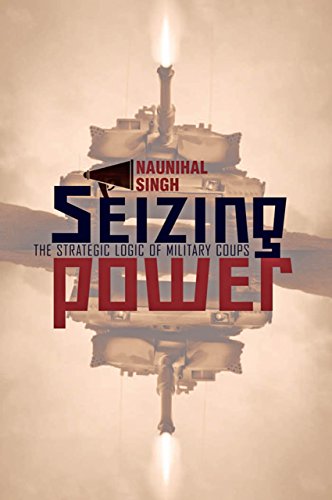
Naunihal Singh’s Seizing Power is a book about military coups and how they work. The timing of this review is a complete coincidence and has no bearing on recent events whatsoever. Anyway, Singh studies the basic three types of coups and makes an academic argument that they are in essence, “coordination games”-that is to say they have to give the appearance of inevitability instead of actual hard power (in most cases.)

Singh divides coups into three categories. The first is coups from the top, like say, the central party committee imprisoning the president and attempting to seize control. The second is coups from the middle, like say, a division-sized force dashing from its base on the border to the capital and hoping the rest of the army can join it. The third is coups from the bottom, like say, rioters in support of a parliament with no army on its own trying to sway the military and take vital television stations. (Yes, all three examples happened in Russia/The USSR. They were the 1991 August Coup, the recent Wagner uprising, and the 1993 constitutional crisis).

Singh spends most of his time covering all three types of coups that happened in Ghana in its history, and then ends with the August Coup of 1991, a coup from the top that should have effortlessly succeeded but in fact failed miserably. Like most academic histories, it gets a little too pendantic at times. But it’s still a great read.

A Thousand Words: Dave’s Redistricting

Dave’s Redistricting

One of my internet hobbies has been using the Dave’s Redistricting site. It allows you to draw up hypothetical legislative districts and see their demographics. I’m currently using it to make hypothetical seats for a vastly expanded US House of Representatives. It’s both fun and illuminating to see how you have to balance various challenges.

It’s very illustrative of showing how it’s actually harder to make “fair” districts than you might think. You can get a nice sensitive block of counties-that are safe seats. Or you can take half of those counties, balance it with half of a large city, and then you can make an evenly bipartisan district-but how “representative” really is an obvious artificial creation like that?

If you like politics in any form, you have to check this out. It’s simple, easy, and is great for both counterfactuals and actual debate.

Review: The Bucharest Dossier

The Bucharest Dossier

I knew I had to read a spy thriller when I saw the setting was Romania. So I eagerly snapped up William Maz’s The Bucharest Dossier. That the author actually grew up in said country during the bad old days made me want it even more. Sadly, what goes up must come down. Taking place in the obvious year of 1989, it uses this excellent setting and…. squanders it.

A clumsy moral equivalence between Ceausescu’s Romania and Reagan’s America and making many of the events of the 1989 revolution the actions of foreign intelligence makes this sour. The author to be fair labels it a work of fiction in the afterword, but I can still see how it leaves a bad taste. There’s also the characterization and love story not really doing it for me.

That leaves the main plot. Now I’ll admit I’m not the biggest fan of Le Carre-style grounded spy novels. So I may be biased in this regard. But it still amounted to little more than a 51% story that was dragged down by its other weaknesses. The book does portray its setting mostly well, which makes me think that Maz would have been better off writing a plain historical novel.

Oh well. This could have been a lot better than it was.

Review: Cody’s Return

Cody’s Return

Stephen Mertz was the main man behind the “Jim Case” pen name adorning the front of the Cody’s Army books in the 1980s. Since he didn’t have the exact rights to the men’s adventure stories featuring John Cody, he made a new character named (brace yourself) – Jack Cody! Who also had thrilling action adventures! What a coincidence! The late Chet Cunningham did something similar with “SEAL Team Twenty”, and it predates self-publishing by quite a bit when authors worked for multiple firms. (In fact, there were times when the throwaway series couldn’t even keep the main character’s name consistent!)

Cody’s Return, in spite of what the name implies, is not the first book in the series. It is, however, the first book in a self-declared trilogy that centers around a crazed arms dealer and his even more crazed girlfriend/cult leader.

The thing about the original Cody’s Army was that, with some exceptions, it was very much a middle of the road series that had all the weaknesses of its format. Which is to say that something like a classic men’s adventure novel is extremely shallow even by cheap thriller standards. And this is the case here as well. This isn’t always a bad thing, but it does make it hard to pick one over another.

What makes this worse is that the book is aiming for a huge plot that it’s trying to stuff into too few pages. I get it’s the intended beginning of a trilogy where the author has complete control, but even in that circumstance it still feels too poorly done. Which is a shame. The plot of nukes, crazies, and colorful characters is something that almost needed a meatier book to do right.

Mertz is a champion of the genre, but he’s done better.

Review: The ISIS Solution

Released at the height of the 2010s anti-ISIS campaign, The ISIS Solution is a short book by several SOFRep authors, which include such familiar names as Jack Murphy and Peter Nealen. It offers critique and recommendations, and since I knew their books well, I wondered how their nonfiction commentary would go. As commentators, they’re pretty good novelists.

As the saga of “Mean” Joe Greene’s transformation from the best defensive lineman to the worst football commentator ever attests, being good in one field doesn’t translate to being successful in another. Granted, some of this is due to the book being short and aimed at a much broader audience than actual security analysts. But more of it is due to a phenomenon I’ve seen sadly too often.

I call this Fire Joe Morgan-ism (not surprisingly, Morgan was another athlete who went from brilliant player to dubious commentator). There a group of spicy screenwriters (seriously) who dabbled in baseball analytics took pride in dogpiling on all the old crusty baseball hacks who didn’t know any stat beyond batting average. It basically amounts to going ahead of the absolute worst baseline (sportswriters in that case, network talking heads in this one) by showing that you do have genuine knowledge of it (military operations/baseball stats), and then doing a little dance and a victory lap because you’ve overcome such an easy target.

Granted, this probably wasn’t as surprising as I’d thought. Murphy’s books ranged from “blatantly political even when good” to “unironic Metal Gear Solid plotline”, while Nealen’s commentary attempts in Maelstrom Rising sank it a lot compared to the far more apolitical Blackhearts series. But it’s still disappointing, and there are a lot better sources out there.

Review: A Killing Truth

A Killing Truth

Author DV Berkom, a self-proclaimed lover of thriller novels, begins her Leine Basso series with A Killing Truth. Short and sweet, the love of its author for the genre shows obviously. The negative side of this love is that this tale of a female assassin doesn’t exactly break much new ground or push any authorial limits. It’s firmly in the 51% middle of books of this nature.

But it’s also positively in the 51% middle. If you want a good cheap thriller, this is the book for you. Everything about this that needs to work does, and I had a great time reading. I look forward to reading more of Berkom’s work, as it’s clear that she knows what makes a thriller good.

And that’s two positives of loving the genre to one negative. I’ll take that.

Review: US Army Doctrine

US Army Doctrine: From The American Revolution to the War on Terror

In his study of published doctrine, Walter Kretchik embarks on the herculean task of reading multiple centuries worth of field-manualese. He looks at the very first to the then latest manuals (the book was published in 2011) and how they were applied in practice. The result is an excellent nonfiction study for field manual nerds like me.

The book is very readable and understandable. I would advise reading the actual manuals themselves if you wanted to know more (they’re all public domain by their very nature and the age of many of them), but as a starting point for both doctrine and warfare, this book is excellent. It’s expensive and niche, but it’s good in addition to being those two.

Review: The Han Solo Adventures

The Han Solo Adventures

Originally published in three installments from 1979 to 1980, the Han Solo Adventures by Brian Daley were the first books in what would become the Star Wars expanded universe. Star Wars fans tend to love them, and I’m one of them. Without restrictions or a desire to one-up the movies (I’m looking at you, Kevin J. Anderson), the books are a fresh fun romp through the Corporate Sector.

Daley can write everything from prison breaks to starfighter bouts to duelists well, and he does in these books. Every Star Wars fan, science fiction fan, or just fiction fan should read these.