Review: Tehran’s Wars of Terror

Tehran’s Wars of Terror and Its Nuclear Delivery Capability
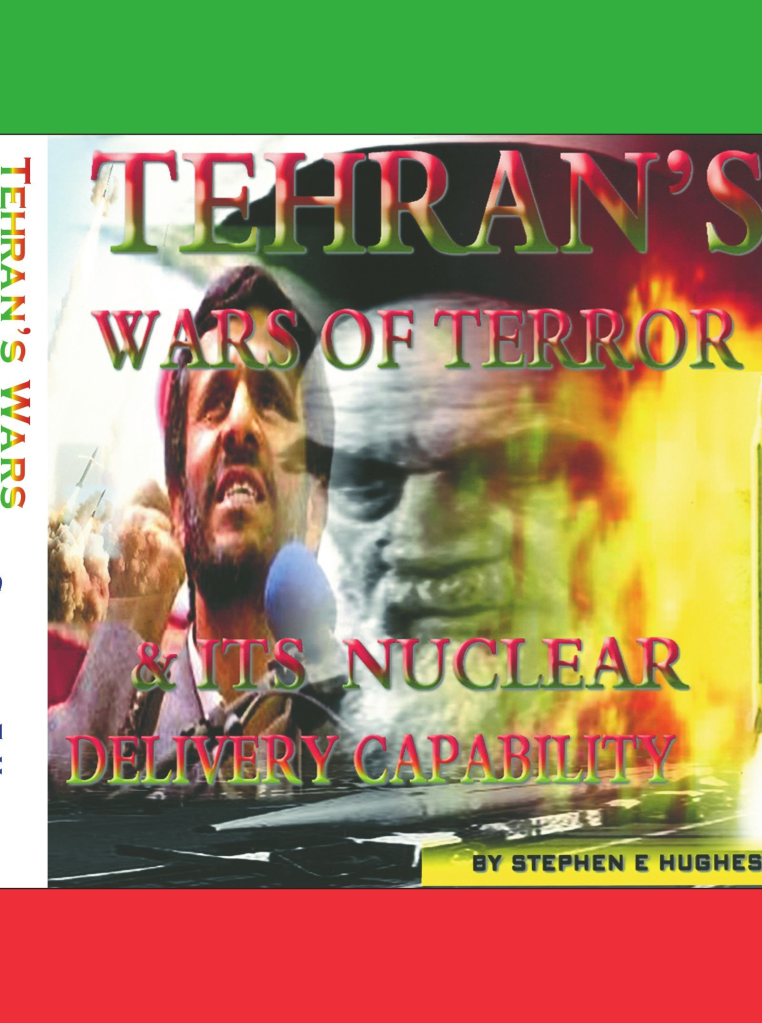
The worst book cover deserves to be seen in all its “glory”

Stephen Hughes’ The Iraqi Threat was a letdown. This is even more of a letdown. Trying to move through the smoke of the infamously secretive post-revolutionary Iranian military (with their five million new systems that appear in every new parade) would be a worthy and very useful endeavor. This not only fails in that regard, it acts like it doesn’t even try.

First off, I’m a “you can’t [usually] judge a book by its cover” type of person. I can understand having a bad cover or a crude cover. But this is an exception, because the cover of Tehran’s Wars of Terror is, without a doubt, the worst I’ve seen of any military reference book. And one of the worst I’ve seen period.

The cover is perfectly representative of the absolute slapdash mush inside. The Iraqi Threat at least had a central theme that it followed. This is just a rambling collection of various articles that are connected with only a vague link to Middle Eastern warfare. It doesn’t even work as a basic “know your enemy” primer because it’s so gargantuan and aimless. I feel surprisingly confident in saying that it’s quite possibly the worst military reference book I’ve read. And if not, it’s certainly down there.

Review: Point of Impact

Point of Impact

Stephen Hunter kicks off his Bob Lee Swagger (aka Deadshot-13) series of sniper thrillers with Point of Impact. I was eager to finally get the chance to read this book, as I’ve heard good things about the series. I was not disappointed. This was a great novel.

Now, granted, there are some bumps. The amount of machismo in the writing’s tone is a little much even for me. More importantly, it has an awkward mix of “Herman Melville for snipers” where it talks about grounded, important setting up for a shot, and “Sniper John Rourke” where the main character can fight at the level of a video game hero and make very accurate shots in a very short amount of time.

But these are not deal-breakers by any means. The action is excellent. The book is long yet well-paced and never feels like it drags on. It has the “slow buildup” of Jon Land at his best applied to a much more serious plot and executed quite effectively. Finally, the big twist feels like an unintentional/accidental critique of the worst “shoot the terrorist” thrillers where the main character doesn’t actually have that much agency. This is definitely not one of those.

I loved this book. I recommend this book. It’s not the absolute best thriller I’ve read, but it’s definitely up there.

Review: Drawing The Line

Drawing The Line

Peter Nealen’s Drawing The Line has been given out as a newsletter sign-up bonus. An American Praetorians story set on the southern American border, I wanted to see how it went. And it was what I basically expected it to be.

Now, the American Praetorians series as a whole is the least good of Nealen’s contemporary action. I say “least good” instead of “worst” because they’re still very good thrillers. It’s just two things get in their way. The first is the feeling of an author still finding his footing, which is less of a problem in this smaller, less ambitious work. The second is writing it in first person, which I don’t think is the best perspective for the genre.

Still, this is intended as a snack, and it’s a very good snack.

Review: Threat Level Alpha

Threat Level Alpha

The sixth book in the Dan Morgan series, Threat Level Alpha is unfortunately a step back. The first problem is that the book reverts to the mean of “shoot the terrorist”, and a clumsy attempt to raise the stakes by making the threat supposedly more dangerous simply doesn’t work. The second is that there are two basically unconnected plotlines in the book.

There are better books in this series. I do not recommending reading this one. It may very well be the worst entry in the Dan Morgan series that I’ve read so far. Read the other five books instead.

Review: Rogue Commander

Rogue Commander

The fifth Dan Morgan thriller, Leo Maloney’s Rogue Commander solidifies his status as the “second-best Jon Land.” Like I’ve said before, this series is the closest I’ve gotten to the excessive fun that was Blaine McCracken and Land’s other heroes. The subject matter is more mundane than Land’s, but the structure, especially the excellent “slow reveal” is very similar and just as effective.

This book in particular emphasizes another trait shared with Land-the swerve where characters dramatically show they were on the opposite side then previously implied. In this case, the titular “rogue commander” is all but stated to be someone-and then, in the climax, revealed to be-gasp- someone else. It’s silly, it’s ridiculous, it’s not high literature in the slightest-and it’s very very fun.

It still isn’t the best in the Dan Morgan series (that would be Black Skies as of now), but you could still do worse than this as your first entry into Maloney’s action hero fantasy. It has everything good about Dan Morgan, and all the fundamentals are solid.

A Thousand Words: Fallout: New Vegas

Fallout: New Vegas

It’s close to the anniversary of the release of Fallout: New Vegas. That game is one I played a gigantic amount several years ago, and it’s one that seemed to suit my style more than the “Bethesda Fallouts” ever did.

New Vegas has a very simple plot. You control a deliveryperson who gets ambushed, shot, and left for dead by someone in a bad suit who wants to gain control of a Las Vegas that’s been left intact after the nuclear war. After being saved by a robot, making your way to Vegas, and dealing with the guy in a bad suit, you get to decide who gets to control it. The plot is simple, but the setting is amazing. It’s this very interesting “post-postapocalyptic” theme where society has fallen-and risen again with big cities and big armies. It feels alive.

What makes this an orange to the “apples” of Fallouts 3 and 4 is that this is more linear. You’re railroaded on the main quest route both by dialogue and the game placing powerful monsters in all the places you’re not supposed to go, and the world is a lot less flat and explorable than in those two. But because my strategy was to just go through the main quests, I didn’t mind.

While this has the infamous “Gamebryo Bugs” and balance issues (speech is an overpowered skill that there’s no point in not maxing unless you want a self-imposed challenge), it’s still my favorite PC RPG of all time.

Review: The Iraqi Threat

The Iraqi Threat And Saddam Hussein’s Weapons of Mass Destruction

In the run-up to the 2003 Iraq War, Stephen Hughes released an unofficial sort of OPFOR compilation called “The Iraqi Threat And Saddam Hussein’s Weapons of Mass Destruction.” As the intelligence forces of the world found out after the war, getting any kind of accurate information on a country both as secretive and as slapdash as Saddam Hussein’s Iraq was a very difficult challenge. So I can forgive Hughes for any inaccuracies in the book, just as how I can forgive pre-1991 western sources on the USSR for not having information that was only unclassified/found out later.

What is significantly harder to forgive is the layout of the book. It’s, to be frank, a total mess. A lot of the most important parts on Iraqi (conventional) capabilities are lifted from an NTC document but strewn about in a way that makes them less understandable. Likewise for his pieces on Iraqi equipment. And militias. And so on. About the only thing really interesting and coherent is a huge section on mountain formations and defenses, which is applicable to far more than just Saddam’s Iraq.

But that can’t save the rest of the book, which is just too poorly organized to be much good. Even accepting it as a product of its time, it’s still effectively unusable, unlike many other OPFOR documents.

A Thousand Words: Stealth

Stealth

2005’s box office flop Stealth has become a cult classic for all the wrong reasons. This military thriller feels like what would would happen if you took someone who once read a Dale Brown novel and watched a few old war movies as his sole references, gave him a $100,000,000 budget, and turned him loose. It has “stealth” aircraft behaving in the least stealthy way possible, a haywire robot plane, and a bunch of jumbled plotlines that end with the characters just walking casually across the Korean DMZ.

I’ve long felt that the movie would be better if it was either smarter or dumber. If it was smarter, it could be prescient look at drone warfare. If it was dumber, it would be a much more focused Iron Eagle-style funfest. Instead it’s just a bizarre mess with the occasional attempt at a serious point mixed with advanced jets fighting like it’s 1916 and product placement music.

Still, I can’t bring myself to truly dislike this movie. The sheer excess of it in all directions means that it’s at least interestingly bad. And it does have explosions in it.

Review: Arch Enemy

Arch Enemy

The fourth Dan Morgan book, Arch Enemy fits with the theme established by its predecessor. It’s kind of clunky and disjointed when it comes to specifics. There are too many plotlines and they’re just sort of shoved together at the end to wrap it up. On top of that, it just moves too slowly.

But in generalities, it’s exactly the kind of book that I love. The cheap thriller that isn’t afraid to have ridiculous set pieces and walk the tightrope between “amazingly stupid” and “stupidly amazing”. Its flaws weren’t enough to have me drop the book, and when it got to the secret oil tanker prison ship, I was grinning like a Cheshire Cat.

This isn’t a work of high literature, but it’s the kind of book I enjoy and enjoyed.

Review: Sporting Blood

Sporting Blood

Carlos Acevedo’s Sporting Blood is a nonfiction chronicle of boxers at their worst. Not at their worst in the ring, but at their worst out of it. His writing is excellent and well-handled (legendary boxing historian Thomas Hauser praises him in the foreword, no easy feat). It’s just the book can get a little repetitive.

There’s some interesting entries, like a 1920s prizefighter prolonging his career through quack medical surgery. But so much of the book is just one entry after another detailing how a boxer got beat up, lost his brain, lost his temporary money, lost his prestige, and sank back into the terrible life he came from. And then there are the stories of how many of them had terrible upbringings-the tale of boxing trainer Tony Ayala Sr. and how he treated his sons was especially disturbing. (Sadly but unsurprisingly, one of them became an absolute monster).

This isn’t the author’s fault, but it does make for melancholy reading. And it also details why the talent pool of American boxers shrank so dramatically after World War II. Because given a choice between that and another career, athletic or note, who would want to subject oneself to the vicious free-for-all of boxing?