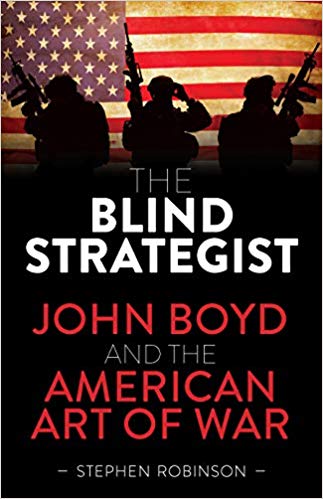
Review: Blind Strategist

Blind Strategist

I’ve wanted a book that dove deep into the excesses of supporters of so-called “maneuver warfare”. In Stephen Robinson’s Blind Strategist, I finally have it. How is it? Mixed. Thankfully, it’s the kind of mixed that makes for a good review.

The book is nominally aimed at John “OODA Loop” Boyd. However Boyd, due to his aversion to writing anything down, his own constantly shifting imagination, and his uh, “difficult personality”, is hard to pin anything on. I do not think it’s a coincidence that Boyd’s teachings are excellent in general terms but almost never work for anything specific.

Blind Strategist spends most of its pages slamming Basil Liddell-Hart and William Lind, who did not have an aversion to writing anything down. It also talks of the Wehrmacht Legend that drove maneuver warfare activism, and defends the oft-criticized William DePuy and his “Active Defense”. (I agree with almost all of the substantial criticisms of Active Defense, but think that in the mid-1970s, the post-Vietnam US Army needed to walk before it could run). Finally, it tries to hold maneuver warfare responsible for the Iraq War’s struggles. Even I think this is going too far, and it doesn’t exactly sound convincing.

Even in its main thesis, this comes across as being overly nitpicky and a little straw-mannish. I do not believe that even almost all of the most devoted maneuver practitioners would deny that there comes a point where you have to close and destroy. Note that I said “almost all”…

…Because Lind is one of those obsessives. And here, weirdly, Robinson arguably doesn’t go far enough. Blind Strategist neglects Victoria, a fantasy where indeed, just doing the right principles and following the right footwork causes the Mary Sue’s enemy to collapse totally without the need for a slugfest. It rightly talks about him trying to shove “third-gen” maneuver war into “fourth-gen” unconventional war, but doesn’t elaborate (and should) on just how he jumps right back to his third-gen map exercises at the slightest opportunity.

I feared this book would go a little too far in the opposite direction, and it does. But I can understand, given the maneuverist min-maxing, why it would do so. I don’t blame Robinson, and if there is room for extreme pro-“maneuver” arguments, there’s also room for extreme reactions.

A Thousand Words: WMMA5

WMMA5

Grey Dog Software’s World of Mixed Martial Arts 5 is an excellent mixed martial arts simulator/tycoon game. It’s best to keep your game worlds small as loading times are still an issue, but that’s the only (small) sour note in a very sweet game. As a tycoon, you can participate in building your own MMA empire, and learn the hard way that trying to do right by either your fighters or your fans has financial consequences.

Or you can just smash the figures together in the game’s Quick Fight mode, which is where I spend most of my time with it. The character editor means you can create anything from all-rounders to monomanical specialists who can’t strike or can’t grapple (or both!) As MMA has even more “moving parts” than boxing, making a proper sim is tough. Thankfully, this delivers.

Review: Small Unit Tactics

Small Unit Tactics

Because of a desire to write action scenes that are at least slightly more maybe, kinda-a-little more realistic than “hand cannons and elbow drops”, and because I’m a sucker for instruction books, I’ve been dipping into visual tactical guides. These are the kind of things the infamous Paladin Press would publish, and aim to translate from field-manualese to English (a more charitable interpretation is that they’re aimed at genuine military personnel and try to make legitimately important stuff clearer). One of them is Matthew Luke’s Small Unit Tactics. How is it?

This book focuses almost entirely on the ambush. Because I actually enjoy reading field manuals for fun, there wasn’t a lot I didn’t already know. But this is a clear example, and it talked about ambushes in a way different from how I’d previously read about them. Maybe because I had read so much about irregular forces, the type most firmly in my mind was “fire, do as much damage as you can, and then immediately try to escape”. The book talks about a further close assault, and labels that kind a mere “harassing ambush”, used mainly for deterring patrols/reaction forces.

This is a good resource for fiction writers and/or armchair generals. The pictures and photos (mostly of military exercises practicing the type of actions written in the book) are well-done, the text is well done, and it can be applied to almost any type of formation. Yes, the classic OPFOR has the simplest foot infantry tactics (unitary squads deploying in lines), but those unitary squads are still capable of launching an ambush. It’s not the be-all-end-all of research, but it’s still a very good component.

Review: Once an Eagle

Once an Eagle

A fairly long time ago, I received Anton Myrer’s Once an Eagle as a gift, because I liked books on military fiction. This book is a classic of its genre and is very highly spoken of. The only issue is, well, I didn’t like it very much. Granted, my first impression of it was clouded simply by a mismatch of tastes. To me (esp. at the time), “military fiction” meant Dale Brown-style thrillers. This book is a sweeping pop epic that just happens to have the American military as its setting, the way my own The Sure Bet King has the underground sports betting industry or Susan Howatch’s Sins of the Fathers has the New York banking industry.

However, even accepting that it’s an orange rather than an apple, I still don’t think it’s a very good orange. Main character Sam Damon is an obvious and massive Mary Sue, and the Manichean nature of the book doesn’t really suit a horrifically complex subject. Maybe if Myrer’s writing fundamentals were really good, they could have saved the book. They aren’t.

You could definitely do (and people undoubtedly have done) a gigantic, excellent pop epic on a long military career. But this is not it.

Review: Blood Debt

Blood Debt

Peter Nealen’s Brannigan’s Blackhearts return with a bang in Blood Debt. When I saw the teaser and saw that the book took place in Kyrgyzstan, I was excited. Central Asia is an excellent and underused setting. Reading the actual book, and seeing the series return to its high-powered enemy heights made me even more excited. A lot of the time fiction works best when it’s audacious, and this is definitely that.

If anything, the action is somehow improved. I got a greater sense of a (very plausible and realistic) fog of war in the action scenes without it taking away from the cheap thriller spectacle. There’s this and there’s well, the main villainess (yes, villainess) having an Esperanto-derived name. What’s not to like?

Review: Danger Close

Danger Close

Cameron Curtis’ Danger Close is kind of like seeing a local band play an original love song in a club with iffy acoustics. It’s not exactly ambitious, and you know the quality isn’t the best, but you don’t care. You enjoy the music anyway. Likewise, this ridiculously cliche “shoot the terrorist” story is still enjoyable.

It has a very predictable arc (I basically knew the fate of a certain supporting character because she reminded me of a similar one in Rambo II). It has the big burly macho ex-operator man-bro main character. It has research that somehow gets some basic details wrong. It has the Clancy/Baen-ist politics of a cliche cheap thriller and then some.

I didn’t care. Not everything can be an epic masterpiece, and not everything should be. This is disposable entertainment and should be treated as such.

Review: US Battleships

US Battleships: An Illustrated Design History

Norman Friedman’s US Battleships: An Illustrated Design History was one of the first really big, really crunchy, really technical books on military equipment that I got. It’s obviously not light reading (at least for normal people), but it flows well. And I honestly think battleships are the best suited to a historical chronicle like this.

Since 99% of their history was in the past tense (the sole exception being the Iowa reactivation at the time of the book), it means there’s less sensitive info around. And since battleships are gigantic and awesome (don’t lie), it makes for fascinating reading. In battleships, you can see the US Navy going from its humble beginnings to its World War II juggernaut.

Technical naval warfare fans should definitely get this book. It’s one of the best of its kind.

A Thousand Words: Ishtar

Ishtar

The film Ishtar, about a pair of dopey musicians that end up involved in a Middle Eastern revolution, is frequently labeled one of the worst films ever. Is it that bad? Not really. Is it bad, period? Kind of. See, it wants to be smart, but it fails spectacularly at being smart. When it lets itself be dumb, it has some good moments.

The highlight of the film is a scene in a bazaar involving a ton of secret agents with terribly stereotyped disguises. It had me laughing massively, and reminded me of the classic Oktoberfest scene in The Pink Panther Strikes Again. But the attempts at actually providing DEEP POLITICAL COMMENTARY? Not so much. Even some of the dumb comedy moments don’t work-there’s a scene later in the movie that involved arms dealers, natives, and the main characters “translating” by speaking gibberish that came across as contrived, unfunny, and honestly a little offensive.

The acting is iffy. Charles Grodin does a great job as a secret agent. The actor playing the emir of Ishtar is undeniably talented and would have worked well in a serious movie, but fails here where a Chaplin/Baren Cohen-style goofball dictator would have fit a lot better. The main characters are annoying and idiotic, but they’re meant to be annoying and idiotic. Does that help? You can decide.

It’s not the best movie of all time or even really “good”, but it doesn’t deserve to be considered one of the worst films ever.

Review: The Clinch

The Clinch

Nicole Disney’s The Clinch is a yuri (female/female) MMA romance. Boy, I never thought I’d be having one of those highlighted on Fuldapocalypse. Anyway, it works very well as both a romance (the main character Eden Bauer is very well developed) and as a mixed martial arts book (Disney is experienced in martial arts herself, and it shows.)

There are a few quibbles, all of which are still highly forgivable. In the book the UFC women’s featherweight division is big and prestigious. In real life it’s a tiny skeleton consisting of just Amanda Nunes and her next tomato can victim. There’s also characters having too much situational awareness in the middle of a fight, which is understandable for literary reasons but still comes across as a little forced and unrealistic.

Still, this is the best mixed martial arts novel I’ve read, romance or not.

Review: National Security

National Security

As something that’s very much a “51%” book, Marc Cameron’s National Security is hard to really review in depth. The first full-length Jericho Quinn (what a name!) book, it fits in the category of “light but fun.” In fact, it’s arguably a better example of the “The ultimate 51% book” than Marine Force One, my past go-to novel, was.

If one was to play a drinking game for cheap thriller cliches in this book, they would die of alcohol poisoning less than halfway through. Everything from the antagonists to the hero, to the way the hero’s operation is set up is there and very familiar to genre enthusiasts like myself. There’s even the weird weapons like silenced .22LR Glocks and air-launched Tomahawks. It’s dumb, it’s sometimes tasteless, and it’s the kind of book I love.