Review: Victoria

Victoria: A Novel of Fourth Generation War

Over the course of many years, theorist and commentator William S. Lind wrote a novel called Victoria. In the 2010s, he finally published it under the pen name “Thomas Hobbes.” When little doe-eyed me got the book, I thought “well, this sounds like a kooky bit of ‘Patriot Fiction’, but at least it’s got a renowned military commentator writing it. So the battles should be good.” What I actually got was a neoreactionary tribute to Old Prussia and a bitter axe grinding by a washed up charlatan who knew only the “ten of the last three financial crises” approach to critiquing military policy.

So the plot goes like this. Captain John [Mary] Rumford, of the USMC, cannot bear to hear a woman say “Iwo Jima” in a casualty remembrance ceremony because it was insulting to the dead (none of whom were woman). So he interrupts her, gets drummed out of the Corps, and meets William [Sue] Kraft. Then comes a frenetic pace as they cakewalk their traditionalist state to victory against one drooling opponent after another. The prose and pacing are actually decent-to-good, which makes the blows hit a lot harder.

However bad the politics (The book has African Americans “willingly” return to being happy farm workers, emphasizes the pure Spanish noble heritage of the only good Latina character, and has societal peer pressure stop the use of most Evil Modern Technology just to give two examples), what I found far more fascinating was just how bad the military aspect of it was. This was earnestly surprising to me at first. After reading more of Lind’s nonfiction writing, it wasn’t in hindsight.

I would sum it up this way: Lind can’t even do failure properly. The best example is this a scene involving the classic Briefing of Doom where Rumford falls asleep. Now the right way to do this would be to have it be badly done with a million terrible overproduced Powerpoint slides or something similar, leading an exhausted Rumford to, to his horror, doze off. Instead the actual subject matter of the briefing is treated as being at fault, with the narrator’s nap being a form of “and nothing of value was lost” contempt. What is the subject matter? Just minor, insignificant details like maps, roads, and local weather. You know, the kind of thing that an army, especially the wunderjager light infantry that Lind loves, doesn’t need to know.

In fact, this blind spot envelops the whole book in a way that’s actually a little funny when looked at. Rumford does not actually fight (the closest he comes in the entire book is having to draw his pistol when near the scene of a drive-by), and he doesn’t really command either. He just hovers around, jumps in from time to time, and gives advice. Almost like it was written by a civilian theorist who hovered around the military, jumped in from time to time, and gave advice.

I counted at least two arcs in the book where a light infantry sneak would have been genuinely effective. But Lind just did not want to write any actual battles. Just pointing at the scene, dispensing generalist advice (and/or coming up with a super-gimmick) and watching the stomp ensue. Lind makes Liddell-Hart look like Luigi Cadorna in comparison in both this and his nonfiction. Because of this, all of his potentially good points and legitimate critiques are squandered.

That Lind gets a lot of the fundamentals right just means the crazy is unfiltered. This book is both distinctive and a huge waste.

Review: Super-Squad

Super-Squad: The Now Missing Component

It’s time to look at one of the most prolific military theorists: Vietnam veteran H. John Poole. Poole’s recent Super-Squad is a detailed call for improved light infantry tactics and a different squad organization, along with a historical study of various opponents from World War I to the present.

I may have never, ever encountered a “mean 51%” nonfiction book like this one. Poole is an infantry veteran who’s walked the walk. His desires are sincere and heartfelt, and many of his goals are valid or at least understandable. Yet there’s just so much else wrong in presentation and even theory here.

The book could probably be around half of its length and work with a concise message of “This is my proposed squad organization. This is how various limited-resource opponents across history used maneuver and skill to counter their lack of direct resources. You cannot always assume superior resources, so this is vital.”

Instead, it’s a long rambling bunch of anecdotes and illustrations, often from old field manuals. Anything that shows the “eastern army” succeeding is trumpeted. Anything that shows them failing is quickly glossed over. The writing lacks humility, to put it mildly. There are statements like “no combined infantry/tank attack has succeeded except on open terrain”, which is simply untrue. The ridiculous lumping of every possible Asian opponent into generalized “eastern armies”, combined with an obsession with ninjas (really!) doesn’t exactly help much. Neither does (especially if you want change) the constant bashing of the existing American military, something that will put most people on the defensive.

This has to be understood as being like Curtis Lemay calling for a giant fleet of super-bombers dropping souped-up nuclear weapons. If your experience involves a hammer, everything looks like a nail. Everything. It gets kind of repetitive and even a little annoying at places.

I don’t regret getting this book. As an “OPFOR light infantry tactics and case studies as written by your kooky old granddad who’s convinced he can save the economy through multi-level marketing” book, it (and many of Poole’s other books, given their similarities) works for what it is. Just don’t really expect it to be anything more.

Review: A Pius Man

A Pius Man

Declan Finn’s A Pius Man is a very weird thriller. It was intended as a conservative Catholic response to The Da Vinci Code and its array of knockoffs, yet delays in the publication of the book had the unfortunate effect of making it appear after the trend had already gone away. So it’s like a scathing critique of disco music-that came out in 1989.

As for the book itself, it’s an awkward mixture of conventional thriller (see the central casting Thriller Protagonist!), out-there thriller (See the pope in his super-armor confront raised-from-childhood KGB assassins!), and a self-serious defense of Pius XII’s historical record that reads like a mediocre undergraduate essay. All this is clumsily shoved together.

I still wouldn’t call this book really “good”. But it’s at least different and a little distinct. Your liking of it will depend on your liking of difference for its own sake. It’s the “mean 51%” compared to stuff like Marine Force One or other rote “shoot the terrorist”‘s “median 51%”.

Review: Project 19

Project 19

James Ronsone and Matt Jackson’s Project 19 is an alternate history story about a far more severe Gulf War. In it, the Soviets, eager to disrupt the world’s oil supply (and thus raise the value of their own products) have more or less openly supported the Iraqis with piles of modern equipment and trained pilots. Thus they charge full-force down the Arabian Peninsula, and the squash of the historical war turns into a frantic struggle instead.

The very designation of this book (and its series) is a matter of question. It’s an alternate history “big war thriller” for certain, but even though not designated as such, I feel it deserves the term “World War III”. Yes, the location is different and so are some of the participants. But I see a giant conventional Soviet-American conflict and know only one thing to call it.

As for literary quality, it’s a little awkward. On one hand, the characters are Steel Panthers cutouts who exist to stand around in conference rooms or operate military equipment with cameras strapped to their heads so that the reader can see them. And the prose, well, sometimes it comes across as even clunkier than what I’ve read in the Kirov series. That is no small feat. Finally, while the technical inaccuracies are never more than mild, something this infodumpy has no right to get details like “Chinese T-62 copies” (which never existed) wrong.

But on the other hand, this is an extremely hard genre to write well. I’d even go so far as to say that “big war thrillers” are arguably the hardest type of fiction to write well. They’re certainly tougher and require far more balancing than normal action hero or small unit stories. What Ronsone and Jackson want to do is make a broad scope telling of a very different war. And here they succeed. It comes at the expense of a lot of other things, but this book succeeds in its main goal.

Apart from that dichotomy, I could have a few more nitpicks about the plausibility. The Soviets couldn’t supply an external country with high-end tanks without either stripping their most essential forward forces or diverting a year or two’s worth of factory production. Even there, advanced tanks didn’t grow on trees. The speed at which the Iraqis advance is more than the ideal distance of a successful operation, much less the imperfect, generally slow military that they were. But all these can be handwaved aside in the name of wanting to provide a challenging opponent, which is where this succeeds. I particularly like the US military being placed in a position where it doesn’t have total air control right away.

So in conclusion, this book has many virtues and flaws. Though not the best example of its subgenre, it’s nonetheless readable for fans of Larry Bond and the like.

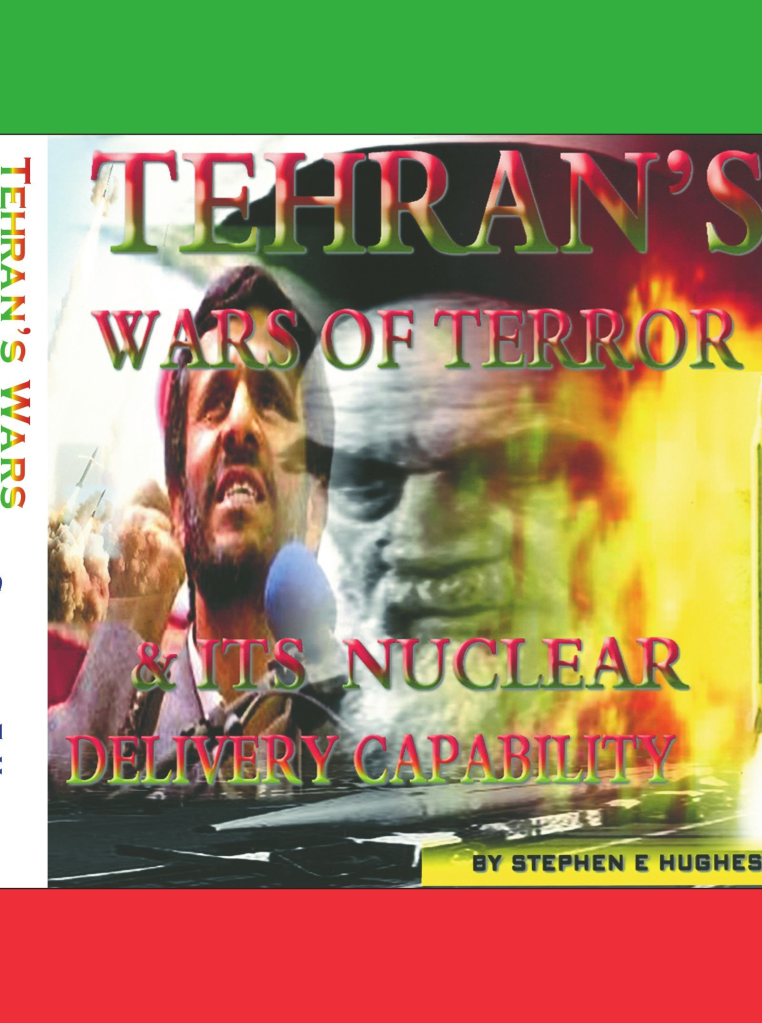
Review: Tehran’s Wars of Terror

Tehran’s Wars of Terror and Its Nuclear Delivery Capability

The worst book cover deserves to be seen in all its “glory”

Stephen Hughes’ The Iraqi Threat was a letdown. This is even more of a letdown. Trying to move through the smoke of the infamously secretive post-revolutionary Iranian military (with their five million new systems that appear in every new parade) would be a worthy and very useful endeavor. This not only fails in that regard, it acts like it doesn’t even try.

First off, I’m a “you can’t [usually] judge a book by its cover” type of person. I can understand having a bad cover or a crude cover. But this is an exception, because the cover of Tehran’s Wars of Terror is, without a doubt, the worst I’ve seen of any military reference book. And one of the worst I’ve seen period.

The cover is perfectly representative of the absolute slapdash mush inside. The Iraqi Threat at least had a central theme that it followed. This is just a rambling collection of various articles that are connected with only a vague link to Middle Eastern warfare. It doesn’t even work as a basic “know your enemy” primer because it’s so gargantuan and aimless. I feel surprisingly confident in saying that it’s quite possibly the worst military reference book I’ve read. And if not, it’s certainly down there.

Review: Point of Impact

Point of Impact

Stephen Hunter kicks off his Bob Lee Swagger (aka Deadshot-13) series of sniper thrillers with Point of Impact. I was eager to finally get the chance to read this book, as I’ve heard good things about the series. I was not disappointed. This was a great novel.

Now, granted, there are some bumps. The amount of machismo in the writing’s tone is a little much even for me. More importantly, it has an awkward mix of “Herman Melville for snipers” where it talks about grounded, important setting up for a shot, and “Sniper John Rourke” where the main character can fight at the level of a video game hero and make very accurate shots in a very short amount of time.

But these are not deal-breakers by any means. The action is excellent. The book is long yet well-paced and never feels like it drags on. It has the “slow buildup” of Jon Land at his best applied to a much more serious plot and executed quite effectively. Finally, the big twist feels like an unintentional/accidental critique of the worst “shoot the terrorist” thrillers where the main character doesn’t actually have that much agency. This is definitely not one of those.

I loved this book. I recommend this book. It’s not the absolute best thriller I’ve read, but it’s definitely up there.

Review: Drawing The Line

Drawing The Line

Peter Nealen’s Drawing The Line has been given out as a newsletter sign-up bonus. An American Praetorians story set on the southern American border, I wanted to see how it went. And it was what I basically expected it to be.

Now, the American Praetorians series as a whole is the least good of Nealen’s contemporary action. I say “least good” instead of “worst” because they’re still very good thrillers. It’s just two things get in their way. The first is the feeling of an author still finding his footing, which is less of a problem in this smaller, less ambitious work. The second is writing it in first person, which I don’t think is the best perspective for the genre.

Still, this is intended as a snack, and it’s a very good snack.

Review: Threat Level Alpha

Threat Level Alpha

The sixth book in the Dan Morgan series, Threat Level Alpha is unfortunately a step back. The first problem is that the book reverts to the mean of “shoot the terrorist”, and a clumsy attempt to raise the stakes by making the threat supposedly more dangerous simply doesn’t work. The second is that there are two basically unconnected plotlines in the book.

There are better books in this series. I do not recommending reading this one. It may very well be the worst entry in the Dan Morgan series that I’ve read so far. Read the other five books instead.

Review: Rogue Commander

Rogue Commander

The fifth Dan Morgan thriller, Leo Maloney’s Rogue Commander solidifies his status as the “second-best Jon Land.” Like I’ve said before, this series is the closest I’ve gotten to the excessive fun that was Blaine McCracken and Land’s other heroes. The subject matter is more mundane than Land’s, but the structure, especially the excellent “slow reveal” is very similar and just as effective.

This book in particular emphasizes another trait shared with Land-the swerve where characters dramatically show they were on the opposite side then previously implied. In this case, the titular “rogue commander” is all but stated to be someone-and then, in the climax, revealed to be-gasp- someone else. It’s silly, it’s ridiculous, it’s not high literature in the slightest-and it’s very very fun.

It still isn’t the best in the Dan Morgan series (that would be Black Skies as of now), but you could still do worse than this as your first entry into Maloney’s action hero fantasy. It has everything good about Dan Morgan, and all the fundamentals are solid.

A Thousand Words: Fallout: New Vegas

Fallout: New Vegas

It’s close to the anniversary of the release of Fallout: New Vegas. That game is one I played a gigantic amount several years ago, and it’s one that seemed to suit my style more than the “Bethesda Fallouts” ever did.

New Vegas has a very simple plot. You control a deliveryperson who gets ambushed, shot, and left for dead by someone in a bad suit who wants to gain control of a Las Vegas that’s been left intact after the nuclear war. After being saved by a robot, making your way to Vegas, and dealing with the guy in a bad suit, you get to decide who gets to control it. The plot is simple, but the setting is amazing. It’s this very interesting “post-postapocalyptic” theme where society has fallen-and risen again with big cities and big armies. It feels alive.

What makes this an orange to the “apples” of Fallouts 3 and 4 is that this is more linear. You’re railroaded on the main quest route both by dialogue and the game placing powerful monsters in all the places you’re not supposed to go, and the world is a lot less flat and explorable than in those two. But because my strategy was to just go through the main quests, I didn’t mind.

While this has the infamous “Gamebryo Bugs” and balance issues (speech is an overpowered skill that there’s no point in not maxing unless you want a self-imposed challenge), it’s still my favorite PC RPG of all time.