Review: Fire Ice

Fire Ice

The novel Fire Ice holds a great deal of importance to me. It was, without a doubt, the first real “cheap thriller” a young me read. This makes it hard to truly judge its literary quality. After all, young me saw the name Clive Cussler on the cover and didn’t know at the time about how the “co-author” system worked, so I assumed it was all him (which had the thankful effect of leading me to earlier Cussler books that were indeed all his own).

With its big locales, action, and high-stakes plot with a Russian oligarch and a supervillain scheme, this has all the ingredients a Cussler thriller and a cheap thriller in general needs. Certainly, for one’s first cheap thriller, you could do a whole lot worse than that. While my reading habits are such that another cheap thriller probably would have taken its place, I still owe Fire Ice a lot for getting me into them.

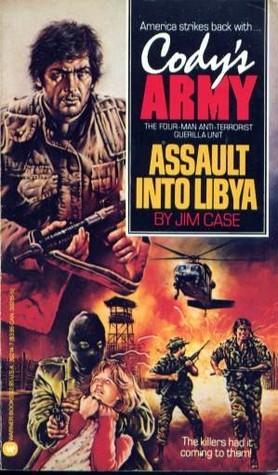
Review: Assault Into Libya

Assault Into Libya

With this post, I will have reviewed every book in the Cody’s Army series on Fuldapocalypse. How does the second, Assault into Libya, hold up compared to the others? Well, it does what a men’s adventure novel is supposed to. Like some of the other entries, it’s a 51% book in a 51% series. Beyond the basics, it only really stands out in being a little more willing than some when it comes to killing off supporting characters.

For the series as a whole, it’s ideal for showing off the most single representative example of what 1980s men’s adventure was like. Teams of secret agents pursue terrorists through headline-ripped locations (this particular book has Libya, the crown jewel then). There’s lots of at least moderately effective action. And yet this book has the same issue that all Cody’s Army entries save for the truly engaging Hellfire in Haiti share-they’re mostly interchangeable and there’s no reason to pick them ahead of better examples in the same genre.

Review: Field of Glory

Field of Glory

With Field of Glory, the Kirov series shifts into another subplot involving-you guessed it-time travelers changing the outcome of famous battles. In this case it’s a French and British time traveler manipulating history with their time-keys as part of a rivalry, with this book being about changing the outcome of the Battle of Waterloo. This entire “Keyholders Saga” was set up early in the series as a possible direction after the initial arc, shelved as an alternate World War II was focused on, and then revived later on as a way to show off wargames in other time periods.

This book is even more blatant than usual about being little but a lets play/after action report. While anyone crazy enough to make it through the Kirov series wouldn’t be surprised by any of this, this is intended as a spinoff. And for what it is, it’s not too bad.

At first it may be confusing and incomprehensible to have a story shift from the World Wars to the distant past, but once the gimmick is understood, it becomes better. Especially since a problem of some of the other Kirovs is that they linger too long on one certain war/campaign. A one-off book doesn’t have that issue.

Review: No Mercy

No Mercy

John Gilstrap’s debut in the Jonathan Grave series, No Mercy, is very much a “grocery store book”. In fact, I first learned of this series after seeing a later book by him in-a grocery store. That being said, not all grocery store books are bad.

This is, in fact, one of the best thrillers I’ve read in a while. Sure, the plot and characters are nothing out of the ordinary for thriller novels, but the execution of Jonathan Grave and his adventure is fantastic. From the opening rescue sequence, I was impressed by the quality of the action. It’s not perfect. The middle drags just a bit. But it’s fantastic nonetheless.

The action is so good that, even though I saw some of my usual quibbles, I brushed them aside effortlessly. From the opening to some unconventional-yet-effective scenes in the middle to a gigantic battle ending, this was a tour de force. No Mercy was the kind of opening act that deserved to bring about a large book series.

Review: Termination Orders

Termination Orders

Leo Maloney’s Termination Orders begins the Dan Morgan series of thrillers. The plot is basically cheap thriller boilerplate, as an action hero faces off against a super-conspiracy. Of course, cheap thrillers succeed and fail based on execution, not concept.

In that sense, the book works. Its action is competent and the pacing done fairly well, although there are a lot of flashbacks in weird places. The exception to the generic yet decent action is one set-piece involving lions that made me smile.

The conclusion I drew is that this book manages to go juuuuust above the middle of the very crowded pack. It’s not the most distinct or best cheap thriller. But it’s done well enough that I wouldn’t call it a mere “51%” book.

Review: Decisively Engaged

Decisively Engaged

It’s been some time since I read a nice, proper spacesuit commando novel. And C. J. Carella’s Decisively Engaged fits the bill. Because boy, is this of the biggest spacesuit commando books ever. It’s Space America vs. The Alien Hordes. Sure there’s a backstory, but all you really need to know is it being (literal) Space America vs. the Alien Hordes.

The military sci-fi cliches are present here in such massive qualities that they stop being annoying and start being oddly endearing. This and the fact that the action is actually decently written-not the best, but at least decently enough-is enough to make the book enjoyable for me. The worst part is overly jumpy perspective shifts, not helped a few clumsy flashback “interludes”.

This is the sort of pulpy cheap thriller that doesn’t feel like “good” would be the right word to describe it. Yet it’s enjoyable, and that’s ultimately what matters more.

Review: For Alert Force

For Alert Force: KLAXON KLAXON KLAXON

Having essentially run low on World War III books that both held interest to me and weren’t already read has been a slight issue for this blog. Thankfully, I found some newer ones. One of these was Jim Clonts’ FOR ALERT FORCE: KLAXON KLAXON KLAXON, an awkwardly-titled book telling the tale of SAC crews in World War III.

This is a near-immediate 1980s nuclear World War III with none of the contrivances to keep it conventional for any length of time that appear in other works. Clonts, a veteran of B-52s himself, tells their story of fighting in these apocalyptic conditions. The book is good for what it is, but tends to wobble a little.

It has the exact strengths and weaknesses of what something written by someone with personal experience brings. On one hand, it’s detailed and a lot of it is accurate (as far as I could tell). A lot of the scenes are tense and well-done. On the other, it has tons and tons of Herman Melville-grade explanations of everything minor and technical.

Still, it could have been a lot worse than it is, and works as an aviation thriller. It’s not the most pleasant, but as this is about nuclear war, that’s to be expected. A more focused Chieftains (albeit with airplanes instead of tanks) is not a bad thing.

Finally, I noticed that it openly declares itself an “alternate history” on the cover, something a lot of fiction, even the kind that could easily qualify as such, doesn’t do. This fits the description unambiguously. It takes place long before its writing time and has history-changing events. So it’s interesting that Clonts felt comfortable enough to label it as such.

In short, I didn’t regret reading this book.

Review: Day of Wrath

Day of Wrath

The time has come to review another Larry Bond book, 1998’s Day of Wrath. Now, I was a little reluctant to do it because of a small meme I have where I joke about how few Larry Bond novels I’ve actually covered on the blog. Oh well.

It’s one of the biggest examples of “Captain Beefheart Playing Normal Music”. The plot is simple enough, as Col. Peter Thorn and Agent Helen Gray take on a super-terrorist plot by a wealthy and fanatical Saudi prince. As far as cheap thrillers go, you could do worse. In total isolation, this would be a middling, slightly above-average thriller book.

But it comes in the context of Bond’s writing style. Day of Wrath has all the weaknesses of it I’d noticed in Bond’s other books. The biggest is an extremely long and extremely predictable opening act, something I noticed in Cauldron, Red Phoenix, and to a lesser extent in Bond-contributing Red Storm Rising as well. This, along with a bit of clunkiness and the dichotomy between “wants to be realistic-sounding” and “has the main characters doing ridiculous action hero feats”, drags it down slightly.

The real problem with this book isn’t that it has Bond’s weaknesses, or that the weaknesses are more prominent than his others. It’s that it doesn’t take advantage of his strengths. This is a “shoot the terrorist” thriller that could have easily been written by one of the many, many other writers in that genre. The plot centers around the not-exactly underused MacGuffin of nuclear bombs. Bond’s ability to write large conflicts is simply never used at all.

Given how rare that type of fiction is, having Bond make a “big war thriller” with the stereotypical Middle East Coalition opponent who used their oil money to fund the production and procurement of various super-prototypes would at least be more distinct. It would be something that a more knowledgeable wargamer could do legitimately better than a “normal” thriller author trying to do such an ambitious tale.

Instead, he ends up like the weird musician doing a standard pop song-not technically bad, but merging with the pack instead of standing out. Putting him against tougher competition, his weaknesses become more apparent. It’s like having Eddie Van Halen for a song and, for whatever reason, not having him do a guitar solo of any kind. Yes, it’s music and the talent is obviously there-but you know it could have been so much more memorable.

Review: Tales of World War III 1985

Tales of World War III: 1985

Looking back at the progression of this blog, I’m reminded a lot of the story of trying to make a cockpit design that could fit the “average pilot”, and then finding that no one actually met that criteria. I feel similarly when I look back at just how little anything actually met my stereotype.

Brad Smith’s Tales of World War III: 1985 series comes closest, edging out Larry Bond’s earlier work. It’s done by a wargame designer and thus features the wargame-friendly setting of 1985 Europe, with battles taking place in various parts of it. There’s a lot of technical description.

I don’t feel nearly as much negativity towards it as I would have and did in the past. Smith has sincerely tried to build characterization, even if the execution is still often clunky and the characters often Steel Panthers cameras in practice. And the wargaming at least takes the series above Ian Slater in terms of technical accuracy. But it’s still a 51% entry in a niche genre, the pilot who isn’t particularly good or bad but has the dimensions to actually fit well in the “average” cockpit.

Review: Ripple Effect

Ripple Effect

I’ll be honest. The sole reason I was attracted to Ripple Effect was the name of its main character, “Bear” Logan. Given how I like thrillers with ridiculous character names, I figured I had to check this one out. So I did. And this time the “the more ridiculous the name, the better” explanation didn’t really work out.

It’s not bad, but it’s only merely adequate at best in a genre filled with adequate books. The only standout feature, besides the name, is how it jumps between first and third person perspective in its writing-something that I don’t think really adds anything. The action is adequate. The pacing is adequate. The characters are adequate for this kind of book. You get the idea.