Review: Rhinelander

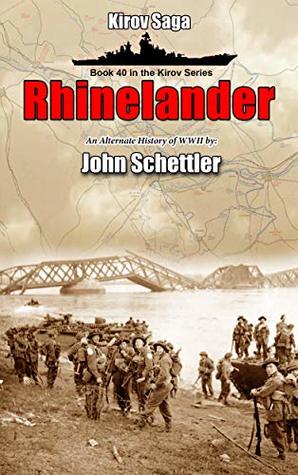
Rhinelander

After 31 (!) books, the World War II arc of the Kirov series concludes in Rhinelander. This is what I’ve been reading for the last month as the latest long, sequential series that I had a weird craving for. This book continues the time travel adventures which grow steadily more convoluted and more obviously a way to set up wargame sandboxes.

It also focuses on an alternate World War II where the initial Allied invasion of France came from the south and there were different tanks (including timeshifted modern ones on both sides) and… lots of changes. Much of it is reminiscent of the final battles on the historical western front, only moved up a year. A sort of “mini-Bulge” is conducted as one of the set pieces.

There was no real way that this lummox could conclude gracefully, so it gets a quick brute-force ending with a lot of exposition to smooth things over for the next timeshift and arc, a contemporary World War III that got the series to my attention in the first place. I was nonetheless content with it, and not just because the Kirov series defies normal critical scaling. Especially knowing the nature of the series and the state of the war at this point, having several books of nothing but the Allies advancing without truly serious opposition would not be ideal.

Review: Red Army

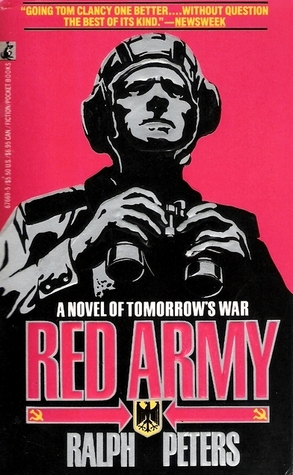
Red Army

So I actually haven’t done a formal review of Ralph Peters’ masterpiece Red Army on this blog yet. I think I should, because well, it’s my clear choice for “best conventional World War III book of all time.” It has fewer competitors for that title than I originally thought when I first read it, but still manages to stay above them.

The story of a conventional WW3 in 198X, the book jumps between the perspectives of various Soviets as they carry out the war. One of the best “big war thrillers” at managing the viewpoint jumps, it never feels awkward or clunky in that regard. The characterization is very good, especially by the standards of the genre. And it works very well at avoiding an excessive focus on technology.

Of course, Peters has the Soviets win, and thus deserves extra credit for going against the tide. At the time the book was published, there was a (justifiable) sense of increasing triumphalism. Having them win and win handily was a good move. Especially since it doesn’t come across as being done for cheap shock value.

There’s a few sour parts. While the viewpoint jumping is good, the two messages of “humanize the Soviets” and “show how they can beat NATO” sometimes don’t work well, especially as the latter means characters done just to explain things (granted, as someone who’s read the translated Voroshilov Lectures and similar materials for fun, I understand it in ways a casual reader at the time almost certainly wouldn’t). There’s criticism of how the Soviets advance too fast, which is valid but which I consider a mild issue, no worse than Team Yankee’s similar problem with lopsidedness. My biggest complaint is how the situation is set up to let the Americans almost entirely off the hook for NATO’s defeat.

But these are small problems at most. Red Army is an excellent book, and I have no problem considering it my favorite “Conventional WW3” novel of all time. And it has one of my favorite book covers ever.

Review: The Ninth Dominion

The Ninth Dominion

The second, and as of now last book in the Jared Kimberlain series, Jon Land’s The Ninth Dominion is a par-for-the-course crazy ridiculous action-adventure book. By the standards of classic Jon Land novels, it has some issues. While it doesn’t help that its immediate predecessor was arguably his most ridiculous (in a good way) novel yet, there’s issues beyond this.

It’s a little less crazy. Beyond that, the biggest issue is that it doesn’t take full advantage of its almost Batman-esque premise of the craziest and most dangerous serial killers escaping. The prose and pacing are a little below Land’s height.

That being said, it still has all the strengths of a Jon Land thriller, and I still enjoyed it significantly. By the standards of more mundane thrillers, it’s quite goofy indeed. Its flaws are not deal-breakers by any measure, and there’s no shame in falling slightly short of a very high bar.

Review: I Jedi

I, Jedi

Michael Stackpole’s I, Jedi may be my favorite Star Wars novel ever. It’s also a book that has absolutely no business being as good as it is. After all, Stackpole is a writer who isn’t the best prose-wise and tends to take game mechanics literally. Corran Horn, his protagonist, is the ur-example of someone parachuting their own Mary Sue into an existing franchise. The first part of the book uses the same plot as a book by the infamously subpar Kevin J. Anderson.

And yet, it somehow works brilliantly. Part of it is that Stackpole’s writing is in better form than usual, in everything from starfighter battles where Corran fights his old teammates and can sense their thought processes to everyday life on a backwater world. Another part of it is that by being small-scale and comparably low-stakes, it manages to actually make the universe look bigger and more wondrous.

Stackpole’s epic might be helped along by the other books of the time, which tended to have a random ex-Imperial using the superweapon of the week and an inappropiately small number of Star Destroyers to threaten the entire galaxy. But even on its own, it works. It embodies the “distant vista” principle, restores a sense of awe, and just succeeds as a story in its own right.

Review: The Secret Weapon

The Secret Weapon

A thriller in the Alexander King series, Bradley Wright’s The Secret Weapon is an example of how tough it is at the margins. My history with the author is a little strange. I’d read some of his books in the past, where they faded from memory as bland and mediocre. Then I saw this book, felt it was bland and mediocre-and then realized I’d read the same author before.

Anyway, the book isn’t really the worst ever. On-paper, it does what a cheap thriller is supposed to do, and only feels like its slightly below average in every category that matters-the action is slightly less exciting, the pacing slightly less efficient, and so on. Yet it’s that little bit that makes the difference.

Because the “action hero” genre is so big, has so many choices, and is reliant on execution rather than concept, for something to fall behind somewhat means there’s a lot out there that’s better. This isn’t like the much tinier “big war thriller” genre where a flawed entry like Chieftains or Arc Light can still be conceptually interesting enough to recommend. Instead, its flaws means it sadly misses the cut.

A Thousand Words: Revolution X

Revolution X

What happens when you take a pair of has-beens fading rapidly from relevance and merge them together? You get Revolution X, an arcade light-gun shooter starring a past-its-prime Aerosmith. The plot is simple-save Aerosmith from a bunch of people in yellow gas masks who’ve outlawed fun. You do so with a gun that fires CDs as well as bullets. Yes, it’s that kind of game.

The gameplay is mostly simple-fire at the hordes of enemy goons on your screen, put more quarters in when they inevitably kill you, repeat as necessary. Two of the later levels make this worse by trying to be more complicated. One, a maze, is simply annoying. The other, a time-sensitive mission where you have to completely destroy a bus before it reaches its destination, is considerably more aggravating.

By the time of its release, Aerosmith had long since fallen from the heights of their popularity, and with more powerful and smaller consoles just coming out, arcades would soon follow. This game is one of those weird novelties that can only happen at a specific time.

Review: The Mongol

The Mongol

The final Casca book credited to Barry Sadler (regardless of its actual authorship-according to some stories I’ve heard, it was a manuscript found after his death), The Mongol is a 51% book in a 51% series. The “which period of history should we put Casca in a theme park version of” wheel stopped at “Genghis Khan” this time.

The good news is that compared to previous flops like The Trench Soldier and The Samurai, this book is significantly better. The bad news is that, like every other Casca book, it’s still melodramatic pulp historical fiction that does almost nothing with its supernatural premise. For a quick read, one could do a lot worse. Yet there isn’t really anything to recommend it ahead of the first two Cascas either.

Thus it’s perhaps fitting that a middling series ended (for a time) on such a middling note.

Review: Altered States

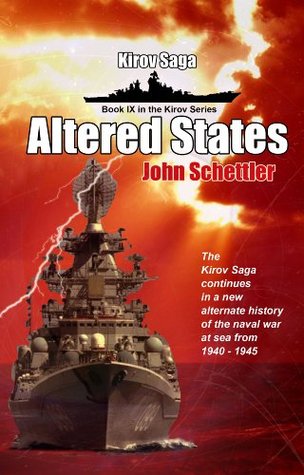
Altered States

The ninth Kirov book, Altered States, is where the series really starts to hit its stride. By Schettler’s own admission, the response to the question of “should I write about the missile cruiser’s later adventures or an alternate World War II where the German surface fleet was bigger?” was “Yes.” And he was glad to oblige, combining the cruiser soap opera with a huge naval battle in a location I haven’t seen in a while-the GIUK gap.

(There’s a Kirov, but there’s not any Backfires or Aegis cruisers or F-14s. It’s like my original vision of Fuldapocalypse mixed with what the blog later became)

This sets the stage for the giant wargame sandbox/time travel soap opera that the rest of the series would become. Not quickly or even the most effectively, but it still does. I’ll admit that the “alternate sandbox” approach is my own favorite way of wargaming, which is why I’ve grown fonder of the series. I’ve found later, similar installments in a series hard to review, and this is one of them. But still, this is where it really clicks into place.

Review: Neptune Island

Neptune Island

The first in the “Lincoln Monk” series (how’s that for a protagonist name) by Tony Reed, Neptune Island is a delight to read. One of the biggest problems with trying to find good cheap thrillers is that the cover and even the blurb alone can’t easily tell whether a book is going to be good or bad.

That being said, this book of a Cheap Thriller Protagonist (capital-that’s how blatant it is), a supervillain billionaire, a superweapon, a beautiful biathelete, and a giant mutant crab is the most fun I’ve had reading a thriller in some time. It’s the kind of book that tosses every sort of “restraint” and “realism” aside in favor of ridiculous spectacle, and it’s great fun, especially after a period of more serious and sedate works.

It’s amazing, and is the kind of book that’s a delight to find. Sure it’s “implausible” and there’s a lot of contrivances, but those are small potatoes. The action is great, the setup is great, it manages to have very good buildup (which I’ve found is surprisingly rare among cheap thrillers), and the whole thing is just incredibly goofy-and really, really fun.

Review: The Natural

The Natural

Sports fiction strangely suffers from the exact same problem that political fiction does. Because there’s so much available in the true world, both past and present, fiction has to be either an obviously forced and exaggerated version or often come across as feeling simply redundant. While success is not impossible, it’s an uphill climb.

One of the classic sports novels is Bernard Malamud’s The Natural, famous for its enduring reputation and movie version that sits alongside Starship Troopers in the field of “movies completely different from the book”. Having read the original book, I have to say: I don’t like it.

There’s one big problem with this book about baseball, which is that Malamud didn’t know that much about the sport. While others have gone into more detail, I’ll say this. There’s some errors like talk of a past World Series between the A’s and White Sox (two AL teams), but the bigger issue is simple. Hobbs comes across as what someone who doesn’t know that much about baseball would think a great player is.

Hobbs is good (unless the plot calls for him not to be) and good in a very boring way, simply hitting and hitting and hitting, not even rising to the level of classic Paul Bunyan baseball stories like how Cool Papa Bell supposedly got hit in the back by his own line drive simply because he ran so fast. Nope, it’s just four home runs in a game and “wondrous averages”. This isn’t a John Rourke or Blaine McCracken of the diamond, it’s a guy skilled in the baseball equivalent of “Special Forces, Ranger, SEAL, and gutter-fighting”.

Without that frame of reference, a lot of it is just references to various baseball legends-Babe Ruth, in the form of the Whammer. Fred Merkle’s baserunning fail, in the form of Fisher’s Flop, the Black Sox (in the form of the ending), and so much more (as the Gerry O’Connor article points out). A modern version would incorporate versions of Bill Buckner, Steve Bartman, and the 2004 lunar eclipse, to give you an idea of how blatant it all is to anyone who knows the slightest bit about early 20th century baseball.

So why am I suddenly so hard on realism and accuracy, when I’m clearly not when it comes to other books? Because the book is self-serious, for one. It’s like trying to write a literary novel about the life of a man who was a soldier, making the battle scenes right out of a stereotypical John Wayne movie, and sometimes descending to Ian Slater levels of technical inaccuracy. Would that interfere with the tone? Definitely.

Especially since, with the benefit of hindsight, this just looks like an exaggerated version (remember the introduction) of the Capital N Narrative approach to sportswriting, the clumsy and inaccurate reduction of a game into a tale of personal morality and internal struggle, applied constantly to real games by sportswriters of dubious quality (sometimes with extra crass humor).

Finally, the prose simply isn’t very good. It’s blocky, incredibly “lush”, and everything is either overdescribed or underdescribed. None of the characters are particularly interesting. And to be honest, in many ways the book feels just as shallow as the movie, only with a different morality. Give me saccharine goo that knows it’s saccharine goo over pretentiousness that doesn’t know its own subject any time.