Review: Undeclared War

The Home Team: Undeclared War

The first book in the Home Team series of thrillers, Undeclared War boasts another one of those amazing cheap thriller hero names. In this case, it’s Ted Reaper, SEAL turned vigilante out to stop a -ready for this?- terrorist. Unfortunately, the main character’s name is the only distinguishing feature about it.

This is one of the most generic “shoot the terrorist” books there is. It wants to have its cake and eat it too concerning realism, which leads to a bizarre situation where the preparations are handled in realistically drudgerous detail, yet the actual action manages to somehow be both out-there and dull. The whole “we’re scrounging vigilantes but hey, we get rare and exotic weapons from our convenient connections” contradiction doesn’t help either.

The lists of weapon descriptions get excessive even by the standards of the genre. I don’t know what I should have expected from a mid-2000s thriller, but this deserves a pass.

A Thousand Words: Red Dawn

Red Dawn

The 1980s classic invasion movie, Red Dawn is a strange beast. While it rightfully ranks up there with Top Gun as one of the most iconic and remembered movies of its generation, I found it had some fundamental issues. And no, it’s not anything dealing with the actual premise.

The production values are very good. The acting is, at the very least, sufficient. Yet the movie’s biggest problem is its conflicting tone. There’s two types of invasion stories, what I call “grim invasion” and “pulpy invasion”. Grim invasion is what most of the original invasion novels were, while pulpy invasion is something out of, well, guess.

Red Dawn sort of awkwardly teeters between elements of both without really settling into one or the other. While not a deal-breaker for the movie, it sours it somewhat and leaves me with the feeling that picking one type, likely pulpy given the concept, would have made for a better story. That being said, the film is still well worth a watch.

Review: Pacific Storm

Pacific Storm

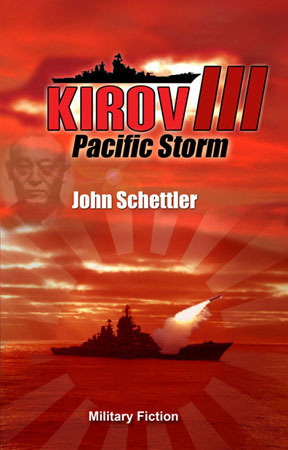
The Kirov series is over fifty books long and counting. But the third entry, Pacific Storm, was planned as a potential stopping point, according to the introduction of a later entry. And while I normally criticize series from Jack Ryan to the Survivalist for passing good opportunities to conclude, it’s for the best that this one sailed right by it.

After having fought through the Mediterranean in the second book, the missile cruiser battles in the Pacific in the third. Besides the issues with the prose, the encounters fall short because the disparity between World War II ships that don’t know what they’re dealing with and a futuristic warship that does means that all the battles have to be contrived in some fashion. Pretty much the only things that work are various surprise gimmicks, close range, and pure numbers, and that’s barely enough to sustain a three-book series.

The ending still involves sequel hooks, but features the ship going back to its present with its crew having realized they started the (nuclear) World War III by firing on an American submarine. When they see the submarine after their “excursion”, they avoid attacking it. Meanwhile, their experiences have changed the “past” significantly. This would be a perfectly good conclusion that still gave room to continue, but it would have concluded three stilted, modestly out-there books. Instead, the series got bigger, more complicated, and, yes, better.

Review: Tiberium Wars

Command And Conquer: Tiberium Wars

The Keith DeCandido novelization of Command and Conquer: Tiberium Wars was widely denounced upon release. I was there on Spacebattles, and I saw the critiques. I read it, and I agreed.

If the book itself was in an original setting, it would be forgettable and bland, a spacesuit commando Marine Force One with a Mary Sue protagonist. The only real quibble would be extremely rapid procurement of new rifles. But as it stands, it doesn’t gel well with the Command and Conquer game. At all.

There might be a mitigating factor in that I’ve also heard that DeCandido got background material for “Tiberium”, the cancelled C&C FPS project and based the book of of that, which would explain some things like the abundance of rifles. However, whatever the circumstances, this is a book to avoid.

Review: Eagle Rising

Eagle Rising

The Kirov series, of which Eagle Rising is the 47th (!) installment, is strange. If I’d read it three years ago, I’d probably have unfairly denounced it as the worst series of all time. In my more recent reviews, I’d sort of wavered from criticizing the individual books to admiring the ridiculous (in a good way!) plot and premise of the setting.

Now I have this weird feeling that’s settled. I unironically love the craziness and excess that the series gets into, while remaining just as critical of the many flaws of the individual books. I’ll take this flawed excess standout over a hundred “51% books” any day.

That being said, this book itself has essentially two set pieces spread out of over many pages and takes place in an entire arc with a forgone conclusion stated as early as the first book in the series. Whatever the author’s intention, the impression I got of this arc, with this particular WWIII having long since been established as ending in a nuclear fireball (hence the time travel and changing it in the first place…), was that it served mainly to show off wargaming set pieces.

The set pieces are a big Russo-NATO showdown in Eastern Europe and the shenanigans of the ship and its crew. The former is a strangely intriguing example of what happens when you rely on wargame simulations to an incredible and unprecedented degree. Besides the obvious issues with such a stilted de facto let’s play, there’s also problems when the simulations produce an undramatic (however realistic) result and there’s not much “cushion” of characterization or low-level danger to balance them. Another issue is that this particular conflict setup is not exactly undergamed.

The latter, a far more out there plot, involves the use of a time travel MacGuffin and some of the crew going onto an island and fighting a pack of wolves (it’s a bit of a long story). It also involves long scenes of clunky dialogue, which is less fun.

In a way, this book, with time travel shenanigans and wargame AARs, is its own series in a nutshell. Is this a good or bad thing? Well, it depends on what you want and/or like.

Review: Aurora Invasion

Aurora: Invasion

What better book series to review on the Fourth of July than the ridiculously star-spangled Black Eagle Force? Aurora Invasion is a later entry in Steinke and Farmer’s “masterpiece”, where the BEF battles a new opponent-aliens.

This is a weaker entry in the series. Part of this is because its authors never were the best in terms of literary fundamentals to begin with, something very true here as well. A bigger reason is that, believe it or not, the rest of the series is so bizarre that fighting UFOs is actually more grounded than some of the other stuff the BEF gets up to.

This is still a decent out-there cheap thriller, but there are better books even in its own series.

Review: The Hunt For Red October

The Hunt For Red October

This is it. The book that started it all. The book that turned Tom Clancy into a juggernaut. It’s time to review The Hunt For Red October. How is it? In short, it’s well-ok?

What I can say about this tale of a loose super-submarine is that it doesn’t really pass the “if this had been published a year or two later by a different author, would it still be as popular as it was?” test. Many works of fiction are so good on their own terms that they’d succeed in that goal. This isn’t. If it had been written by someone else later on, it’d probably be barely remembered as a middle-of-the-road technothriller.

The novel itself isn’t bad by any standards, but it still has all of the issues that would drag Tom Clancy down later on. It’s just those are in a smaller and more manageable form. There’s some bloat, but it’s manageable here. There’s a few too many subplots, but they’re manageable here. There’s the bias, but it’s manageable here. You get the idea. It’s easy to see why it could be a success in its time, but with hindsight, and with me having read other technothrillers before it, I don’t find it that impressive.

It’s also a little dated. Some of it is technical issues that are understandable and minor (for instance, a western author could be forgiven for getting the type of reactor in an Alfa-class wrong). But some of it is the general “wow” factor, again that would have made them a lot more impressive to someone at the time than to a post-Gulf War reader for whom advanced military technology is familiar. This is of course an issue with all of his books and with technothrillers in general. However, it is not an issue with the lavishly-produced, well-filmed movie.

I would say that, like Red Storm Rising, The Hunt For Red October is more of a historical book than an enduring technothriller that can really stand on its own. However, Red October comes across slightly worse in that regard due to being in a bigger niche. While also smaller than I originally thought, the number of technothrillers is still considerably larger than the number of conventional World War III novels.

Review: The Tenth Circle

The Tenth Circle

The latest, and as of now the last Blaine McCracken book released, The Tenth Circle is a frustrating misfire. While Dead Simple was, for the most part, a consistent middling slog without Land’s past spark, this occasionally shows the craziness that makes most of the series such a treat-and then drops dramatically.

The book opens with a delightfully preposterous and ridiculous set piece that does Blaine McCracken justice as he destroys an Iranian nuclear site. If the rest of the book was like that, I’d be giving it a wholeheartedly positive review. Unfortunately, it isn’t.

The problem is that the rest of the book is just too inconsistent. It’s often too self-serious for its own good-and then it returns to individually out-there set pieces. It’s not as (comparably) bad as Dead Simple and a lot of the fun is still there, but shares the problem in that its central core is a more conventional thriller that revolves only around the use of exotic explosives. Yet unlike its immediate predecessor, Pandora’s Temple, it just doesn’t live up to the classic McCrackens.

Review: Planeswalker

Planeswalker

The second novel in the Magic: The Gathering “Artifacts Cycle”, Lynn Abbey’s Planeswalker is a strange book that succeeds in one way but seemingly fails in its main goal. Where it succeeds, at least to me, is in one of its main characters.

Xantcha, a woman who was created by the technomagic horror plane of Phyrexia as an infiltrator, but who grew to have (mostly) free will of her own, steals the show. I’ll admit that the notion of an artificial almost-but-not-quite human is a fascinating one for me, and Abbey succeeds at portraying her well, certainly better than Urza himself.

Part of the problem is that the rest of the book consists of clunky pushes towards one middling set piece after another. As good as Xantcha’s story is, it gets in the way of the main plot. Furthermore, having the numbers routinely get big – ie “A THOUSAND YEAR journey” actually makes the experiences seem smaller and more mundane. Thus one big part of the book is better than the whole. But that part sure is good.

Snippet Reviews: June 2020

It’s time for more snippet reviews.

The Kingdom of the Seven

There are two things you need to know about The Kingdom of the Seven. 1: It is one of the tamer Blaine McCracken books. 2: It features an evil televangelist building an underground city in an old salt mine.

Sword of the Prophet

The final entry in the Cody’s Army series, Sword of the Prophet is a merely middling book. Though not the worst men’s adventure novel ever, it’s not hard to see why this was the last in the series.

If Tomorrow Comes

A Sidney Sheldon novel about a female con artist, If Tomorrow Comes stands out for its ridiculous character arc. The protagonist goes from being a naive fool to a super-genius very quickly.