Review: The Return of the Dog Team

The Return of the Dog Team

It’s time for Fuldapocalypse to dive into the world of “William W. Johnstone’s” novels. Johnstone himself wrote (and apparently considered his proudest work) the original Last of the Dog Team in 1981. By 2005 he was dead, though he lived on as a “Tom Clancy’s”-esque brand name, with its sequel being written “with” “Fred Austin” (who I’m convinced is just a house name).

To be honest, this isn’t really that bad-or that good. Yes, the heroes are ridiculous unstoppable Mary Sues, but this is far from the only book to have that issue. Yes, the military details are frequently inaccurate, often to excess (behold the “A-130” gunship helicopter), but that’s also common. Yes, there’s axe-grinding politics and horrible stereotypes, but-you get the idea.

In a strange way, William W. Johnstone stood out. This doesn’t. It’s just “shoot the terrorist” mush that hundreds of writers have done better without the baggage attached to the name. It’s a little better technically than Johnstone himself, but still. People remember the 1899 Cleveland Spiders. They don’t remember the 2002 Kansas City Royals.

A Thousand Words: The Hunt For Red October

A Thousand Words: The Hunt For Red October

Probably my first exposure to technothrillers came on the screen, when I watched The Hunt For Red October long ago. The movie is both a classic and, in my controversial opinion, better than the book.

Yes, I said it. The movie distills the essence of the book into one brief tour de force. The main plot is simple enough to distill into screen form without most of the clunkiness that Clancy had even back at the beginning. Yes, there’s more “Hollywood-ism”, but there’s also less of Clancy’s bias.

Technothrillers in general are hard to adapt to the screen because they require a big budget to be effective. In this case, the filmmakers got the budget, got the actors (Sean Connery’s accent notwithstanding), and knew how to separate the wheat from the chaff. The result is one of the best film adaptations of all time.

Review: Covert Action

Covert Action

Chet Cunningham’s Covert Action was one of his last books released, out on a small independent press. While I didn’t think too much of it upon my initial readthrough, now I think it clarifies something that’s been bothering me.

Having read some of Cunningham’s SEAL Team Seven novels, the book itself is basically one of those. The names are obviously changed, but the plot structure of hyperactive zipping around the world and constant action remains unmistakable to someone who’s read the “Keith Douglass” books helmed by him. The problem is that thanks to even iffier fundamentals and considerably worse proofreading, it goes from “ok” to “bad.” The book itself I’d just leave and not really recommend.

But what was the “a-ha” moment for me was how this affected reviewing. This is an example of how some cheap thrillers can feel interchangeable-because in some cases they are. There’s this. There’s the same author doing most of the work on both the MIA Hunter and Cody’s Army series. And finally, in one of the most extreme examples, the “Sharpshooter” and “Marksman” series of ‘shoot the mobster’ novels in the 1970s shared so much and were so rushed that manuscripts from the latter were used for the former, to the point where the main character’s name didn’t stay consistent.

There’s going to be a lot of overlap in a genre that’s formulaic by nature. And not all, or even most of the books I read reach this extreme. But there’s an undeniably sour feeling I’ve been getting as I reach for the keyboard.

The kind of “51% book” that Marine Force One still stands as the best example of can still be perfectly fun to read. But I’m finding, much like I’ve found with books in the same series, that repeated examples of those are getting harder and harder to actually review.

Review: Destiny In The Ashes

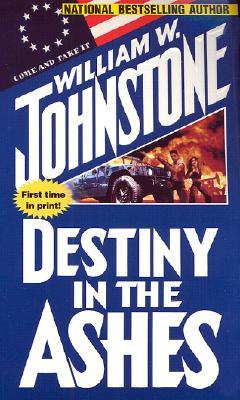
Destiny In The Ashes
ashesdestinycover

William W. Johnstone’s Destiny in the Ashes is the 32nd (!) book in the series. Released near the end of Johnstone’s life, there are legitimate questions as to whether it’s the work of Johnstone the person or “Johnstone”, the pen name used by his niece and an army of ghostwriters behind ironclad NDAs since his death. I will only say that it reads like the real Johnstone and certainly isn’t any better than anything unambiguously written by the real Johnstone.

It took over ten books for Jerry Ahern’s Survivalist to stop being truly post-apocalyptic. It took Johnstone less than one. Instead it was focused entirely on societal commentary, if the commentary came from a pretentious, incoherent redneck.

The “plot” of this book is a Middle Eastern terrorist is striking the “US” run by the EVIL LIBERAL GUN GRABBERS, and they are forced to call upon Raines in the Great People’s SUSA Utopia for help. Raines steps up, in part with lectures about the inferiority of helicopters for troop insertion compared to HALO jumps. Naturally, the Americans go in with helicopters and get killed, while the Rebels HALO drop with ease.

The “military action” in this book (and the whole series, I must add) is legitimately strange and not just poorly written. It would be one thing if, by accident or design, it involved unrealistic and overly cinematic action. There’s some of that, but there’s also hunched strategy sessions that just make no sense and end in Mary Sue stomps.

The conclusion of this book involves an effortless jaunt out to Iraq in a passage that reads like a far worse version of a Chet Cunningham SEAL Team Seven novel. This continues the trend made far earlier in the series when Johnstone ran out of domestic “punks” for Raines to kill and had to send him abroad to get more.

The writing is terrible, the pacing is only somewhat bad, the plotting is terrible, and the characterization is extra-terrible. Yet, if it makes sense, the Ashes series is genuinely and distinctly terrible. A horrendous writer got a conventional publisher to produce and distribute literally dozens of his picture-book war stories and become successful enough that he endured as a “Tom Clancy’s” -esque brand name. That’s what makes it stand out.

Review: The Trench Soldier

The Trench Soldier

cascatrenchcover

This is the 250th post on Fuldapocalypse. I could write about the undeniable fear living a hundred miles from a pandemic epicenter. I could write about how the blog has been one of the few high points during an unsatisfying life ridden with mental health issues even before the crisis,

But instead, since there’s enough gloom out there already, I’m going to write about a bad Casca book. And The Trench Soldier is very bad. And unlike The Samurai, which had Casca just plopped inside an essentially unrelated adventure, this has him front and center. It’s bad in a criticize-able way. While trying to find the true authorship of the Sadler-fronted Cascas is essentially impossible, the talk has been that he did not personally write this. Whoever did, well, they failed-but failed amusingly.

The Casca Formula I saw after just a few books is in rigid force here. Take a historical period-World War I, in this case. Plop Casca in it and subject him to the most stereotypical pop culture set pieces of that era, from charges into machine guns to poison gas. Have him meet the appropriate historical figures, in this case Immelman and a young Herman Goering. Utterly fail to explore any element of his character, or I should say any potential element of his character, because his character doesn’t really exist or stay consistent at all.

What makes The Trench Soldier special is that it goes above and beyond the usual. Events that took place throughout the war are stuffed into a few months in 1914. There’s a ridiculous scene where Casca battles a Zeppelin. If the whole series was full of this over-the-top craziness, I’d think a lot more highly of it. Sadly, it’s not. The historical inaccuracy can be summed up by him defending the Maginot Line at Verdun in 1914.

It’s not a good book, and it’s rare that even a bad example in a series puts every single one of its flaws in the forefront. But this is what The Trench Soldier does. It somehow manages to take all the Casca weaknesses and amplify them while keeping the very small number of strengths. And that’s strangely impressive.

Review: The Vengeance Of The Tau

The Vengeance Of The Tau

The first Blaine McCracken book to stumble, The Vengeance Of The Tau is an interesting case study in how a series can lose its mark while still remaining good. This still has all of Land’s strengths and weaknesses.

Where it goes wrong, besides just having big shoes to fill, is in the revelation of its MacGuffin. While Land is normally great at slowly building up and finally showing what ridiculous premise the book has as its foundation, here he implies something incredible and reveals it to be more lame and mundane. This isn’t just the final gimmick turning out to be something less than Land’s most out-there, it’s an example of going backwards that he almost never does in other books.

This, combined with somewhat less crazy set pieces, makes this lesser in comparison to McCracken books that came before and after it. In a vaccuum it’s still Jon Land, and it’s not even the worst book in the series, but there are definitely better ones.

Review: The Gambit

The Gambit

Take a stilted first novel, add a difficult genre, and you have Brad Carlson’s The Gambit. This tale of Iranian plots and the Americans out to stop them reminds me of, if anything else, an even rougher version of Gavin Parmar’s Unseen Warriors. The problem is that technothrillers are harder to do right than small unit thrillers. I don’t want to be hard on the author. This is a first novel, I know firsthand how much effort writing any kind of long fiction is, and everyone has to start somewhere. But I have to be hard on the book.

There’s the clumsy prose, but there’s also the awkward pacing. There’s the action that falls well below even the standards of Marine Force One, but there’s also a ton of conference rooms and really rote instances of military equipment doing its thing (I hesistate to use the term “action” for the scenes describing it). There isn’t even an out-there premise. It’s just “shoot the terrorist” and stopping the most basic and mundane plots, all the while moving through something horrendously unpolished.

There are good independent first novels. This is not one of them.

Review: Black April

Black April

George Veith’s Black April is an excellent chronicle of the final fall of South Vietnam. Taking as many sources as he could, Veith paints the picture of an understudied and underappreciated campaign.

The interior workings of the North Vietnamese are very fascinating and, in my opinion, the best part of the book. This is because the campaign was the biggest example of a Soviet-style army defeating a western-style one decisively. While all the planning texts and documents can show a strict operational plan where everyone adheres to their role, in any reality, friction and human conflict is always there, and this shows an example of it in practice.

Veith is on less firm footing with the southerners. While his goal to emphasize the damage of the aid cutoff and give the southerners a fair emphasis compared to their scapegoating as inept bumblers from start to finish is admirable, his opinions about the primacy of the aid cutoff don’t always match with the examples he shows. This isn’t to say that it wasn’t an incredibly important factor, but the frequent examples are of southern units getting chopped up by better-handled northern ones, not attritional slugfests that only ended when they ran low.

Still, this book is an excellent historical reference.

Review: Bloodstorm

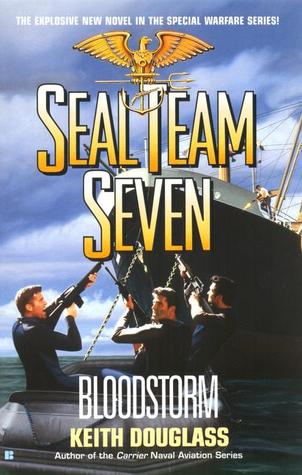
SEAL Team Seven: Bloodstorm

st71 cover

A Chet Cunningham SEAL Team Seven novel, Bloodstorm is a strange book. It features a globetrotting chase to hunt down loose ex-Soviet nukes, going everywhere from Libya using them in a Dale Brown-ist fashion to Afghanistan (in a pre-9/11 book) to Syria.

There’s the usual tons of weapon descriptions, including a “Bull Pup” (two words) that matches the ill-fated OICW in terms of what it does. Like Frontal Assault, this is a hyperactive thriller that zips around the world over the span of a comparably short book-and yet it still feels overly padded. Cunningham was no stranger to writing out large quantities of books very fast, and this feels like one of them, with a huge amount of  sloppiness. While a cheap thriller is better off moving too quickly than moving too slowly, there are better books of this type out there.

Review: The Ragnarok Conspiracy

The Ragnarok Conspiracy

Erec Stebbins’ debut in the INTEL 1 series is The Ragnarok Conspiracy. If you can accept A: Politics that are flipped 180 degrees from the stereotypical “shoot the terrorist” thriller (without spoiling much, it involves western antagonists destroying Muslim holy sites from the get-go), and B: Said politics being too-frequently pushed with all the subtlety of an after-school special, it’s not a bad thriller.

The political preachiness is a knock against it, but it’s not nearly bad enough to get in the way of a thriller with good fundamentals. Yes, it’s a rote thriller. Yes, its message doesn’t exactly go well with a main villain who’s the kind of person Blaine McCracken deals with on a daily basis. But I’ve definitely read worse.