Review: Gray Matter Splatter

Gray Matter Splatter
gmscover

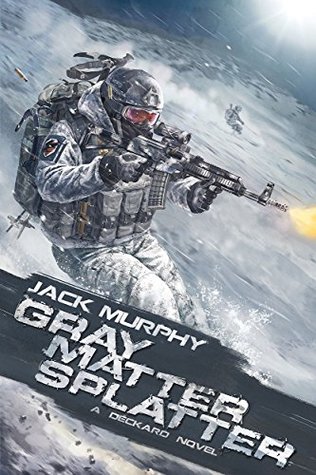
The path to opening Gray Matter Splatter was a little offbeat. I thought Jack Murphy’s debut in the Deckard series, Reflexive Fire, was wildly uneven, the kind of book that’s “Mean 51%” instead of the consistently middling “Mode 51%”. I also, similar to my experience with spacesuit commandos last winter, was getting a little worn on middling action books after reading so many of them.

So I figured, having heard that this was the craziest out of the four Deckard books, that this book with a great title was worth a shot to leap out. And so I leapfrogged over the other two and headed straight for the fourth. It was a good decision.

Now this book still has many of the problems that plagued Reflexive Fire-the political soapboxing that got in the way of the plot, the not-unusual but still irritating long descriptions of weapons, the jumpy perspectives, and the less-than-developed characters. But it’s improved to a considerable degree with the fundamentals, and the mega-conspiracy behind everything is at least tamer than the mega-conspiracy in Reflexive Fire. So there’s a little less dissonance there.

But in terms of what matters, the action is excellent and challenging as Deckard and his mercs fight their way across the entire Arctic Circle. While the sustained action may be a little more implausible than the low-level action in Reflexive Fire, I’m certainly not complaining in that sense.

This is still a cheap thriller for all its pretensions. But it’s a good cheap thriller.

Review: Dead Simple

Dead Simple

deadsimplecover

The ninth book in the Blaine McCracken series, Dead Simple marked a point where it took a very long hiatus afterward.

It’s easy to see why. This book devolves into “Captain Beefheart Playing Normal Music” in a way that no previous Blaine McCracken book did. McCracken is, in the early parts, treated as aging and vulnerable-a problem both in terms of thematic dissonance and how he’s back to his old self instantly when the climax happens. The moments of whimsy and craziness that make the series so amusing feel half-hearted at best. The storyline is closer to a mundane “shoot the terrorist” than any previous McCracken, the MacGuffin is the least interesting and most bland in the series to date, and its historical-treasure subplot felt awkward and out of place, like it was trying too hard to follow the exact path of a Clive Cussler novel.

If this was in isolation with a new hero named, I dunno, Bruce McDowell, I’d have considered it a decent, slightly eccentric, run-of-the-mill “51% thriller”. But in comparison to its gonzo predecessors, it can’t help but fall short. Leaving the series buried for over a decade before a fortunate revival might have been for the best if the alternative was to stagger on into mundanity, losing everything that made Blaine McCracken fun and distinctive to begin with.

Review: A Talent For Revenge

A Talent For Revenge

specialistcover

I think I may have found it. The apex. The apogee. The peak. The high point, the distillation of everything that “men’s adventure” fiction contained, all packed into A Talent For Revenge, the premier book in the “Specialist” series by “John Cutter” (a pen name of John Shirley).

The book stars supermerc Jack Sullivan as he’s hired by an heiress to kill an exiled African dictator. (Yes, the plot can be summed up in one sentence. This is men’s adventure). The men’s adventure-ness of this can be summed up by how the book blends more or less every single trend that these throwaway pulps put together.

  • 70s men’s adventure was notorious for sexual sleaze. Guess what this book has lots of?
  • 80s men’s adventure was notorious for ridiculously long descriptions of weapons. Guess what this book has lots of?
  • 70s men’s adventure frequently let its heroes get banged up. This happens to Sullivan, but….
  • 80s men’s adventure frequently turned its heroes into unstoppable fleshy Terminators. Sullivan also definitely qualifies as one.
  • Then there’s the constants, like a ridiculous amount of gore and a total lack of tastefulness.

By the late 80s, the genre had (with the obvious exceptions) begun to harden around the “80s, no sex, lots and lots of gun descriptions” style. The 90s commercially devastated it to such a degree that technothrillers looked untouched in comparison. When I came of age, “men’s adventure” in its purest form was down to cheap-looking Gold Eagles with awkward covers.

So I have a strange appreciation for this spectacle. If I had to show someone one book that would sum up “men’s adventure”, it would be this one.

Review: Kidnapped

Kidnapped!

Kidnappedcover

The Twilight 2000 tabletop RPG is a classic of the Fuldapocalyptic World War III genre. So it’s a little disheartening to debut it on this blog with what could easily have been the nadir of the franchise. But the “Kidnapped!” module is still a very interesting example of just a bunch of things all going on a bunch of different paths until it all just breaks.

The big “problem” is that T2K’s later modules were a victim of the very success of its initial premise. The initial European setting was a good way to square the circle of “we want you to be in the military, but we don’t want you to just have to follow orders and sit around until an artillery barrage kills you.” It was also a good balance between “We want to give you limited resources unlike a contemporary setting, but we also want to give you more toys than a full post-apocalyptic setting.”

Yes, this led to issues between the two tones of a “grim struggle for survival” and “like a classic tabletop RPG, only with tanks instead of dragons”. But I have to give GDW credit for making something distinct and adaptable. Then the question is “how do you follow up on that?”

Enter the North American modules, which became increasingly theatrical and bizarre. The “Airlords of the Ozarks” module made me use the term “Arkansas vs. The Blimps” to describe any long series that veers into craziness. It got to the point where it wouldn’t have been too surprising to see the heroes venture into an Upstate New York bunker to retrieve Adolph Hitler’s frozen corpse (as happened in the later Survivalist novels).  But Kidnapped takes the cake both for pure dissonance and poor design.

  • It starts with a description of the super-drought about to strike North America. Too bad the actual main focus isn’t about this Frostpunk-style societal triage. No, it’s about a Hitman/Splinter Cell-style “go and get a high value target”. The target is Carl Hughes, leader of the authoritarian New America, in his Shenandoah supervillain lair.
  • Hughes, the target of the adventure, does not get official stats or an official portrait. But there is a page devoted to a gang of Native American marauders (oh, you 80s action RPGs) and several pages devoted to an abandoned New American facility that does nothing but give a “clue” and a “We’re sorry, Hughes is in another castle” experience.
  • Is Twilight 2000 supposed to be semi-grounded? Good. Now plausibly take on a fortified lair with over a hundred guards and a target who needs to be captured alive (so you can’t just snipe him).
  • Naturally, to fit this mammoth Cadillac V8 into a Smart Fortwo and make the module even slightly viable, there are gimmicks like convenient gaps in the security camera coverage, guards who’ve lived and worked together for years being able to fall for players in simple disguises, and Hughes never going any more than one level deep in the four-level underground complex even when threatened.
  • There are lots of descriptions of places that are either irrelevant or “beef-gated” (too well guarded to realistically challenge), and the “listing of important characters” not only doesn’t have Hughes, but also doesn’t have anyone else actually living in Hughes’ lair. But it does have lots of throwaway bandits-of-the-week!

So Kidnapped! is something I’d recommend only for Twilight 2000 completionists or people fascinated by “How NOT to make an RPG module.” It’s at the point where, if people were running a T2K game in North America and the GM wanted them to take on Hughes, I’d recommend just writing a scenario from scratch instead of consulting this.

For a second opinion on Kidnapped, you can check the the Twilight 2000 Wargaming Blog. That opinion is also not complimentary.

Review: Day Of The Delphi

Day Of The Delphi

delphicover

Despite being the sixth in the series, Day Of The Delphi is actually the first Blaine McCracken book I’d heard of. How had I heard of it? Well, it’s quite a story. Shamus Young, one of my favorite video game commentators, had listed it as one of his least favorite books ever. Naturally, this piqued my interest and I found the greatest thriller protagonist name ever. A little later, I heard the name “Blaine McCracken” again, got The Omega Command, and never looked back.

As for Day Of The Delphi itself, it’s excellent-by Blaine McCracken standards. The previous entry, The Vengeance of the Tau was still good, but it suffered from having the first disappointing central gimmick in the series. McCracken returns to form in this ridiculous epic.

The tone of this book (and the whole series) can be summed up by a scene disappointing to me. The disappointing scene did not involve any inconsistency, by now routine super-gambits, or laughably inaccurate designations of weapons. All those are in the book, but they aren’t the disappointing part of it.

No, the disappointing scene was a fight in a slaughterhouse that failed to take advantage of the potential to use live cows as weapons. McCracken uses the ramrod to kill an enemy. It needed more “battle cattle”. Other than the lack of battle cattle, this was a ridiculous Blaine McCracken spectacle extraordinaire. Yes, even by the standards of other books in the series.

It doesn’t have a MacGuffin that’s weird, but it makes up for by having an incredibly ridiculous (the plan of this book’s super-conspiracy ranks as dumb even by the standards of Blaine McCracken super-conspiracies) main plot. Some might reasonably think that’s bad. To me, I view it as part of the fun.

Review: The Samurai

The Samurai

cascacover

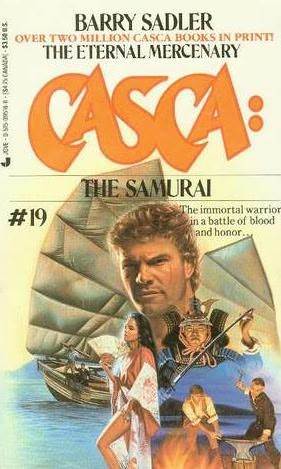
With the nineteenth entry in the series, The Samurai, Casca swings and misses dramatically like a called-up minor leaguer facing Nolan Ryan. Of all the Casca books I’ve read, this is the worst of them (so far). I’ve heard conflicting answers as to who was actually writing the later Casca books before Sadler’s death, but whoever was did not succeed here.

Knowing the history of the series, I was expecting a clumsy, stereotypical depiction of ancient Japan. And I got it. But it also has very blocky, clunky prose and flat fight scenes that take away the biggest strength of the Casca series-the ability to have effective action despite its protagonist being, you know, immortal.

Not that it really matters much, because here Casca himself might as well just be a second-rate hired gun in a dull story about dull rivals fighting for power in dull battles. Having all the weaknesses of the Casca books but none of the strengths, The Samurai is something I wouldn’t recommend even to fans of the series.

Review: SEAL Team Seven Direct Action

SEAL Team Seven 4: Direct Action

directactioncover

The SEAL Team Seven series, however much I enjoyed the first installment, is not the kind of series where reading every book in order is the most appropriate. So I decided on Direct Action for two main reasons. The first is that the summary seemed a little interesting. The second is that it’s the first book after original author William Keith was replaced by another writer under the “Keith Douglass” house name.

So, Lt. Blake Murdock (it’s not quite Blaine McCracken but it’s close) has to lead his SEALS into Lebanon to destroy a plant producing counterfeit American money, fighting Hezbollah and the Syrian Army in the process. The prose is a little clunkier and the action somewhat more extreme than the first book, but it’s still a good cheap thriller.

In fact, this book manages to have its cake and eat it too in a good way. It manages to have its SEALS scything their way through enemy fighters, soldiers, commandos, BMPS, and helicopters while at the same time throwing semi-plausible bits of “friction” in their path to make them earn their mission-and not without loss.

A part of me has “glass half empty” thoughts where I think “what if the big-name technothriller writers did a slightly higher-brow version of this instead of clunking along with an increasingly obsolete Cold War thriller model?” and lament what wasn’t. But another part of me has “glass half full” thoughts where I can just enjoy this well-done cheap thriller for what it is.

Review: Steel World

Steel World

steelworldcover

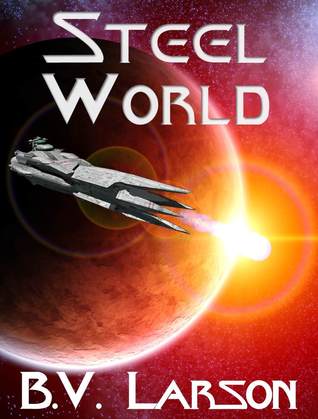
For BV Larson’s Steel World, I returned to a familiar place-the land of spacesuit commandos. Almost every single value checks out. Dystopian background? Check. The main character is a super-special spacesuit commando in a super-special spacesuit commando unit (in this case, a secret dirty tricks “Legion”)? Check. The main characters use nothing more than power armor and ray guns that don’t seem to really do much? Check. The tactics are iffy and everyone uses Roman ranks? Check.

The only novel feature, besides the use of “rules of war” that are clearly structured to enable the plot, is revivification. However, in practice all it does is remove tension, best summed up by having people -multiple times at that- want to be “killed” for the sake of convenience.

For all my complaining, Steel World manages to dodge the biggest problem with the subgenre. Its training sequences are not overly long, and I was thankful for that. And for all its issues, it’s still readable and fun as a mindless spacesuit commando novel.

Review: Red Storm Box Set

The Red Storm Box Set

James Ronsone and Miranda Watson’s “Red Storm” series ran for six books. The omnibus box set I bought contained the first three- “Battlefield Ukraine, Battlefield Korea, and Battlefield Taiwan”.

This checks all the boxes. Lots of conference room infodumps with generals and leaders? Check. Huge descriptions of everything? Check. Characters whose sole characterization is at best an infodump and (more frequently) at worst a “Steel Panthers Characterization” where they’re just paper placeholders who crew military equipment? Check. Hopping around viewpoint characters around the world with what feels like no rhyme or reason? Check. And the cherry on top is the Hackett-style “city trade” plotnukes, as Oakland and Shenyang go boom.

This is what I thought I’d be reading en masse when starting Fuldapocalypse. Thankfully, it hasn’t been what I actually have been reading. Reading countless non-dry, non-World War III books has allowed me to view this in a better perspective than I had before. In the past, I’d have probably just denounced it with a combination of fire-breathing and eye-rolling.

I still view this as a subpar book-it’s in the awkward, neither fish-nor-fowl area of being too “literary”, gimmicky, and inaccurate in a rivet-county way to be a War That Never Was-style pure play by play while being too bland and disjointed to be an actual literary book. But now I can weirdly appreciate it for trying to scratch a specific itch. My mindset has gone from “this is bad” to “this has flaws and isn’t really my thing.”

If a sort of “Hackett but with some technothriller gimmicks” style book is your thing, you could do worse than this series.

Snippet Reviews: August 1-11 2019

It’s time for more snippet reviews.

The Omicron Legion

The fourth Blaine McCracken book, The Omicron Legion continues Land’s style of ridiculous plots, quadruple-crosses (yes, I’m using that word), and BLAINE MCCRACKEN action. If you liked the past Blaine McCracken books, you’ll like this a lot.

The Mercenaries: Blood Diamonds

This Peter Telep (under a pen name) novel would be a routine 2000s thriller if not for one thing-the dialogue. It’s ridiculously and constantly crazy. This wouldn’t be too big of a deal if the actual story was goofy to match, but it’s supposed to be a serious tale of weary mercs in the southern African wilderness.

While it at least it stands out a little because of that, this book really ought to be focused around a Macguffin giant magical diamond that can power a super-deathray, not a stash of normal ones.

Terror in Taos

One of the Penetrator novels, Terror in Taos serves up all the 1970s “vigilante vs mobsters” action one could possibly want. By the standards of the genre, it’s very good. The action, which includes hero Mark Hardin storming a desert castle, is good. There’s even a bit of semi-mystical Native American stuff that makes it even more ridiculously over-the-top and fun (yes, it could easily be tasteless and offensive to a modern audience, but this is a 70s action novel-what did you honestly expect?).