Review: The Fourth Reich

The Fourth Reich

bef4cover

After the cataclysmic misfire of Blood Ivory, the Black Eagle Force series returns to its greatest form in The Fourth Reich.

Following in the wake of such great literary works as the Bionic Commando video game and that deep, haunting movie, They Saved Hitler’s Brain, the book pits the BEF against the high-tech Reich from its base in South America. Any book that has Hitler reawaken in a clone body and immediately demand to know where his mustache is can’t be truly bad.

And the BEF is never more in its element then when it’s dogfighting against Horten flying wings. This is the kind of enemy they were made to face. Thus this book, for all its slight clunkiness, remains as big a joy as Eye Of The Storm and Sacred Mountain were.

Review: Blood Ivory

Blood Ivory

befbloodivory

Blood Ivory is the fourth entry in the Black Eagle Force series, detailing the super-team in their super-VTOL aircraft as they face terrorist poachers and cruise ship hijackers.

It’s also where the series simply collapses like the Hornets did in one infamous 2009 playoff game. Almost everything good and distinctive about it isn’t there, and everything that’s bad and derivative about it is. The names get even worse, and the politics (particularly at the “climax”) go from “stupid, wish-fulfilling, and strangely charming” to “stupid, wish-fulfilling, and creepy”.

But those are the least of its problems. There are two bigger ones.

  • The fundamental flaws with the rest of the series are there, and made even worse by a descent into jumping technothriller plots.
  • Substantially worse, the central “more Mack Maloney than Mack Maloney” gimmick is tossed aside almost completely. Past BEF books, particularly the first two, had opponents suitable for the super-VTOLs. This one just doesn’t.

What’s left is what amounts to two intertwined fourth-rate “small unit thrillers” that have, you guessed it, most of the weaknesses and few of the strengths of that subgenre. They’re too silly to be good “serious” thrillers by far, and they’re too mundane to be good “goofy” thrillers.

It’s uncommon to have a book series misfire so dramatically in one entry, especially one without excuses like editorial pressure (this series is self-published) or changes of writers (not evident here). But this book misfires indeed. It’s like the time Captain Beefheart tried recording “normal” music, taking something where the eccentricity was the biggest draw and leaving only mush.

Review: Citizen Warrior

Citizen Warrior Series

J. Thomas Rompel’s Citizen Warrior series is an interesting example of how the “lowbrow cheap thriller” series has evolved and in some ways gone full circle, as well as an example of how external political changes can affect writing. It’s also something that goes from “kinda OK” to “kinda not OK”.

The first book,  The 4th Branch can be viewed as just another throwaway cheap thriller. The plot, aka “STOP THE TERRORISTS AND THEIR DRUG CARTEL ALLIES”, is not distinct even by cheap thriller standards. The characters are barely there, with the most development given to the cliche stereotypical puppy kicking antagonists. The right-wing politics are axe-grinding and constantly reinforced.

As an action novel (when it finally gets going), it’s merely decent. Better than a flop or even “51% novel”, but not at the level of one of the all-time greats. But what it is a good example of is a genre that’s going full circle. It’s a return to the “vigilante” style of cheap thriller.

The prevailing style (there were obviously exceptions) of cheap thriller protagonist in the 1970s was the “vigilante”, following in the wake of Mack Bolan. In the 1980s, as evidenced by Bolan himself, it shifted to the “secret agent” paradigm. This returns to outside-the-law vigilantism. For someone like me who overanalyzes cheap thrillers, I thought it was interesting.

The second book, One Down, is only interesting in how changed political circumstances can change some of the tone of a novel. Let’s just say that the first was published in 2016 and the second was published in 2017. Other than that, it kind of fails.

The politicization gets tiresome and makes the main characters look like whining complainers, not determined heroes. Most of the heroes and villains are the same, the new ones aren’t interesting, and the stakes are arguably lower than in the first book. The action isn’t any better, and one scene where the heroes far too easily take on foes that include machine gun-carrying technicals felt a bit too far.

That is also interesting in that it dips a little bit into the “secret agent” type of thriller, unlike the clear “vigilante” style of the first book. This study is more interesting than anything actually within the pages of One Down.

Review: White Jacket

White Jacket

So, the time has come to review someone I probably didn’t think I’d be reviewing when I started the blog-Herman Melville and his naval book White-Jacket.

Now, I’ve used the term “Herman Melville for _______” to describe fiction that is overly descriptive at the expense of other things , ie “Team Yankee occasionally devolves into Herman Melville for tanks”. Thus, White Jacket is Herman Melville for Herman Melville. To be fair a lot of 19th century novels are like that, it’s just the writing style of the time, but Melville particularly stands out.

Even at the time, Melville didn’t think very highly of this book, viewing it as something done purely for the money. Even a century and a half apart, I can see the reasoning “Ok, I need a book done, I’ll just slightly fictionalize my experience in the US Navy and send it to the printers.”

White-Jacket, in spite of its clunkiness, manages to stand out for two reasons. The first is its historical value in the life of a 19th century sailor and the operations of the US Navy at the time. The second is that yes, it’s realistic. You want a truly realistic military story, something like this with modern technology is what you’re going to get. I’ve said only part-jokingly that a truly realistic military video game wouldn’t be ARMA , it’d be Desert Bus. This is why I’m not a stickler for realism in literature.

Review: Return of The Starfighter

Return Of the Starfighter

bef3cover

It says something about how crazy the Black Eagle Force series is when a book with the premise of a Chinese catamaran supercarrier leading a would-be invasion of the west coast prompted in part by the Federal Reserve’s loose monetary policy is one of the tamer and more grounded entries. And yet, that is how Return Of The Starfighter felt. The BEF fights alongside restored and upgraded Cold War aircraft (like the F-104) to battle the invasion fleet.

The Black Eagle Force series is kind of like the literary equivalent of the Postal 2 video game. It’s rather “dubious”, makes no sense,  always teeters on and sometimes crosses the line from “tasteless” to “offensive”, and isn’t the best set up, but the pure spectacle is what makes it enjoyable.

Lose the spectacle and the series loses its appeal, turning into a too clunky, too descriptive, too infodump-heavy technothriller. Return of The Starfighter, coming on the heels of Sacred Mountain’s goofy-crazy ridiculousness, tones it down ever so slightly and ends up looking a little like an avant-garde band’s attempt to play “normal” music. That some of the plot and battle elements are inevitably repeating by the third installment also doesn’t help.

It’s still over the top and still has its sense of wonder. This series, thankfully, isn’t devolving into later-Clancy levels of over-seriousness and pretentiousness by any means. But for a series that runs on crazy, going closer to mundanity takes away the greatest fun. Even if the mundanity comes in the form of a two-hulled mega-aircraft-carrier.

Review: Strike Vector

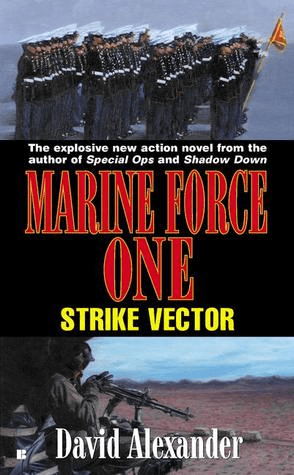
Strike Vector

strikevectorcover

Strike Vector is the the second book in the Marine Force One series. Whereas the first book was a 51% book, this feels a little worse.

The plot deals with Marine Force One going on a mission to stop smuggled superweapon MacGuffins from reaching Saddam Hussein (this book was published in 2002). The opening part has a lot of badly written sexual sleaze to it (guess how much that adds to the novel), and the main action portion, as Maj. Saxon and his team fight their way through the Middle East, has such wonders as an AC-130 engaging MiG-29s in aerial combat and managing to destroy one of them before being shot down.

As for the main event, it has three problems. The first is the devolution of its main character. In the first book, Saxon was an ass. Here he’s an undeveloped trigger-puller who’s just there to fight and be present for the battles.

The second is that the battles themselves never really rise that high. The writing on them is still very much at the “51% level”, and the main characters are a little too capable for the tone. The character of Maj. Saxon may be toned down, but the fighting capability of Maj. Saxon is still very, very great. The third is that there are a few too many gimmicks in the action scenes, a few too many fights for the sake of fights.

The result is a slightly worse-than-normal entry in a middling series.

Review: Contract For Slaughter

Contract For Slaughter

contractforslaughtercover

The first book in the “Eagle Force” series, Contract For Slaughter was released in 1989 by Dan Schmidt, a veteran of the action-adventure genre who wrote literal dozens of Mack Bolan tales. Coming close to the tail end of the 80s action-novel boom, it provides a very, very good example of it.

It’s a team-centric book where a group of colorful mercenaries in the low single digits (in this case four people) form and fight. This is both a first installment (so it has a not insignificant space devoted to the “forming” part) and it’s short (so there’s less room for the final fight). Though to be fair, a lot of the “forming” segments involve fighting too. Lots and lots and lots of fighting. The action is solid for a book of this genre, even if not the absolute best, and Schmidt wasn’t afraid to throw a curveball in terms of the plot and enemies.

What stood out to me, at least a little, was how the weapons were basically 80s Action Novel Bingo. What felt like every single flashy and exotic writers toy showed up in the pages of this book. Ooh, big MM-1 grenade launchers! Ooh, super-advanced G11 rifles! And of course, the classic giant pistols (can’t forget them). Even Jerry Ahern’s beloved Detonics show up as well.

This was one of the cheapest of the cheap thrillers, but I had lots of fun with it nonetheless.


Review: Raptor Force

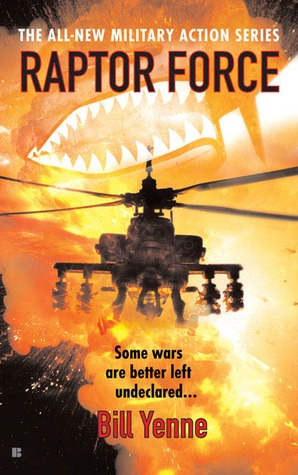
Raptor Force

raptorforcecover

Bill Yenne’s Raptor Force is a case of a book that dips into multiple action subgenres and seems determined to take the worst parts of each while being unable to grab the best. It’s the kind of commandos-vs-terrorists novel that might seem simply pedestrian if it didn’t have the premise it did.

See, the reason the task of hunting down bloodthirsty and effective terrorists is entrusted to this mega-top-secret band of off the grid commandos (based on the Flying Tigers in-universe) is because the US (along with most other countries) gave the UN veto power over its military power projection (!). This is the kind of thing that zombie sorceresses were made to do.

The heroes are all flat space-fillers, the villains are the most cliche terrorists straight out of Command and Conquer Generals, and the stock supporting characters are exactly who you’d expect them to be. This wouldn’t be a big problem if the fundamentals were good, but they’re not.

Raptor Force has the constant perspective and place-hopping of a technothriller but none of its technology or great power conflict. It has the focus of a small-unit book but none of the spectacle or “punch” that a good one has. The actual action scenes are decidedly underwhelming, the worst thing a cheap thriller can be.

This was not a good novel. Even the potentially over the top premise wasn’t run with, opting for the overly serious technothriller style instead of a shameless spectacle.


Review: Marine Force One

Marine Force One

The book Marine Force One is an example of a “51% book” that is elevated by the context in which it stands.

The book tells the story of an elite commando force tasked with hunting SAMs in the Balkans, in a conflict that feels like a jumbled mix of historical recollections of Operation Allied Force (evasive SAMs! Stealth fighters lost!) and think-tank reports (Resurgent Red Russians!) all tossed together. The Cobra Force of our heroes has to hunt the SAMs while butting heads with a Spetsnaz force assisting their Slavic ally.

If there’s one thing distinctive besides being dated, it’s that the main character, Maj. David Saxon, is an ass. He’s a one-dimensional figure who gave up his material possessions and marriage to focus on being in the military (and doesn’t miss his ex or even his son at all), he punches someone for being annoying to him during a debriefing, and when (however briefly) off-duty, he just uses prostitutes as the sole “relationship”. Yet rather than have his seriously flawed character be taken advantage of, Saxon is otherwise treated as a Mary Sue who can do what the rest of the military can’t. Very few other characters, even the villains, enjoy such detail.

Other than that, everything is just good enough. The action is just good enough but not the best. The pacing is at least fast, if not the best. The exposition can be annoying but isn’t too annoying, and so on. So why did I feel better about this book than I ‘ought to’ have? Well , the first part is that sometimes a 51% book is what one needs.

The second part is that given the publication date of 2001, the beginning of a very, very dark decade for technothrillers, the “competition” is less serious. In a context full of overpriced, under-proofread self-published books, legacy series continuing on pure inertia, and the few remaining editor-proof super-authors, a nice light 51% book isn’t bad at all.

Review: Burmese Crossfire

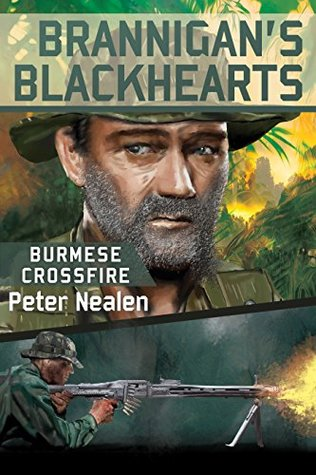
Burmese Crossfire

burmesecrossfire cover

One of the reasons why I sound more critical towards Peter Nealen than I actually am is because this particular book set the bar very high. From the moment I read it, I fell in love. The Brannigan’s Blackhearts series was meant to be a love letter to the classic action-adventure novels of the 1980s, and Burmese Crossfire delivers.

Colonel Brannigan, leader of a small mercenary band, gets a mission to go to the titular Southeast Asian country. Cue a “rumble in the jungle” (with apologies to Ali and Foreman) against many Burmese and North Koreans. This isn’t that much more than a classic simple action-adventure novel. But it takes that formula and with beautifully written, well-done action, hits a home run.

It’s in a well-researched, obscure part of the world that’s an ideal place for a book of its genre. One of my favorite small-unit action-adventure books of all time, this is well worth a read.