The Empire Vs. The Commonwealth

Reading Dominion got me thinking about an alternate history setup of a similar nature. Not a plausible one but a way to pit the British Empire against the ex-British Empire/Commonwealth. What got me thinking at first was the British in the book struggling to hold onto India. I’m thinking “hang on, this could be playable.”

So I fired up Command: Modern Operations and saw an opportunity to use many of the low-end WWII-era platforms, including German 1940s ones. I did a sample scenario and fell in love. So I expanded. It may or may not lead to anything more, but it’s something worth telling. Again, historical plausibility is not the main focus, so I’ve probably gotten a lot wrong.

The main forces are the fledgling independent Indian Army along with reinforcements of ANZACs and other volunteers, including American “Flying Tigers” in that animal’s home country. Opposing them are the Collaborationist UK Government and Germans, the latter struggling massively to project power. They still send the now-completed Graf Zeppelin carriers over. (Look, this isn’t a hard AH).

The scenario I did was of a bombing raid on Karachi from Oman-based Anglo-German bombers. (Why Oman? It was in range. Why Karachi? Partition into India and Pakistan hasn’t happened, at least not yet). While this scenario saw the attackers sweep aside the defenders and drop successfully with the loss of only one bomber, circumstances can always change. In any case, it was very interesting and fun to play in an area not typically covered by wargames, and got my imagination flowing.
Review: Aircraft Projects of the Commonwealth Aircraft Corporation

Aircraft Projects of the Commonwealth Aircraft Corporation

I’m a sucker for big historical reference books, so I got Aircraft Projects of the Commonwealth Aircraft Corporation, a detailed look at Australia’s aviation company from WWII to its buyout postwar. Everything from the semi-improvised military aircraft of the war to their license-built airplanes designed by other firms (ie Sabres and Mirages) to their ambitious designs is covered.

The last segment includes some pretty crazy things like a trainer/low-end ground attacker that’s swing-winged and an interceptor powered by four very small engines. The latter is a good example of how much the designs had to fit the parts rather than the other way around. This book is a well written, well-laid out treat and I highly recommend it.

Review: The Cold Hand of Death

The Cold Hand of Death

Brent Towns’ latest Team Reaper thriller as of this post is The Cold Hand of Death. It can basically be described as the technothriller equivalent of gulping down an energy drink in a distorted physics chamber where time moves faster. It’s like the book never goes more than two pages without a shot being fired or something blowing up. There’s the usual world-in-crisis technothriller plot, but even this is warped up to ludicrous speed.

I’ve mentioned the previous installments as being fast-paced, but this takes them to a totally different level. It’s like comparing a fast propeller plane to an SR-71.

It just feels excessive. The writing is not bad. It aces the action scenes, and that’s what a thriller needs to get right. But the best action writers of all time would struggle to keep any book interesting if it had as many battles as this one. This is like a deep fried gummy candy. It’s not inedible, but it’s just not the sort of thing you’d want to eat/read lots of.

Review: WW III

WW III

It’s finally time to review the third major archetype of World War III fiction. Ian Slater’s WW III embodies the “what realism?” school of fiction. In fact, he may be the least technically astute technothriller author out there-and you know I don’t say this lightly. Slater embodies frequently going into huge technical detail on some kind of weapon or vehicle-and getting said details wrong.

Anyway, the plot itself is a simple “Second Korean War and Fuldapocalypse big war thriller”, only with a ton of jumbles. Besides his technical inaccuracy, Slater’s work is also defined by its incoherence. In longer series this translates to absolutely no sense of continuity. Here it’s just sloppiness.

And yet this book is oddly fun in a Tommy Wiseau/Ed Wood style way. It’s a good game to see when Slater actually gets a technical comment right. Seeing the adventures of Mary Sue lead-from-the-front general Douglas Freeman is amusing, even if Slater fills the rest of the NATO cast with drooling doofuses to make him look better. Every fan of these kinds of World War III should really read this, if only to appreciate the virtues of the books that, whatever else, got most of the basic details right.

Review: Righteous Kill

Righteous Kill

For all the prominence of the “go back in time to kill Hitler” trope in popular culture, there are surprisingly few books that feature it as the main plot point. Ted Lapkin’s Righteous Kill is one of them. The book has a delightfully simple plot-Israeli commandos go back in time to kill him.

The book has its flaws. The prose can be clunky and frequently descends into “I know the exact designation of a Scud TEL” level infodumps. This is also not a neutrally toned book, to put it mildly, and the ending is a little too neatly tied up. But these flaws are outweighed by its strengths, which is to say it manages to pit 2010s troops the author thinks are awesome against 1940s ones and still feel like a credible fight. This is not an easy feat, and it’s to Lapkin’s great credit that he succeeds in pulling it off.

This is both a fun book and a good one.

A Thousand Words: Automation

Automation: The Car Company Tycoon Game

Because one of my past jobs involved working in a parking lot, I developed an interest in cars just as I discovered that Automation: The Car Company Tycoon Game existed. It was a great fit at the time, and has only grown and developed since then. A very detailed car design simulator with a basic but growing campaign mode, it’s not for everyone but is a delight for auto enthusiasts.

I’ve enjoyed making all sorts of cars in there, from the ones you’d expect to weird ones like gigantic rumbling inline 4 motors and stuffing monster engines into the bays of Corolla-sized econoboxes (talk about “hot hatches”). I even made something like the Dodge Ram SRT-10 by putting a supercar engine into a pickup truck. The game is unforgiving and has a pretty steep learning curve, but if/when you get the hang of it, you can do really great car things.

Review: Deadly Intent

Deadly Intent

The second book in Brent Towns’ Team Reaper series, Deadly Intent is one of the best thrillers I’ve read in some time. The action here is almost literally non-stop as the titular force battles against a seemingly never-ending stream of enemies in a battle that spans multiple continents.

The constant action, team-based protagonists, vast geographic setting, and more out-there elements of the plot (to put it mildly) reminded me of one of the Stony Man Gold Eagles. The difference though is that this is done better than the Stony Man/Able Team/Phoenix Force entries I’ve read. The action and narrative flows a lot more smoothly, and the characters feel more developed (in a small sense, but still).

There are times when a book, even a cheap thriller, benefits from slowing down and having lots of buildup. But there are other times when one, like this, benefits from just welding the gas pedal to the floor. This is quite the experience and I highly recommend it.

Review: USA Vs. Militia Series

USA Vs. Militia Series

Ian Slater’s USA vs. Militia series is one of those bizarre footnotes in military thriller writing that I just had to check out in full. A while ago, I reviewed Battle Front, which is actually the third installment. Having since read all five books, now I can give my opinion on the entire series.

I described Battle Front as “This book is about 5-10% crazy goofy, and about 90-95% dull tedium.” In short, this is applicable to the entire series, particularly the last two books. These involve more pedestrian hunt-the-MacGuffin plots with small unit heroes that serve as a perfect example of “Captain Beefheart Playing Normal Music Syndrome”. The most bizarre part is a general personally leading this formation, and it has all of Slater’s numerous writing weaknesses without the appealing strengths. If it consisted of two books with action somewhat below the Marine Force One line, I’d have barely given them a second thought.

But the series is more than that.

At its best, you have ferocious fights between the federal army and militia in technicals with add on “reactive armor” (Slater is, to put it mildly, not the best with terminology). You have Abrams’ deploying from C-130s. And of course, you have preternaturally well-organized and numerous militia romping through the country. To try and make them viable, Slater turns every federal commander and soldier who isn’t Mary Sue Douglas Freeman into hopeless bumblers. It’s still badly written in actual practice save for some bizarre prose turns Slater uses, but the novelty is still something.

There’s two more distinctive elements. The first is the politics. Now, normally you’d expect a book about a second American civil war to be monstrously political. This, surprisingly isn’t. Or at least it feels oddly detached, coming from an Australian-Canadian having to look across the border through a distorted, second-hand lens.

The second is a complaint I’ve heard a lot about Slater’s World War III series, and which I saw firsthand here-he has absolutely no concept of continuity. There are references to the Third World War, references to the Gulf War, jumping references to real events that happened before the book in question got published, contradictory historical references, and no real sense of overall progression. The series ends on a strange half-conclusion, with the out-of-universe reason for its stoppage obviously clear from its publication date of December 2001.

This series occasionally can be an interesting curiosity, but it’s a mere curiosity without much substance.


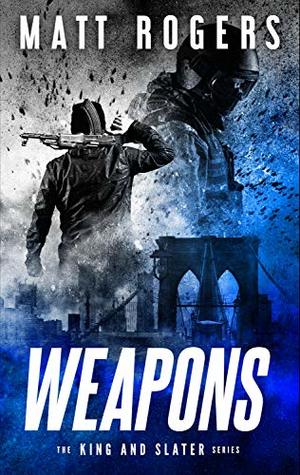
Review: Weapons

Weapons: A King And Slater Thriller

weaponscover

When I got Weapons by Matt Rogers, I didn’t really get that it was a merging of two series’ with entries in their own right. So I was a little confused at first, not helped by a slow start. Thankfully, once the story picked up, I got a huge wave of cheap thriller action. This isn’t exactly a standout cheap thriller by any means, and it has flaws.

One of the biggest is the variable competence of the characters. This book acts like a more grounded thriller until the moment the heroes are backed into a corner, at which point they gain, among other things, incredible aiming ability. It also has a mundane cheap thriller plot with my usual quibbles.

But the actual action is still well-done in spite of these issues, and that’s what a cheap thriller needs to be. You could do a lot worse if you want a basic explosive thriller.