Weird Wargaming: The Axis Contraptions

After World War II, various veterans of the vanquished (to put it that way) offered to design and make various military platforms. Only a few actually entered production. Kurt Tank designed the HF-24 Marut and sputtered-out Pulqui jet fighters. An Italian submachine gun, the TZ-45, found its way into the Burmese Army. Most fell victim to the same culprits: A combination of Cold War military aid and cheap Allied surplus sweeping them aside, while not being high-performance enough to beat them that way.

Yet for alternate historians/wargamers/writers wanting to add various wunderwaffe to their scenarios, it’s not that implausible that a few could slip through here and there. They’d mostly be out of the way unless history moved to that region (for instance, the Willy Messerschmidt-designed HA-300 would undoubtedly see service in the Arab-Israeli Wars if it entered mass production.) But they could still be done.

What would be most interesting would be the really exotic and large Luft 46 aircraft and wunderpanzer tanks. Those would probably need veto-able foreign engines (or other less obvious components) and would be no picnic to design. But they would be the most fun to play.

People Playground Peoples

People Playground Peoples

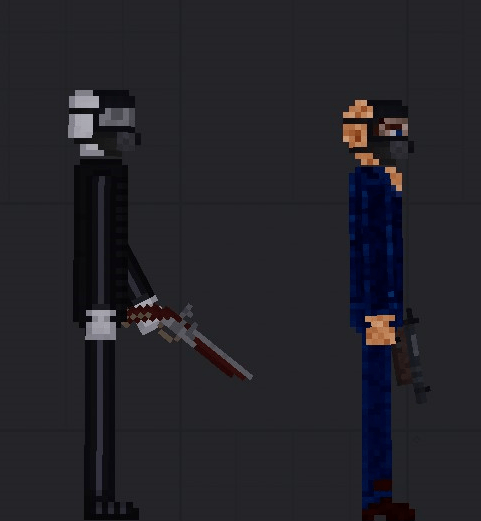
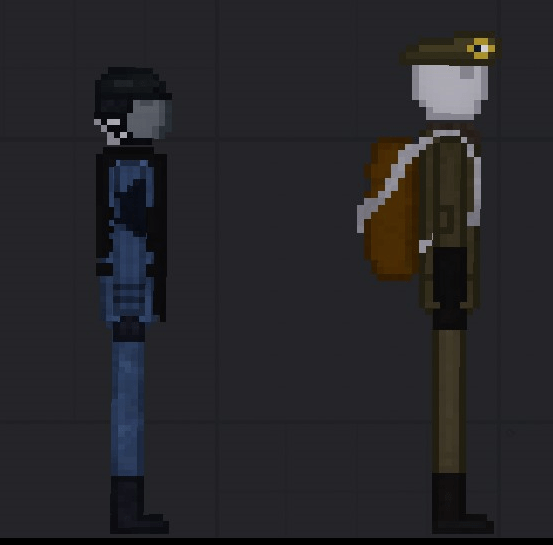
My favorite go-to relaxing game now, especially after I’ve discovered the massive and excellent mod scene, is People Playground. I of course act out a lot of scenarios-ok, a few types of scenarios, involving the mysterious mad science facility. And here are the “roles”.

Subjects

Represented usually by the default “humans”, subjects are the test subjects who are either being killed in terrible ways (don’t feel too bad for them, they struggle to walk several steps) or rebelling in some form (and usually ending up getting killed in terrible ways).

Technicians

Dressed in work-esque outfits, technicians usually sport some kind of chemical mask. They’re often placed by pieces of machinery, where they operate them and oversee experiments (very, very frequently becoming collateral damage). Unlike troopers, technicians mostly use a min-max arsenal-either finicky destructive contraptions or simple/improvised-type weapons that they built themselves.

Troopers

Troopers are the enforcement arm of the facility, being dressed in various kinds of military uniform and carrying a large variety of conventional weapons. Don’t worry, they always get killed in quantity too.

Commanders

Clad in various types of ornate and/or formal clothing, commanders wield sidearms and direct the “experiments”. However, a field commander is just as vulnerable as anyone else on the playground.

The Warhead Mystery

David Seed’s magisterial analysis of nuclear terrorism in fiction has confirmed one large suspicion I had about such books: The warhead MacGuffin is, far more often than not, stolen or donated by a sinister benefactor instead of being scratch-built. The Sum of All Fears is one big exception, just as how Red Storm Rising has Iceland invaded and the war staying completely conventional from start to finish. Because I love overthinking stuff like this (in violation of the wise words of literary theorist Mr. Hippo that not every story has to have significance), I have a few possible theories.

Theory 1

Theory 1 states that this is an example of being, even accidentally, technically reasonable. There are large practical issues with constructing even the simplest Little Boy-esque designs. The biggest and most obvious is appropriate fissile material, but there’s more that’d be hard to do and harder to do in secret. Of course, most authors would probably be going with their gut telling them it’s just easier to skip that step. Seeing so many writers get absolute basic technical details wrong makes me think it’s more a broken clock being right at that moment than anything else.

Theory 2

Theory 2 is less generous and states that it’s because it’s easy to write, means you don’t have to research, and can just say “here, they got a nuke.” Even The Sum of All Fears, as (over)-researched at it was, did this in a way by almost literally dropping the Israeli bomb into the laps of the antagonists.

Theory 3

Theory 3 is simply the result of bandwagoning. Because everyone else is having the nukes being sold or donated, the authors are simply writing what they know. Tom Clancy is weird in that while a lot of people adopted his themes, his exact style is not replicated nearly as much (and understandably so)

_ _ _

The warhead issue symbolizes something I’ve noticed about fiction: Realism is often not really that much of an asset. Roughly speaking, a lot of the people won’t know any better, many of the ones who do know won’t care, and a giant subset of those who do care will find issue no matter what. This combined with thrillers almost always succeeding and failing based on execution and not concept means my advice would just be to write what you’re comfortable with.

My personal take is this: Since I’ve been reading so much on the topic, and since I find the stolen/gifted nuke overused, I feel like I’d have the warhead be scratch-built if I wrote a book on the subject.

Reactor Grade Plutonium

Reactor-grade (as opposed to weapons-grade) plutonium has been hotly (no pun intended) argued over as to its suitability for nuclear warheads. From the open-source claims I’ve been reading, there are arguments that I’m not qualified to address the technical side of, but a couple of common themes have emerged:

  • Every extant nuclear power has chosen to go ahead with the additional expense of weapons-grade plutonium rather than trying to make something out of reactor-grade material. There have been tests and rumors, but that’s it.
  • Reactor-grade plutonium is hotter, more dangerous when exposed [making design and handling more difficult], requires more material for less explosive power, and is far more likely to fizzle (detonate instantly with a much lower yield).
  • However, even the low yield (less than a kiloton) is still a radioactive Beirut explosion, raising fears of nuclear terrorism with stolen reactor-grade materials.
  • Improved design can remove many of the shortcomings of reactor-grade plutonium.
  • The increased yield uncertainty makes it less attractive for tactical operations.

Still, the technically “easiest” way just to make a nuclear explosion with national-level resources would be to use civilian reactor-grade plutonium to put together an atomic charge. The list of countries that could do such a thing is much longer than the conventional nuclear states. Granted, they’d be facing a large backlash to make an explosive charge that’s 1940s-level at best and has little practical military utility, but it’s what’s the most possible in spherical cow terms.

The Super-Mansion

The conclusion of The Sure Bet King took place at a Los Angeles super-mansion. My current WIP is also focused around a super-mansion. The super-mansion is one of those setting places that I just love. They’re (impractically) big, they can have a lot of stuff, and they can have very different themes.

The closest thing to an official definition of a “mansion” is “a luxury home at least 5,000 square feet in size”. Super-mansions are even more nebulous, with their only real distinguishing feature being their bulk. My own definition is “it’s a super-mansion if any one room in it is bigger than an entire normal mansion”.

The Poker Boom

As someone very young during the online poker boom of the mid-2000s, I knew it existed but wasn’t anywhere near aware of how insane it got. Looking back and doing research, I can say that for about three years, robbery became legal, as long as you were a good poker player. The excesses of it were sometimes just big, like how pros “multi-table” at several sessions at once, playing thousands upon thousands of hands a day, all while staring at the computer for many hours.

But the most interesting part is the zero-sum nature of poker and how that doomed the bubble to pop as much as anything the government did (after all, laws and court cases didn’t stop offshore sports betting at all). The boom featured sharp sharks dropping the equivalent of nuclear depth charges on poor square fish who’d seen Rounders and Chris Moneymaker living up to his namesake and thought “why not me?”

The problem came when liquidity dried up. Without a stream of new fish to get skewered, many former pros learned that they became the lower ones on the food chain. Many moved on to the similarly zero-sum daily fantasy sports, which popped just in time for sports betting to get legalized and crypto speculation to take off. And if the people complaining about restrictions because they tried to arbitrage off of William Hill got their wish and forced the sportsbooks to sharpen, the same feeding frenzy/market bubble that benefited only a few ultra-sharps would happen. In fact, I’m half-convinced it’s happening already, sportsbook restrictions or not.

The reason being that neither sports betting nor poker are actually that profitable for the house, especially after promotions, but that’s another story for another time. As is the story of poker-the book takes place roughly at the same time as the historical poker boom and one of my Sure Bet King ideas envisioned main character Eddie Ross being a moderately skilled poker who crushed weaker ones during the boom (with obvious effects on his ego), but a combination of the path the novel took and me thinking I didn’t know enough about poker nixed it.

While I don’t regret it, I think the right terms to use is that there was an opportunity that I did not follow. After all, the climax of The Sure Bet King is of a-based-on-a-true-story boxing event where sharps took advantage of squares in massive force. The poker boom was like that, only for years instead of one day.

The Journeyman

In sports, “journeyman” often just means a lower-tier player. This is certainly the case in the individual sport of boxing, where “journeyman” is often a polite way of saying “tomato can”. But in team sports, “journeyman” often means a peculiar kind of athlete.

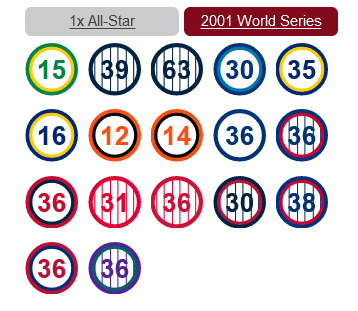
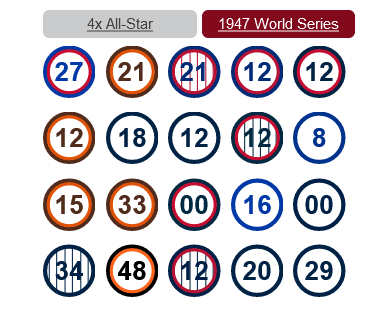
The two most stereotypical journeymen in baseball were pitchers Bobo Newsom and Mike Morgan.

From their Baseball Reference pages, I can say that that’s a lot of uniform numbers. The baseball player who currently holds the “record” for most teams played with is Edwin Jackson. So this kind of super-journeyman has to have a certain quality. They must not be bad enough that they simply drop out of the big leagues altogether after a comparably short and disappointing career, but they also can’t be good enough to have one team try and hold onto them. On that point, while free agency has allowed journeymen to move elsewhere on their own terms, the shuffled-around player definitely existed long before that-just ask Bobo Newsom himself, or all the other pre-1976 (when free agency began) baseball journeymen.

Some journeymen have unique skill sets. Jesse Orosco is perhaps the best example. With a pitch that was close to unhittable by left-handed batters, he became a “LOOGY” (Left Handed One Out Guy) who pitched into his mid forties as someone who showed up, threw to one or two batters, and then left the game.

To me, the journeyman offers a unique literary opportunity. The character can thrive at their sport and play for champion teams. But they aren’t a dominating superstar and live life on the edge in a way that said dominating superstar doesn’t. And they could go from a winner one day to a loser the next. The possibilities are massive.