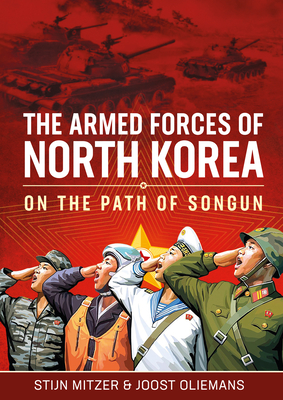
Review: On The Path of Songun

The Armed Forces of North Korea: On The Path of Songun

It’s been a while since I read a really, really good military nonfiction reference. Thankfully, Stijn Mitzer and Joost Olieman’s The Armed Forces Of North Korea: On The Path Of Songun takes the cake. The product of the same people behind the legendary Oryx Blog of military intelligence, this took a while to finally get going. Thankfully, it’s well, well, well worth the effort.

So why is it so good? Well, for a start, it’s incredibly well researched, written, and photographed. It’s not an OPFOR manual or a ridiculously broad order of battle chart. What it does do is go into legitimate detail and depth about the KPA and its rise, fall, and rise. What made me absolutely fall in love with this was how this is the rare military book that doesn’t fall into either extreme of “unstoppable or helpless”. When I saw the self-proclaimed intent to the debunk the notion that the KPA wasn’t/isn’t a threat, I feared it would go too far in the opposite direction.

That was not the case. I was treated to a very evenhanded look that amounts to “Yes, there’s modernization, yes there’s legitimately advanced indigenous developments, but as of now it’s limited and foreign support is undoubtedly there” and doesn’t hesitate to point out their shortcomings and material issues. The authors are even good at pointing out what they can verify and what they can’t, a must for dealing with a country as secretive as North Korea.

For enthusiasts, general audiences, wargamers, and anyone, really, this is a great book that I highly recommend.

Looking At Desperation Formations

Occasionally, I dip into what I’ve called “Normandy Syndrome”, which goes something like this. Because the Normandy Campaign may be the single most studied and written about engagement in western history (with the possible exception of Gettysburg), I tend to look at other, different, more novel conflicts. However, this means that because I haven’t looked at them in some time, the big name campaigns become understudied to me in their own right, meaning that then I do take a look at them…

Generally though, I go back once I’ve had my fill. This time is partially an exception, as I’m looking at (gulp) Axis military formations. Don’t worry, this isn’t me becoming the kind of person who can memorize the name of every single Tiger II platoon commander. In fact, what interests me the most is the bad, hodgepodge, underresourced formations.

One area where Normandy Syndrome in general holds up is in force structure. It’s very easy to find and understand Soviet/American organizations as applied postwar. So thus seeing how different ones looked is distinctive to me, and I’m a sucker for OOB charts. But seeing unit TO&Es derived from limited resources, as opposed to Cold War excess, is also a good worldbuilding exercise for postwar formations under similar constraints.

First up are the Italians. Divisions with two three-battalion regiments, often “reinforced” by a Blackshirt battalion or [small] regiment, were the order of the day. I’ll get back to this formation later.

A 1943 assessment of Italian artillery (pg. 79) said it was a hodgepodge, middling force. A postwar assessment of Italian artillery (pg. 25) said-it was a hodgepodge, middling force. Contrary to the stereotype, both sources praise the crews, but note they were underequipped and unsurprisingly deployed forward more often than the Western Allied norm. Which makes sense given transportation issues and the comparative lack of direct fire support.

Then there’s ZE GERMANS. Not the wunderwaffe Germans, but the tattered, late-war, desperate Germans. For all the “lol-Italians” snickering, it’s worth noting that the Germans themselves had six battalion divisions later in the war, both of a downscaled classic type of two three-battalion regiments and a “Volksgrenadier” type of three two-battalion ones that was (on paper) equipped with more automatic weapons to make up for it.

Volksgrenadiers and Volkssturm are often confused. The former was meant to be more capable than other similar-sized formations due to a mass of automatic rifles and machine guns and even in practice was no worse than any other later-war formation, while the latter was the last-ditch pathetic old men with panzerfausts and ancient rifles militia that people know.

Then there’s my favorite, the later-war armored formations. By 1945, a “Panzer” division had only one battalion of actual tanks and one of APCs even at full strength. In fact, it reminds me more than anything of a postwar light OPFOR formation. One battalion of tanks, a few miscellaneous AFVs and vehicles (ie, for the WW2 formations, it was gun tank destroyers, for postwar ones, they’d be likely replaced by ATGM carriers), and some infantry in softskin trucks, equivalent either to a small division or just a brigade, depending on the type. In practice, well, I’ve heard multiple sources say, and I believe them, that the 1945 Germans were comparable qualitatively to the 1941 Soviets.

Because having too few resources is far more common than having too many (and this is before attrition!) I feel looking at the Axis minors and late-war Germans is a good exercise if developing fictional formations. It’s also a very refreshing and important contrast from the usual myth of waves of Tigers.

Review: Tupolev Tu-22

Tupolev Tu-22

The Tu-22 “Blinder” is one of those “overshadowed by more famous successor” aircraft, the Backfire, which was doing the “let’s keep the same nominal designation for a new aircraft to pretend its more similar than it actually is” long before the Super Hornet. Sergey Burdin and Alan Dawes’ history of the Blinder is one that does it justice.

Though this is a very dry and very technical book overall, it does have some humorous anecdotes, such as how the Libyans used their Tu-22s (spoiler alert: Not very well). It also defends the bomber, with evidence, from the charge that it was a deathtrap. The authors make the good, backed-up case that it was no more dangerous than any other 1950s design, a period known for its high attrition. I’m reminded of the tale of it being unusual when the flagpole at Nellis wasn’t at half staff.

As for why a 1950s design stayed in service so long, the combination of the Soviet packrat attitude and its ability to carry monster ASMs a decent distance meant it was still viable. This “redemption of the ugly duckling” makes me eager for a similar book on another Soviet aircraft with a poor reputation, the MiG-23.

Really, this is a great book for aviation enthusiasts. I didn’t mind the reams of charts, and it goes into detail on lots of things. And the “use oddball tactics” side of me loved the passage where they trained/experimented with using the tail gun against ground targets. This is a solid work and I recommend it.

Review: Firepower

Firepower: A History of the American Heavy Tank

R. P. Hunnicutt was the dean of American tank history, and in Firepower he turned his attention away from the famous Shermans, Pattons, and Abrams’ to something more obscure-heavy tanks. Due to the issues needed to ship them across the oceans, the American military was never the fondest of heavy tanks (a similar issue with being able to travel on bad roads and be easily shipped across the Eurasian landmass has always constrained the size of Soviet/Russian tanks). Excluding the Pershings considered “heavies” while operating alongside lighter Shermans, the only heavy tanks actually produced were a handful of M103s.

But their doctrine was heavily (no pun intended) spelled out and there were, as this reference book shows, a lot of interesting designs. These range from the produced M103 to the World War II boondoggle that was the M6 to the French-esque autoloaded Cold War heavies that languished in obscurity until the World of Tanks computer game. And of course, there’s the monstrous, monomaniacal T28.

This is a dry reference book that reads like a dry reference book. Yet its subject matter is obscure and fascinating, and I highly recommend it to tank enthusiasts and people who like “what-ifs”.

Big Guns in Big Units

The corps/army level artillery mission hasn’t really changed that much since World War I, at least from what I’ve seen.

  • Counter-battery
  • Deep strike
  • Supporting the right effort at the right time.

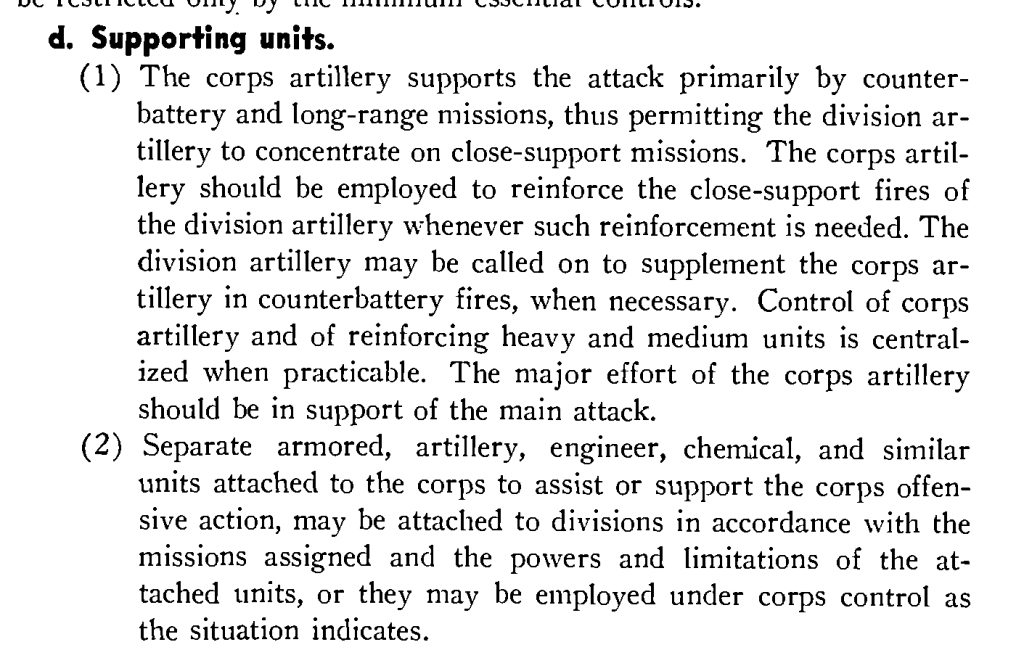
As always, the Soviets were the most explicit in spelling it out, as one set of field regulations shows.

The American FM 100-15, from a similar time, had a similar statement.

As far back as 1923, the regulations explicitly state:

“The primary mission of corps artillery is the destruction or neutralization of hostile batteries, the destruction of hostile defenses, and long-range interdiction fire.”

As technology has consistently improved, command has “flattened”, and the understanding of its role has become more obviously apparent, more recent documents don’t spell it out so exactly. But the general concept is still there and present.

Review: Soviet Military Operational Art

Soviet Military Operational Art: In Pursuit of Deep Battle

David Glantz is one of the most famous and prolific western Sovietologists. In his 1991 Soviet Military Operational Art, he took a big yet close look at their conduct of campaigns, from theory to practice, from the revolution to the then-present. As with everything he’s written, it’s dry history. But it’s excellent for what it is.

Special focus needs to be given to his looking at the more obscure and lesser-known periods of Soviet military history, such as the revolution and Russian Civil War itself, the interwar period, and the immediate post-WW2 one. These tend not to get as much attention as WWII itself and the 1980s hypothetical WW3s, but are just important historically and frequently very different tactically. Looking at the layout of a Russian Civil War division, so different from the formations I knew, I thought “this was like when baseball pitchers threw underhand”.

The book is still a little dated in some areas, and has a few issues. I think the most glaring one is Glantz overstating the effect of the Stalin purges. While they didn’t help the Red Army, looking at later Russian sources gives me the impression that its biggest problem was expanding too much too quickly and that the purges were just the icing on the cake. Khrushchev-era politics would give an obvious incentive to blame Stalin directly for as much as possible.

But this is a small issue and the book itself is still excellent.

The Monster Rocket

I give you the Type 762 rocket launcher, a fairly old and obscure Chinese self-propelled artillery piece. This is well, if you combined a FROG, a TOS-1, and a Giant Viper all into one platform, you’d get this.

From its stated (as always, take with a grain of salt) statistics, it has a pair of very short range (around only a kilometer!) thermobaric rockets (like the TOS-1), that are huge at 425mm diameter (only somewhat thinner than the FROGs) and which are primarily meant for clearing minefields (like the Giant Viper). Although with a rocket that big, I’m guessing that it’ll “clear” more than just land mines in the area it hits.

Truly an oddball.

The Breach

One of the most difficult military operations (although to be fair, none could be considered truly “easy”), and one I’ve recently been looking at in my armchair studies, is the breaching operation. Requiring firepower and engineering in massive and coordinated amounts, its challenge is emphasized in everything that talks about it. Yet what’s equally interesting is that defending against such an attack requires just as much in the way of perfectly synced combined arms as launching it.

It’s a counterintuitive paradox that fortifications (the official term for preparing them called “survivability” ) are important to manuever war and mobile counterattacks are equally important to positional warfare. For the former, I’ll just say that artillery hasn’t exactly gotten less effective since World War I. For the latter, any position can be eventually reduced and overwhelmed with firepower if the opponent is given the chance.

Review: The Rules of The Game

The Rules of The Game: Jutland And British Naval Command

In the seventh game of the 2001 World Series, Mariano Rivera faced Tony Womack, giving up a game-tying hit and setting the stage for Luis Gonzalez to win the series for the Diamondbacks. In that plate appearance, Womack triumphed. In the rest of their careers, it was quite potentially the greatest relief pitcher ever (Rivera) against a poor hitter whose sole virtue was speed in baserunning (Womack). A sample size of one doesn’t lead to good results.

Unfortunately, this is what Andrew Gordon tries to do in The Rules Of The Game: Jutland and British Naval Command, a history epic that is equal parts awe-inspiring and frustrating. When younger, I hung on this book’s every word. Now, it comes across highly erratic. See, the writing quality is still amazing. The research and attention to detail is excellent as well. In terms of historiography, Gordon stands out.

It’s just a shame that in terms of slant, he stands out as well.

Gordon is one of the few historians who stands with David Beatty over John Jellicoe, and his defense is weird. In the actual book, Gordon points out Beatty’s flaws -he put the slower but most-armored Queen Elizabeth battleships in the back of his formation, he didn’t coordinate more, he was a ‘difficult’, arrogant person that nobody liked, and so on. And yet he still supports the BCF commander on “his heart was in the right place” grounds. You know, he was scrappy, and he had that clutch spirit.

With a bias towards a decisive victory that never truly needed to happen, the book comes across as not what it could have been. Gordon takes that sample size of one (hey, remember the time a relief pitcher with only two career plate appearances managed a double off of Randy Johnson? The time Muggsy Bogues blocked a shot from Patrick Ewing?) and seems to just miss the forest for the trees-or if he doesn’t, he barely dwells on it.

This book is still a huge accomplishment and one very much worth reading. It just needs to be understood that it’s not exactly the most neutral in tone.

The GWRBI

Baseball is a sport full of statistics, and there’s one weird footnote of a stat that was, from 1980 to 1988, elevated to prominence. This was the Game Winning Run Batted In. Defined simply as “The RBI that gives a club the lead it never relinquishes” , it existed but never felt that prominent. The career leader in GWRBIs during this period was Keith Hernandez.

“Normal” RBIs were one of the first stats that sabermetricians slammed, and with good reason. The stat is simply too context-dependent and reliant on how good at getting on base the players batting before the RBI hitter are. Rickey Henderson didn’t have that many RBIs because he was always a leadoff hitter, so the bases were either empty or he appeared after the team’s worst hitters. GWRBIs have that and the same “reliant on the other half off the inning” issue as pitcher wins. And while meant to embody the likes of Bill Mazeroski’s famous home run, the definition of a GWRBI means that a marginal player singling in the first run early in an 11-0 squash is also credited with it.

So few people mourned the stat when it was discontinued. Yet I have a strange affection for it, for while near-useless for evaluating players, it reveals a little about the paths of individual games.