Review: A UN Legion

A UN ‘Legion’: Between Utopia and Reality

Stephen Kinloch Pichat’s A UN ‘Legion’: Between Utopia and Reality is a very inconsistent book. This may be due to its subject matter, which involves the various proposals for a UN standing army, proposals made since before the formal United Nations Organization even existed.

About half the book, at least figuratively, is written in a particularly bad form of “academic-ese”. I had trouble getting through it and I read long dissertations for fun (seriously). Even if unintentional, the problem is that the political obstacles to such a force are so obvious and so easily explained that any long statement will become unfulfilling.

That being said, the other half of the book is a concise, well-written, and well-sourced example of various proposals. They come in two categories. The first is a gigantic “World Army”. The earliest proposals, made during World War II, fit this category, with numbers that seem big to a modern reader but weren’t back then. “World Armies” frequently were capped by a standing high-readiness force (think the 18th Airborne Corps or maybe the USMC/VDV).

The second is a smaller and more theoretically practical “UN Army”, a comparably small force designed for specific contingencies. One of the most detailed examples, which Pinchat describes, is the ‘Vital Force’/’UN Legion’ proposal amounting to several brigades of light to medium troops. Others amount to similar versions of the same thing-something that can conduct most normal peacekeeping missions, but without the ad hoc nature of existing setups.

I’m a little reluctant to recommend a book that sinks to such lows, but it’s still a good resource. It’s just a bit of a shame it’s not better laid out, but this is an academic history and the text is still good when it counts.

The Flying Aircraft Carrier: Not Just For Comic Books

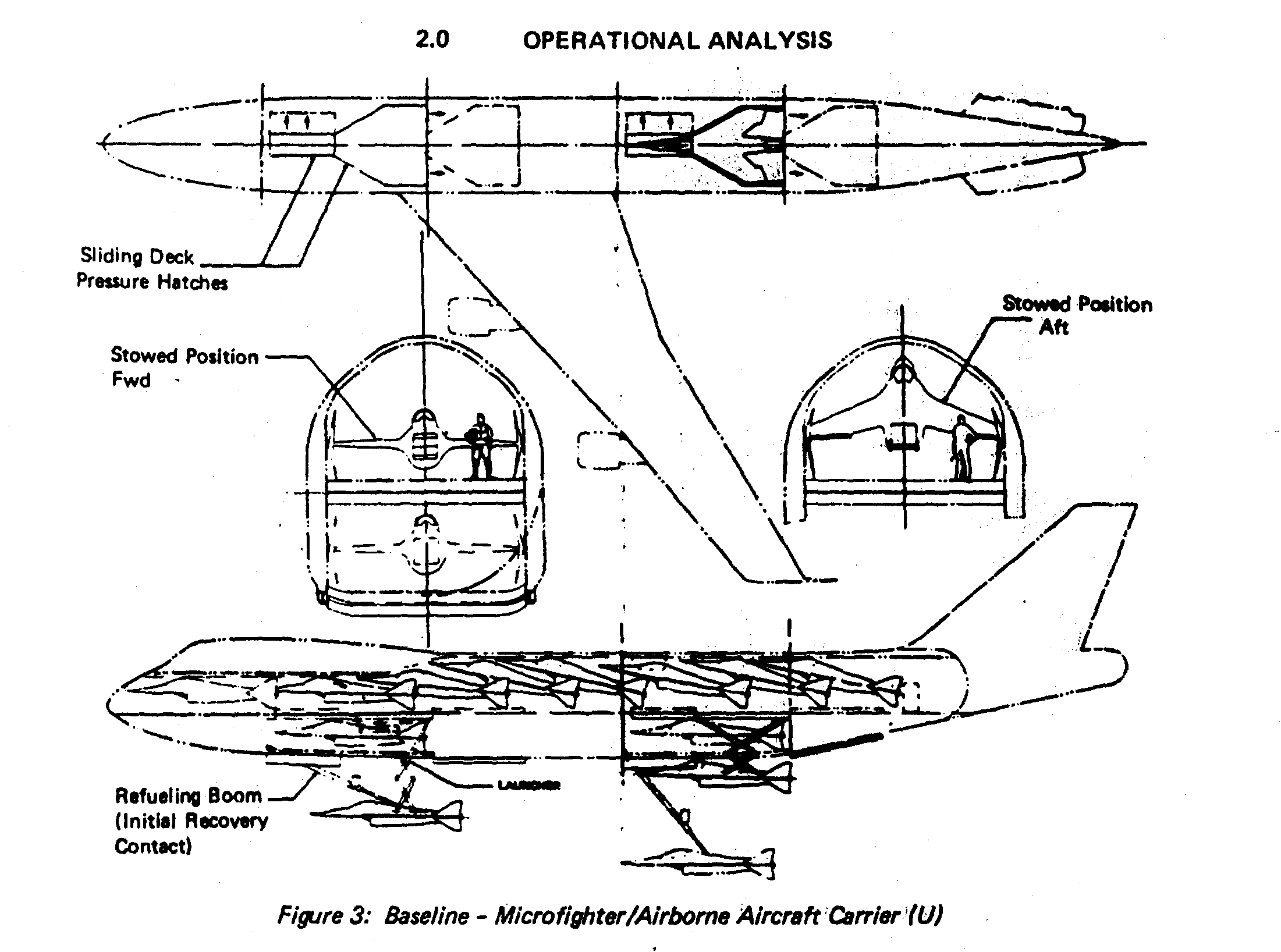
Yes, there was a serious study on the possibility of equipping 747s with trapeze catches and stuffing them full of “microfighters” to serve as flying aircraft carriers that could reach any hot spot soon.

aacdesign

Besides the expense and equally obvious safety issues, these microfighters were only benchmarked against the MiG-21 and their small size would make them harder to upgrade (although this could be mitigated by increasingly miniaturized electronics and giving them smart weapons that didn’t need to be carried en masse). Still, this is a similar gimmick to what the absolutely crazy (in a good way) Black Eagle Force series did with its fighters, and it’s great for fiction.

Front Defensive Operations

frontdefense

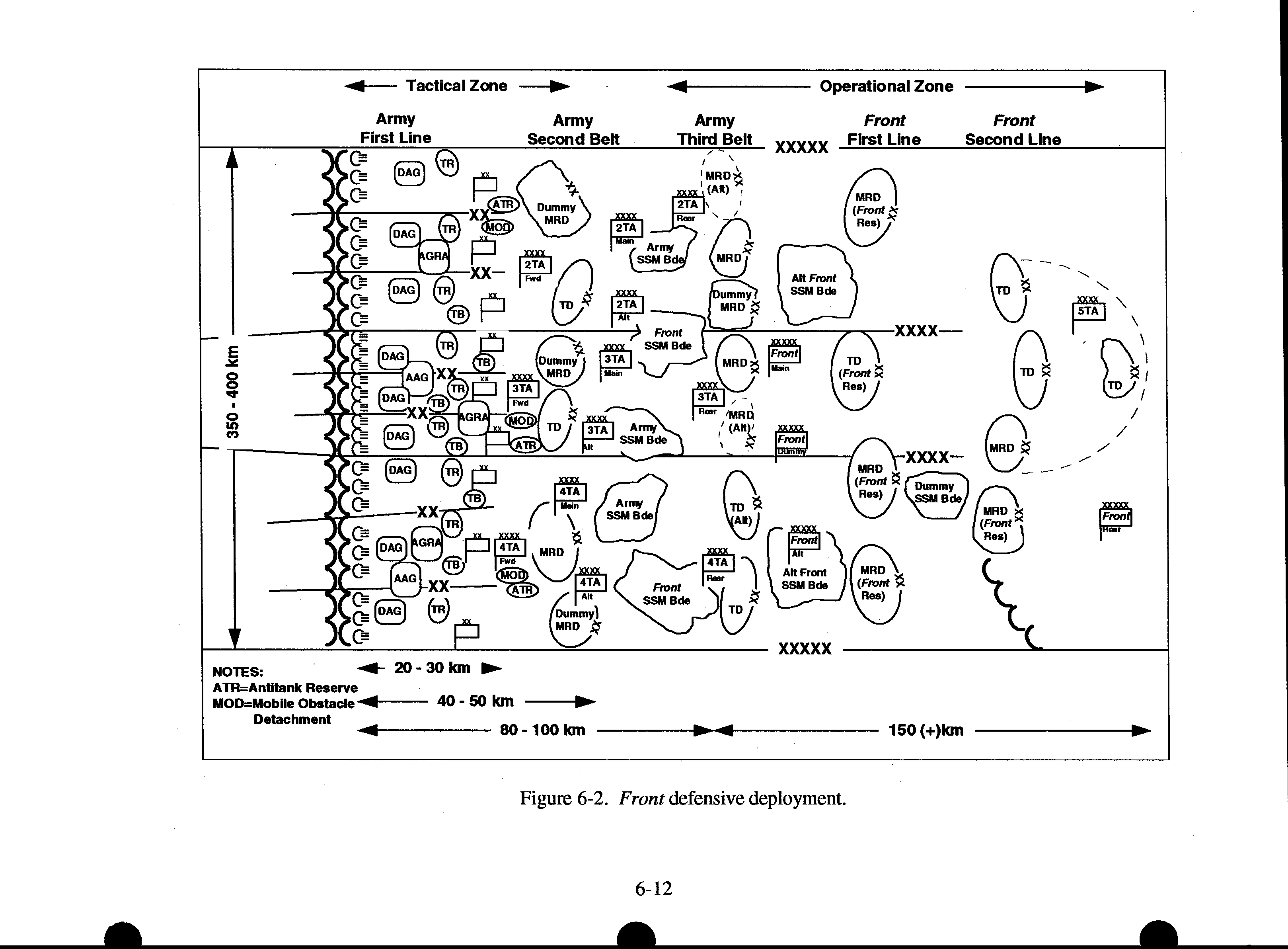
From the Heavy OPFOR Operational, here is a picture of a front-sized defensive operation. My first thought upon seeing it and counting the divisions, besides any political concerns, is – “Does NATO even have enough forces to break through it without a huge amount of technological superiority”?

This particular diagram is something of an idealized best case, as the front has both a second-echelon tank army to counterattack and several independent divisions as “combined arms reserves”. But still. I’d have to ask…

  • How much of a force multiplier are the initial belts (which were expected to be overrun?)
  • How much of the artillery and missile forces can survive and fire effectively on the attackers as they approach?
  • Most importantly, what’s the overall context?


Autoloaders in Soviet tanks

Why did the Soviets so eagerly adopt autoloaders for their tanks? I don’t have any direct primary sources supporting it, but I have some hunches.

  1. Size. Soviet/Russian tanks have always had substantial size/weight limitations for transporting them along the entire length of the rather large country. This explains a lot, including why there was less (which is not the same as no) focus on tanks fighting other tanks, as opposed to using artillery and ATGMs. If the autoloader can make the tank smaller by removing one of the crew, it helps a lot.
  2. Making crew training less relevant. If you have a gigantic force of in-and-out conscripts, you don’t want to rely on something that relies a lot on individual skill.
  3. The third, which I saw in an intelligence piece on the Soviet tank company, stated “in understrength units there may be no loader in tanks other than those of the company and platoon commanders.” I’d really like to see more evidence for this, although it does say understrength.

There’s probably more like how it makes using bigger guns easier, but those are the biggest three that come to my mind. I also like to think of how the inevitable national bias would change if it was, for whatever reason, the opposite. Instead of tales of arm-wrecking autoloaders, there’d be sniggering of “we have high-tech auto-loaders, and the Soviets are still having people stuff the tank with shells-look at how they’d get tired.”

Review: Black April

Black April

George Veith’s Black April is an excellent chronicle of the final fall of South Vietnam. Taking as many sources as he could, Veith paints the picture of an understudied and underappreciated campaign.

The interior workings of the North Vietnamese are very fascinating and, in my opinion, the best part of the book. This is because the campaign was the biggest example of a Soviet-style army defeating a western-style one decisively. While all the planning texts and documents can show a strict operational plan where everyone adheres to their role, in any reality, friction and human conflict is always there, and this shows an example of it in practice.

Veith is on less firm footing with the southerners. While his goal to emphasize the damage of the aid cutoff and give the southerners a fair emphasis compared to their scapegoating as inept bumblers from start to finish is admirable, his opinions about the primacy of the aid cutoff don’t always match with the examples he shows. This isn’t to say that it wasn’t an incredibly important factor, but the frequent examples are of southern units getting chopped up by better-handled northern ones, not attritional slugfests that only ended when they ran low.

Still, this book is an excellent historical reference.

The Motorcycle Regiment

The motorcycle regiment was one of those obscure units in military history. At least according to one Soviet World War II organization, it was essentially a reinforced motorcycle-heavy battalion with motorized artillery and, at least on paper, a tank company, that could act as a forward detachment or be broken up into recon patrols without issue. Some descriptions have them being multi-battalion formations.

A postwar set of field regulations on regimental operations describes it as follows.

A motorcycle regiment (battalion) is a tactical unit (small unit). It is made up of battalions (companies) and other small units. The regiment (battalion) is intended for conducting reconnaissance of the enemy. In addition, it has the capacity to:.
— pursue the retreating enemy, destroy headquarters and signal centers, and disrupt the work of the enemy rear;
— destroy enemy airborne landings;
— seize crossings, important lines,, and objectives, and hold them until the arrival of friendly troops;
— protect the exposed flanks of friendly troops.
The motorcycle regiment and battalion can carry out reconnaissance missions operating as an entity or as small units which are designated as reconnaissance detachments and separate reconnaissance patrols.
Independent of the character of the combat mission to be carried out, the motorcycle regiment and battalion may be reinforced with artillery, tanks, self propelled artillery, small units of special troops, and air support.

The motorcycle regiment was made obsolete by increased mechanization (the recon battalion in later large units fills more or less the same role), but it’s one of those unconventional formations I have a strange interest in.

Review: Divided Armies

Divided Armies

Jason Lyall’s Divided Armies is a big look at how societal inequality can influence military peformance. It’s mixed and uneven but still worthy.

First, the research is exhaustive and extensive. Lyall specifically aims to avoid a Eurocentric/great war bias by looking at a gigantic sample size of conflicts around the world from 1800 to the present. The book is not the easiest read and is written in “Academic-ese” with lots of political science formulas. However, I didn’t consider this a bad thing so much as just being part of its very nature (it’s not the only book of this type of I’ve read). The case studies feature more and more obscure battles. It’s a solid, disciplined set of information that shows a lot of underappreciated and understudied wars.

Of course, this book also has the weakness of the approach. I had two main doubts about this book. One was that Lyall would overcorrect and make the issue too dominant. Although not quite as bad as I feared, I saw a lot of this happening.

The weakest part of his research by far is, ironically, when he goes into great power wars. His study of the World War II Eastern Front, despite citing modern scholars, is still disappointing and clearly viewed through the lens of his thesis. So it means an overt focus on the early war (because the Soviets were clearly doing poorly), and an over-focus on Stalinism at the expense of other factors (because it fits the tone of the book). This image is rather distorted, to say the least.

A far less bad but still iffy example comes from his comparison of Ethiopa in the 1998 war with Eritrea and the DRC in the simultaneous Second Congo War. Despite Lyall’s box-checking and vigorous arguments, I’m still left thinking of the two having far more differences than similarities. They’re not the ones I’d use in a direct comparison, the former having overwhelmingly more experience with large, conventional operations.

The second doubt I was also vindicated with was a sense of “you needed a ton of formal data to say this?” The conclusion of less cohesive societies translating that into ineffectual military performance was not exactly the most shocking or counter-intuitive one.

However, with those caveats in mind, as well as the usual focus on keeping eyes open, the book is still a worthwhile read. The basic conclusion is sound, the examination of previously under-explored conflicts is fascinating, and if the “what” isn’t the most interesting or noteworthy, the “how” definitely is.



Review: Armies of Sand

Armies of Sand

This is the first Fuldapocalypse nonfiction book review. Kenneth Pollack’s Armies of Sand is a semi-adaptation of his thesis, The Influence of Arab Culture on Arab Military Perfomance, and a semi-sequel to his book, Arabs at War. That looked at how Arab armies underperformed in the 20th century and examined the “how”. This looks more at the “why”.

Pollack uses bits and pieces from both Arab states at war and the non-Arab “control groups” to look at the four explanations-Soviet doctrine, over-politicization, underdevelopment, and culture. The first is a total red herring, with Pollack concluding that if anything, it was at least a little helpful. The middle two have had obvious influence, but can’t explain all of it. The final one is what he feels is the most satisfactory answer.

My biggest problem is his methodology, even though I think his conclusions are mostly sound. A lot of his sources are dated, some of the more lurid anecdotes are thinly-sourced, and a few times the implications go from the more reasonable “New York Knicks” (undeniably underperforming, sometimes significantly so) to the exaggerated “Washington Generals” (completely hopeless from start to finish at everything). This is the kind of argument where you need a lot of rigor, so seeing him pass on examples,  even those that would support his case like looking at the North Vietnamese air force when he used the Vietnam War in another control group, has made me raise an eyebrow.

Still, Pollack handles the cultural argument well, by pointing out education and particularly military training as how it took root. He stresses the dangers of stereotyping and, most importantly, shows both how culture and warfare can change and how workarounds were developed. All of the workarounds involved, in some form or another, a smaller army with a more selective choice of personnel.

Armies Of Sand is not and should not be the last word on the Middle East or military history, and should not be unhesitatingly accepted. But I still highly recommend it, and not just for information on Arab armies. Its study of politicization and underdevelopment in general is fascinating, and it’s well-written.


Soviet Planned Rates Of Advance

This covers a variety of ideal/aimed for Soviet advance rates, citing translated primary sources when possible. The actual ability to meet these rates in practice would depend greatly on circumstances. All figures are in kilometers per day.

_ _ _ _ _ _

Late 1940-mid 1950s (conventional): 25-35 infantry, 40-50 tank armies [Front Offensive Operation, 1974]

Late 1950s (nuclear): 45-60 [Front Offensive Operation, 1974]

1960s (nuclear) 60-70 [Front Offensive Operation, 1974]

Late 1960s (conventional): 35-40 [Front Offensive Operation With Conventional Weapons, 1969]

1970s-80s (Europe): 40-60, 30 (Southwest Theater, Mountainous) [Voroshilov Lectures, Front Offensive Operation, 1977 ,  Heavy OPFOR Operational]

1970s-80s (China, other weaker opponent): 70-100 [Voroshilov Lectures]

1990s-2000s (conventional, GENFORCE-Mobile): 30-40 (optimistic), 20-30 (optimistic, poor terrain) 15-20 (modest) [Generic Enemy: Mobile Forces]

The Military Techno-Thriller: A History

The Military Techno-Thriller: A History

I absolutely loved Nader Elhefnawy’s “The Rise And Fall Of The Military Techno-Thriller.” So when I found that he’d written a recent big-picture overview of the genre , I was delighted and eagerly snapped it up. Rather than starting with the classic ‘invasion novels’ of the late 1800s, Elhefnaway moved even further, beginning in the 1600s.

Thus begins a multi-century tour de force, deftly pointing out not only the books themselves but also the cultural context behind them. This book is both long enough to be comprehensive (mostly) and short enough to be easily readable, making it the best of both worlds.

The picture it paints of the “techno-thriller” per se is of a genre that could only really thrive at one very specific sort of time. It has to exist in a period of heightened military tension that can’t spill over into any sort of massive backlash and a period of novel technology at the same. Such a period existed around the turn of the 20th Century and in the 1980s. At least in the latter case, it was not sustainable even without “events”, and with the “events” (ironically consisting of a war in the first period and a peace in the second), both were doomed.

There are a lot of fascinating insights that made me go “a-ha”, for lack of a better term. Elhefnawy’s statement that “Full-scale great power war scenarios like Clancy’s Red Storm Rising, Coyle’s Team Yankee or Ralph Peters’ Red Army (1989) were in the minority” matches what I found after starting this blog-my “blind man touching the elephant” background in wargaming and alternate speculation made me think the ‘big-war’ subgenre of that sort was considerably larger than it actually was. Another insight I found intriguing was the notion that Red Army was as successful as it was because it was novel in large part compared to other Fuldapocalyptic tales. And the tone of the writing, being frequently critical but never sneeringly dismissive, works very well too.

I think my biggest substantive disagreement with Elhefnawy’s conclusions is his depiction of the technothriller now. He mentions the “rise-of-China/return-of-Russia” change in geopolitics, but argues that “Nonetheless, the cultural trends evident in the 1990s proved quite robust”. I think that shift gave the the technothriller a bigger bump in popularity than he gives it credit for, especially given the headwinds it’s had to work against (the fragmentation of publishing and pop culture).

And while I don’t want to nitpick the omission of certain areas in something that’s meant to be a general overview, there’s a few I where thought more detail could have been warranted. In particular are what he calls the “vigilante novels” (ie, Mack Bolan). These are interesting in that they provide a parallel track of pop culture that both stood apart from and moved closer to the technothriller across the length of time. That phenomenon gets a segment but deserved more. There’s also the long-term “squeezing” of the mainstream publishing industry, and a deeper look at how that and the push for big, higher-margin books both helped and hurt the technothriller would have been nice. (It’s mentioned several times, but never in too much depth).

Still, these are just very small critiques for an excellent book that examines an overlooked genre through a variety of interesting perspectives in a highly readable way. I cannot recommend The Military Techno-Thriller: A History enough for fans of the genre.