The Style of Camouflage

Camouflage uniforms have sometimes been issued in limited amounts, especially during the World Wars. In some cases, they were chosen for practical reasons. Recon troops and others who needed legitimately better concealment were given them. One interesting case is the US only really deploying camouflage uniforms in the Pacific theater in WWII, as the Germans loved camo, and thus using them in Europe caused too much confusion. Another one is how a lot of armies that previously used the classic M81 Woodland have updated their uniforms, since the ubiquity of that pattern has made it very easy for enemies to make disguises.

But there have also been cultural reasons, for lack of a better term. And not just bandwagoning like the infamous American “every service stomps into a digital camo pattern” experience in the 2000s. I’ve heard that the postwar Bundeswehr was slow to adopt camouflage uniforms because of their association with the Third Reich. And in places like Saddam Hussein’s Iraq, camouflage has been reserved for elite units as a sort of status symbol. There’s also police forces adopting blue and/or gray pseudo-camouflage to show a sort of “military power”.

This aspect of camouflage uniforms is both ironic (something intended to blend in is chosen because of its looks) and interesting to me. As is the reputation that seemingly neutral camo patterns develop based on who uses them.

Weird Wargaming: The “Pharaonic” Division

One of the gems in the Micromark Army List order of battle sets is the “WW2.5” hypothetical set. In an alternate victorious Germany, it’s kind of a way to do a battle with all sorts of never-were prototypes and units from Allies and Axis. However, the organizational structure remains largely the same as historically-with one strange exception.

This is the “Pharaonic” Division, adopted by Egypt as part of returning to its ancient roots (yes, this is an excuse plot). And it’s interesting. At division level, it’s very conventional (three brigades, one armored and two infantry), and at brigade level mostly so (two “hosts”/subunits of either tanks or infantry).

However, the regimental (or “host“, as it’s called) level is extremely different. Like the infamous pentomic formations, it has five companies and skips the battalion level. Line platoons consist of five ten-man squads. Artillery battalions consist of five batteries of five guns each.

Tanks do not follow the rule-of-five and instead use a more conventional 4-3 model (4 tanks in a platoon/troop and 3 of those in a company/squadron). However, tank squadrons have an organic pentomic mechanized infantry troop. Although they’re not in the OOB document, I can see hypothetical independent armored formations intended for attachment to infantry units being organized in the “5 subunits” way to make attachment and organization easier. It’s worth nothing that the self-propelled guns used primarily for infantry support/defense are arranged this way.

The original pharaonic division was only covered in mechanized form, but its principles mean it can easily be adopted to other types of units. For instance, I can easily make a triangular pharaonic division with either three or six infantry hosts (depending on if you want a brigade level or not) and the usual support elements.

Review: Hit And Fade

Hit And Fade

The second book in the Forgotten Ruin series, Hit And Fade features the timeshifted Rangers going against something close to the original Fuldapocalypse “mascot”. Not a zombie sorceress, but a lich, a zombie sorcerer. I guess his sister was off provoking a Third World War and disabling the nuclear warheads.

The book is very similar to its predecessor in terms of quality, which makes it a little hard to review (in contrast to the original). All of what I’ve said about the good and bad parts has been stated already, and it doesn’t feel that different. If I had to say something, I’d say that the contrivances in worldbuilding add up when repeated, and that there aren’t enough new good qualities to make up for that.

Still, this is not a bad book. Its flaws are not insurmountable, and if this was the first in the series that I’d read, I’d probably feel differently. If you want to see Rangers fighting a skeleton mage, you’re in the right place.

Looking At Desperation Formations

Occasionally, I dip into what I’ve called “Normandy Syndrome”, which goes something like this. Because the Normandy Campaign may be the single most studied and written about engagement in western history (with the possible exception of Gettysburg), I tend to look at other, different, more novel conflicts. However, this means that because I haven’t looked at them in some time, the big name campaigns become understudied to me in their own right, meaning that then I do take a look at them…

Generally though, I go back once I’ve had my fill. This time is partially an exception, as I’m looking at (gulp) Axis military formations. Don’t worry, this isn’t me becoming the kind of person who can memorize the name of every single Tiger II platoon commander. In fact, what interests me the most is the bad, hodgepodge, underresourced formations.

One area where Normandy Syndrome in general holds up is in force structure. It’s very easy to find and understand Soviet/American organizations as applied postwar. So thus seeing how different ones looked is distinctive to me, and I’m a sucker for OOB charts. But seeing unit TO&Es derived from limited resources, as opposed to Cold War excess, is also a good worldbuilding exercise for postwar formations under similar constraints.

First up are the Italians. Divisions with two three-battalion regiments, often “reinforced” by a Blackshirt battalion or [small] regiment, were the order of the day. I’ll get back to this formation later.

A 1943 assessment of Italian artillery (pg. 79) said it was a hodgepodge, middling force. A postwar assessment of Italian artillery (pg. 25) said-it was a hodgepodge, middling force. Contrary to the stereotype, both sources praise the crews, but note they were underequipped and unsurprisingly deployed forward more often than the Western Allied norm. Which makes sense given transportation issues and the comparative lack of direct fire support.

Then there’s ZE GERMANS. Not the wunderwaffe Germans, but the tattered, late-war, desperate Germans. For all the “lol-Italians” snickering, it’s worth noting that the Germans themselves had six battalion divisions later in the war, both of a downscaled classic type of two three-battalion regiments and a “Volksgrenadier” type of three two-battalion ones that was (on paper) equipped with more automatic weapons to make up for it.

Volksgrenadiers and Volkssturm are often confused. The former was meant to be more capable than other similar-sized formations due to a mass of automatic rifles and machine guns and even in practice was no worse than any other later-war formation, while the latter was the last-ditch pathetic old men with panzerfausts and ancient rifles militia that people know.

Then there’s my favorite, the later-war armored formations. By 1945, a “Panzer” division had only one battalion of actual tanks and one of APCs even at full strength. In fact, it reminds me more than anything of a postwar light OPFOR formation. One battalion of tanks, a few miscellaneous AFVs and vehicles (ie, for the WW2 formations, it was gun tank destroyers, for postwar ones, they’d be likely replaced by ATGM carriers), and some infantry in softskin trucks, equivalent either to a small division or just a brigade, depending on the type. In practice, well, I’ve heard multiple sources say, and I believe them, that the 1945 Germans were comparable qualitatively to the 1941 Soviets.

Because having too few resources is far more common than having too many (and this is before attrition!) I feel looking at the Axis minors and late-war Germans is a good exercise if developing fictional formations. It’s also a very refreshing and important contrast from the usual myth of waves of Tigers.

The Question of Motivation and Interior Forces

For one alternate half-fantastical daydream war scenario I’d created (that I may or may not be simming further), I had one fictional country’s interior ministry forces fight harder and better than their regular army did. This despite them not being really designed for conventional war at all and having nothing heavier than box-APCs and crew-served weapons. Part of it was good mountainous terrain that played to the strengths of lighter forces (like them, particularly their commando units) while weakening heavier ones (like the attackers). But then it got me thinking to other parts.

  • Being all-volunteer (even if only for pay) compared to the mostly draftee military.
  • Being a sort of counterbalance to the regular army that put them on alert. (This is why they’d have antitank weapons and training, for instance…)
  • Finally and more crucially, being tied to the regime rather than the country. This meant they had more to lose in the event of a defeat.

Review: Soviet Military Operational Art

Soviet Military Operational Art: In Pursuit of Deep Battle

David Glantz is one of the most famous and prolific western Sovietologists. In his 1991 Soviet Military Operational Art, he took a big yet close look at their conduct of campaigns, from theory to practice, from the revolution to the then-present. As with everything he’s written, it’s dry history. But it’s excellent for what it is.

Special focus needs to be given to his looking at the more obscure and lesser-known periods of Soviet military history, such as the revolution and Russian Civil War itself, the interwar period, and the immediate post-WW2 one. These tend not to get as much attention as WWII itself and the 1980s hypothetical WW3s, but are just important historically and frequently very different tactically. Looking at the layout of a Russian Civil War division, so different from the formations I knew, I thought “this was like when baseball pitchers threw underhand”.

The book is still a little dated in some areas, and has a few issues. I think the most glaring one is Glantz overstating the effect of the Stalin purges. While they didn’t help the Red Army, looking at later Russian sources gives me the impression that its biggest problem was expanding too much too quickly and that the purges were just the icing on the cake. Khrushchev-era politics would give an obvious incentive to blame Stalin directly for as much as possible.

But this is a small issue and the book itself is still excellent.

The Conventional Guerilla Army

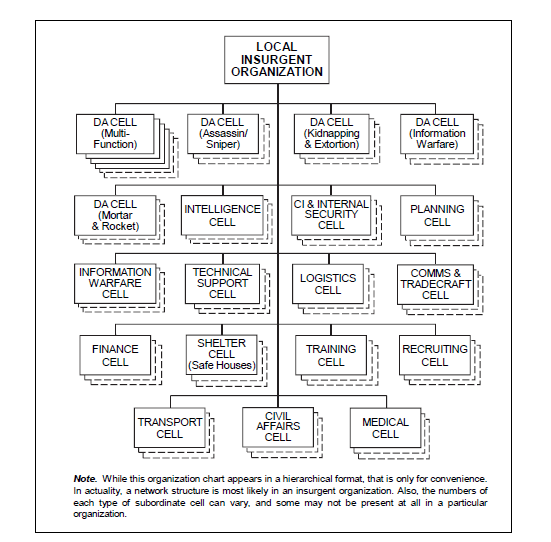
Yes, I know this title sounds like a contradiction. Yet the irregular opponent operates in tiers.

At the “bottom” tier of organization, as per Training Circular 7-100.3, Irregular Opposing Forces (source of diagram), there is what that document calls “insurgents”, ones devoted purely to doing damage.

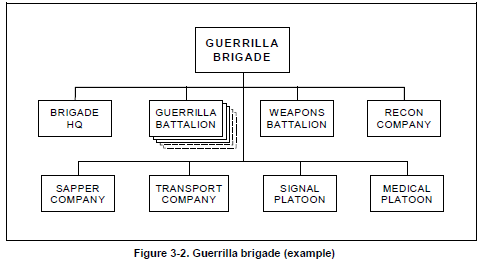
Next are what it calls “Guerillas”. The definition is “

“A guerrilla force is a group of irregular, predominantly indigenous personnel organized along military lines to conduct military and paramilitary operations in enemy-held, hostile, or denied territory (JP 3-05). Thus, guerrilla units are an irregular force, but structured similar to regular military forces. They resemble military forces in their command and control (C2) and can use military-like tactics and techniques.”

(Bolding added by me)

The document holds “guerillas” to be more organized and more capable of conventional-ish action than “insurgents.” It lists (obviously rough) organizations up to brigade size.

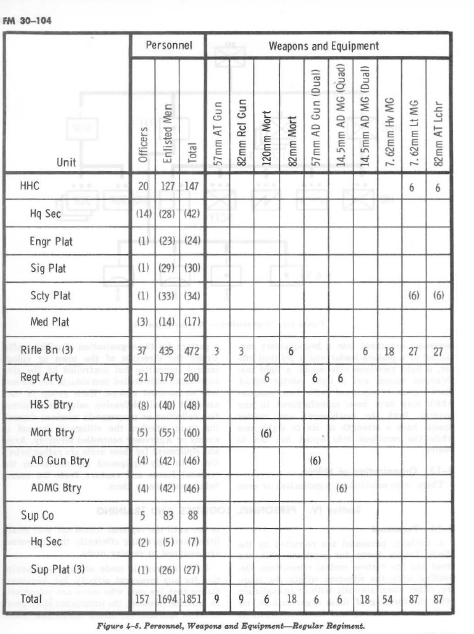
Then it gets trickier. Then there emerges “regular forces” that are intended to fight and hold ground conventionally. The Vietnam-era “Handbook on Aggressor Insurgent War” (FM 30-104, 1967) has a sample regiment of these regular forces organized as follows.

FM 30-104 rightly notes that these are organized similar to conventional Aggressor rifle regiments, only with lighter equipment. This flows right into the highest tier, consisting of…

  • Forces trained and equipped similarly to their external patrons (since very few unconventional forces can grow this powerful without outside backing). These are less interesting from an organizational standpoint, as the only things really distinguishing them are the origins of their forces and sometimes skill.
  • Irregular forces that have the size and equipment to succeed at conventional operations. These will have de facto infantry, motor vehicles (the infamous “technicals” ) and a smattering of supplied/captured AFVs, operable in what would be considered “detachments” in more structured armies in terms of their size and (lack of) organization.

Review: Forgotten Ruin

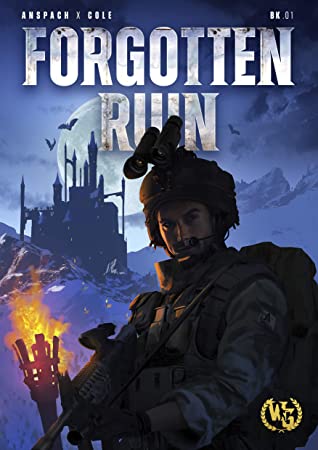
Forgotten Ruin

A lot of books are what I call “median 51%”, middle of the road stuff that’s perfectly fine to read but which can be hard to actually review well. Then there’s Jason Anspach and Nick Cole’s Forgotten Ruin. I can hardly think of a better example of a “Mean 51%” book. The means a work of fiction that does some things very well and others-not so much. This kind of book can both be disappointing and engaging, and perfect to critique.

Since its magic-vs-technology, fantasy-vs-firepower conflict is music to my ears, I knew I had to check it out. So how was it?

From the start, it’s written in first-person, which I consider suboptimal for thrillers. But this isn’t a deal-breaker. A lot of the characters are one-note stereotypes and the main narrator comes across as a macho ass. But that’s not a deal-breaker either.

The bigger dichotomy comes from the worldbuilding and action. To be frank, the worldbuilding doesn’t live up its potential. It puts its modern military heroes in a fantasy world, but then does nothing but stuff it full of generic fantasy creatures. And the contrivances needed to set it up range from “oh, this political reference is really hamfisted and likely will age quickly” to “OH COME ON!”. (What a coincidence the main character is a linguist who just happens to be able to speak all the right languages, which are variations of existing human ones!)

Then there’s the fighting, which is of course the centerpiece of this kind of book. I’m also of two minds on this. On one hand, at times it reminded me of artificial Payday 2 assault waves where masses of enemies just keep charging forward into superior firepower, which is not a good thing. But on the other, there were instances of cleverness and, more importantly, the setup was evenhanded. As I’ve seen way too much fiction where the “primitives” are just tomato cans for the “awesome modern armies”, this was a welcome change.

While I had mixed feelings about this, its premise is good enough and well executed enough to make me want to continue. And it’s the kind of book I really enjoyed thinking about and writing about. And that alone makes it worthwhile to me.

Review: Third World War: The Untold Story

Third World War: The Untold Story

It’s very hard for lightning to strike twice. And in Third World War: The Untold Story, John Hackett tried. He did not really succeed. The problem was that much of the appeal of the original came from being the first out of the gate, whereas by 1982 the zeitgeist had clearly shifted. (An obscure and amusing example comes from the line “World War III is drawing near” in the XTC song Generals and Majors, released in 1980).

While possibly unfair to list the earliest instance of a genre as not having held up well over time, I do believe that Hackett’s work has aged the worst of all the few “big-name” conventional WW3 books. It’s earliest, and it’s clearly meant as an explicit lobbying document in a way that the (still-slanted) other works of that nature did not. And this applies far more to a modestly repackaged version released four years after the original. Because that’s what it is.

This is the book equivalent of one of those “remastered special edition” movie DVD releases. There’s a reason why those, even if the underlying film is sound, do not generate nearly as much enthusiasm as the first, novel release.