Review: Lions of the Sky

Lions of the Sky

lionscover

The F/A-18 centric Lions of the Sky is naval aviator Paco Chierici’s first novel.

If I was to make a comparison, I’d say it’s like a modern version of Sweetwater Gunslinger 201 with a few more technothriller elements thrown in. Or, to use a less obscure pop culture reference, a modern version of Top Gun in print form with somewhat higher stakes.

I’m willing to forgive a lot of the roughness in a first novel, especially if I ultimately still found it enjoyable (which I did). Yet I feel obligated to point out that it is indeed there. The problem is that the sum of the parts seem like more than the whole. In particular, the entire “Spratly Islands Technothriller Plot” that winds in and out through the book is the least interesting part of it. What went through my mind as I read every section involving it was “it didn’t need to be like this. To set up the final action set piece, there doesn’t need to be a stakes-raising gimmick like what happens here.”

Beyond that, it doesn’t flow the best. There’s no real exact way to describe it and it’s clearly just the rough edges every first novel has, but the slightly clunky pacing is still apparent.

When the actual aircraft action scenes occur, they’re well written. Many of the on-the-ground relationship scenes are also well written. There’s definite talent here, and I hope, if/when Chierici completes any more books, he plays to his strengths and makes it a little more coherent in one direction or another. Lions of the Sky itself isn’t bad by any means, but it still feels like just a decent orange dish that has a few apple slices awkwardly stuffed in.
Review: Shadow Tyrants

Shadow Tyrants

shadowtyrantscover

Deciding to try my luck with grocery store novels, I grabbed Shadow Tyrants, a “Clive Cussler’s” book written with Boyd Morrison. It was an Oregon Files novel, and it followed my rule of “go for the most out-there premise.” This had infighting amongst an ancient conspiracy, with only the Oregon and Juan Cabrillo able to stop them. What could go wrong?

The biggest problem is the prose. It’s not unread-ably bad, but still comes across as kind of simple and bland. Thus a premise that could have supported a delightfully goofy adventure ends up being hobbled and coming across as a 51% technothriller. (Although the super-conspiracy is still better and more capable than Casca’s Brotherhood ever was-those guys are the St. Louis Browns of super-conspiracies). There’s headline namedrops and clear “I know the name but not much else” descriptions of weapons systems.

There’s a lot of contrived deus ex machinas in close proximity to each other. I’d be more forgiving if the prose had cushioned it, but it instead amplified them. For instance, what could have been a excellent naval battle (the best use of the Oregon) ends up being just a disappointing clash of the technothriller gimmicks.

Worse, the “historical tie-in” seems even more forcefully shoved in. It’s not like the superweapons had an ancient component. It’s just that these ancient scrolls led to the super-conspiracy, and we get a shoved-in epilogue to remind us that Cussler books are supposed to feature grand adventures with historical artifacts, not just be middling technothrillers piggybacking on his reputation. Unfortunately, that ship sailed decades ago.

This is still a good enough “51% technothriller”, and it’s still more engaging and fun than just a rote “shoot the terrorist” thriller novel. But it, much like a lot of the other Oregon books, doesn’t live up to its potential.

Review: Advance To Contact

Advance To Contact

advancetocontactcover

In the early stages of Fuldapocalypse, I reviewed Andy Farman’s Stand To, a World War III tale. Or rather, a sleazy spy tale that became a World War III tale that involved everything I thought I’d be seeing en masse on Fuldapocalypse, and then some. Lots of descriptions. Lots of viewpoint characters. Lots of meticulously described battles.

Now I’m in one of those full circle moods. I still had the remaining books in the series left unread, so I decided to return to that mostly untapped World War III vein and read the second Armageddon’s Song book, Advance to Contact.

Farman has had decades of legitimate expertise as a soldier and police officer, and indeed the infantry fighting scenes in this book sometimes actually work. The key word here is “sometimes”. Often they blur together (since the characters are so forgettable and interchangeable). Often Farman fills it with infodumps on the exact levels of equipment and/or author lectures on whatever topic is technically relevant. Often the viewpoints are yanked away and yanked back. Often they’re overdescribed to the point where it loses its focus. Still, I should give legitimate credit where credit is due. There’s one scene with doomed Belarusian soldiers where he actually writes well, doesn’t get too infodumpy, and keeps the ‘camera’ focused on them instead of jumping a continent away after a few paragraphs.

Another instance of deserved credit is that the plotting and pacing is a little better than in Stand To. The war is underway, so the goofy spy plot is less prominent and the viewpoint jumping merely at the level of “exaggerated technothriller” rather than the wrenching shifts of Stand To.

That being said, it still has most of the problems mentioned over a year ago in the review of Stand To. The times when details are gotten wrong (given the ridiculous amount of description) are annoying. Farman doesn’t focus on where he’s most skilled and comfortable but instead gives giant air/sea battles. There are bizarre events like B-2s being used as tankers and Tu-160s as special forces insertion craft. The dialogue for anyone not in the military is frequently awkward. And the pacing is just glacially slow.

Still, like with the first book, I couldn’t feel mad about this and frequently felt amused. This is an earnest series by a first-time fiction writer. It’s just that what could have been at least a rival to Chieftains with some more focus turned into this clunked-together technothriller kitchen sink.

Snippet Reviews: October 2019

The Press Gang

Kenneth Bulmer (as “Adam Hardy”) wrote the Fox series of age-of-sail adventures in the 1970s. The Press Gang is marked as being the second in the series in the modern Kindle format, but it was the first actually printed (chronological vs. publication order?).

In any case, the tale of George Abercrombie Fox is not the best one to ride across the waves. Bulmer’s prose, which I recognized from the Dray Prescot books, isn’t the best, and the setup is this weird hybrid of cheap thriller and Herman Melville “this is what an age of sail ship is like”.

The Enigma Strain

Nick Thacker’s first book in the Harvey Bennett series of thrillers, The Enigma Strain is a solid thriller, if a 51% one. The book features the titular park ranger and a CDC scientist as they fight to stop a plot that involves an ancient, exotic disease and multiple nuclear bombs.

On one hand, it’s in the awkward uncanny valley that plagues a lot of cheap thrillers. It’s clearly too ridiculous to be realistic, but it’s not bombastic enough to be the gonzo silly thriller that it deserves to be. On the other, it’s still competent enough to be a passable, fun reading experience, and that’s what cheap thrillers are supposed to be.

Review: Deep Blue

Deep Blue

Reading Deep Blue, one of the later John Schettler Kirov books, brought a strange feeling to me.

Reading it, I encountered all of the issues with Homecoming, the previous book in the series I’ve read. And then some. The almost interchangeable battles are over-detailed and underwhelming to an extreme. The plotlines are clunky and shoved together. By all “normal” accounts, I should have been dismissive at best and disliking at worst. But I just wasn’t. As I read through tons of time-travel shenanigans, I felt a sense of “woah. Wow”, for lack of a better phrase.

It hit me when the ship time-warped from the current near-future World War III to another near-future World War III, only with different equipment and different sides. Everything just then clicked suddenly into place.

This is kind of like the later Survivalists-if Ahern had meticulously simmed every clash in Advanced Squad Leader or something like that and recorded the verbatim results in the books. And the time travel isn’t just a small throwaway part-it’s a a big central element, with a huge effort towards enabling this kitchen-sink wargaming. It’s like having a zombie sorceress start a Fuldapocalyptic World War III, and devoting a lot of effort to her, her rivals, and her powers as you move from 1985 to 1988 to 1981 to a 1986 with the YF-17 chosen as the light fighter and the British using a different divisional structure.

I still don’t recommend the actual books, unless you like lots and lots of barely disguised wargaming AARs. But if I had to choose a series with a lot of novelty and effort put into it or a series that just clunks along without any of those, I’m definitely picking the former. The sheer excess of the Kirov series makes it at least interesting.

Review: SEAL Team Seven Direct Action

SEAL Team Seven 4: Direct Action

directactioncover

The SEAL Team Seven series, however much I enjoyed the first installment, is not the kind of series where reading every book in order is the most appropriate. So I decided on Direct Action for two main reasons. The first is that the summary seemed a little interesting. The second is that it’s the first book after original author William Keith was replaced by another writer under the “Keith Douglass” house name.

So, Lt. Blake Murdock (it’s not quite Blaine McCracken but it’s close) has to lead his SEALS into Lebanon to destroy a plant producing counterfeit American money, fighting Hezbollah and the Syrian Army in the process. The prose is a little clunkier and the action somewhat more extreme than the first book, but it’s still a good cheap thriller.

In fact, this book manages to have its cake and eat it too in a good way. It manages to have its SEALS scything their way through enemy fighters, soldiers, commandos, BMPS, and helicopters while at the same time throwing semi-plausible bits of “friction” in their path to make them earn their mission-and not without loss.

A part of me has “glass half empty” thoughts where I think “what if the big-name technothriller writers did a slightly higher-brow version of this instead of clunking along with an increasingly obsolete Cold War thriller model?” and lament what wasn’t. But another part of me has “glass half full” thoughts where I can just enjoy this well-done cheap thriller for what it is.

Review: War Breaks Out

War Breaks Out

When I got Martin Archer’s War Breaks Out, I was expecting a plodding Cold-War-Turned-Fuldapocalyptic-Hot story. The initial premise and the mediocre experience of the previous book I’d reviewed, Israel’s Next War, made me think that. Instead, I got one of the most crazy and just plain out-there examples of a World War III story I’ve ever read.

  • The timestream got scrambled. There are Eurofighter Typhoons and people who were injured in the Iraq and Afghanistan wars, but at the same time there’s a 1980s WWIII and everyone is using M60s and T-62s. Oh and Belgium has F-15s for some reason.
  • We’re introduced to the main character (who frequently appears in a weird form of first-person similar to that present in Israel’s Next War) immediately. He’s a one-star general who gets a quick promotion worthy of spacesuit commandos. The president decides he’s just that good, and needs a fighter, not those deskbound bureaucrats! (To be fair, this is officially the third in a series with the same main character, but still).
  • Said main character promptly comes up with a bunch of gimmicky tricks and special ops to turn the tide of the impending war against the USSR. These range from tricking Soviet AWACS with mass transponder changes to landing troops with ferries in the Baltic. Naturally, they all work.
  • The actual battle scenes themselves are the least amusing and most clunky and repetitive. Except for something I haven’t seen in a while-the attempted Soviet invasion of Iceland! It’s been a while, Ísland. I missed you!
  • The book ends with one of the most ridiculously blatant examples of “Foreshadowing” for the next installment in the series that I’ve seen. It’s not foreshadowing so much as building a city of giant neon signs indicating the plot point, then causing it to be lit up in a giant fireworks display that’s internationally televised, telling the plot point in a Super Bowl commercial, and then carving the plot point into the moon for good measure.


This was an experience. It’s probably as bad as “World War 1990” in terms of pure writing quality, but I had a lot more fun reading (and reviewing) it. I guess a better example would be an even more rough version of Ian Slater.

Review: Red Storm Box Set

The Red Storm Box Set

James Ronsone and Miranda Watson’s “Red Storm” series ran for six books. The omnibus box set I bought contained the first three- “Battlefield Ukraine, Battlefield Korea, and Battlefield Taiwan”.

This checks all the boxes. Lots of conference room infodumps with generals and leaders? Check. Huge descriptions of everything? Check. Characters whose sole characterization is at best an infodump and (more frequently) at worst a “Steel Panthers Characterization” where they’re just paper placeholders who crew military equipment? Check. Hopping around viewpoint characters around the world with what feels like no rhyme or reason? Check. And the cherry on top is the Hackett-style “city trade” plotnukes, as Oakland and Shenyang go boom.

This is what I thought I’d be reading en masse when starting Fuldapocalypse. Thankfully, it hasn’t been what I actually have been reading. Reading countless non-dry, non-World War III books has allowed me to view this in a better perspective than I had before. In the past, I’d have probably just denounced it with a combination of fire-breathing and eye-rolling.

I still view this as a subpar book-it’s in the awkward, neither fish-nor-fowl area of being too “literary”, gimmicky, and inaccurate in a rivet-county way to be a War That Never Was-style pure play by play while being too bland and disjointed to be an actual literary book. But now I can weirdly appreciate it for trying to scratch a specific itch. My mindset has gone from “this is bad” to “this has flaws and isn’t really my thing.”

If a sort of “Hackett but with some technothriller gimmicks” style book is your thing, you could do worse than this series.

Review: The Peace of Amiens

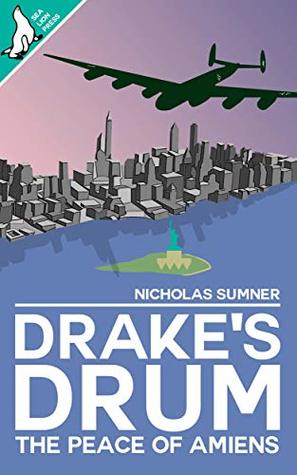
Drake’s Drum: The Peace Of Amiens

drakesdrumcover

A fresh Sea Lion Press Release and the first book in an intended series, Drake’s Drum: The Peace Of Amiens is classic “crunchy” alternate history. Starting with flaws in British naval shells being fixed in World War I and a more decisive British victory at Jutland, the “butterflies” spiral off until a bankrupt Britain throws in the towel in World War II, the Caucasus is overrun and the Soviet economy collapses, and the stage is set for a German-American confrontation (the cover depicts Amerika Bombers striking New York, with the book ending on a cliffhanger).

The book cuts between character vignettes and “pseduo-history”. I didn’t get the most out of the character scenes, as well intended as they were, save for one chilling scene depicting the Madagascar Plan in “action”. Thus like a lot of alternate history, it leans a lot on plausibility.

And here, it does better than many others. I’ll also admit to not being the biggest fan of this kind of genre, but this is how to do it right. First, there’s very clearly a lot of research being done, and it being done in a good way. Second, there’s a sense that a lot of it feels right. There are handwaves like the war outcomes and stumbles like my pet peeve of the pool of American political candidates being too small. But there’s more things that sound right and plausible, especially compared to other alternate histories.

For people who like detailed alternate history, The Peace of Amiens is a treat.


Review: Homecoming

Homecoming

homecomingcover

John Schettler’s Homecoming is two things. The first is yet another entry in a ridiculously long soap opera Axis of Time knockoff with a Kirov battlecruiser sent back in time to World War II. While it’s been stated that this book could serve as a standalone beginning and people didn’t need to read the previous 40 (!) books to get it, I still felt a little lost.

The second is a contemporary World War III and a glorified let’s play/after action report of Command: Modern Air/Naval Operations (think a stiffer version of The War That Never Was). When I read the battle scenes, there was this suspicious part of me that went “ok, these are so rote and so exact that it looks like he was simming them through Command or Harpoon or some other wargame.” And it turns out that he was.

I was happy because of all my work with and use of Command. No matter what my feelings are regarding the literary quality of such a work, I felt happy and kind of proud of it being used in such a fashion.

As for leaning so heavily on wargaming itself, well, I’ve kind of adopted a more “glass half-full” approach to it. In the past, I’d have probably denounced it dramatically along the lines of “why should I read about a wargame when I can play it?”. Now, in no small part thanks to my horizons being broadened by many other books, I’ve softened somewhat.

I still can and will criticize books (like this) for being too much like a rigid let’s play/after action report. I still feel using wargaming as an exactly transcribed play-by-play (ie, 10 A-6 Intruders escorted by eight F-14 Tomcats launched to bomb ________…) rather than just to get a general feel for the situation (ie, “how much of a threat is ______’s air force to a carrier air wing? What’s a good figure for how many aircraft I should have the protagonist carrier lose?), isn’t the best way to go if one is making a literary story.

But at the same time, I’ve gotten a renewed appreciation for wargaming in fiction, even in cases like this. What I feel it does is add at least some more plausibility than would be the case in a less-researched book. And it simply isn’t the case that moving the “technical plausibility and detail” slider forward causes the “literary quality” slider to automatically go backward.

Leaving the battles aside, one of the biggest issues with Homecoming is the pacing, especially in matters of conversation. Let me just say that it’s easy to see why the Kirov series had 40 books before this one. It’s a shame, because a series that involves a time-traveling battlecruiser and properly wargamed-out divergences holds a lot of promise. It’s just the execution leaves something to be desired.