Review: Skeleton Coast

Skeleton Coast

Arguably the very first “cheap thriller” I read was Fire Ice, in Clive Cussler’s NUMA Files. By this point (unbeknownst to me at the time), he had already entered his “Tom Clancy’s” phase, farming out a lot of spinoffs to different authors. One of my favorite and most enduring books of this time is Skeleton Coast.

The Oregon Files involves the titular super-ship disguised as a tramp freighter and its commander, Juan Cabrillo. Here it battles African rebels and a plot by an evil environmentalist to cause an environmental crisis (Trust me-do not expect the plots of Cussler books to make sense). There’s also the classic Cussler “Historical Flashback To The Present MacGuffin” scenes, which I was never the fondest of.

What makes Skeleton Coast succeed is its climactic battle. In many other books, the Oregon hasn’t really faced threats that are worthy of its armament and abilities. Here, it fights an army with all its firepower, and the result is very well done by cheap thriller standards. It feels a little more natural and a little less gimmicky than other Cussler books. For someone wanting to experience the huge “Cussler Franchise”, this book is one of the better entries.

Review: The Seventh Carrier

The Seventh Carrier

coverseventhcarrier

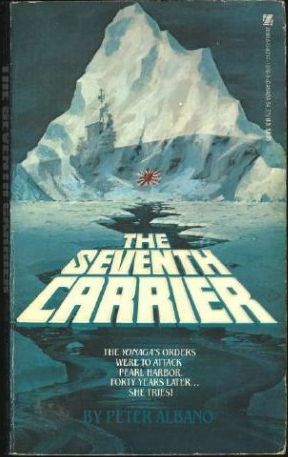
Peter Albano’s The Seventh Carrier is one of those novels that rivals even Lunnon-Wood’s Dark Rose for “most ridiculous premise yet”. In it, an American boat, and later a Coast Guard helicopter are attacked by something using World War II Japanese ammunition. There are rumors that it’s some kind of privateer using surplus weapons, but it’s not, as the survivors of the boat, held captive, can attest.

It’s the Yonaga, a fourth Yamato hull, turned into a carrier like Shinano. Kept hidden in a cove, it was frozen for forty years. According to the book it was because of a glacier rockslide, but I know a zombie sorceress froze it with her fimbulvter ice magic. They survived (not in suspended animation) by, among other things, tapping into geothermal steam power. Then they eventually attack Pearl Harbor anyway with their propeller planes and do better than they ought to. This is not the kind of book where thinking about how things in it would plausibly happen is encouraged.

The action is good, even if it’s somehow both a little kooky (guess why) and a little rote (a few too many exact descriptions of what the aircraft did). The characterization is not. To say that the portrayal of the Japanese is stereotypical is like saying that Manute Bol was a little tall, and the other characters aren’t much better.

It’s not the worst book ever, but like Dark Rose with its Libyan-Palestinian invasion of Ireland, The Seventh Carrier is better for the ridiculous novelty of the premise than the actual substance of the execution.

Review: Israel’s Next War

Israel’s Next War

Martin Archer’s Israel’s Next War was… strange. I’ve read my share of “boom boom goes the tank” war “thrillers” where there are what feels like five million characters (very few of whom are interesting) and five billion weapon descriptions (very few of which are relevant). Thus I was bracing for the book to be like that, and I was not wrong. But it goes a lot deeper than those surface issues.

First, there’s the action itself between Israel and an alliance of its traditional enemies, where I went “No. No. This isn’t how it would go” on many occasions. I guess I just can’t help myself, being the avid wargamer and historian that I’ve been. Something unrealistic, flawed, or not the most well researched isn’t a deal-breaker (far from it). But given the quality of the rest of the book, it went from eyebrow-raising to  head-shaking. Some of it is good, if a little rote. But more of it isn’t, and it all feels like Archer’s sources were:

  • A half-remembered History Channel piece on the Yom Kippur War.
  • Various “Modern Military Equipment” coffee table books.
  • Command And Conquer Generals.

The technology is all over the place, and the equipment is neither consistent nor particularly accurate. Combined with a dull non-war plot, this would feel like a ramshackle technothriller, if not for the final icing on the cake. That would be the writing style.

Archer writes the book in first person, constantly shuffling back and forth between first-person viewpoints with a label preceding their section. The nadir of this is a character named only “The Iraqi Lieutenant Colonel”, but the others aren’t much better. The prose alternates between the “BBGTT” classic of “Infodumps-R-Us” and something that’s surprisingly (and jarringly) “bouncy”, for lack of a better word. It clashes, to put it mildly.

For all those flaws, it’s not the absolute worst, either in plausibility or or in drama. But the “quirks” noted above push Israel’s Next War from being potentially bad and dull to bad and slightly weird. At least I had fun making this review.

Review: White Jacket

White Jacket

So, the time has come to review someone I probably didn’t think I’d be reviewing when I started the blog-Herman Melville and his naval book White-Jacket.

Now, I’ve used the term “Herman Melville for _______” to describe fiction that is overly descriptive at the expense of other things , ie “Team Yankee occasionally devolves into Herman Melville for tanks”. Thus, White Jacket is Herman Melville for Herman Melville. To be fair a lot of 19th century novels are like that, it’s just the writing style of the time, but Melville particularly stands out.

Even at the time, Melville didn’t think very highly of this book, viewing it as something done purely for the money. Even a century and a half apart, I can see the reasoning “Ok, I need a book done, I’ll just slightly fictionalize my experience in the US Navy and send it to the printers.”

White-Jacket, in spite of its clunkiness, manages to stand out for two reasons. The first is its historical value in the life of a 19th century sailor and the operations of the US Navy at the time. The second is that yes, it’s realistic. You want a truly realistic military story, something like this with modern technology is what you’re going to get. I’ve said only part-jokingly that a truly realistic military video game wouldn’t be ARMA , it’d be Desert Bus. This is why I’m not a stickler for realism in literature.

Review: Return of The Starfighter

Return Of the Starfighter

bef3cover

It says something about how crazy the Black Eagle Force series is when a book with the premise of a Chinese catamaran supercarrier leading a would-be invasion of the west coast prompted in part by the Federal Reserve’s loose monetary policy is one of the tamer and more grounded entries. And yet, that is how Return Of The Starfighter felt. The BEF fights alongside restored and upgraded Cold War aircraft (like the F-104) to battle the invasion fleet.

The Black Eagle Force series is kind of like the literary equivalent of the Postal 2 video game. It’s rather “dubious”, makes no sense,  always teeters on and sometimes crosses the line from “tasteless” to “offensive”, and isn’t the best set up, but the pure spectacle is what makes it enjoyable.

Lose the spectacle and the series loses its appeal, turning into a too clunky, too descriptive, too infodump-heavy technothriller. Return of The Starfighter, coming on the heels of Sacred Mountain’s goofy-crazy ridiculousness, tones it down ever so slightly and ends up looking a little like an avant-garde band’s attempt to play “normal” music. That some of the plot and battle elements are inevitably repeating by the third installment also doesn’t help.

It’s still over the top and still has its sense of wonder. This series, thankfully, isn’t devolving into later-Clancy levels of over-seriousness and pretentiousness by any means. But for a series that runs on crazy, going closer to mundanity takes away the greatest fun. Even if the mundanity comes in the form of a two-hulled mega-aircraft-carrier.

Review: The Red Collusion

The Red Collusion

redcollusioncover

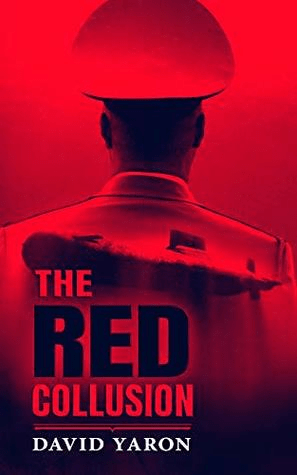
David Yaron’s The Red Collusion is a tale of rogue Soviets in 1981 attempting to start World War III, leading to a climax where they attempt to attack an American ballistic missile submarine.

This book is mostly pedestrian but has managed to surprise me in one regard-the sheer number of conference room scenes. The ratio of “people talking” scenes to “people actually doing something” scenes is very, very, high.

It’s realistic to have people talking and arguing about a big plan before they (attempt to) carry it out, but it’s also realistic to have cars stopped at red lights. Imagine a travel book where the author described every single red light, stop sign, and gas station the car stopped at, as well as every single argument the occupants of the car had about where to stop for gas or food. And then in the final action, there’s a time limit-so they urgently, reluctantly, and desperately stop at those traffic lights.

This is the technothriller version of that. Much of the book, apart from a few decently-written if generic spy fiction scenes, consists of the conspirators talking. It amounts to chapter after chapter of…

“Let’s do this.”

(cue long explanation of and preparations for what they want to do.)

“Actually, it would be better if we did this.”

(cue long explanation/plot thread)

“No, we should really do this.

(you get the idea).

Once they finally get going, the rushed “action” isn’t the worst, but isn’t exactly good either. This leaves the book as a strangely amusing novelty. The Red Collusion is saved from  simple mediocrity by taking a genre trope to ridiculous excess. I’ll leave it up to the readers to decide if it’s a good or bad thing.


Review: Sixth Fleet

Sixth Fleet

meadowssixthfleet

I look at the Sixth Fleet series by David Meadows. Looks like it could be to naval warfare in general what Tin Soldiers was to tanks and Raven One was to aviation. Then I look at the publication date-2001. I start to have a bad feeling. Still, I shouldn’t stereotype 2000s technothrillers, so I go ahead anyway. Then I read the book in full, and yipes.

It’s very much a 1990s technothriller at heart. Regional enemy (Libya) with a super-gimmick? Check. Hand-wringing over defense cuts? Check. COMPUTER DIGITAL WARFARE? Check. Even leaving all of that aside, the prose is just very, very clunky and any scene with a character who isn’t American is rather “dubious”.

Worse still is how the first book is meant as the opening act in a long series. This means the pacing goes from “bad” to “REALLY REALLY BAD”. I’ve seen better pacing in later Survivalist books than here, and instead of Ahern’s flights of fancy, there’s a generic “mustache twirlers with super-gimmicks” story with the usual technothriller viewpoint jumping.

I wanted to like Sixth Fleet but just couldn’t. The fundamentals are too iffy, the subject isn’t that conceptually interesting, and its pacing is just horrifically slow and uneven. In many way, it feels like the stereotypical late-1990s/2000s technothriller writ large.

Review: The Black Effect

The Black Effect

blackeffectcover

Harvey Black’s The Black Effect is the kind of book I thought I’d be reviewing en masse on this blog, at least in terms of basic plot. Namely, in 198_ World War III breaks out. Cue a lot of tanks exploding. This is the second book in Black’s _____ Effect series, and the first I reviewed at Sea Lion Press before this blog even started.

The Black Effect is what I feared Team Yankee would be before being pleasantly surprised.  It’s a mostly-conventional 198X WW3 book that happens to be a picture-perfect case for why a bowl of ingredients does not equal a meal.

Some of the individual ingredients (battle scenes) in the novel are good, if repetitive. Others are weighed down by things like Black constantly listing the full designations of every piece of equipment in overwhelming detail (fog of war? target fixation? Limited viewpoints? What are those?). But as a whole the book just amounts to a disorganized parade of various pieces of military equipment and graphene-thin Steel Panthers Characters differing only in what they’re crewing and how much ‘camera time’ that they get before being blown up.

There is an almost total lack of anything cohesive or coherent beyond “WW3 stuff happens”. It gets to the point where the intelligence photographers who were the high point of the previous installment turn into just another pace-breaking liability. This at least doesn’t have The Red Effect’s using up nearly all of its space on historical events with names badly changed (ie, Stanislav Petrov became “Perov”) before rushing to stuff a bunch of battles into the last thirty pages.

The Black Effect isn’t all bad. It’s more evenhanded than a lot of WWIII stories, it being written as an alternate history with decades of hindsight helps with some (but not all) technical accuracy issues, and it works at providing simple action scenes. It’s just I’ve read better, even in this very specific subgenre.

Review: Hunter-Killer

Hunter-Killer

hkcover

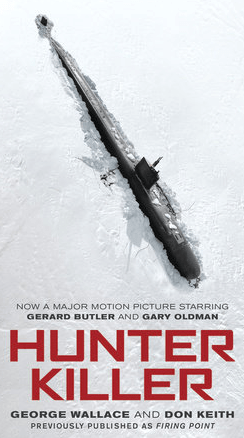
Before I start my review of Hunter-Killer (or its original title, Firing Point), the submarine thriller novel about the rogue commander of the Russian Northern Fleet and the American submarine out to stop him, I must mention that I have not seen the movie adaptation. What I’ve heard about said adaptation from other people ranges from “bad, but in an amusing way” to “bad, and not in an amusing way.” But I wouldn’t know any better.

So, for the book itself, what I got was something that was neither bad (amusing or not) nor really all that good. It was a sort of middle-of-the-road technothriller (this is not an insult) that was too bulky for its own good (there’s a big plotline barely related to the submarine stuff about Russian mobsters manipulating the stock market that only exists as a form of additional ‘crisis overload’) but still managed to avoid the clunkiness of say, a later Tom Clancy book.

The submarine action itself? Passable. The SEAL action? Passable. The characters? Ehh, a little less than passable. The book was published in 2012, but feels incredibly 1990s in its depiction of Russia, some of its technology, and its overall tone. That’s one of the few really interesting things about it, and it wouldn’t surprise me if it turned out that some of the drafts were written in that decade. Other than that, Hunter Killer/Firing Point is just a humdrum popcorn technothriller that unfortunately embraces length for length’s own sake. There’s a lot worse out there, but there’s also a lot better.

Review: Northern Fury H-Hour

Northern Fury H-Hour

(note: I received a review copy).

When I first got into Command: Modern Air/Naval Operations, I noticed a scenario set called Northern Fury, describing a third world war with a surviving USSR in the early 1990s. One of the first scenarios I played was one of the smaller ones there, called “A Cold And Lonely Place.”

Since then, I’ve been following the scenario set, and was delighted to hear that the novel had been announced. Having gotten a review copy and been cleared to post, I can say that H-Hour, the first book in the Northern Fury series, works well and dodges a lot of the pitfalls it could have fallen into. The August Coup has succeeded and the Third World War is not far off, with this story focusing not on Central Europe but in other theaters, particularly Norway and its waters.

First, it needs to be said: This book wears its technothriller heritage and inspiration on its sleeve, for better or worse. It has many of the prime technothriller elements in it. That being said, it handles them well, and in particular manages to escape-and escape completely- two pits that fiction like it tends to fall into.

The first is that it does not feel like just a rote let’s play/after action report of Command. Without giving too much away, focusing a lot on land makes it seem better, deeper, and out of the sim’s comfort zone, so to speak.

The second is more impressive and more important. Northern Fury manages to avoid what I call “Steel Panthers Characterization.” Named after how in the computer wargame “Steel Panthers”, units will have a rank and surname in the language of their nationality, Steel Panthers Characterization is when Character Name X controlling Military Weapon Y will appear in scene Z, with no characterization save for maybe a thrown-in national or rank stereotype. They will appear, operate the necessary piece of military equipment, and often die in the process. Then another flat character will appear.

In Northern Fury, this doesn’t happen. While there is a lot of viewpoint hopping, all the characters and their arcs have meat on their bones. This was an impressive feat that did a lot to raise my opinion of the book.

So, to briefly conclude, Northern Fury: H-Hour is both an excellent example of how a simulation can be used in the creation of a novel (like the original Harpoon tabletop version was for Red Storm Rising) and a very good throwback to the technothriller/WWIII fiction of days past.

Northern Fury: H-Hour releases on May 6. Its official website is here