The Amphibious Hook

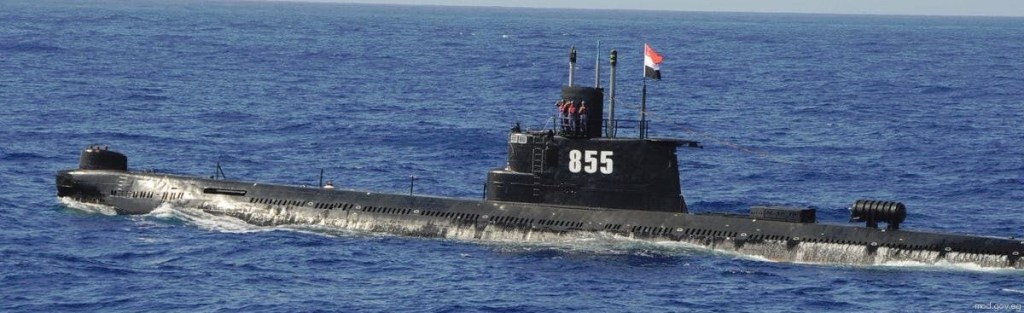
The Amphibious Hook is a type of theoretical maneuver that allows for a naval support of a land offensive. It is either an operational or tactical offensive, with the Heavy OPFOR Operational noting that such ones would never be done outside of extensive air support. The document also argues that it generally would take the form of an amphibious regiment/brigade in the first wave and then normal mechanized troops unloading on the shore after the beach was cleared to continue the push. But of course, depending on shipping, it could easily be more.

(Brief note: Strategic amphibious operations are D-Day and even Inchon. Tactical ones are things like doing a boat raid. Operational ones are, fitting that level, more vague and mean things like ‘land a big enough force to divert their reserves so that the main land push can run more freely’).

The section on amphibious landings (Heavy OPFOR Operational sec. 2-13 to 2-15) also speaks of naval units being an easy way to reinforce airborne ones, assuming the geography works. There’s also, as happened in the Gulf War, the threat of an amphibious hook.

Ironically, one of the best ways for a defender to counter an amphibious hook is to ignore it. Or if not ignore it, recognize that it’s going to have trouble moving inland and can be contained with second-line forces and not divert too much to stop it, leaving the opponent with a small toehold always at risk of being cut off.
A Thousand Words: Big Fight

Big Fight: Big Trouble in the Atlantic Ocean

On one hand, the 1992 arcade brawler Big Fight can be viewed as nothing but a mechanically bland copycat of Final Fight and the like. While this is true, it’s also very hard to deny that the game is also a very weird and bizarre eccentric game with a premise that could have been written by Jon Land, graphics that fit said style perfectly, and translation terrible even by the standards of the day that weirdly adds to the charm.

See, the entire game takes place on a cruise ship/battleship/supervillain base called the “SKELETON CREW”. There are three protagonists with designs that aren’t anything to write home about the standard fast/strong/balanced differences. The normal enemies likewise are standard fare… but then come the bosses. They not only include a sumo-kabuki and an ancient Egyptian mummy-wizard, but the big twist is that after each defeat, everyone except the final boss becomes a playable character.

Every one has the same dialogue, repeated here verbatim: “[boss]: ‘Now I came to my sense. Can you take me into partnership? [character who beat the boss]: Sure.”

It’s not explained if they were mind controlled or whatever, but yeah. The sprites and backgrounds are not ‘good’ in terms of pure detail, but they’re bright and do exactly what they need to do. The ship has a variety of zoos, gardens, gyms, and the like to rival Spaceball One.

Is this a good game to actually play? No better than other ones of its time. Is it fun to look at? Oh yeah.

Review: The Nordkapp Affair

Northern Fury: The Nordkapp Affair

(note: I got permission to read this book pre-release for the sake of a review).

This fairly short novella to the Northern Fury epic is a side story about a Norwegian ferry at the beginning of the war. It has to try and evacuate people from what could become a warzone (spoiler alert: It does). While a simple plot, it’s a very suitable one.

One thing I particularly liked was keeping the “camera” focused entirely on the ship itself and a running tally of its status. Whereas a lot of “Big War Thrillers” understandably show the big war, something as focused as this is a lot different.

Which is a good thing, as there’s something to be said for an HMS Ulysses type story. Which I mean both in terms of tone/structure and in terms of location-an excellent place for a war novel.

The Cosmic Angels

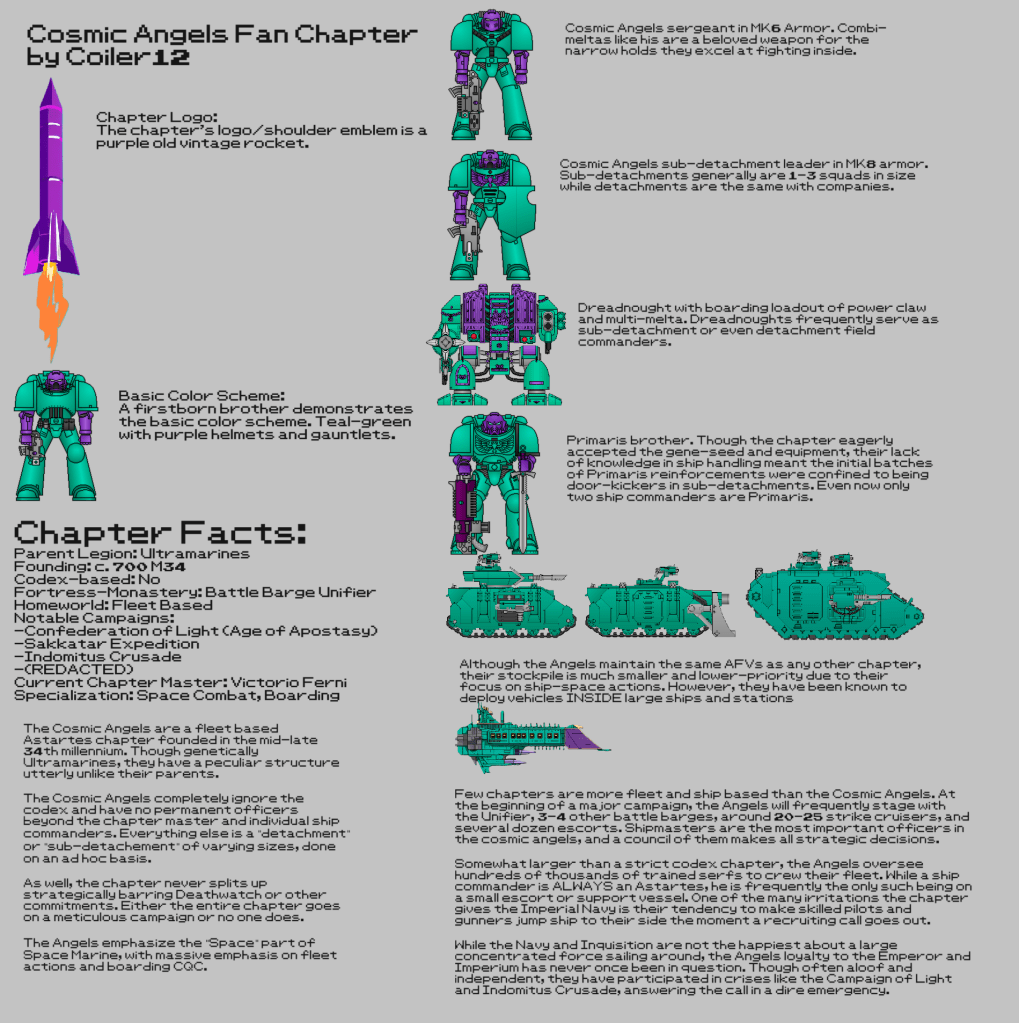
When it comes to Warhammer 40k, I do not have the highest opinion of or interest in the setting’s mascots. I’ve been an Imperial Guard fanatic (no not that kind) since day one of my interest in the setting, and this also applies to their spacefaring counterparts in their humongous flying cathedrals. However, I have made several fan Space Marine chapters (as every 40k fan is obligated to do), and the one with the most detail is the Cosmic Angels. With the aid of Stable Diffusion and some online “marine coloring tools” I made this infographic on them.

(And yes, it is definitely, totally a coincidence that my interest in Starmada and constant setting crossover battles coincides with me elevating an extreme fleet based chapter. Totally. A. Coincidence.)

Weird Wargaming: The SW40k Project

I’m delighted to announce the initial release of a Starmada project of mine: The Star Wars vs. 40k fleet lists. Based on the fanfic, it aims to bring the battles from said fic to the generalist wargame. So far initial Imperial Navy and Republic fleets have been made. More, including Astartes, Separatists, and whatever else my brain thinks up, is planned.

Notes:

  • Ships are judged based on absolute and not relative size. This means the 40k ships are usually gigantic with the HP to match.
  • The Republic is a swarm fleet whose ships are almost always pound for pound inferior, just like in the fic itself.

Weird Wargaming: The Realistic Space Warship

In the late 1970s, the BDM Corporation did a study for what a plausible space warship could look like (thanks to the invaluable Atomic Rockets for its analysis).

It has a spin-gravity crew quarters, is powered by nuclear reactors, and its armament consists of a laser in a de facto turret, a forward facing railgun, and a rear-facing particle beam (because the radioactive particles can’t risk hitting the ship).

The Space Shuttle in the picture is for scale-the whole thing is about two hundred meters long!

What’s In A Space Warship Name

(That I’m interested in this topic just as I’ve gotten into Starmada is just a coincidence, I swear.)

Atomic Rockets is a great site for semi-realistic spacecraft design. However, one of their contributors was adamant about not transplanting ship names wholesale from maritime ones, as has happened many times before. Is this a sensible avoidance of tropes or just hipsterism for the sake of being different?

I feel it depends on the setting and tone. IE Warhammer 40k and its broadside space cathedrals and obvious Age of Sail symbolism can adopt naval terminology just fine. But there are understandable reasons to avoid the ‘superdreadnought’.

Names I think could make the cut:

  • Battleship. Pretty self-explanatory.
  • Carrier for anything carrying smaller craft. Also pretty self-explanatory.
  • Gunship/gunboat. I think this has already passed one test in that plenty of real aircraft are called gunships, and an added bonus of being a good literal description for many designs. (IE, big weapon on a spinal mount the rest of the ship is built around).

Cruiser, Destroyer, and Frigate are already a mess and have been for decades if not longer. These smaller ships are probably the best to make up your own terminology for (ie “Dragonship”).

Weird Wargaming AAR: Starmada Star Wars/40k

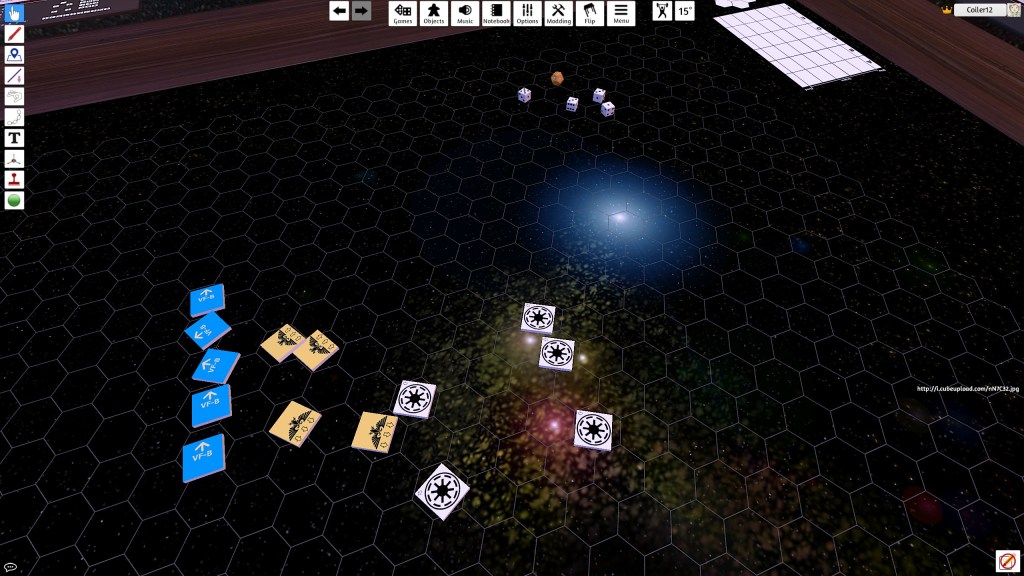
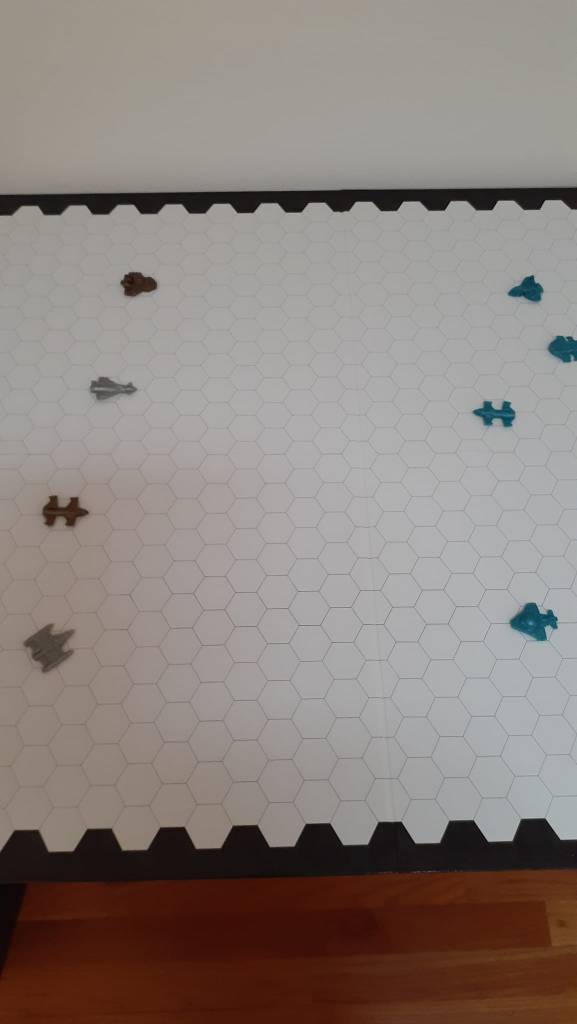
So inspired by the Star Wars vs. Warhammer 40k web serial, I made crossover fleet lists for Starmada. Then using Tabletop Simulator for a convenient hex map and making some quick counters in its editor, I ran a small fleet engagement of four Imperial frigates vs. five Republic ones.

The fleet lists are still subject to major revision but suffice to say the Star Wars side is about accuracy and fighters and the 40k one about brute power and durability. In this case brute force won out as the Imperium destroyed four Republic vessels for the loss of only one of their own.