Craig Kaston and George Cox’s two volume series on American airlifters is one of the main reasons for the recent fascination I’ve had with these cargo-bearing beasts. Like a lot of books in the series, both are excellent. However, one of the volumes outshines the other, though through no fault of the authors.
The first volume is well-written and illustrated, but it describes a time period where, for the most part, it’s just variations on big-bellied freighter aircraft. The second volume has a lot of those too, but also has weird shapes, VTOLS, napkin company projects that make Mukhamedov and Stavatti look like Boeing and Airbus, and so much more.
If you have to get one book, get the post-1961 volume. But both are well worthy of any aviation history enthusiast’s bookshelf. Fair warning-you may twist your brain into a pretzel trying to estimate just what some of these oddballs can and can’t transport. It’s what I’ve been doing a lot, and I have no regrets.
The NTC special text dubbed “The Iraqi Army: Organization and Tactics” is a valiant attempt at quickly trying to adapt to a different enemy. While the Iraqis used lots of Soviet equipment, their actual doctrine was more British-based on paper and often varied from both (usually for the worse). Just all on its own, it’s a fairly conventional and standard OPFOR document. But I find the context incredibly fascinating.
Like in Lester Grau’s much later The Russian Way of War, a tightrope had to be walked between the observed performance and the theoretical doctrine. Given the latter country’s vast paper trail and its known obsession with quantifying everything, separating the two was/is an easy task. As is/was noticing when theory inevitably diverged from practice, from Grozny to Hostomel.
Here, not so much. The Iraqi Army was notoriously slapdash, so the challenge was even greater. One example I like is that an Iraq War wargame supplement even told the player not to try and use any kind of standardized formation for them at all (!). On the more important doctrine, it acknowledges the flaws shown in the war with Iran, but cautiously and wisely goes with what can be paraphrased as “This may have been an aberration, treat them as a mechanized force worthy of their equipment”. That in many cases they turned out not to be showed the importance of assuming strength rather than weakness.
As a primary source, this is a very interesting snapshot. Plus it’s in the public domain and available readily now.
American Secret Projects: Bombers, Attack, and Anti-Submarine Aircraft
One of the American Secret Projects series, this book looks at air-to-surface planes from the end of World War II to Vietnam. Covering everything from mammoth strategic bombers to light propeller planes, it’s an ideal aviation niche history book. With lots of illustrations, the obscure become visible.
With this book you can see all the bizarre and erratic 1950s designs. You can see how the AX project that became the A-10 started off as just a rich man’s Skyraider. This is an excellent book for any aviation enthusiast.
So, the long-feared Russian all-out invasion of Ukraine has begun. I kind of suspected this would happen when A: 75% of the Russian Army, including units from Eastern Siberia, was moved to the border, and B: The Kremlin began making knowingly impossible demands. Frankly, knowing what I know now, it’s kind of miraculous that it took thirty years to get this far.
(And no, Ukraine couldn’t have kept its for all intents and purposes unusable nukes it technically inherited, and it still did the right thing in not trying.)
Fuldapocalypse will continue as normal, as fiction is not real life. I will refrain on commentary as even the well-informed and honest accounts can be subject to confusion. However, I will say that when it became clear that war was inevitable, I made the very deliberate decision to pivot away from my Soviet-Romanian “big war thriller”, and not just because of the general concept or even the area. Having a massive, high-tech, Russian-led army striking against a former client whose only effective resistance is urban and unconventional warfare is a little too on the nose-in fact, the scenario is so similar that you could basically do a find and replace for “Belarus” and “Bulgaria” and change nothing else.
Thankfully, I do have some very good news. The pivot away from that concept to a follow-up thriller involving gambling, mansions, nuclear weapons, and dirty black ops in Southeast Asia with aged characters from The Sure Bet King has gone beautifully. The plot for that has finally clicked, and I’ve been making excellent progress there.
Norman Friedman turns his knowledgeable eye to one of the most arbitrary ship classes in British Cruisers. Going from the early 20th Century to the Cold War, he covers the enigmatic ship type that can best be summed up as “bigger than a contemporary destroyer, but not too big”. From wartime workhorses to unusual goofy designs, Friedman leaves few Royal Navy stones unturned.
The final desperate attempts at large capital ships after 1945 are the most interesting to me. The large “escort cruisers” started off as ASW helicopter ships, then grew into the famed de facto light carriers they became and were later used as. Everything else was rightly shelved. But this is a typically excellent technical history of cruisers in all eras.
Minnesota is home to a very strange demographic: Just as how North Carolina has an unusually large number of basketball colleges, the Land of Ten Thousand Lakes has an unusually large number of “romantic” scandals involving female politicians. And they have ranged from the most powerful (state Senate Majority Leader Amy Koch, forced out after a relationship with a subordinate), to the most embarassing (State Rep Tara Mack, literally caught in the act with another legislator), to the absolute most bizarre.
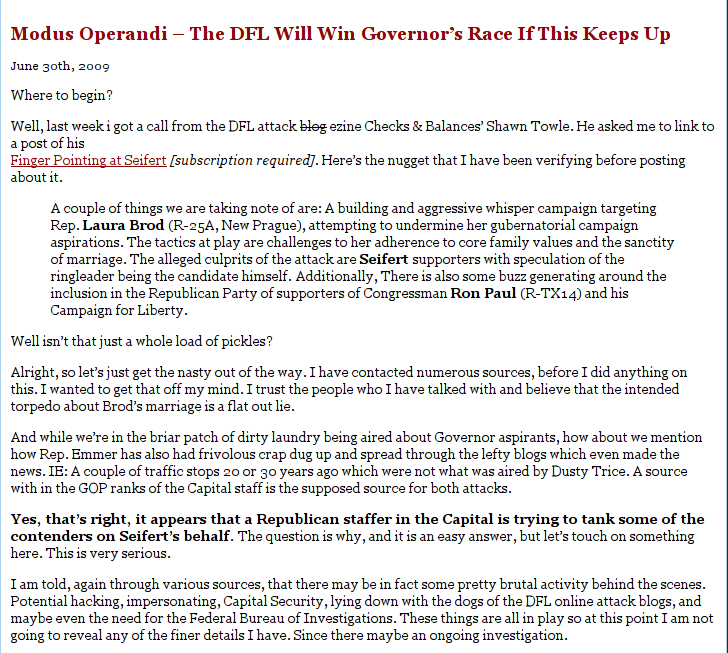
Even after nine tumultuous years, I still haven’t seen a political scandal as utterly bizarre as the Laura Brod one. And it’s not about anything she did or was accused of doing (consensual affair and posing for an ill-considered photo). It’s about how it unfolded.
Much of the stuff is only accessible via archives, but as far as I can tell, this is how I’ve read it went down. In August 2008, State Rep. Laura Brod had an affair and posed for a naughty photo. In 2009, when she was expected to run for governor, a ton of internet gossip and drama went out (but no real concrete evidence). There was legal action involving her and a “John Doe”. Brod bailed out of her expected campaign for governor for “health reasons”, and then did not run for reelection in 2010.
Hacking, impersonating, yikes!
In 2011, she was appointed to the University of Minnesota Board of Regents. Around the same time, the Koch/Michael Brodkorb scandal broke, and Brodkorb sued for gender discrimination, alleging that women who slept with male superiors weren’t punished the way he was. A list of his allegations against specific people mysteriously and briefly ended up online, in what was largely regarded as a deliberate mudsling.
In July 2013, out of nowhere, a single-use Tumblr appeared with the Brod photo and the words “This is a picture of University of Minnesota Regent and former State Rep. Laura Brod. A thousand words describe this picture and the story behind it.” But those ‘thousand words’ did not appear (until now, arguably). The now-defunct City Pages ran a series of articles about the Brod photo, talking about its supposed political importance, and eventually going into the details of when the picture was taken and that Brod had spent campaign money on legal fees afterwards. They did not mention or even really speculate on anything like who the photographer/”other man” was, if the relationship brought about any conflict of interest, or anything that would make it a legitimate scandal and not just a tawdry swipe at someone no longer in office.
The result was that everyone expressed sympathy for Brod, and rightfully so. Everyone from her divorcing husband to people who called themselves staunch political opponents spoke on her behalf. The articles about the photo trailed off, no real news about investigative results emerged, and everyone moved on. Laura Brod later remarried and had a successful life outside of government.
The strange thing is the slow drip nature of it, which, combined with the lack of actually identifying or speculating, has made me wonder if that meant the people releasing it were covering for the photographer/”other man”.
Of course, that was a little long ago, but Minnesota couldn’t resist keeping the “streak” going. State GOP Chair Jennifer Carnahan was forced out amid a trafficking (!) scandal, and drunkenly stated that she didn’t care about her ill congressman husband because he’d “soon be dead”. Then came the retaliatory gossip on the internet alleging that she had multiple abortions.
Meanwhile, New York political scandals tend to be boring. Then again, we never elected a pro wrestler as governor…
McNamara’s Folly: The Use Of Low-IQ Troops in the Vietnam War
Involving applicants and draftees who would previously have been rejected, Project 100,000 was one of the least-covered but most horrendous parts of the Vietnam War. Hamilton Gregory, who served along multiple “entrants”, writes one of the most scathing and personally touching history books in McNamara’s Folly. I say “personal” because I have some mental conditions, and growing up, went to school with others with traits very similar to those described in the book. To send these people into battle, whatever one thinks of the Vietnam War as a whole, feels particularly wrong-as did the theory that military service would make them better.
Project 100,000 was done mostly to avoid tapping into a National Guard/reserve force that came from a wealthier and more politically sensitive background (only around a hundred National Guardsmen were killed in action in the whole war). Its recruits were killed in action at a rate three times greater that of serving soldiers as a whole. Officers of all ranks hated the program, and their reactions ranged from trying to steer the “Moron Corps” (or less nice terms) people into the least dangerous areas to having them be the point man on patrols because of perceived expendability. Gregory is clear to point out that he could not find any confirmed cases of Project 100,000 recruits being deliberately executed by their compatriots to prevent their ineptitude from resulting in more deaths, but the constant rumors are telling.
Weaving personal experiences (such as one particularly chilling story of a fellow recruit who didn’t even know that the Vietnam War was happening when he entered boot camp) with scholarly research, this is an excellent recounting of a project that benefited no one, save for maybe the North Vietnamese.
Likely because it’s lacked the direct confrontation with a major western power that North Korea or Middle Eastern states have had, Myanmar is one of the more forgotten and undercovered of the militarized pariah states. That military dictatorships are not exactly known for their openness and transparency doesn’t help things. Thankfully, Maung Auyng Myoe has risen to the challenge with Building The Tatmadaw.
The often murky and convoluted history of the military, as well as the brutal but often underreported internal wars, is shown in depth. As is the Tatmadaw’s force structure and conventional paper doctrine. For the former, it follows (at least as of the writing of the book) a common in Southeast Asia pattern of having “regional forces” tied to a certain area and mobile reaction forces (known here as “light infantry divisions”) that can travel where needed. Regarding the latter, Myoe’s description comes across as basically a Light OPFOR right out of Central Casting. The picture is that of an infantry-heavy force where advanced and heavy equipment is present but not dominant, and where the strategy against an external opponent consists of fortifications and irregular tactics to counter the material disadvantage.
Published in 2009, this is bound to be outdated, especially given the massive tumult that has happened since then (the “thaw”, the anti-Rohingya campaign, and the military re-takeover). But as always, that’s not the author’s fault. I did notice a few slip-ups and a bit of clunkiness when talking about specific military issues, but none of those are very big or bad. If you want to learn about the Tatmadaw, this book is an excellent resource.
A book devoted to German aircraft carriers could have all the pages be blank and still be technically accurate. After all, the decision to not go ahead with them was one of the very, very few good ones the country made in World War II. But Simon Beerbaum’s work on them manages to show an excellent train of thought. For most of the actual writing and layout quality, what I said about the Russian carriers book applies just as well to this. What’s interesting is the content.
You might think that a compilation of never-built German designs would have a lot of weird ones as gargantuan as they were impractical. And you would be right. But there was a method to the madness of several. Intended as commerce interdictors, the carrier designs mostly had substantially large gun armament but smaller airwings. They resembled a pre-missile version of the Kiev “air carrying cruisers” in that regard. The book also covers postwar helicopter/VSTOL designs proposed by shipyards for export customers. It’s an interesting look at an interesting set of designs.
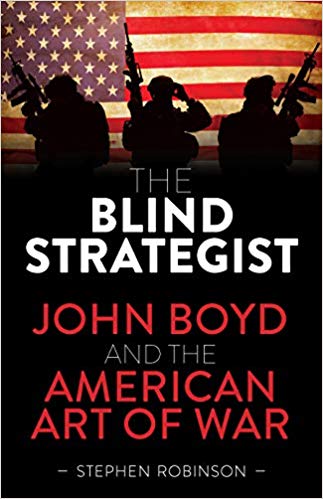
I’ve wanted a book that dove deep into the excesses of supporters of so-called “maneuver warfare”. In Stephen Robinson’s Blind Strategist, I finally have it. How is it? Mixed. Thankfully, it’s the kind of mixed that makes for a good review.
The book is nominally aimed at John “OODA Loop” Boyd. However Boyd, due to his aversion to writing anything down, his own constantly shifting imagination, and his uh, “difficult personality”, is hard to pin anything on. I do not think it’s a coincidence that Boyd’s teachings are excellent in general terms but almost never work for anything specific.
Blind Strategist spends most of its pages slamming Basil Liddell-Hart and William Lind, who did not have an aversion to writing anything down. It also talks of the Wehrmacht Legend that drove maneuver warfare activism, and defends the oft-criticized William DePuy and his “Active Defense”. (I agree with almost all of the substantial criticisms of Active Defense, but think that in the mid-1970s, the post-Vietnam US Army needed to walk before it could run). Finally, it tries to hold maneuver warfare responsible for the Iraq War’s struggles. Even I think this is going too far, and it doesn’t exactly sound convincing.
Even in its main thesis, this comes across as being overly nitpicky and a little straw-mannish. I do not believe that even almost all of the most devoted maneuver practitioners would deny that there comes a point where you have to close and destroy. Note that I said “almost all”…
…Because Lind is one of those obsessives. And here, weirdly, Robinson arguably doesn’t go far enough. Blind Strategist neglects Victoria, a fantasy where indeed, just doing the right principles and following the right footwork causes the Mary Sue’s enemy to collapse totally without the need for a slugfest. It rightly talks about him trying to shove “third-gen” maneuver war into “fourth-gen” unconventional war, but doesn’t elaborate (and should) on just how he jumps right back to his third-gen map exercises at the slightest opportunity.
I feared this book would go a little too far in the opposite direction, and it does. But I can understand, given the maneuverist min-maxing, why it would do so. I don’t blame Robinson, and if there is room for extreme pro-“maneuver” arguments, there’s also room for extreme reactions.