Review: Women At War

Women At War

Edited by Elspeth Ritchie, Women at War is a collection of academic essays about the massive expansion of women in the US military through the years of war in the 21st century.

Now there’s a few things I’d like to say about the controversial topic of women in the military. The first is that in the “yes or no” arguments, my armchair opinion is “we don’t really have a choice”. As the current crunch shows, topping up a big volunteer military is tough already. There simply are not 200,000 ready gigachads who would join the military instead. The second is that I hate the term “combat roles” to refer to the controversy of infantry/armor/etc…, because it implies a false dichotomy between never intended to be in harms way and full inclusion in fields where you could raise legit objections. The third is that the worst thing that could happen to women in the military (or minorities in any field, basically) is the kind of identity-politics obsessed person who thinks that any disproportionately small amount of _____ in _____ must be due entirely to the Bias of the System.

Anyway, this actual book is a mixed bag. There are a lot of understandably dry but very thorough and cited articles on various effects that are done with proper hard-science rigor. Then there’s the fluffy pretentious ones that feel very out of place. Like I understand getting figures on how many women have been “naughty” on overseas deployments is going to be hard, but you could at least try instead of engaging in theorizing that ranges from the obvious to the silly. And that at least you can justify the theoretical with the difficulty in getting solid figures. There are other topics where instead of examining say, how the cultural differences in another country make the incorporation of women into the military better or worse, the writer just gives out marshmallow talc.

Stuff like this is why I just can’t recommend the book fully, even though it has many excellent articles and resources. Then again, that and its high price is just the nature of academic publishing. Of course, the other side of the coin is that you can get lots of relevant facts, figures, and stories about the topic, which is also the nature of academic publishing. So its your call.
Review: Stealing the Atom Bomb

Stealing The Atom Bomb: How Deception and Denial Armed Israel:

I want to say that Roger Mattson’s Stealing the Atom Bomb does the story of a critical and underreported part of nuclear history justice. In the mid-1960s, Israeli agents swiped enough highly enriched uranium to make multiple first-generation warheads from an enrichment plant in Pennsylvania. As the subject matter is incredibly secret, Mattson had to wade through a massive jungle to find out more. To his credit, the book is well-researched and detailed.

The problem is that so much of the book is about how the investigations went. That could be interesting in and of itself, but it’s told in such a stilted, dry way. So I regretfully have to say that what could have been a great resource has become a niche topic for nuclear weapons historians.

Review: Freezing Cold Takes

Freezing Cold Takes: Football Media’s Most Inaccurate Predictions and the Fascinating Stories Behind Them

With both the college and pro football seasons having started, it’s time to look at Fred Segal’s Freezing Cold Takes, a compilation of football media predictions that ended up being extremely wrong as well as the context surrounding them. It’s not the deepest book, but it’s certainly deeper than the fired-off hot takes concerning sports that long predate the internet.

As a fun bit of NFL history, this book is worth a read. You’ll laugh and you just might learn something. While it shouldn’t be the last word, its good as a first one.

Review: The Show That Never Ends

The Show That Never Ends

Political reporter (but the book is thankfully almost without mention to contemporary politics) David Weigel wrote The Show That Never Ends, a story of the heyday of progressive rock in the 1970s. It’s an interesting book. But it’s not a perfect one.

Weigel succeeds at putting prog rock, a genre many are embarassed to like (I’m not) into perspective. Its underappreciated just how big it was in its time due to the “punk not disco effect”, where films and shows set in the past will emphasize what was “cool” instead of what people actually listened to. Jethro Tull could make two silly concept albums and both were hugely successful.

The problem is that the book comes across as aimless and meandering. It has width at the expense of cohesion-much like prog rock itself. While not for everyone, music fans will enjoy this for what it is.

Review: Inheriting the Bomb

Inheriting The Bomb: The Collapse of the USSR and the Nuclear Disarmament of Ukraine

I’ve looked forward to few nonfiction books as much as I anticipated reading Marina Budjeryn’s Inheriting The Bomb, about how nuclear weapons were removed from Ukraine after the USSR’s breakup (the word choice is deliberate). I was not disappointed. This is an amazing book that can for all intents and purposes clear up the “could Ukraine have kept its nukes” confusion.

I’ve already posted about WMDs and the non-Russian SSRs. Short answer is “They never had control or the necessary pieces to maintain the arsenal of nuclear weapons on their territory, but they nonetheless had the raw technical ability to make an arsenal”. Raw technical ability but little else. Budjeryn doesn’t go into that much detail on counterfactuals (though she does wisely defer to credible experts in that regard and cites them).

She does go into lots and lots of detail on the political twists and turns and not just for Ukraine itself. Yet it was far more reticent than Belarus or Kazakhstan were and viewed itself as a legitimate holder of the weapons. Factors from the fact that Russia was threatening Ukraine almost literally from day one (and by Yeltsin officials and not Zhirinovsky-ist fireeaters) to the desire to preserve jobs in the giant Dnepropetrovsk missile plant are mentioned. This is a great, indispensable book about a very important topic, and I cannot recommend it enough.

Review: Aircraft Projects of the Commonwealth Aircraft Corporation

Aircraft Projects of the Commonwealth Aircraft Corporation

I’m a sucker for big historical reference books, so I got Aircraft Projects of the Commonwealth Aircraft Corporation, a detailed look at Australia’s aviation company from WWII to its buyout postwar. Everything from the semi-improvised military aircraft of the war to their license-built airplanes designed by other firms (ie Sabres and Mirages) to their ambitious designs is covered.

The last segment includes some pretty crazy things like a trainer/low-end ground attacker that’s swing-winged and an interceptor powered by four very small engines. The latter is a good example of how much the designs had to fit the parts rather than the other way around. This book is a well written, well-laid out treat and I highly recommend it.

The Cluster Debate

So the Americans have provided cluster weapons to Ukraine. Unsurprisingly, the internet debates around them have not been the most fruitful or productive. The consistent opponents are one thing in that I find their arguments as flawed as they are understandable. Yes, it’s perfectly fine to be concerned about unexploded ordnance and collateral damage-as if there wasn’t plenty of that already, most of it caused by…. someone other than Ukraine.

But the more interesting thing to me has been the talk, largely from OSINT accounts, of treating clusters as an unstoppable superweapon. Between this and the Bayraktar TB2 slobbering of days past, it’s as big a sign as Michael Jordan’s baseball career that excellent talent in one area doesn’t equal having it in another. Anyway,

  • Concern about unexploded bomblets, and not just for collateral reasons, is valid.
  • Clusters are situational and even in the past before “normal” shells got better designed, had many situations where they were worse. They also had some where they were better.
  • Cluster shells will still be extremely useful, if only because they’re a fresh source of things that things that go boom.

Review: North Korea’s Hidden Assets

North Korea’s Hidden Assets

H. John Poole returns to Fuldapocalypse with North Korea’s Hidden Assets, a warning about how North Korea may be stronger than anticipated. Or rather, that’s a central message in a meandering book. The content here ranges from loooong descriptions of Iwo Jima fortifications (because as a country occupied by Japan, they were undeniably influenced by its doctrine. Legit link, but not worth the obsession he shows) to constant tirades against the clunky, idiotic American doctrine and how the North Koreans have so much better military culture and small unit tactics.

Some of the book’s arguments are good. Poole spends a lot of time legitimately arguing against mirror-imaging a Second Korean War as being a repeat of the mechanized charge to take the entire peninsula that was the first. He argues and reasonably so that the north would be more likely to bite, hold, and wear the Americans and southerners down to win at the peace table. And the fortifications and tactics from the first Korean War are at least more relevant. So are the surprisingly few times he looks at contemporary North Korea (the nominal point of the whole thing)

But this book is mostly axe-grinding. It’s also hypocritical in that Poole portrays it as some kind of secret hidden source when almost all of its analysis comes from official US government documents-showing at least someone else already there knows of a worst-case perspective on North Korea. There are much better serious studies of that opponent out there.

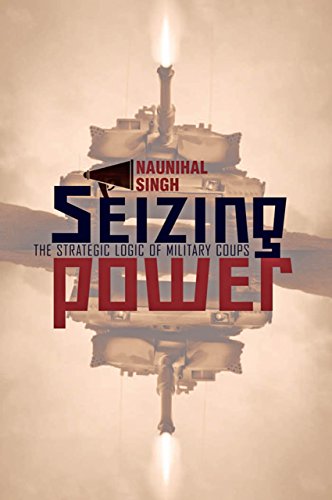
Review: Seizing Power

Seizing Power

Naunihal Singh’s Seizing Power is a book about military coups and how they work. The timing of this review is a complete coincidence and has no bearing on recent events whatsoever. Anyway, Singh studies the basic three types of coups and makes an academic argument that they are in essence, “coordination games”-that is to say they have to give the appearance of inevitability instead of actual hard power (in most cases.)

Singh divides coups into three categories. The first is coups from the top, like say, the central party committee imprisoning the president and attempting to seize control. The second is coups from the middle, like say, a division-sized force dashing from its base on the border to the capital and hoping the rest of the army can join it. The third is coups from the bottom, like say, rioters in support of a parliament with no army on its own trying to sway the military and take vital television stations. (Yes, all three examples happened in Russia/The USSR. They were the 1991 August Coup, the recent Wagner uprising, and the 1993 constitutional crisis).

Singh spends most of his time covering all three types of coups that happened in Ghana in its history, and then ends with the August Coup of 1991, a coup from the top that should have effortlessly succeeded but in fact failed miserably. Like most academic histories, it gets a little too pendantic at times. But it’s still a great read.

A Thousand Words: Dave’s Redistricting

Dave’s Redistricting

One of my internet hobbies has been using the Dave’s Redistricting site. It allows you to draw up hypothetical legislative districts and see their demographics. I’m currently using it to make hypothetical seats for a vastly expanded US House of Representatives. It’s both fun and illuminating to see how you have to balance various challenges.

It’s very illustrative of showing how it’s actually harder to make “fair” districts than you might think. You can get a nice sensitive block of counties-that are safe seats. Or you can take half of those counties, balance it with half of a large city, and then you can make an evenly bipartisan district-but how “representative” really is an obvious artificial creation like that?

If you like politics in any form, you have to check this out. It’s simple, easy, and is great for both counterfactuals and actual debate.