Review: Luxury Fleet

Luxury Fleet

Professor Holger Herwig’s Luxury Fleet is the single best book on the Imperial German navy that I’ve read. It manages to be both detailed and fun, going into political squabbles and technical details while remaining easy to read. Reading it really gets you a feel for the “Luxury Fleet”, or “Tirpitz’s Folly”.

It’s great to read this alongside Andrew Gordon’s The Rules of the Game, an equally effective study of its adversary. But if you’re into naval history at all, this is well worth a purchase on its own.

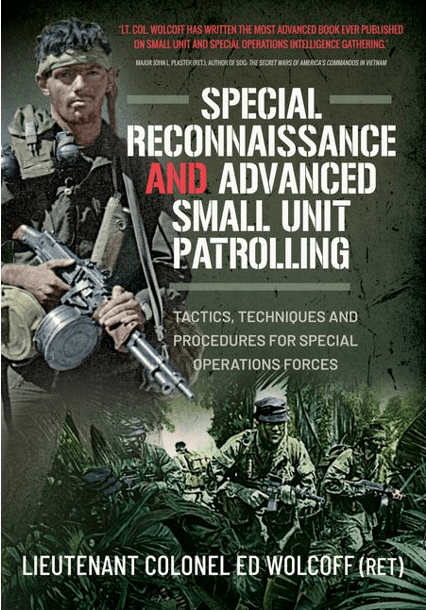
Review: Special Reconnaissance and Advanced Small Unit Patrolling

Special Forces (specifically MACV-SOG) veteran Edward Wolcoff has created a masterpiece in Special Reconnaissance and Advanced Small Unit Patrolling. Despite the long and clunky title, the book itself is very accessible. The goal was to create a list of tactics, techniques, and procedures determined by both theory and practice. It was also to present them in a way that was easily accessible and not written in field manualese (indeed, taking issue with official doctrine is stated in the introduction as a big motivation for the entire book). Wolcoff succeeds admirably in both parts.

This is not just for people who actually do light infantry patrols. Even armchair writers like me will find it very useful for both research and curiosity. Few stones are left unturned. This aims to be comprehensive and it succeeds. It does arguably focus a little too much on the past, but given the author’s Vietnam service, this is quite understandable. While “tone” isn’t the most relevant for a book like this, I enjoy how this comes across as being critical of official doctrine and often greatly so, but not in a bitter or axe-grinding way (Wolcoff has said that he submitted this book to a security review and cooperated with the Pentagon in its publication, FWIW).

What I particularly like is how Wolcoff makes it very clear that failure is as big a teacher (if not more) as success. Survivorship bias can skew things massively, so it’s important to look at what didn’t work as well as what did. This is a great resource for well, anyone, and well worth a purchase.

Review: The Eleven Days of Christmas

The Eleven Days of Christmas

For Christmas, I feel like I should review a Christmas book. A Christmas book that’s also a Fuldapocalyptic history book is Marshall Michel’s The Eleven Days of Christmas, about the final significant bombing campaign in the Vietnam War. Michel, himself an aviator veteran of the war, left no stone unturned to try and get the full story. To try and find the truth about Linebacker II, he went not only to American sources, but as many North Vietnamese ones as he could access, and even esoteric ones like the memoirs of Joan Baez (who was in Hanoi at the time).

The result is a masterpiece that illustrates Strategic Air Command as this clunky newbie that had sat out the war and then blundered into it. And also spun its clumsy, ineffective performance into a great victory. This is perhaps the biggest unintentional weakness of the book: The claim that Linebacker II was mixed at best and ineffective at worst is a lot less controversial now than it was at the time he wrote it.

Still, anyone interested in the Vietnam air war has to get this book. Merry Christmas and happy holidays to all!

Review: High Intensity Military Urban Combat

High Intensity Military Urban Combat

The book High Intensity Military Urban Combat focuses on exactly what the title says. It aims to teach in the very relevant task of high intensity war in built-up areas. To an extent (being adopted from an official use only instruction) it’s focused on a military audience and having them “unlearn” the circumstances of low-intensity urban war (superior resources, ability to do complex operations, rightful focus on collateral damage) compared to a slugfest in Seoul/Tallin/Taipei (or wherever. There are a lot of big cities!)

Focused on squad level operations, it’s well-illustrated and detailed. To a degree, it duplicates what’s in existing publications, although trading field manual-ese for clear text and good diagrams is a welcome tradeoff. I can’t say how helpful it’d be to a professional audience, but to an armchair observer like me it’s illuminating.

Review: Little Girls In Pretty Boxes

Little Girls In Pretty Boxes

Joan Ryan’s gut-wrenching nonfiction book Little Girls in Pretty Boxes is a beautifully written book about a hideously ugly topic. That is gymnastics, one of the most horrifying and least cost-effective sports ever. One horror story after another comes out of it. Fatal crashes, eating disorders, and girls forced into horrendous discipline and generally ruined by something that almost all of them see absolutely no benefit from. The aging curve is so ridiculously steep that at 24 , Simone Biles was considered the equivalent of athletes with freakish longevity like Jamie Moyer or Frank Gore.

Ryan’s only “problem” is that she’s so good at telling something where stage parents leave their daughters in the hands of a Ceausescu-vintage slave driver (and, with recent revelations after the book’s publication, someone far, far, worse). Most sports involve the participants getting bigger and stronger. Gymnastics forces them to stay small and underdeveloped. There’s been understandable talk of banning American Football, but Ryan makes a much better case for gymnastics.

It’s a good book about a bad sport.

Review: Pros and Cons

Pros and Cons: The Criminals Who Play in the NFL

Jeff Benedict and Don Yaeger’s Pros and Cons is a 1999 book about the massive instances of NFL players who had criminal records. These players were not just chosen in the draft in spite of their criminal backgrounds, but were often shielded by their teams to great extents. So far, that does not sound surprising, being just a few years removed from the OJ Simpson trial. But they deliberately avoid talking about the obvious “superstar power” and instead focus near-entirely on how the teams twist to protect criminal players who are not stars by any definition of the term.

It’s well-researched and has many harrowing examples. But it comes across as flawed for two big reasons. The first is that it ultimately feels sensationalist for the sake of sensationalism. This is of course a massive inherent issue for true crime books like it. But it seems to go further in that it assumes its readers are holding to a hopelessly outdated “Gee whiz, look at that Mickey Mantle, so nice and clean” mindset that I can assure you was not present even in children at the time of the book’s release (I know this because I was one at the time. I can tell you that I knew more about Dennis Rodman’s off-court antics than about what made him good on it).

Which leads to the second not-its-fault problem. This is like a book on unrestrained warfare-released in 1913. The internet was a paradigm shift in how these inevitable incidents were processed and viewed, and arriving just before it really broke out massively makes it horrendously dated.

I can’t really recommend this book. It’s a dated true crime book that’s basically redundant by this point.

Review: Taiwan’s Former Nuclear Weapons Program

Taiwan’s Former Nuclear Weapons Program: Nuclear Weapons On-Demand

David Albright and Andrea Stricker’s 2018 book on the abandoned nuclear weapons program of Taiwan tells the true story of one of the biggest nuclear programs that never resulted in a functioning bomb. The authors themselves note the similarities to the previously-reviewed underground South African program-and the huge differences.

The big catalyst was, unsurprisingly, the mainland’s successful deployment of nuclear weapons in 1964. What followed was a decades-long game that lasted as long as the Taiwanese military regime itself, where it tried to slip nuclear construction ability under the nose of the Americans who feared escalation. A tale of both technical and political detail, it’s excellently told.

Where I differ book is in its conclusion. Albright and Stricker argue that the Americans were fully in the right in stopping the program. To me, I would feel a lot more comfortable about Taiwan’s security if it had the ability to make Shanghai and other close, large cities disappear in a fireball. Many Taiwanese themselves made legitimate arguments against them that were quoted in the book: It would trigger the PRC to rev up earlier, and Taiwan was so small that they’d be vulnerable to a counterforce strike. But I still think a submarine deterrent would go a long way.

Still, opinions aside, this is a great look at an underappreciated weapons program.

Review: Forever And Five Days

Forever And Five Days

Fitting the “lurid true crime” genre exactly, Forever and Five Days tells the story of female lovers and serial killers Gwen Graham and Cathy Wood, nurses aides at a Grand Rapids care home who murdered several patients. The story of a questionably run facility filled with dispirited elderly people, the description of Alpine Manor would be creepy even if there were no murders.

The saga of Graham and Wood is yet more proof that serial killers are not Lex Luthor evil geniuses. The two made so many unsuccessful attacks that their prospective victims openly claimed people were trying to kill them, only avoiding suspicion as long as they did because many old people were delirious.

While it has the weaknesses of the sensationalist true crime book, this also has the strengths. If you like historical stories of serial killers, I’d recommend this.

Review: Lavi

Lavi

Engineer John Golan decides to tell the story of the IAI Lavi fighter in the book of the same name. It’s a very frustrating, “mean 51%” book. First, the good part. The aeronautical engineering stuff (which takes up an understandably large portion of the book) is well done (if over my head mostly). Likewise, the story of its development and cancellation, with tumult and controversy in both America and Israel, is also well told.

The problem comes from the slant of the book. In terms of bias towards the Lavi, Golan feels the same way about it as Arrian did about Alexander the Great. It’s understandable for an engineer to feel that way: The Lavi being a clean-sheet design meant that there was more it could with less size in the strike role than the adapted F-16. But this also leads to tunnel vision and avoiding the context. Which is that an expensive toy may not have been the best option overall for a country with a reduced conventional threat and in an economic collapse at the time (inflation in Israel was reaching near-Weimar levels).

There are also a few “brown M&Ms” (oversights that raise some eyebrows for me). Golan speaks of the Osirak raid as “setting Saddam’s nuclear program back a decade” (if anything, it accelerated it), and takes the 10-1 kill rate in the Korean War at face value. More annoyingly, it falls too much for the “Pentagon Reformer” arguments.

Finally, relying on fighter pilots gave me the exact opposite thought than Golan intended. His impression of the Yom Kippur War veteran pilots leaning so hard on the Lavi was that of pragmatists who’d been through the worst of war. My impression was of them (understandably) wanting a gold-plated plane while not being able to see the forest for the trees. As Bill James put it “The trees really are not, when you think about it, in a very good position to evaluate the issue.” It gets to the point where you probably wouldn’t know from this book alone that the Bekaa Valley air battle was the squash it was with the “worse” aircraft.

Still, this is an interesting book on an interesting plane. For aviation enthusiasts, it’s well worth a read.

The Asian Sportsbook

Finally got the chance to hear about the peculiarities of Asian sportsbooks in an old podcast by betting hand Matthew Trenhaile. Of course it comes a year after I wrote an Asian megabook as if it was a western-facing post-up (you deposit money in the book instead of operating on credit) one in The Sure Bet King. Anyway, the entire segment is great and I recommend you listen to it.

Asian sportsbooks have had (note the past tense) a reputation for being “sharp”, ie taking bets unquestioned with huge limits. But as the podcast notes, it’s wrong to compare them to the western-facing “sharp books” (Circa Sports / Pinnacle /BetCRIS). The short version for their “balancing act” is simple:

  • A complex “agent system” that evolved from technological constraints and also legal ones.
  • More importantly,a gargantuan pool of recreational money (at least in soccer) and the ability to, for lack of a better word, “dilute” the sharp money across it.

The podcast, recorded in 2018, mentioned this system declining already. Limits were being noticeably reduced, especially for lower-tier leagues. The wider adoption of the internet makes the tangled agent pyramid less and less necessary. Since then, everything I’ve seen has indicated this trend becoming more pronounced.

It’s a fascinating look at an extremely important but murky even by sports betting standards component.