The Amphibious Hook is a type of theoretical maneuver that allows for a naval support of a land offensive. It is either an operational or tactical offensive, with the Heavy OPFOR Operational noting that such ones would never be done outside of extensive air support. The document also argues that it generally would take the form of an amphibious regiment/brigade in the first wave and then normal mechanized troops unloading on the shore after the beach was cleared to continue the push. But of course, depending on shipping, it could easily be more.
(Brief note: Strategic amphibious operations are D-Day and even Inchon. Tactical ones are things like doing a boat raid. Operational ones are, fitting that level, more vague and mean things like ‘land a big enough force to divert their reserves so that the main land push can run more freely’).
The section on amphibious landings (Heavy OPFOR Operational sec. 2-13 to 2-15) also speaks of naval units being an easy way to reinforce airborne ones, assuming the geography works. There’s also, as happened in the Gulf War, the threat of an amphibious hook.
Ironically, one of the best ways for a defender to counter an amphibious hook is to ignore it. Or if not ignore it, recognize that it’s going to have trouble moving inland and can be contained with second-line forces and not divert too much to stop it, leaving the opponent with a small toehold always at risk of being cut off.
David Isby’s 1988 edition of Weapons and Tactics of the Soviet Army is perhaps the missing link in the OPFOR puzzle. I have to give the obligatory “this is a Cold War western source” to get it out of the way. That being said, once basic prudence is applied, this is an amazing compendium.
It covers every single major weapons system in the 198X Soviet army detailing not just the paper specs but also the intended doctrinal use and actual combat experience in Afghanistan or with foreign armies. This comprehensive look at the whole and not just the sum of the parts is sadly too rare and is very welcome here.
This is a rare, expensive, and massive book. But it is well worth it to any scholar of the Fuldapocalypse.
ATP 7-100.1, Russian Tactics, the newest OPFOR document, is now out.
Yes, it is of the nation that already had the mostanalysis and published doctrine there. Yes, the document includes a disclaimer that basically goes “we know you’re asking this question”:
This ATP is not meant to represent how the Russians are currently fighting in Ukraine. Many insights and observations can be collected daily to either affirm or refute Russian doctrinal strategies and tactics, but it’s far too early to acknowledge any definitive changes in doctrine. The Military District and unit diagrams in this ATP may be affected based on early observations of the conflict in Ukraine. With so many Russian units now in Ukraine, it will take some time to determine a new laydown of forces if that becomes necessary. Furthermore, with the losses Russia has suffered, it is too early to assess the structure and equipping of any Russian unit for the next 5 to 10 years. We are still studying the conflict in Ukraine and continuing to revise our assessments. Therefore, the ATP is not the correct medium for publication of our initial observations nor potential future changes for the Russian Army. Instead, this type of information will be available at https://oe.tradoc.army.mil/how-russia-fights
Still a great and highly anticipated (by me at least) resource.
What if I was to say that in certain theaters, your supply requirements can be lessened significantly? One only need compare built-up Iraq and not-so-built-up Afghanistan to see the different challenges. Or Vietnam vs. the Fulda Gap. But this is one that can best be used by an OPFOR against a wealthier foe-although rising global standards of living allow this to be applicable more and more.
Ok, so the US Army ranks different supply types by “Classes”. Now Class I, the one we’re focused on, is in short, food. Now one field manual, based on WWII experience, has it being about 7 pounds per person per day. Add that to a 20,000 strong division slice and you get 71 tons per division per day. But more room can be saved for other supplies if you adjust the Class I supply to a different amount, like say…
nothing.
Beyond what they have on their basic loads, the troops are to loot, plunder, and “requisition” food completely. Entirely. And remember: This is not neglecting enough food. This is a completely deliberate choice. What could go wrong?
Every so often an observer will encounter a war (the Ukraine conflict being the most recent) and then find that numbers, firepower, and the dreaded capital-A Attrition still matter, as they always have. Some of this is just seeing technological hype being inevitably worn down by realistic imperfection. But more of it is just because of the annoying way the Liddell-Hart/Boyd/Lind “MANEUVER WAR” crowd has wormed its way into military discourse.
Ok, so a lot of it is just WWII mythology of the Germans running circles around the French. But guess who’s amplified all that? Yep, the maneuverists. And in Liddell Hart’s case going all the way back to the first ever recorded battles where the “Indirect Approach” always won. So much as how people become legitimately shocked when, after a long dose of Pierre Spreyism, it turns out a new piece of military equipment actually works, they also become shocked when it turns out that fortifications are indeed viable if not essential, that the Big Breakthrough is hard, that maneuver has limits, and that there are few substitutes for force and attrition.
Studying actual doctrine even in maneuverist periods doesn’t make one surprised. After all, a Sov Kras Don Circ Heavy Opfor operational maneuver group gets going with a massive breakthrough concentration of firepower and stays going through mobile organic firepower. But going by popular media does.
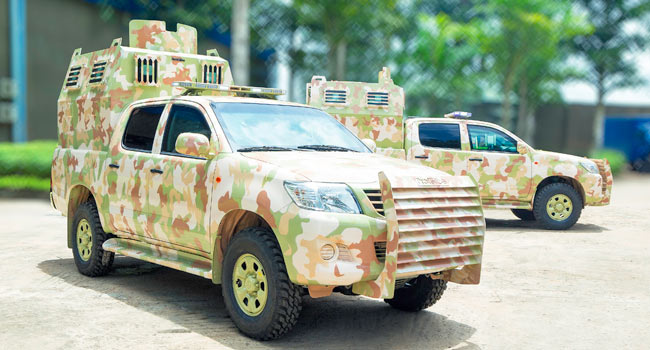
Stable Diffusion gave me a chance to make something I’ve long imagined: A truck-APC belonging to a Seleucian (one of my OPFOR countries) Motorized Special Forces unit. First, the picture itself.
There are many existing heavy-duty pickup conversions like this: An armored pickup with the bed replaced by a capsule that’s even more fortified.
(You get the idea)
Now for their organization: Seleucia’s large “Special Forces” components are motorized to varying degrees. The quotation marks are because few of them are what NATO would consider “special forces”, with many being simply conventional troops with better training and motivation than the other ragged masses of that country’s huge army. Still, Seleucian motorized SF have shown their capability.
A Seleucian motorized SOF battalion is similar to a light infantry one, only with armored personnel carriers. As the mere “transport” capacity is prioritized, motorized SOF often ride in older and/or cheaper vehicles-like armored pickup trucks. APCs frequently hide after dropping off their dismounts. A common defensive tactic for Seleucian commandos is to drive close to an ambush site, conduct the ambush on foot, then scramble back to their carrier and move to another one later on.
However, it is not uncommon for Seleucian motorized SOF to accompany heavy units of tanks and SPGs in conventional operations. Here they fight similarly to Stryker/BTR style infantry in faster wheeled APCs of other countries. In conventional defensive operations, motorized SOF have a somewhat unusual role as mobile antitank detachments. Thanks to their skill, mobility, and flexible organization, SOF battalions with large amounts of of anti-armor weapons can be used similarly to the tank destroyers of other nations.
The Saxon and BTR-152 are examples of the basic style of APCs frequently found in Seleucian motor SOF units. Tracked vehicles, mostly basic ones like M113s and MTLBs, are rarer but not unheard of, especially where the terrain suits them.
The GENFORCE-Mobile organizational chart got the then-still-in-development BTR-90‘s stats wrong. It’s both too light (at 17 metric tons compared to the 21 of the real one), and more importantly has too many dismounts (ten as opposed to seven I’ve seen in every real source). The real BTR-90 was cursed by coming right as the USSR fell, but in many ways it was also just a wheeled BMP-2, so its lack of entry into service is understandable.
But I thought (both for the All Union story and for my own fun) “Well, what if you could get a vehicle with ten dismounts?” The squad would grow to USMC size (two or three in the vehicle plus ten dismounts), and it presents a very tricky puzzle: Get a vehicle that is fit for a mobile corps (so it has to be viable in direct combat, both offensively and defensively), can carry ten dismounted troops as standard, and can’t be too big or heavy. If you want heavier weapons, it basically needs a remote uncrewed turret to not tip the scales. It’s not technologically impossible by a long short, but tradeoffs will have to be made.
Finally, the big squad means I can finally introduce my “eastern fireteam” concept I rejected for the next-gen BMP. Which makes more tactical sense, since doctrinally they’ll be fighting away from their vehicle more often, especially in rough terrain or as part of a tactical heliborne operation. So they need to be (theoretically) better in terms of both equipment and skill.
As for how it works, well, I’m writing right now a chapter where such a motorized rifle unit storms a Romanian town…
So first I must say that I owe a lot to the Battle Order website and channel for inspiring me. Go check it out. Anyway, the GENFORCE-Mobile document, while a tour de force overall, has surprisingly little on the absolute smallest unit tactics. It does say that the basic and mobile forces do use very similar tactics (it’s just the latter have more training on them). Anyway, there isn’t much to say for the high-intensity doctrine. Primarily use lines, squads are unitary without teams, the vehicle commander doubles as squad leader, and that’s that.
The table of orders and equipment does (by virtue of looking at quantities of in a platoon), have one RPK variant and one RPG variant (marked as an RPG-29 in that example) per squad in the mobile forces, similar to historical practice. The company weapons platoon has an array of light ATGMs (marked as Metis, but those would probably be superseded) and PKM belt-fed machine guns.
(Strangely, the early 199X OPFOR squad is actually weaker on paper dismounted than its predecessors, with only one magazine machine gun instead of two belt-fed ones).
Soviet unitary squad line. From DDI-1100-7-776, The Soviet Motor Rifle Company, 1976
The legacy regular army, basic forces, or whatever you call them uses this doctrine relatively unchanged. But what about the new ones?
I had the Sovereign Union’s mobile corps using tank-based IFVs. There have been similar attempts in actual history, yet I figured these would be the more interesting. Basically the priorities shift a lot here. The historical BMP-3 is skewed in exactly the wrong direction. Instead of a glass cannon packed with all kinds of boom-makers, the focus is on shielding the newly-important resource with tank-level armor.
So in this timeline the BMP-3 is one of those things that only sees small amounts of use in its home country, but nonetheless achieves success on the export market. The Mobile Corps in All Union primarily rode into Romania with either BMP-2s or IFVs based on existing tank platforms. Whereas the historical T-64 APC proposals were an act of desperation, these have a deliberate goal of more protection and mass production ability, similar to the Israeli tank-APCs of real life.
Two real Soviet surplus IFV proposals are two from Ukraine, the circa 36 ton “Vavilon” on the T-64 chassis and the 46 ton “Berserk” on the T-84 (upgraded T-80) one. Apart from trading protection (the Vavilon was advertised as having STANAG 6 30mm AP protection and being able to withstand a 125mm round from 500 meters, likely against the front) for weight and logistical issues, the armament is pretty standard IFV fare: A 30mm autocannon, various machine guns and grenade launchers, and ATGMs. Crew of both is three for the vehicle itself and up to eight dismounts.
Now for the fun part.
Option A: 7+3 Unitary
Composition: Squad leader/vehicle commander (rifle/PDW), vehicle driver (PDW), vehicle gunner (PDW), 1-2x machine gunner (LMG), 1x rocket launcher (RPG), 1x assistant (rifle+RPG ammo), 1x rifle grenadier (self explanatory), 2-3x riflemen (rifle). One of the riflemen could be a “deputy leader” who commands dismounts when the commander stays with the vehicle.
This is the smallest and most conservative organization. It’s designed to duplicate the BMP procedure of having one empty paper-strength seat so that platoon/company troops can ride along. It fights like a standard unitary squad.
This also fights as a unitary squad, although a marksman is moved to squad level and the deputy commander who controls the dismounts is a permanent table position. Still fights as a simple unitary squad. Marksman is optional
Option C: 4-4-3 Fireteam
Composition: Squad leader/vehicle commander (rifle/PDW), vehicle driver (PDW), vehicle gunner (PDW). Fireteam A: Team leader (rifle), team machine gunner (LMG), team launcher (RPG), rifleman (rifle, ammo for MG/RPG). Fireteam B: Team Leader (rifle), team machine gunner (LMG), team launcher (RPG), rifleman (rifle, ammo)
This is a massive divergence and features the dawn of the fireteam, with two four-man elements and two RPG launchers (with one of the riflemen possibly a marksman). Naturally, more advanced formations and dismounted maneuvers are used.
My personal choice for the sake of the All Union story would be Option B. It’s still similar enough to be comfortable, informal task-organized teams can still easily be formed if need be, but is also more advanced. Not just having a squad marksman but in having a specific dismount commander, which makes it easier for the APC to act as part of a separate “armored group“.
Indirect fire assets available to a GENFORCE mobile corps. As expected, they have a lot of them. The basic forces are largely equipped and organized with 1990-era Soviet equipment.
Battalion
Combined arms battalions have a…. something of 24 2S31 120mm gun-mortars at paper strengths. Why the “something”? It’s because it’s called a battalion in the document, but feels a little awkward to have a battalion under the command of a battalion. It’s just as confusing in Russian, where it’s a variant of the word “division” equivalent to a western battalion of artillery or missiles-yet a different variant of “division” is a classical multi-regiment/brigade division. Anyway, the battalion’s battalion/division-whatever takes the place of the classic regimental 2S1 formation.
The other indirect-capable (if clumsy) asset is the four 2A45 Sprut 125mm AT guns in the battalion’s anti-tank battery. While the USSR used towed anti-tank guns in the classic TD role throughout its existence, it also used everything for indirect fire. Although firing tank ammunition and only having a max elevation of 25 degrees, a big cannon is a big cannon is a big cannon.
Light motor rifle battalions used for infantry-dominant areas and heliborne operations have 8 towed 82mm 2B14 mortars and just as many 2B16 Nona-K 120mm towed gun/mortars.
Brigade
Intended to be treated similarly the Basic Forces division, combined arms brigades have an organic artillery regiment. This consists of 54 six-inch SPHs (the 2S19 Msta is the default) and 18 light multiple rocket launchers (the default is the “Prima”, a version of the BM-21 with 50 tubes per truck instead of 40). The artillery regiment has its own set of organic spotter drones.
Light motor rifle brigades, which are used for a similar role as the battalions mentioned above, only larger, have 18 MRLs, 36 towed 2A65 Msta-Bs, and 18 2A61 light 152mms (Think a smaller, lighter 152mm gun with muzzle brake on a three-pronged D-30 carriage).
Corps
The combined arms corps has two missile brigades with eighteen surface-to-surface missile TELs each (Tochka/SS-21 in the document, but anything in that category could be used). It also has a multiple rocket launcher brigade with 72 medium MRLs (default is BM-27, but again, anything in that ballpark). Rounding it out is an artillery brigade of Giatsints- 48 towed and 48 self-propelled.
The corps air assault battalion has eight 2S9 Nonas.
Front/Strategic Grouping
Fronts will have brigades/regiments, usually lumped into one administrative artillery division of the weapons mentioned above and 2S7 eight-inch SPHs. They will also usually have a rocket brigade of the 9A52/BM-30 Smerch or something similar (bigger than a BM-27, that’s for sure), as well as longer-ranged ballistic and cruise missiles.
The guns and multiple rocket launchers are almost always pushed down to army and corps-level artillery groups in battle.
Looking at the 1990s OPFOR documents, a “new” (well, newer in a formal sense) type of formation arises: The “armored group” (bronegruppa). It’s important to note the history of Soviet-style doctrine beforehand. The stereotype, often true, is of formations operating as entire units for a certain task. Thus a formation (generally a company as the smallest) will as an entire unit operate as one arm of an attack or another. In defense one formation will sit and fire behind fortifications while another will act as the counterattack/reserve.
The armored group is ad hoc by nature. Formed with a number of armored vehicles usually equivalent to slightly more than a platoon (although GENFORCE-Mobile mentions ones slightly smaller than a company if the parent unit is big enough to handle it), the key is the following:
The tanks operate away from their parent unit.
More crucially and importantly, the IFVs operate “empty”, with their infantry having already dismounted.
The use of an armored group depends on the situation, of course. Examples given in the GENFORCE-Mobile and Heavy OPFOR Tactical documents are:
Sweeping around to hit the side while the dismounted infantry and main force attacks from a different axis.
Serving as the base of fire while the dismounted infantry and supporting arms do the sweep.
Acting as a reserve/pursuit force, especially one that can quickly roar in and (however temporarily) block off a route from a retreating foe.
Acting as a counterattack force on the defensive.
The armored group’s origins come from the Soviet war in Afghanistan, where such formations were used in an irregular, nonlinear, frequently rough-terrain war.





 Fuldapocalypse Fiction