The Armored Group

Looking at the 1990s OPFOR documents, a “new” (well, newer in a formal sense) type of formation arises: The “armored group” (bronegruppa). It’s important to note the history of Soviet-style doctrine beforehand. The stereotype, often true, is of formations operating as entire units for a certain task. Thus a formation (generally a company as the smallest) will as an entire unit operate as one arm of an attack or another. In defense one formation will sit and fire behind fortifications while another will act as the counterattack/reserve.

The armored group is ad hoc by nature. Formed with a number of armored vehicles usually equivalent to slightly more than a platoon (although GENFORCE-Mobile mentions ones slightly smaller than a company if the parent unit is big enough to handle it), the key is the following:

  • The tanks operate away from their parent unit.
  • More crucially and importantly, the IFVs operate “empty”, with their infantry having already dismounted.

The use of an armored group depends on the situation, of course. Examples given in the GENFORCE-Mobile and Heavy OPFOR Tactical documents are:

  • Sweeping around to hit the side while the dismounted infantry and main force attacks from a different axis.
  • Serving as the base of fire while the dismounted infantry and supporting arms do the sweep.
  • Acting as a reserve/pursuit force, especially one that can quickly roar in and (however temporarily) block off a route from a retreating foe.
  • Acting as a counterattack force on the defensive.

The armored group’s origins come from the Soviet war in Afghanistan, where such formations were used in an irregular, nonlinear, frequently rough-terrain war.
How Big Would The Mobile Forces Have Been?

The GENFORCE concept featured an eastern OPFOR divided into legacy “Basic” and more advanced, mixed, “Mobile” forces. Yet how many formations of the latter would plausibly exist in a nation the size of the USSR?

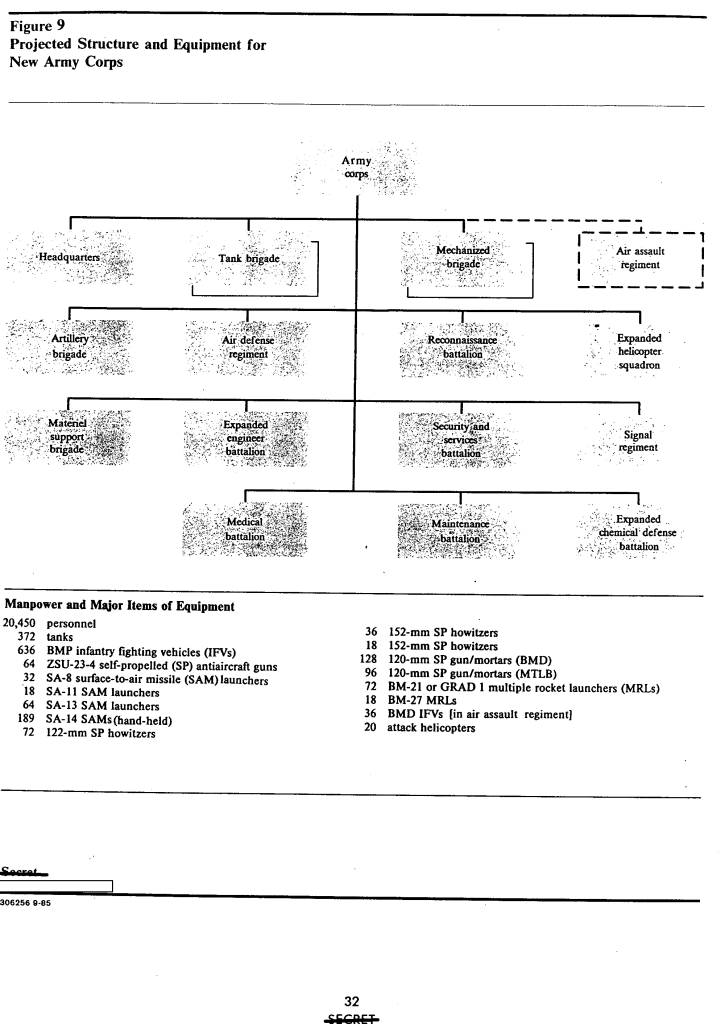
I found a possible answer in a 1985 CIA analysis called “Trends And Developments in Warsaw Pact Theater Forces, 1985-2000” (a great source for a continued Cold War in its own right). The mobile combined arms corps, effectively a big division, is mentioned.

Obviously assuming a surviving USSR and Warsaw Pact, the document estimated that nine such corps would be ready by 2000. Three of these would be in the western theater, two in the southwestern, and one on in the northwest. Two would be in the Far East and one in the south/middle east.

180,000 personnel would be needed from a napkin calc of corps numbers x paper strength of each corps. It’s actually closer to the actual number than most because existing tail assets could be used to support them. However, there will be undoubtedly more people than that necessary, especially to have them achieve their full potential.

The problem isn’t getting that many soldiers. It’s getting that many good soldiers, especially because these mobile corps are specifically designed to be better and more complex tactically than previous line formations. And because they have to compete with the airborne and naval infantry for the best inductees.

Interestingly, the document itself also mentions the possibility of the tank divergences continuing, with the basic forces (word choice deliberate) getting a less exotic model and the mobile corps getting a more out-there one. This would also coincidentally make two bureaus/plants very happy instead of one, so I can see it happening.

It’s an interesting document in any case.

My OPFOR Countries

Screenwriter Stephen E. de Souza has a catch-all Latin American country called “Val Verde” he uses whenever a politically neutral country in that part of the world is required for one of his movies. (In Arnold’s Commando, John Matrix wiped out the entire military of Val Verde by himself.) I have made several Val Verdes in my brain that I’m in the process of putting down in writing, and which may become more than just an order of battle chart.

They are:

Cardona

Cardona is the conventionally weakest OPFOR country and the closest to de Souza’s Val Verde in terms of theme. It draws from both South American and Southeast Asian influences (if I wanted to be really shameless, I could have it have large conveniently Spanish-speaking regions and equally large parts with native Asian languages.)

Cardona’s military is large in numerical terms but lightly equipped and is focused on internal control rather than external invasion. It also has no shortage of irregular groups of all shapes and sizes.

Seleucia

Named for the Seleucid Empire, Seleucia is a catch-all Middle Eastern OPFOR country. Like its namesake, it features terrain from the Mediterranean to the Altais. A diverse and fractious nation, it is at times (ie, when the scenario calls for it) a strong state and at times a weak one. But even at its conventionally weakest, it’s still more powerful in material terms than Cardona is.

Seleucia can be the opponent in everything from irregular warfare to Gulf War level major battles. It also can have nuclear weapons in some cases.

Teutonia

Named after a form of Germany, Teutonia is the developed western European country. The most technologically advanced of these states for the time period, it was once a world power and remains a continental one.

In addition, Teutonian exports are found all over the world, including in the other two mentioned countries. Teutonia is a nuclear power if the tech level of the scenario allows it.

All three will be elaborated on, possibly in prose form… (winks)

The Hungry King

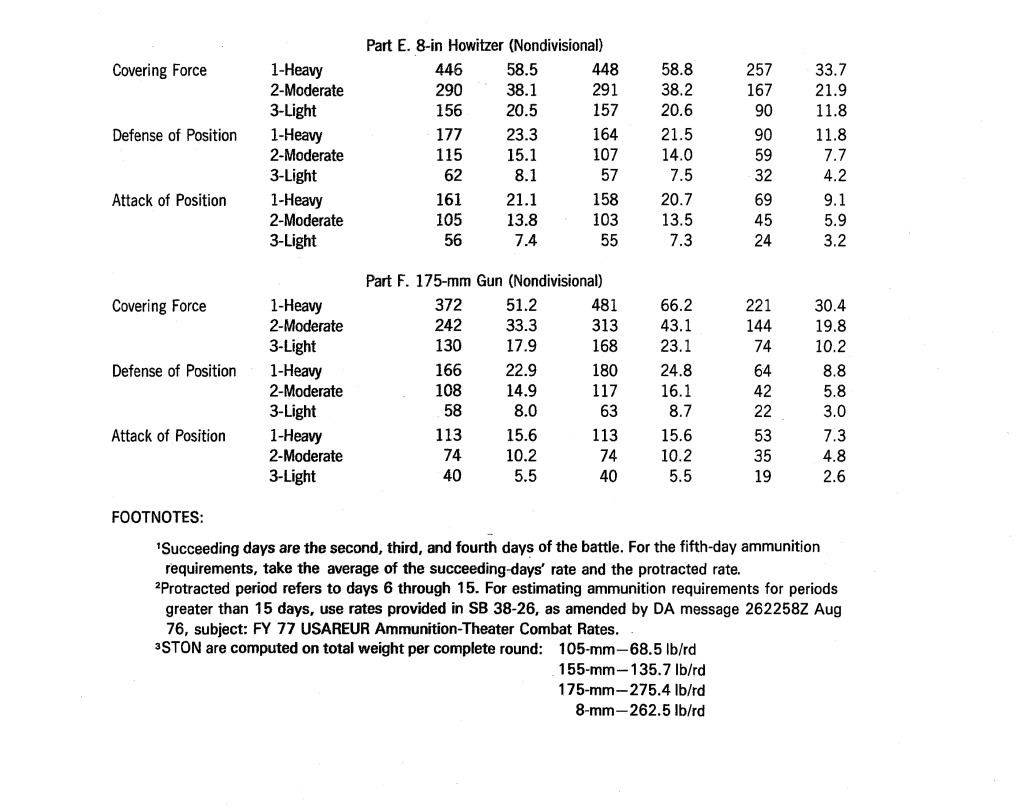
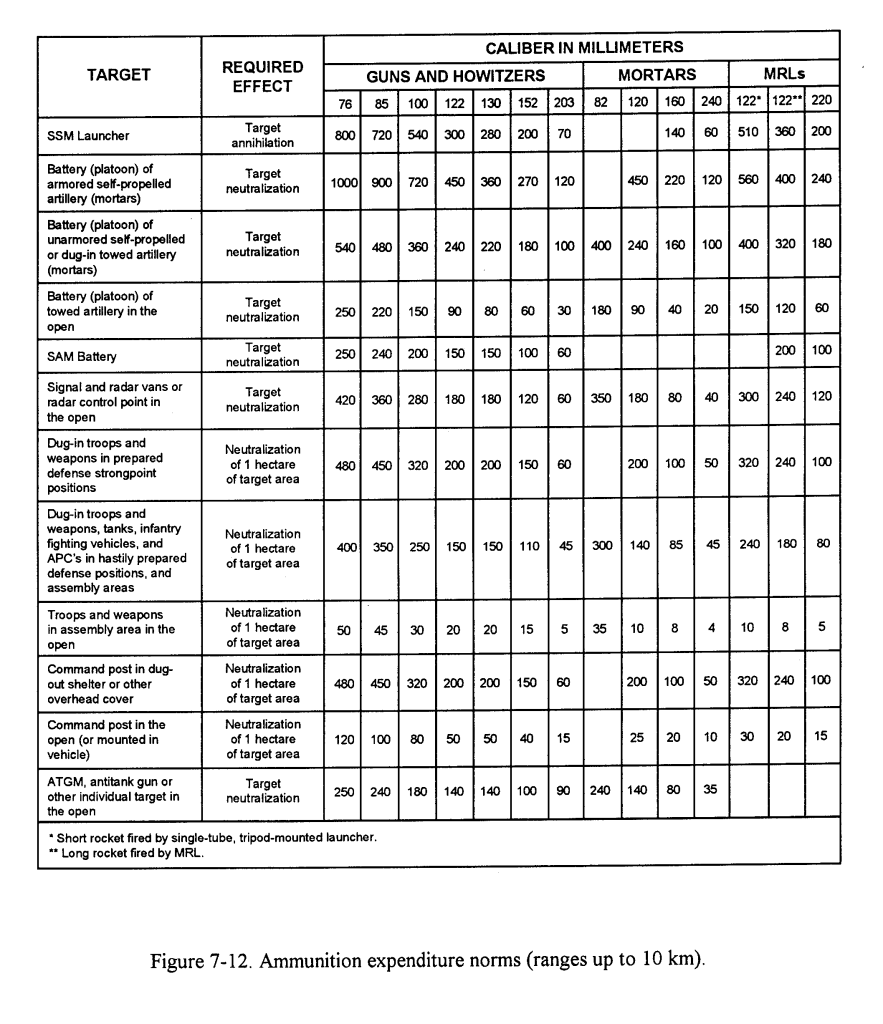
High-intensity warfare uses up a LOT of artillery shells. Like, a lot. How much? Well, these charts from the Light OPFOR Tactical (for eastern calibers) and FM 101-10-1/2, 1987 edition (for western calibers) give a notional example. They’re not identical-the OPFOR norms chart is shells fired towards a target while the FM 101-10-1 one is shells used up by a certain artillery piece per day-but they both show how much metal and explosive is going to fly (the answer: A lot).

Artillery is called the “king of battle”, and the king can get very, very hungry sometimes. Moving large quantities of heavy, highly explosive shells is no small feat, and to succeed or fail with that task means the difference between victory and defeat. A conventional Fuldapocalyptic World War III in the 1980s would have a massive quantity of artillery shells fired every day.

The Plutonium Red Team Study

In the mid-1990s, a “Red Team” (simulated adversary) was launched by the Sandia national laboratory. It looked at all the processes for disposing of excess plutonium (especially after the fall of the USSR) and studied their potential vulnerabilities for unsavory acquisition of nuclear materials. The report is a very interesting read.

Everything from fuel assemblies to mixed/ceramic encased disposed plutonium is studied. The vulnerabilities studied include both accessing it at the storage site and separating the weapons-usable material. It’s quite interesting, yet gives the impression that most nuclear thieves would need to be employed by either a state or the cast of Payday 2. Which is kind of the point, showing the difference between more and less plausible points of failure.

Review: The Russian Way of War

The Russian Way of War

One of the biggest surprises of the initial part of the 2022 Russo-Ukrainian War was that the former did not fight according to its paper doctrine. At all. Lester Grau and Charles Bartles The Russian Way of War is an excellent attempt at explaining said doctrine for a western audience. As anyone who’s studied them knows, they’ve left quite the paper trail. While sources like the VDV Textbooks Collection can provide them online in Russian fairly handily, this translates them to English.

And it translates them to English well. I have a few quibbles. The biggest is the authors taking an overly optimistic view of vehicle adoption, perhaps taking propaganda sources a little too much at face value. But the rest of it is well-done and evenhanded. The only real “problem” I’ve noticed is that I’ve read so many OPFOR documents that much of what they’re saying is already familiar.

But that’s a good “problem” to have, and I was still enlightened by this book. Every wargamer wanting to do missile-age combat involving the Soviets/Russians should read this.

Airfield Construction

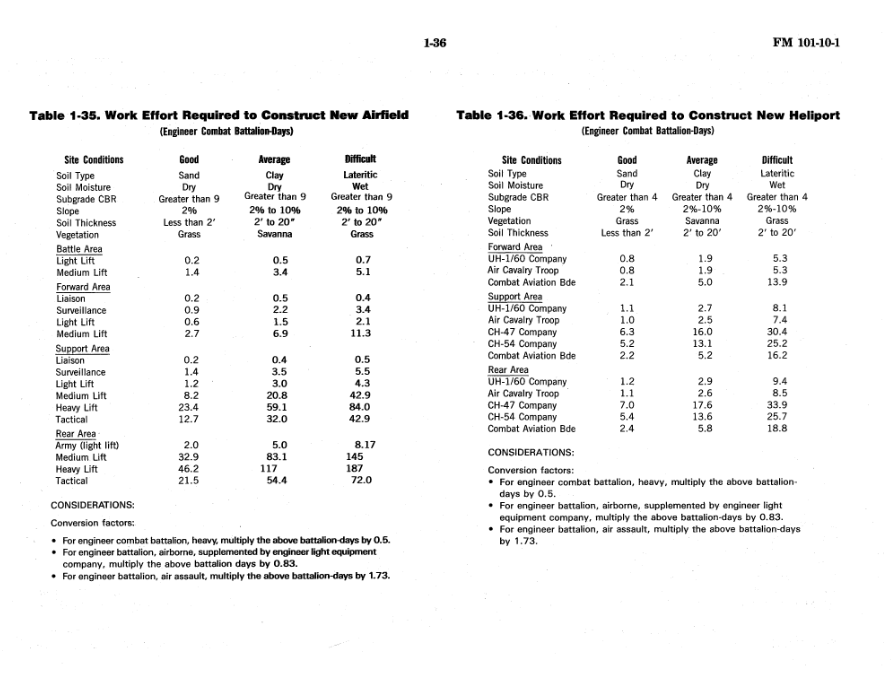
Notional airfield construction times from the 1987 Staff Officer’s Handbook

Although obviously outside the scope of this simple spherical cow chart, I do wonder when the point would come when more engineer battalions would pass the point of diminishing returns. Nine women can’t make a baby in a month, after all.

A Heavy OPFOR army/corps has an organic engineer brigade with heavy equipment that would presumably halve the time required. Fronts will also include at least one engineer brigade. The construction of airfields and other base areas is a stated mission of those high-level assets. (If only the Russians had spent 2021 building and refurbishing better depots right on the borders instead of just piling up the rusty AFVs…)

Fatadin Mukhamedov

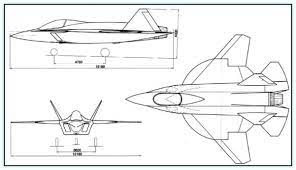
In one of those weird footnotes of aviation history, Mukhamedov, like Stavatti in the west, has been a maker of so-called “paper planes”. The company owes its existence to Fatadin Mukhamedov, a Soviet/Tajik engineer who had a successful career with the big bureaus (for instance, the Dushanbe center of Mikoyan) before striking out on his own. No actual aircraft were produced by the Mukhamedov bureau before Fatadin’s death in 2013, but the bulk had one specific shape.

Mukhamedov designed everything from fifth-generation fighters to gargantuan transports with the same distinctive circular inner wing. The most practical and achievable design was an advanced jet trainer/light strike aircraft for the competition eventually won by the Yak-130. Not coincidentally, the design may have found its way to Iran as the would-be HESA Shafaq. All of the other circular planes were just interesting and distinctive dreams.

But, in other timelines, dreams can come true….

Review: The Soviet/Russian Aircraft Carriers

The Soviet/Russian Aircraft Carriers

It’s time to ring in the new year with…. another history book. This one is Simon Beerbaum’s book on Soviet and Russian aircraft carriers. It’s not just about the Kiev and Kuznetsov classes, which I feared it might have been. On the contrary, it has everything from pre-WWI czarist proposals to post-revolution plans for converting surplus ships (with limited technology/resources, it would have been easier to finish a large warship as a carrier rather than an armored, big-gun battleship) to never-weres like the Ulyanovsk and Project 11780 Kherson “Ivan Tarava” helicopter amphib based on the Kiev.

This is an amateur enthusiast project, so it has issues with formatting and inconsistent quality in the line drawings. Those are small issues, and if I had a bigger gripe, it’d be that far too little attention is given to the actual air wings of those carriers-the entire reason they’re built. It’s vague, especially when there’s no shortage of equally fascinating never-were carrier planes as well (from the Yak-141 to navalized MiG-23s to other exotics).

Still, this book does what it sets out to do. For a country whose carriers have arguably all been prestige peacocks, a lot of designs were made. If you want an intro to these flattops, you could do a lot worse than this book.