Review: Out Of The Ashes

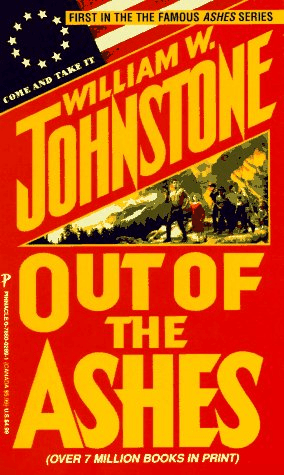
Out Of The Ashes

outoftheashes

William W. Johnstone’s The Ashes series (not to be confused with the cricket series) is one of the worst long-running series ever. I might even be bold and say that it’s the single worst chronological series made by a mainstream commercial publisher that I’ve read. Even if it isn’t, it’s certainly up there. They, along with the The Big One novels, were some of my first exposure to “bad books” as I knew them.

In a fashion strangely typical of me, I read the later Ashes first, finding them via the ancient 2000s method of buying them in a bookstore. Somehow these monstrosities were successful enough to reissue after their initial publication date. So a curious thought came to me. Was there a chance, in spite of what I’d heard and read in other reviews, that the early Ashes might have been good, or at least not terribly bad? Could they have started as second-rate but readable Survivalist knockoffs and then devolved into the rambling political screeds and one-sided, toothless battles I knew them as? Did they have merit?

Well, now I’ve finished Out Of The Ashes, and I can confidently give an answer to that question. N-O-P-E.

  • The book starts with an introduction to paperback pulp author (hmm….) and former supermerc Ben Raines nobly turning down a chance to participate in a coup attempt against the EVIL LIBERAL GUN GRABBERS.
  • Then the General Jack Ripper-style conspirators, in an overlong “first act”, trigger the apocalyptic nuclear war everyone who saw the covers of the book knew would happen. It’s like if someone watched Dr. Strangelove and read the opening of a Larry Bond novel at the same time while glugging down bottle after bottle of whiskey, and then wrote something down while drunk.
  • Then Raines wakes up and experiences arguably the lamest and tamest Easy Mode Apocalypse ever, where he has no problem finding supplies (including weapons in a convenient arsenal) and bedding one beautiful woman after another while he battles and effortlessly kills all sorts of stereotypes. After this, any attempt to truly be considered post-apocalyptic stops. For what seems like the rest of the series.
  • Then the political tirades start getting even worse, with Raines starting his authoritarian Huey Long-on-steroids paradise utopia where unemployment is 0% and everyone is educated “properly”, and no one can be truly rich. But it’s not communism or socialism because of guns. Yes, he uses that exact argument in the book.
  • Then the strawman journalists, in a scene that seemed, and probably was longer than any of the actual battles, are taken to the Tri-State Glorious Peoples Democratic Republic Utopia for another exposition.
  • Then the federal EVIL LIBERAL GUN GRABBERS, in a scene that dials up the gore and squickiness (but not in a good way), slaughter the “paradise” and force Raines to return to guerilla warfare, setting up the rest of the series (don’t worry, he’ll be back commanding unrealistically huge armies and ruling Utopia 2.0 soon enough).
  • Finally, some of the Tri-States survivors and allies kill the EVIL LIBERAL GUN GRABBERS. The end, but not of the series, with its 34 (!) more installments.

Whew.

So what are the issues that plague this book and its XXXIV sequels? If I had to choose only three (and there are a lot more than those), I’d say these.

  1. Johnstone cannot write action well, and he cannot pace well, the two things cheap thriller writers need to be able to do. Pretty much every single fight amounts simply to “and then Raines shot them”, they almost never last more than a few paragraphs, and the tone of the book is such that removes the “well, they’re realistically short” justification. There are a very small number of exceptions, but it’s not worth digging through 34 books of slop when even a mediocre cheap thriller leaves Johnstone in its dust.
  2. The story frequently goes from “product of its time” to “ugly and creepy” in terms of offensiveness. The prose doesn’t help one bit, with it sounding clunky, creepy and oddly juvenile.
  3. Johnstone is not consistent or coherent in the slightest with his political tirades. Not only that, but they make the main character look pathetic, like a grumbler instead of Jerry Ahern’s stoic badass John Rourke.

This book, and this series, is one of the worst of all time.


Review: The Gamma Option

The Gamma Option

The third Blaine McCracken book, The Gamma Option continues the crazy twists and turns, the crazier plot swerves, nonsensical politics, and surprisingly solid fundamentals that marked the previous two installments. It does yo-yo a little more into “amazingly stupid” (to give any detail on these moments and twists would be to spoil them, but rest assured-they are very, very, dumb)  but still has a lot of “stupidly amazing” moments. My favorite of these is Chekov’s Monster Truck.

See, Blaine McCracken notices a monster truck parked nearby when he goes to interview someone. I knew when I read the passage that the monster truck was not Jon Land’s attempt at some kind of weird literary metaphor, nor was it just a bit of background description. I knew that McCracken was going to end up driving it in a chase scene. And drive it he did.

This is everything I expected from a Blaine McCracken book, and it has all of the ridiculous appeal that makes reading them such a treat.

Review: Skeleton Coast

Skeleton Coast

Arguably the very first “cheap thriller” I read was Fire Ice, in Clive Cussler’s NUMA Files. By this point (unbeknownst to me at the time), he had already entered his “Tom Clancy’s” phase, farming out a lot of spinoffs to different authors. One of my favorite and most enduring books of this time is Skeleton Coast.

The Oregon Files involves the titular super-ship disguised as a tramp freighter and its commander, Juan Cabrillo. Here it battles African rebels and a plot by an evil environmentalist to cause an environmental crisis (Trust me-do not expect the plots of Cussler books to make sense). There’s also the classic Cussler “Historical Flashback To The Present MacGuffin” scenes, which I was never the fondest of.

What makes Skeleton Coast succeed is its climactic battle. In many other books, the Oregon hasn’t really faced threats that are worthy of its armament and abilities. Here, it fights an army with all its firepower, and the result is very well done by cheap thriller standards. It feels a little more natural and a little less gimmicky than other Cussler books. For someone wanting to experience the huge “Cussler Franchise”, this book is one of the better entries.

Review: Strike Force Red

Strike Force Red

strikeforceredcover

C. T. Glatte’s Strike Force Red is an alien World War II. The book might invite comparisons to Harry Turtledove’s Worldwar series, but is actually much different.

Aliens, wishing to take over the world to repair their damaged spaceship, land, kill Hitler, make Stalin into their pawn, and then proceed to form a League of Evil with everyone from Mao to Vorster on their side before sending a Soviet army to invade Alaska. Opposing them are, of course, the Americans with anachronistic P-51s (with even more anachronistic female pilots) and Sherman tanks.

So, I’ll get this out of the way. Historical war novels are generally not my thing. Especially not World War II novels. I’m just weird in how I judge them, and a lot of my feelings on the genre can be boiled down to “if I want to read about a historical conflict, I’ll read a history book”. So I’d be lying if I said this bias wasn’t slanting my review.

That being said, this book has a lot of wasted potential. High on the list are the aliens themselves. They’re mustache twirling puppy kickers who fail to be anything but the sort of “pop-up antagonists” usually reserved for spacesuit commandos. They’re not complex or developed or deep. Improving them would be easy as sincerely believing their rule to be ideal for humanity’s improvement (like XCOM’s Ethereals) or being able to be better than Stalin and thus inspire genuine loyalty among their subjects would make them more interesting. Or both-they clean up and improve in authoritarian and/or war-torn areas, earn the loyalty of the populace, and then find that wealthier, freer countries don’t take as kindly to them.

Barring that, they could at least be entertaining space opera megalomaniacs. They’re not. The aliens come across as being like washed-up actors who are desperate for a paycheck, so they put on the rubber alien suit and phone in their lines for the B-movie they hate but do anyway for the money.

But even higher is the technology, which seems very unimaginative. I don’t expect a deep examination of industrial capacity in the 1930s, but going straight to P-51s and Shermans in 1940 because those are the most famous is both inaccurate and dull. Likewise for T-34s and “MiGs”. The alien technology is rarely exploited and, in practice, amounts to just a way to get a Soviet army over to Alaska. It’s like a Fuldapocalyptic story where in 198X, a zombie sorceress full of magic explicitly appears and starts World War III-and all she does is torture animals for fun and move a motor rifle brigade to Iceland.

This book should have featured multi-turret tanks with deathrays against American Heroes in pulp science contraptions. Instead it’s just a rote war drama with all of the potential it had in its plot left unexploited.

Review: The Zone Hard Target

The Zone: Hard Target

hardtarget

In 1980, Hard Target was released. It was the first book in The Zone series of post-semi-apocalyptic World War III novels. Just that description alone gives the impression of the book being weirdly different. And in many ways, it is.

The background of this book is simple, contrived, and still somewhat novel. Basically, there’s a World War III, but now the fighting is limited to a contaminated zone in Europe, and the westerners have super-hovercraft for some science fiction flair. I was reminded of the Ogre board game/franchise, which has hovercraft and limited conventional nuclear war (it makes sense in context). That came out three years before this book did, and I don’t know how much influence, if any, it had over the writing.

This is a “have your cake and eat it too” kind of book. On one hand, the action is grittier and gorier compared to some other works in the genre, and the target MacGuffin is a tank repair unit and not some kind of superweapon. On the other, it’s still very much a cheap thriller with a premise, like Twilight 2000, that’s pretty much designed to be an adventure-friendly setting.

But this isn’t necessarily a bad thing, and Hard Target is a good book for what it is. It checks the boxes of what makes a cheap thriller passable, and as obviously contrived as they were, the setting and tone were novel enough to take things up a notch for me.

Another opinion on this book can be found on the excellent Books That Time Forgot blog.


Review: The Seventh Carrier

The Seventh Carrier

coverseventhcarrier

Peter Albano’s The Seventh Carrier is one of those novels that rivals even Lunnon-Wood’s Dark Rose for “most ridiculous premise yet”. In it, an American boat, and later a Coast Guard helicopter are attacked by something using World War II Japanese ammunition. There are rumors that it’s some kind of privateer using surplus weapons, but it’s not, as the survivors of the boat, held captive, can attest.

It’s the Yonaga, a fourth Yamato hull, turned into a carrier like Shinano. Kept hidden in a cove, it was frozen for forty years. According to the book it was because of a glacier rockslide, but I know a zombie sorceress froze it with her fimbulvter ice magic. They survived (not in suspended animation) by, among other things, tapping into geothermal steam power. Then they eventually attack Pearl Harbor anyway with their propeller planes and do better than they ought to. This is not the kind of book where thinking about how things in it would plausibly happen is encouraged.

The action is good, even if it’s somehow both a little kooky (guess why) and a little rote (a few too many exact descriptions of what the aircraft did). The characterization is not. To say that the portrayal of the Japanese is stereotypical is like saying that Manute Bol was a little tall, and the other characters aren’t much better.

It’s not the worst book ever, but like Dark Rose with its Libyan-Palestinian invasion of Ireland, The Seventh Carrier is better for the ridiculous novelty of the premise than the actual substance of the execution.

Review: Between Two Scorpions

Between Two Scorpions

Political columnist and journalist Jim Geraghty’s first novel was The Weed Agency, a fluffy tale of a fictional government agency that proved as enduring as its nominal targets. His second, Between Two Scorpions, is a far different beast. In it, a married couple of spooks travel around the world as they battle a decidedly unconventional terrorist threat.

Despite the very different genre I could see a lot of the same quirky strengths that brought The Weed Agency to life. Geraghty has a great sense of humor and it shows throughout the novel. The action is very good and the settings (including my personal favorite of Central Asia) are very novel. A big help is that the book isn’t as axe-grindingly partisan as one might fear one written by a conservative columnist would be.

The biggest issue I can pinpoint is a bit of thematic dissonance. Basically, the sincere, serious, and thought-provoking commentary on how a media culture can amplify hysteria is done well, but it doesn’t mesh the best with the witty globetrotting superspy adventure story. That being said, it’s not the worst offender in that regard I’ve read by far, it’s a forgivable lapse, and I can give Geraghty credit for trying to be topical in a way that’s more than superficial and still doing well.

There are a few other minor bumps, but it otherwise does well. Between Two Scorpions is a fun, solid novel that dares to stretch a little, and I recommend it.

Review: The Pact

The Pact

pactcover

Robert Patrick Lewis’ The Pact is the tale of Special Forces operators representing the only viable defense against a Russian-Chinese-Iranian invasion of the United States. The good news about this book is that Lewis is a Special Forces veteran who brings his knowledge to it. The bad news about this book is that Lewis is a Special Forces veteran who brings his biases to it.

The plot is the same kind of basic invasion novel plot that was old when Teddy Roosevelt was young. After the EVIL LIBERAL GUN GRABBERS have had their way with the US, the enemy alliance swoops in with computer attacks and unconventional warfare that naturally goes off without a hitch, save for the intervention of the special forces vets who’ve planned and built the lairs and stockpiled the equipment needed (against the advice of their nagging wives, of course). Then they fight back with the aid of a Freemason counter-conspiracy.

The first problem is that the action in this book is too realistic for its own good. I can’t blame a genuine veteran for writing what he knows, but come on. Axis Of Evil invasions and Freemason-operated super-bunkers do not exactly go well with detailed, nominally realistic operations. It also has a lot of “have your cake and eat it too”, such as one scene where it’s mentioned how hard it is to shoot down a helicopter with an unguided weapon-but oh look, they did it anyway.  Finally, realism or not, it isn’t the best written.

The second and bigger problem is that the main character is totally insufferable. He spends the entire first-person book monologing repeatedly about how awesome special forces are and how awesome he is. Repeatedly and constantly. It had the opposite effect on me, giving the impression of an arrogant swashbuckler who’d be foolishly overconfident if not for plot shields. The scene where the heroes find a former EVIL LIBERAL GUN GRABBER politician turned prisoner and execute her while smiling didn’t really help matters either. The icing on the cake is when the main character turns out to have the same name as the author. Really.

And those plot shields are there, from the “conveniently lucky” (the enemy neglecting flank protection) to the blatant (an M2 Bradley falling right into their laps). It’s a problem I’ve noticed in, of all things, some of the more out-there modules in Twilight 2000. If the mechanics/style is supposed to be realistic and grounded but the plot calls for the protagonists to do extraordinary things, you need a lot of pure contrivances for them to succeed. It’s a very tough tightrope to walk, especially when the premise is stretched to the level it is here.

Even by the standards of the “invasion novel”, there’s better works in the genre out there than this one. I’m not going to say it’s impossible to mix the concept of a Jerry Ahern novel and the rigorous execution of say, a Duffer’s Drift-style work like The Defense of Hill 781. But it would require a considerably better author than the one who wrote The Pact.

Review: PRIMAL Unleashed

PRIMAL Unleashed

primalunleashedcover

PRIMAL Origins was good. PRIMAL Unleashed is better. Here Jack Silkstone hits his stride with the super-agent supermercs as they fight warlords and arms dealers in a struggle from Afghanistan to Eastern Europe and beyond. To be honest, it felt a little like X-COM, only against terrorists instead of aliens.

It’s just a really good example of a cheap thriller that hit all the right notes. The plotting and pacing are well done. The action manages to be well done with just a touch of grounding even as spectacular feats are performed. The enemy is credible (from a challenge standpoint) and Silkstone isn’t afraid to have them do damage to the heroes.

There’s also, completing the puzzle, a diversity of action that fits very well. It isn’t just a classic Gold Eagle-style “a few guys with rifles”. There’s scenes in APCs, shootouts, and aircraft attacks. This feels closer to the ideal of “a more serious Mack Maloney” I’ve always sought than any other book I’ve read in quite some time.

It’s also an example of the post-2000 technothriller. Which is to say, it’s a story of super-technology and special forces as they fight to stop the villains from taking the MacGuffin. But here, it’s done right. I highly recommend this book.

Review: The Battle Begins

The Battle Begins

battlebegins

So, a part of me, probably the same part of me that went “OK, read a long Jerry Ahern series in order”, said “OK, now read another, slightly less long Jerry Ahern series in order.” So it was time to go to the Defender series, namely the first installment, The Battle Begins.

Instead of John Rourke, ex-supercommando and high-powered gun nut, we have David Holden, ex-supercommando and high-powered gun nut. Cue a large amount of action as he and a group of “Patriots” fight back against a plot that can best be described as “Cyrus from The Warriors actually put his mega-gang war plan into action, and he was sponsored by the Kremlin.”

This has many of the same strengths as The Survivalist. Namely, it’s 80s action in novel form with a sincere attempt at humanizing its protagonists that isn’t seen as often as it should be. When the inevitable Detonics .45 pistol showed up, to me it was like the scene in a Zelda game when Link grabs the Master Sword. And the final battle is in a nuclear power plant with a computerized voice counting down the seconds until meltdown, with said meltdown able to be stopped by pushing one button.

Yet it has some of the Survivalist’s weaknesses as well, and then some. First, it’s a lot more politicized than the Survivalist ever was, and while the portrayal of the Soviets in Total War was decently evenhanded, the portrayal of the antagonists in this book is not. Ahern put a lot of effort into trying to dodge the uncomfortable racial implications by blatantly diversifying his heroes. He put very little in trying to make their opponents even slightly sympathetic. But then again, this is a 1980s action novel, and at least it’s not that much worse.

The phrase “at least it’s not that much worse” can arguably be applied to this book as a whole. Is it better than The Survivalist? No. Would I recommend it over the Survivalist to someone for their first Jerry Ahern book? Is it still a perfectly readable ridiculous over the top 1980s action novel? You bet it is.