Review: Confrontation

Confrontation: The War With Indonesia 1962-1966

Peter van der Bijl’s Confrontation is a military history of the four-year small war known as the Konfrontasi. It goes into extremely military detail. What’s not to like? The answer is, surprisingly, a lot. This isn’t really a bad book, but it is a flawed one.

The first flaw comes from the nature of the war: It really wasn’t much of one. It was more a political stunt by Sukarno than anything else, and the actual service chiefs did the bare minimum to support it. This isn’t the author’s fault, but his priorities are. There’s less of the politics (though they’re still present) and more of firefights in the jungle that blend together (almost always ending with “better-trained Commonwealth troops get the better of worse Indonesians”).

The second comes from the author’s biases. There are a lot of rants about journalists, especially journalists covering the Troubles, which feel kind of out of place. Worse is the absolute fawning hagiography of the British and Commonwealth armies. This is accurate in terms of specifics vis a vis the Indonesians, but still gets annoying, as does the very British slant of “unlike you knuckle-dragging Yanks, we won our jungle war” without noticing the very different context of Malaya. Finally, there’s no real attempt to explore escalation counterfactuals beyond just “The Indonesian air force and navy wasn’t very good”.

This ultimately comes across as just a series of jungle warfare vignettes. It’s not the worst book about its conflict, but it’s not the best and could be much more.

Review: PROMIS

PROMIS

Jack Murphy’s PROMIS series tells the story of wandering mercenary Sean Deckard as he makes his way around Cold War battlefields. A collection of short, action-packed novellas, it kind of reminded me of, well, Barry Sadler’s Casca of all things. Just replace the immortality curse with a super-prediction computer equation thingy in the background (the titular PROMIS system) and you have these books-kind of.

It’s like Casca in that it was created and written by a genuine special forces veteran, and like Casca in that it sets out a justification to plop the main character in action set pieces. The three published locations are Vietnam, Rhodesia, and South Africa. Not that it’s much worse than any other cheap thriller in practice, but I’d prefer a slightly less iffy location than both of those two. Even Central America would be better…

…Especially because, unlike Casca, there’s no real attempt at creating the surrounding scene outside of action sequences at all. While Casca had theme parks and parades of famous historical figures, this doesn’t even have that. Even by cheap thriller standards the characterization is really, really, really bare. The action is at least decent, even if it has the “try to have its cake and eat it too by trying to be both semi-grounded and spectacular” problem. But that’s not enough to raise the series to even a “51%” level.

Thankfully, I know that Murphy can do a lot better. Go read the far superior and awesomely titled Gray Matter Splatter instead of these.

Review: The Gamekeeper’s Night Dog

The Gamekeeper’s Night Dog

David Putnam’s The Gamekeeper’s Night Dog is one of the weirdest alternate history novels I’ve read. And yes, I have read every single Kirov novel. None comes close to this… thing. Really, to talk about it in conventional literary terms is almost beside the point. It’s middling in terms of quality and is a little too bloated, but why talk about that when you have such a befuddling premise?

See, in the 1890s, protagonist David Banner (no relation to the Hulk) has the Judeo-Christian God appear in a dream from His home in the black hole in the center of the Milky Way. A nightmare scenario (aka actual history) awaits if the last of the classic English Bulldogs (always capitalized in the book) goes extinct. There’s exposition where World War I, II, and even III is shown, with animal cruelty activists being portrayed as the equals of history’s worst monsters.

Also, apparently the divine value of a nation comes from the kind of dog that it has. Yes, it’s a weird book. Anyway, man and dog alike uplift the world, fight a very different Boer War, and continue to battle in an ahead-of-its-time World War I. We get loving depictions of bulldogs ripping men and animals to pieces. In fact, most of it is basically just bulldogs in “action”. The question remains: How do you even judge this book? My answer is simple. You can’t. It is not a novel so much as a very bizarre artifact.

People Playground Peoples

People Playground Peoples

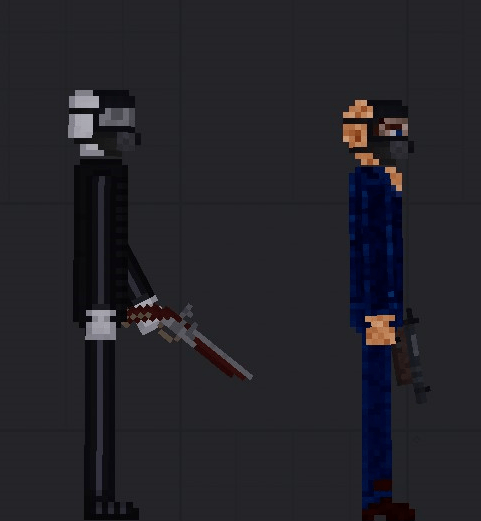
My favorite go-to relaxing game now, especially after I’ve discovered the massive and excellent mod scene, is People Playground. I of course act out a lot of scenarios-ok, a few types of scenarios, involving the mysterious mad science facility. And here are the “roles”.

Subjects

Represented usually by the default “humans”, subjects are the test subjects who are either being killed in terrible ways (don’t feel too bad for them, they struggle to walk several steps) or rebelling in some form (and usually ending up getting killed in terrible ways).

Technicians

Dressed in work-esque outfits, technicians usually sport some kind of chemical mask. They’re often placed by pieces of machinery, where they operate them and oversee experiments (very, very frequently becoming collateral damage). Unlike troopers, technicians mostly use a min-max arsenal-either finicky destructive contraptions or simple/improvised-type weapons that they built themselves.

Troopers

Troopers are the enforcement arm of the facility, being dressed in various kinds of military uniform and carrying a large variety of conventional weapons. Don’t worry, they always get killed in quantity too.

Commanders

Clad in various types of ornate and/or formal clothing, commanders wield sidearms and direct the “experiments”. However, a field commander is just as vulnerable as anyone else on the playground.

Review: Act of Justice

Act of Justice

Former SEAL Dick Couch’s Act of Justice is a thriller with one of the most distinct premises I’ve read. If it can even be called a thriller, for most of the book amounts to one strange plotline. When I saw the tagline of “alternate history”, I was intrigued. Though this book really tiptoes on the line between alternate and “secret history”, where there are divergences that didn’t change the results of history as we know it. Taking place in the War on Terror, this book offers an alternate/secret story for how the government managed to find Osama bin Laden. It starts with a Herman Melville-level description of the Abbotabad raid, and then goes… places.

First, Couch uses this as an opportunity to plug his previous books, taking the super secret special hired “Intervention Force” and making them central. While I haven’t read any of them, their inclusion and the references were still kind of glaring and gave the impression of “look at my Mary Sues”. Second, the bulk of the book is, well… it could be called “They Saved bin Laden’s Kidneys” for accuracy. The plan involves using superscience listening devices implanted in a set of fresh kidneys, making bin Laden more useful alive than dead. Most of the effort is devoted to the ways the operation is set up and finally conducted.

It’s fanciful, especially because all the parts of the plan fall into their lap. Thus while different, that’s really all that it is. But it still has the qualities of a 51% book, and I’ll gladly take a Dark Rose-style 51% book with a weird premise over a 51% book without one.

Review: On Nuclear Terrorism

On Nuclear Terrorism

Michael Levi’s On Nuclear Terrorism has been the best book I’ve read in some time. In fact, of all the books and papers I’ve read on this topic, it’s arguably the greatest. Levi takes a holistic approach, using the analogy of a sports team where trying to judge each component in isolation falls short. Although he uses baseball when football is a much better analogy. Oh well.

The decision to look at the big picture as well as noting the issues that alarmist worst-case analysis brings are relevant to much more than countering nuclear terrorism. He also turns “the terrorists only have to succeed once” statement on its head by pointing out that while true, it can also be said that “they have to succeed every step of the way, while their opponents only have to succeed at one”. This sort of reasoning is welcome whatever the subject.

Not that this is a brief overview-it goes into a lot of detail on things like the uses and limitations of scanning detectors and does a lot of detail on gun-type weapons (implosion ones get less effort, because given the issues states have had, non-state actors going for them is arguably pushing it). And he even goes into psychology as well, which is important for the goals of irregular groups.

The impression I’ve gotten from this and other sources is that nuclear terrorism can be compared to Y2K. Y2K was mistakenly perceived as an overblown panic when in reality it was a legitimate issue largely solved by a massive effort when the new millennium rolled around. Similarly, while the threat of even a radioactive Beirut/Tianjin/Port Chicago-level blast (to say nothing of even a Little Boy-level bomb) is a legitimately frightening one, the similarly massive efforts to work against it have (to date of course) deterred even attempted nuclear terror attacks. The Aum Shinrinkyo cult marked the only known attempt at a substantive irregular nuclear program, and it failed despite numerous factors in its favor (lots of money, able to operate openly pre-chemical attacks, and access to Russia at the depths of its 1990s desperation).

Bad sports analogies and occasional clunkiness aside, this is an excellent book.

Review: Onslaught

The Fae Wars: Onslaught

J. F. Holmes’ The Fae Wars: Onslaught is the story of magical evil elves invading the contemporary world with magic that can overcome technology. It’s just a cheap thriller, but it’s a fun cheap thriller. The action is constant and told from both sides, with both experiencing difficulties.

While the military stuff is frequently both contrived (foreign arms dealers getting a giant super-arsenal into New York City), and inaccurate (the human aircraft engage at far closer distances than they realistically would, for one), this isn’t the kind of book where one would quibble about such things. It’s a fun magitech war novel that should be treated as a fun magitech war novel.

Review: Redux

Redux

The second book in Steven Konkoly’s Black Flagged series of thrillers, Redux sadly doesn’t live up to either its predecessor Alpha or the later Deep Sleep. Granted, it took me a while to read it because of too close things-first, it involved killer diseases, second, it involved Russia, but I finally got around to it. It’s still not exactly the worst thriller ever, but it’s not the author’s best, unfortunately.

While the action isn’t exactly bad per se, the book still bounces around too much from character to character and place to place. This combined with the frequent exact spelling out of every weapon and accessory makes it look like a Gold Eagle book-and not in a good way. Even the best players can swing and miss, and this is a miss.

Review: Africa Burning

Africa Burning

Back when I was young, I made a horrendously negative review of Gavin Parmar’s Africa Burning, talking about how little sense the tale of a giant army of T-90s and M113s (really) appearing in the Chadian desert to charge up into the modernized, reformed, opened Libya made. (Boy did that “prediction”, made pre-2011, about the direction of the country, age poorly).

Now, well, I have a soft spot for this amateur Ian Slater/technothriller/shoot the terrorist-wannabe novel. It reads like someone acting out their action hero fantasies after seeing and reading a lot of relevant fiction, and the earnest, genuine quality of it has made me smile. I may not recommend actually reading it, but at least I don’t have a bad feeling towards it anymore.

Review: All Lines Black

All Lines Black

The internet novella has grown on me as a way to “sample” an author’s work before I “chow down”. So it was with great interest that I picked up Dalton Fury’s All Lines Black. This short tale of operator Kolt Raynor (again with the cheap thriller names!) in the middle east isn’t going to set any records for originality or serve as anything but a writing sample.

However, the writing is excellent. The action fundamentals are done right, and that’s what matters in a genre like this. Given Fury’s (it’s a pen name, obviously) legit experience, it works fine, even if it understandably gets a little too Herman Melville in places. If you want fun, I recommend this.